When you click on links to various merchants on this site and make a purchase, this can result in this site earning a commission. Affiliate programs and affiliations include, but are not limited to, the eBay Partner Network.
1819 New-York Society Library Receipt to Rev. Samuel Farmar JarvisSigned by Head Librarian John Forbes | Son of Bishop Abraham Jarvis | Early New York Americana
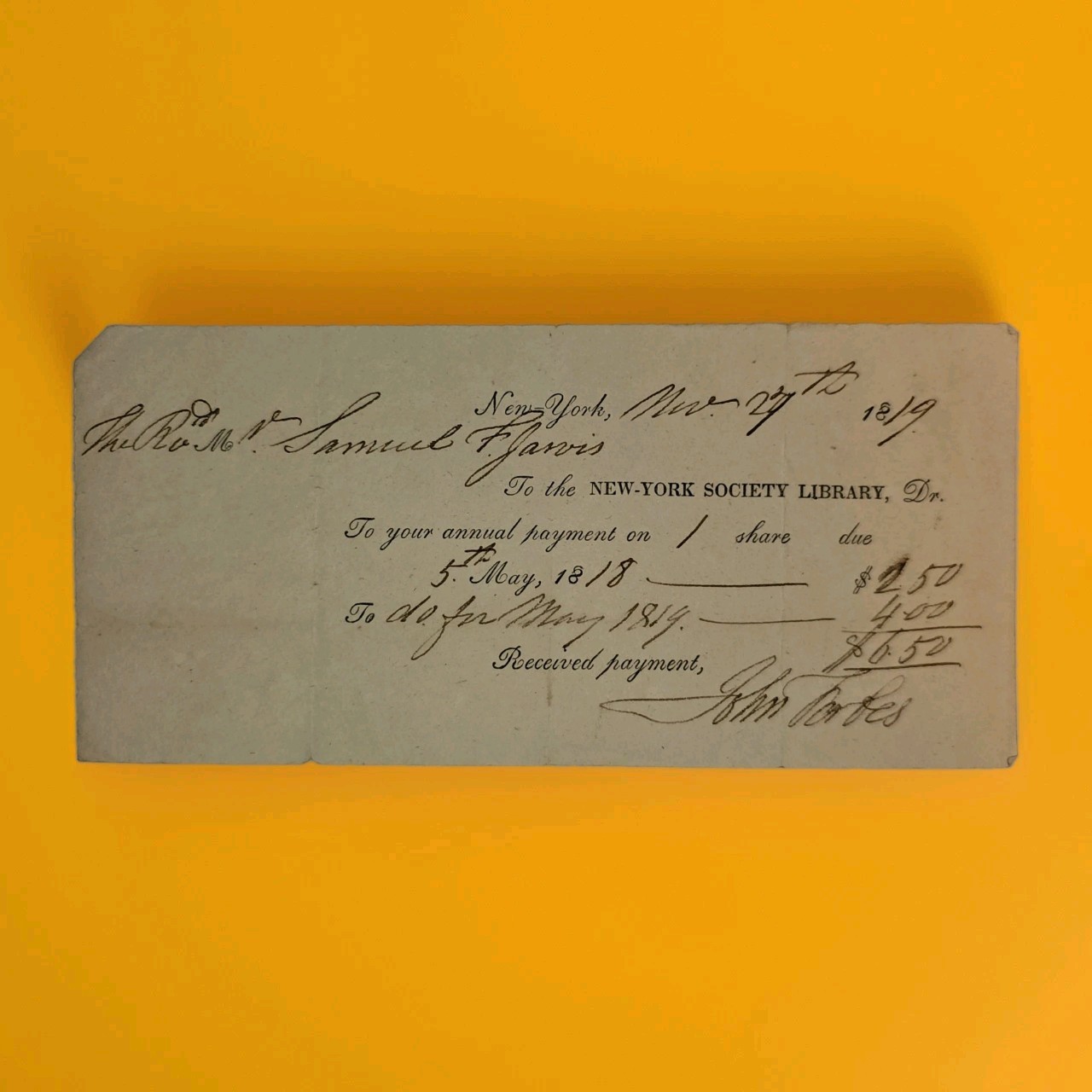
Offered is an original printed and manuscript receipt from the New-York Society Library, dated November 27, 1819, documenting the annual subscription payment of Rev. Samuel Farmar Jarvis (1786–1851). The receipt is personally signed by John Forbes, the longtime Head Librarian and Secretary of the Society Library, and records Jarvis's payment for his library share and several years of outstanding dues.
This remarkable document connects one of America's oldest libraries with one of the nation's most distinguished Episcopal families, making it an exceptional artifact of early American religious, literary, and cultural history.
Transcription
Front
The Rev'd Mr. Samuel F. Jarvis
New-York, Novr. 27th, 1819
To the NEW-YORK SOCIETY LIBRARY, Dr.
To your annual payment on 1 share due
5th May, 1818 ............. $2.50
To arrears from May 1814 .... $4.00
Total .................... $6.50
Received payment,
John Forbes
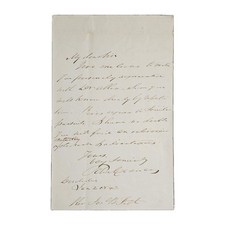
Reverse
John Forbes
Librarian N. York Library
Novr. 27, 1819
Historical Importance
Founded in 1754, the New-York Society Library is the oldest library and oldest cultural institution in New York City. Long before the establishment of the New York Public Library, it served as the city's premier subscription library, providing books and scholarship to New York's leading ministers, attorneys, physicians, merchants, educators, and statesmen.
Unlike modern public libraries, members purchased shares in the institution and paid annual assessments to retain borrowing privileges. This receipt records Rev. Samuel Farmar Jarvis paying the annual assessment on his share while settling overdue dues dating back to 1814, providing a rare glimpse into the operation of one of America's earliest literary institutions.
Original receipts from the New-York Society Library are seldom encountered, particularly those connected to prominent historical figures.
Biography – Rev. Samuel Farmar Jarvis (1786–1851)
Rev. Samuel Farmar Jarvis was one of the foremost Episcopal theologians, classical scholars, historians, and authors in nineteenth-century America. A graduate of Yale College, he devoted his life to the ministry and scholarship, becoming widely respected for his writings on church history, biblical studies, and the origins of Christianity.
Jarvis served as rector of several prominent Episcopal churches and became one of the leading intellectual voices of the Protestant Episcopal Church in the United States. His published works and lectures influenced generations of clergy and established him as one of the denomination's greatest scholars.
This receipt documents his membership in the New-York Society Library, reflecting his participation in the literary and scholarly circles that shaped early American intellectual life.
Biography – Bishop Abraham Jarvis (1739–1813)
Rev. Samuel Farmar Jarvis was the son of Bishop Abraham Jarvis, the second Bishop of the Episcopal Diocese of Connecticut and one of the principal architects of the American Episcopal Church following the Revolutionary War.
Consecrated in 1797, Bishop Jarvis guided the church through its formative years after independence from England. A Yale graduate and respected theologian, he played a central role in preserving Anglican traditions while helping establish the Episcopal Church as an independent American institution. The Jarvis family became one of the most influential clerical families in early American religious history.
Biography – John Forbes (Head Librarian & Secretary)
John Forbes was one of the most influential librarians in early American history. He served as Head Librarian and Secretary of the New-York Society Library from 1794 to 1824, overseeing the institution for three decades during a critical period of growth following the American Revolution.
As librarian, Forbes managed the library's collections, maintained shareholder records, collected annual subscription payments, and helped expand one of the nation's premier literary institutions. In 1819, subscription libraries like the New-York Society Library were the primary source of literary access for New York's educated and civic-minded citizens decades before the creation of the New York Public Library.
Forbes also served as the elected librarian of the New-York Historical Society from 1805 to 1809, while that organization shared quarters with the Society Library, placing him at the center of New York's early scholarly community. His family's connection to the institution continued when his son, Philip Jones Forbes, succeeded him as Head Librarian in 1828, guiding the library through another era of expansion.
His signature on this receipt represents the official acknowledgment of payment by one of the most significant librarians of the Early Republic.
Summary of Importance
This exceptional manuscript brings together three pillars of early nineteenth-century American history:
- Rev. Samuel Farmar Jarvis, one of America's greatest Episcopal scholars and theologians.
- John Forbes, the long-serving Head Librarian and Secretary of the New-York Society Library, who helped preserve and expand New York's oldest library.
- The New-York Society Library, founded in 1754, the oldest library and cultural institution in New York City and one of the earliest subscription libraries in the United States.
The document illustrates the close relationship between religion, scholarship, and literature in the Early Republic, when institutions such as the New-York Society Library served as the intellectual heart of the city. Surviving signed receipts connecting these prominent historical figures are scarce and highly desirable, making this an outstanding artifact for collectors of Americana, New York history, Episcopal history, libraries, genealogy, and early manuscript material.
A museum-worthy piece linking one of America's oldest libraries, one of its foremost librarians, and one of its most distinguished religious scholars.