When you click on links to various merchants on this site and make a purchase, this can result in this site earning a commission. Affiliate programs and affiliations include, but are not limited to, the eBay Partner Network.
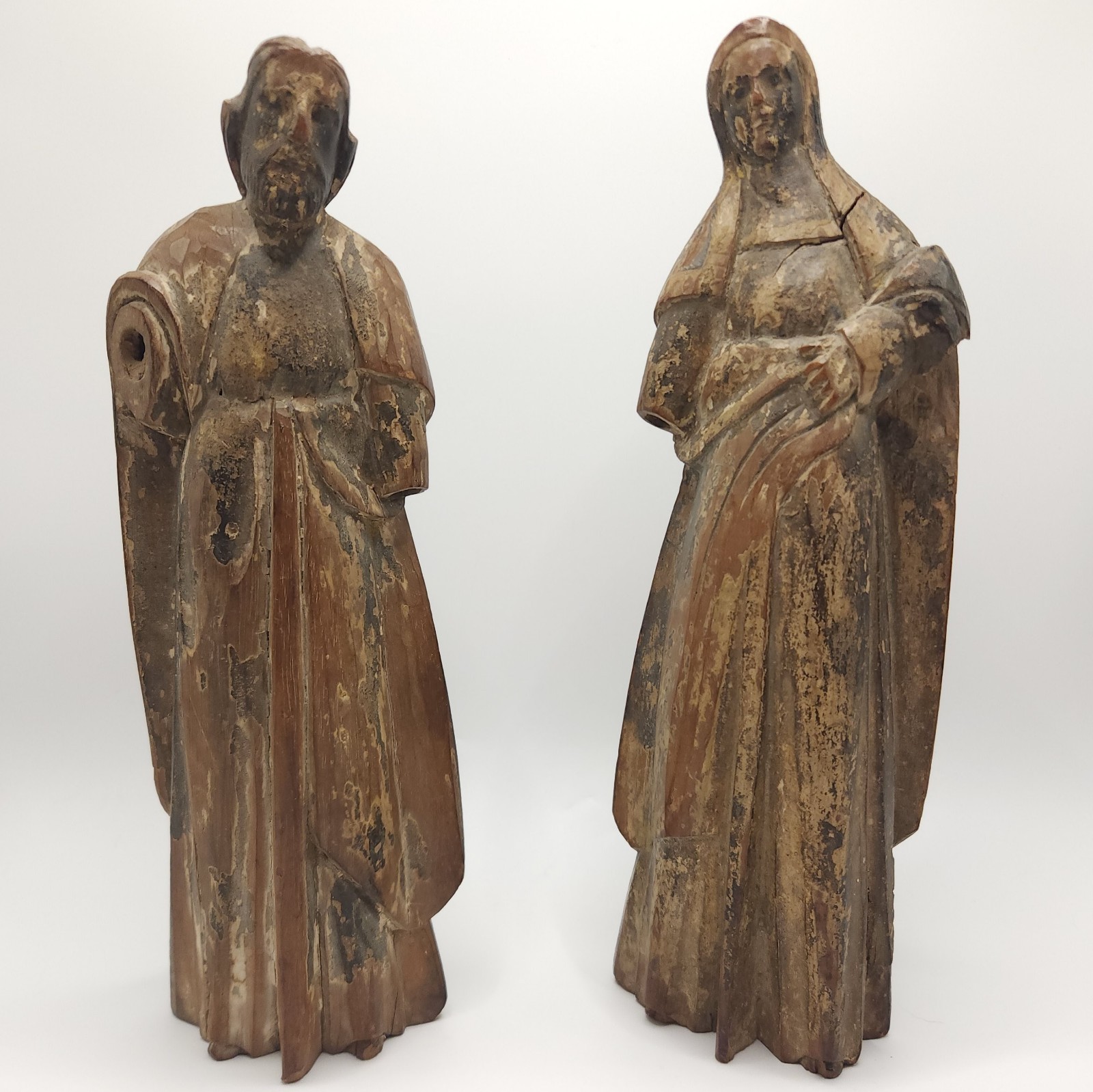
These two hand-carved and painted wooden Catholic devotional figures are very likely a companion pair, probably representing the Virgin Mary and Saint Joseph. Believed to date from the 18th or 19th century, they may once have belonged to a Holy Family or Nativity group, a household shrine, chapel, or another religious setting. Their precise origin is unknown, but their construction and appearance belong to a long tradition of Catholic devotional woodcarving.
Standing approximately 12 inches tall, this pair shares a distinctive appearance, with long flowing robes, carefully worked folds, and a quiet, frontal presentation. The female figure wears a veil framing her face, while the male has a full beard and hair carved in repeated parallel strokes. Much of their former painted finish has disappeared, leaving darkened wood, traces of color, and the visible marks of the carver's tools.
Carving and Surface
The carving is restrained but expressive. Long vertical folds emphasize the figures' height, while the faces, cuffs, hair, and drapery retain considerable definition despite the extensive surface wear. The female figure's surviving hand gathers a fold of her robe across the body, adding movement to an otherwise still composition.
Both figures were formerly polychrome, with surviving blue to blue-green color around the eyes and on the female figure's robe. Smaller areas retain yellow to yellow-ochre-colored material. Remnants of a pale, granular layer are visible beneath and alongside some of the remaining color, consistent with the preparation layers traditionally applied to wooden religious sculpture before painting. The exact composition of these materials has not been determined.
Examination of the male figure's exposed end grain under magnification shows numerous small vessel pores characteristic of a diffuse- or weakly semi-diffuse-porous hardwood rather than pine, fir, or spruce. Poplar, linden, and several other hardwoods are compatible with this structure, although the exact wood has not been identified. Photos 10 through 12 show the male figure's end grain, surviving blue near the eye, and layered surface. Photos 23 and 24 show traces of blue around the female figure's eye and on her robe.
Construction
Both figures were carved principally from solid wooden blocks, with their shoulders and upper sleeves forming part of the main bodies. The male originally had separately carved lower forearms and hands attached by wooden tenons fitted into mortises at the sleeve cuffs. Both are now missing, leaving two corresponding openings.
The female figure has one similar open cuff mortise where a lower forearm and hand are missing. Her opposite arm and hand survive across the front of the body, with the fingers holding and gathering the drapery. There is old breakage and loss at the outer elbow or sleeve on that side. It is unclear whether the surviving arm was separately fitted or carved with the main body.
Separately carved and fitted hands, arms, and religious attributes were common features of traditional Catholic wooden sculpture. The missing hands may once have held a staff, flowers, a book, or another identifying attribute. Their absence makes a definitive identification difficult. The Virgin Mary and Saint Joseph remain the most likely subjects, although Saint Anne and Saint Joachim are another possibility.
The backs are solid and less fully finished than the fronts, retaining long facets from hand tools rather than completely modeled rear drapery. Both undersides have flush-cut wooden mounting pegs, indicating former attachment to bases or another supporting structure. Whether the two figures originally shared a base is unknown.
Their closely matching height, carving style, sleeve construction, back treatment, surface history, and mounting methods strongly suggest that they were made together as companion figures.
Age, Origin, and Condition
The figures are believed to be antique, most plausibly dating from the 18th or 19th century, although a 17th-century date remains possible. Their solid-block construction, separately fitted extremities, hand-tooled backs, old mounting provisions, and surviving polychrome surfaces are characteristic of traditional devotional woodcarving. An early 20th-century date within a continuing traditional carving practice cannot be entirely excluded.
Carved and painted wooden religious figures have a long history in Spain, Italy, and southern Germany. Closely related carving and assembly traditions flourished throughout the Spanish-speaking Americas, particularly in Puerto Rico (where they are widely known as santos de palo), Mexico, Guatemala, New Mexico (where freestanding figures are commonly called bultos), and the Andean regions.
The present pair shares characteristics with these traditions, but no specific country, workshop, or regional school has been established. Their features are compatible with both European and American religious sculpture.
Both figures remain extremely firm and structurally solid, with no loose or weak areas. They show extensive historic surface wear, darkening, and loss of former polychromy and pale surface material, with surviving color concentrated largely in protected areas.
The male figure is missing both separately fitted lower forearms and hands. Faint age lines are visible on the underside. The female figure is missing one lower forearm and hand, while her opposite hand survives holding the drapery. There is old breakage and loss at the outer elbow or sleeve of that surviving arm. She also has a long, deeply darkened old split extending from the lower side toward the shoulder and neck. The split is stable.
Measurements
Male figure: 11 3/8" high × approximately 4" wide × 2 1/2" deep. Weight: 12.1 oz.
Female figure: 11 7/8" high × approximately 4" wide × 2 1/8" deep. Weight: 13.8 oz.