When you click on links to various merchants on this site and make a purchase, this can result in this site earning a commission. Affiliate programs and affiliations include, but are not limited to, the eBay Partner Network.
1791 New York City Merchant Receipt – John Evers – Possible William Denning Connection – Revolutionary War Patriot & U.S. Congressman
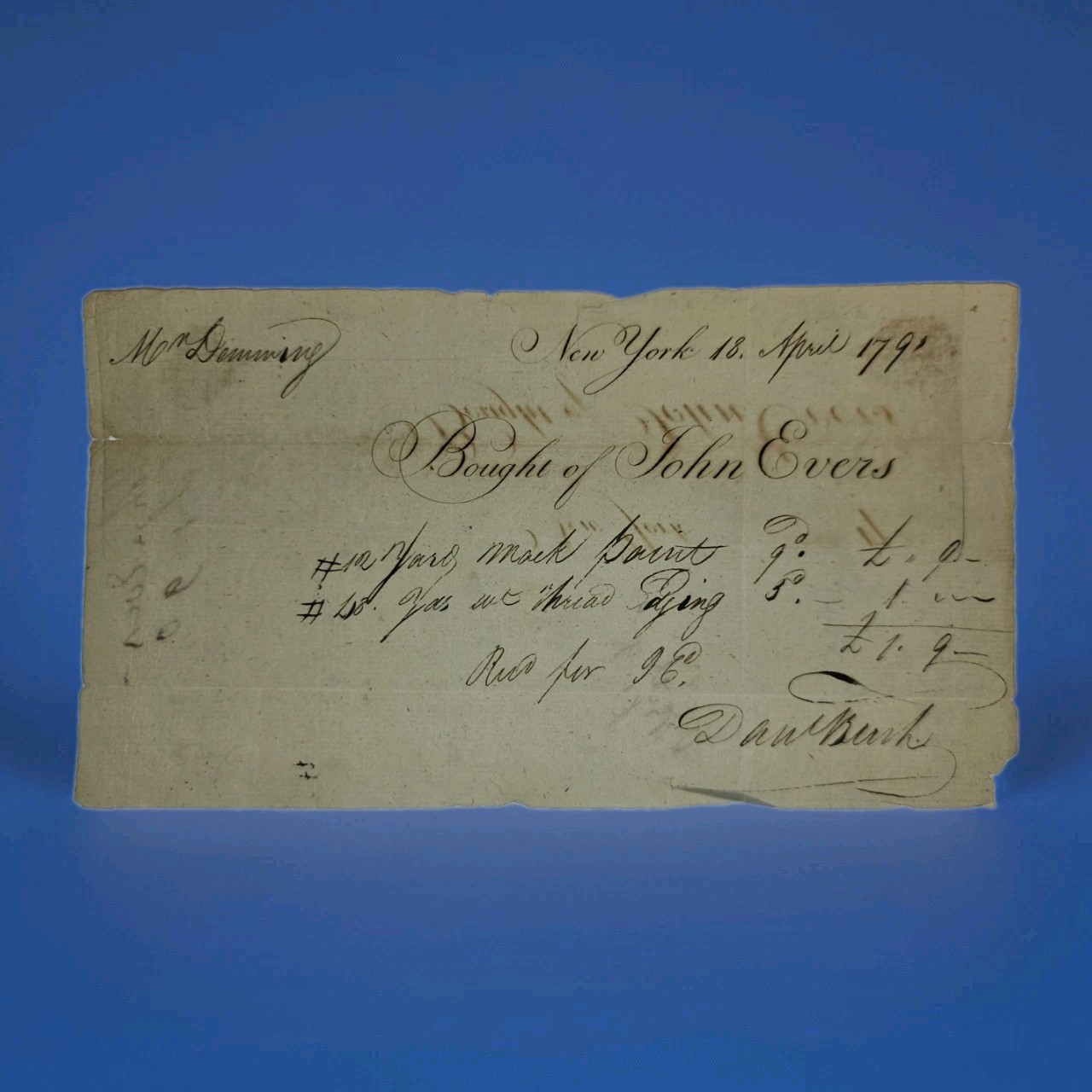
Original handwritten New York City merchant receipt dated April 18, 1791, documenting a dry-goods transaction involving John Evers and a purchaser identified as "Mr. Denning," possibly William Denning (c. 1740–1819), the prominent Revolutionary War-era patriot, merchant, New York State Senator, and United States Congressman.
The document is signed by "Danl Burk," apparently acting on behalf of John Evers, and records a transaction totaling £1 9s. 0d. Dating to George Washington's first presidential administration, this original 18th-century manuscript offers a fascinating glimpse into commercial life in the newly established American republic.
Document Details
Date: April 18, 1791
Origin: New York City, New York
Purchaser: Mr. Denning (possibly William Denning)
Merchant: John Evers
Merchant's Reported Address: 4 Queen Street, New York City
Signed By: Danl Burk (possibly Daniel Burk)
Transaction Amount: £1 9s. 0d.
Document Type: Original handwritten merchant receipt / receipted bill
Period: Early Federal America, George Washington administration
Material: Period manuscript paper with original ink handwriting and reverse endorsements
The receipt records two purchases measured in yards, apparently involving textiles or related dry goods. The exact merchandise descriptions remain partially undeciphered.
The reverse bears an additional handwritten endorsement identifying John Evers and the amount of £1 9s. 0d., reflecting the period practice of folding and filing commercial accounts.
Historical BiographiesWilliam Denning (c. 1740–1819) — Possible Purchaser
William Denning was a prominent New York City merchant, Revolutionary-era patriot, financier, and American politician whose career extended from the struggle for independence into the early United States government.
During the American Revolution, Denning was active in New York's Patriot movement and participated in several important revolutionary institutions.
He served on the New York Committee of Sixty and Committee of One Hundred, organizations involved in coordinating colonial resistance to British policies. He also participated in the New York Provincial Congress and served in connection with the Continental Navy Board, supporting the American Revolutionary cause.
Following independence, Denning continued his commercial activities and became an influential figure in New York politics.
He served in the New York State Senate from 1798 to 1808 and subsequently represented New York in the United States House of Representatives from 1809 to 1810.
By April 1791, Denning was already an established merchant and former Revolutionary patriot operating in New York City.
The purchaser identified on this receipt as "Mr. Denning" may be William Denning, given the date, location, and his known commercial activities. However, the document does not record his first name, and this identification remains unconfirmed.
If established, the association would connect this ordinary commercial transaction to a notable participant in the American Revolution and the early federal government.
John Evers — New York City Dry-Goods Merchant
John Evers was an early New York City merchant reportedly listed in the 1791 city directory as operating a dry-goods establishment at 4 Queen Street, within Manhattan's historic commercial district.
Queen Street, later incorporated into Pearl Street, was situated near the East River waterfront, an important center of shipping, trade, and merchant activity in 18th-century New York.
Dry-goods merchants supplied textiles, thread, clothing materials, and related merchandise to households, tradesmen, and other merchants.
The items recorded on this receipt, measured in yards, are consistent with the type of merchandise handled by a dry-goods establishment.
This surviving receipt identifies Evers as the seller and provides a tangible example of the business transactions that helped sustain New York's growing mercantile economy.
The reported directory identification is useful historical context, although it has not been independently verified for this listing.
Daniel Burk ("Danl Burk") — Receipt Signer
The document concludes with an acknowledgment reading approximately "Recd for J.E.," followed by the handwritten signature "Danl Burk" with a large decorative flourish.
Burk appears to have acknowledged the transaction on behalf of John Evers.
He may have served as a clerk, shop assistant, or authorized business representative responsible for receiving payments and preparing commercial receipts.
His exact biographical identity and position have not been independently established.
The document preserves his original manuscript signature, providing an additional example of late-18th-century commercial handwriting.
Historical Significance1. An Original Document from George Washington's Presidency
Dated April 18, 1791, this receipt was written less than two years after George Washington's first inauguration.
New York City had served as the first capital of the United States under the Constitution from 1789 to 1790 and remained one of the country's most important commercial and financial centers.
The receipt therefore dates to a formative period in American history, when the institutions of the new federal government and the nation's commercial economy were rapidly developing.
2. Possible Association with a Revolutionary Patriot and Congressman
The purchaser's surname, Denning, raises the possibility of a connection to William Denning, an important figure in Revolutionary-era New York political and commercial life.
Denning's involvement in revolutionary committees, the New York Provincial Congress, and later state and federal government makes him an interesting historical figure.
Although the identification is not definitive, the potential association gives this manuscript additional interest for collectors of early American political history.
3. Early New York City Commercial History
The document records a transaction involving John Evers, reportedly a merchant at 4 Queen Street.
This neighborhood formed part of Manhattan's bustling waterfront commercial district, where merchants, importers, shopkeepers, and tradesmen conducted business.
Surviving receipts of this kind provide primary-source evidence of everyday commercial activity in the early American republic.
4. Early American Currency and Financial Practices
The transaction totals £1 9s. 0d., representing one pound and nine shillings in the traditional pounds-shillings-pence accounting system.
Under the customary New York currency system of eight shillings per Spanish dollar, the amount was equivalent to approximately $3.63 in contemporary American currency.
Although the United States had established a decimal monetary system, traditional accounting practices continued to appear in commercial records.
This receipt illustrates that transitional monetary environment.
5. Original 18th-Century Manuscript and Material Culture
The receipt retains its original handwritten merchant heading, transaction entries, signature, folding patterns, and reverse accounting notations.
Its decorative penmanship and surviving paper provide an authentic example of late-18th-century business documentation.
The reverse also exhibits circular stains possibly associated with old sealing wafers, suggesting the document was historically folded and secured.
Condition
Original antique condition consistent with approximately 235 years of age.
The document displays age-related toning, scattered discoloration, original folds, edge wear, small paper losses, and minor separations or weaknesses along portions of the folds.
The reverse retains handwritten endorsements and circular discolorations or possible sealing-wafer remnants.
The principal manuscript text and signature remain substantially legible.
Please review all photographs carefully, as they form part of the condition description.
Summary of Importance
An original 1791 New York City merchant receipt documenting a dry-goods transaction during the first presidential administration of George Washington.
Its principal historical interest lies in its early Federal-period date, association with New York merchant John Evers, original signature of Danl Burk, and possible connection to William Denning, a Revolutionary-era patriot who later served in the New York State Senate and United States Congress.
The document also illustrates the continued use of pounds, shillings, and pence in American commercial accounting, along with the everyday business practices of Manhattan merchants during the early years of the republic.
A desirable piece of early American commercial ephemera for collectors of Revolutionary War history, Federal-period manuscripts, historic New York City, early American merchants, and political memorabilia.
The association with William Denning is plausible but not conclusively established. This document does not bear William Denning's signature.
Guaranteed original period manuscript, not a modern reproduction.