When you click on links to various merchants on this site and make a purchase, this can result in this site earning a commission. Affiliate programs and affiliations include, but are not limited to, the eBay Partner Network.
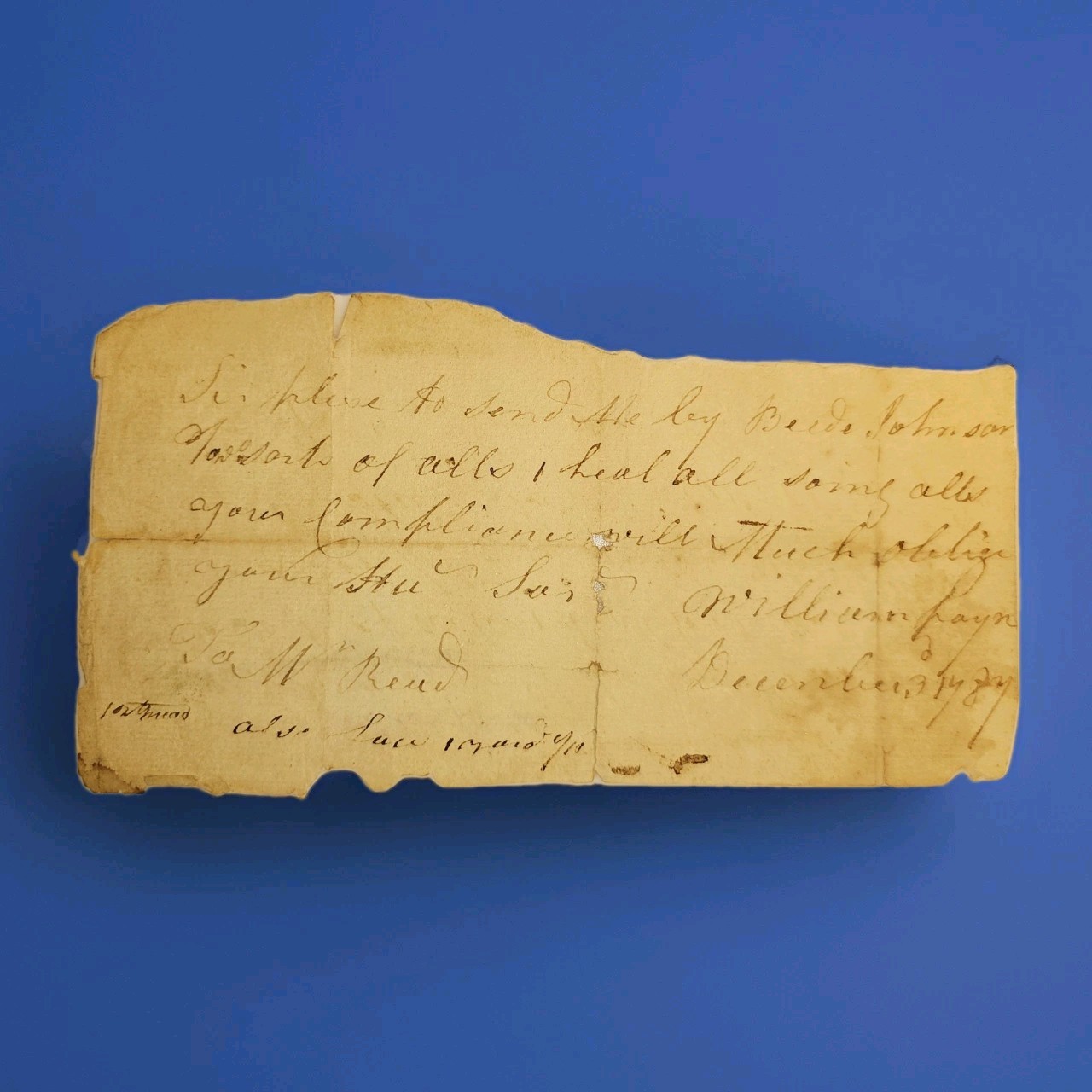
Rare original Revolutionary War-era folded merchant letter signed by Colonel William Payne (1751–1844), prominent Virginia planter, Revolutionary War officer, and associate of George Washington, dated December 29th, 1784, and addressed to Mr. Reed associated with the Scottish-American mercantile firm Huie, Reid & Co.
This authentic manuscript survives from the fragile rebuilding years immediately following the American Revolution, only one year after the Treaty of Paris formally recognized American independence. The document directly connects to the powerful merchant and planter networks operating in Dumfries and Prince William County, Virginia during the formative years of the United States.
The letter appears to read in part:
“Sir please to send Me by Beeds Johnson
No 2 of all I have all doing all
your Compliance will Much oblige
your Hum Servt William Payne”
Addressed:
“To M^r Reed”
“Mr Reed also Due 19 and 9”
“December 29th 1784”
Colonel William Payne (1751–1844)
William Payne was a prominent Virginia planter and Revolutionary War veteran who lived at the Buckland estate in Prince William County, Virginia, northwest of Dumfries. He was the son of William Payne Jr. and Lucy Stephen and belonged to one of the established planter families of Northern Virginia.
During the American Revolution, Payne served as a Colonel in the Virginia militia, participating in the defense and political life of Revolutionary Virginia during the struggle for independence.
He is most famously remembered in American historical lore for an incident involving George Washington in 1783. During a contentious Alexandria election dispute, Payne reportedly struck Washington during an argument. Rather than escalating the conflict, Washington later invited Payne to dinner, and the two men ultimately became close friends. The story became widely repeated in early American histories as an example of Washington’s restraint and character.
The Payne family maintained substantial business, land, and mercantile interests connected to Dumfries and the broader Potomac trade region during the late 18th century. Payne’s son, Merryman Payne, also appears in surviving merchant and trade records tied to Dumfries commerce during the same period.
Huie, Reid & Co.
The letter’s association with Huie, Reid & Co. places it directly within the important Scottish-American mercantile network that dominated much of the Chesapeake tobacco and export trade during the colonial and early Federal periods.
Scottish firms such as Huie, Reid & Co. operated sophisticated Atlantic commercial systems linking Virginia planters and merchants to Glasgow and British trading centers. These merchant houses supplied imported British manufactured goods while exporting tobacco and agricultural products abroad. Following the Revolution, firms like Huie, Reid & Co. played a critical role in restoring Atlantic commerce and stabilizing the economy of the newly independent United States.
Historical Importance
This manuscript represents an exceptional convergence of:
- Revolutionary War history
- George Washington association
- Early Virginia commerce
- Dumfries mercantile trade
- Scottish-American business networks
- Post-Revolution economic reconstruction
- 18th-century manuscript postal history
Surviving routine business correspondence from the immediate post-Revolutionary period is increasingly scarce, especially examples tied to identifiable Revolutionary War figures and documented merchant houses.
Item Details
- Original folded merchant letter
- Signed: Colonel William Payne
- Dated: December 29th, 1784
- Addressed to Mr. Reed / Huie, Reid & Co.
- Iron gall ink on laid paper
- Revolutionary-era commercial manuscript
- Merchant accounting notation present
- Approx. 8 inches unfolded
Condition
Fragmentary but historically attractive condition with expected fold wear, separations, edge losses, toning, and handling wear consistent with an authentic 18th-century working commercial document. Signature, date, and merchant references remain visible and display well.
An outstanding and historically important surviving artifact linking Revolutionary War veteran Colonel William Payne, the Dumfries mercantile trade, and the early commercial rebuilding of the United States following independence.