When you click on links to various merchants on this site and make a purchase, this can result in this site earning a commission. Affiliate programs and affiliations include, but are not limited to, the eBay Partner Network.
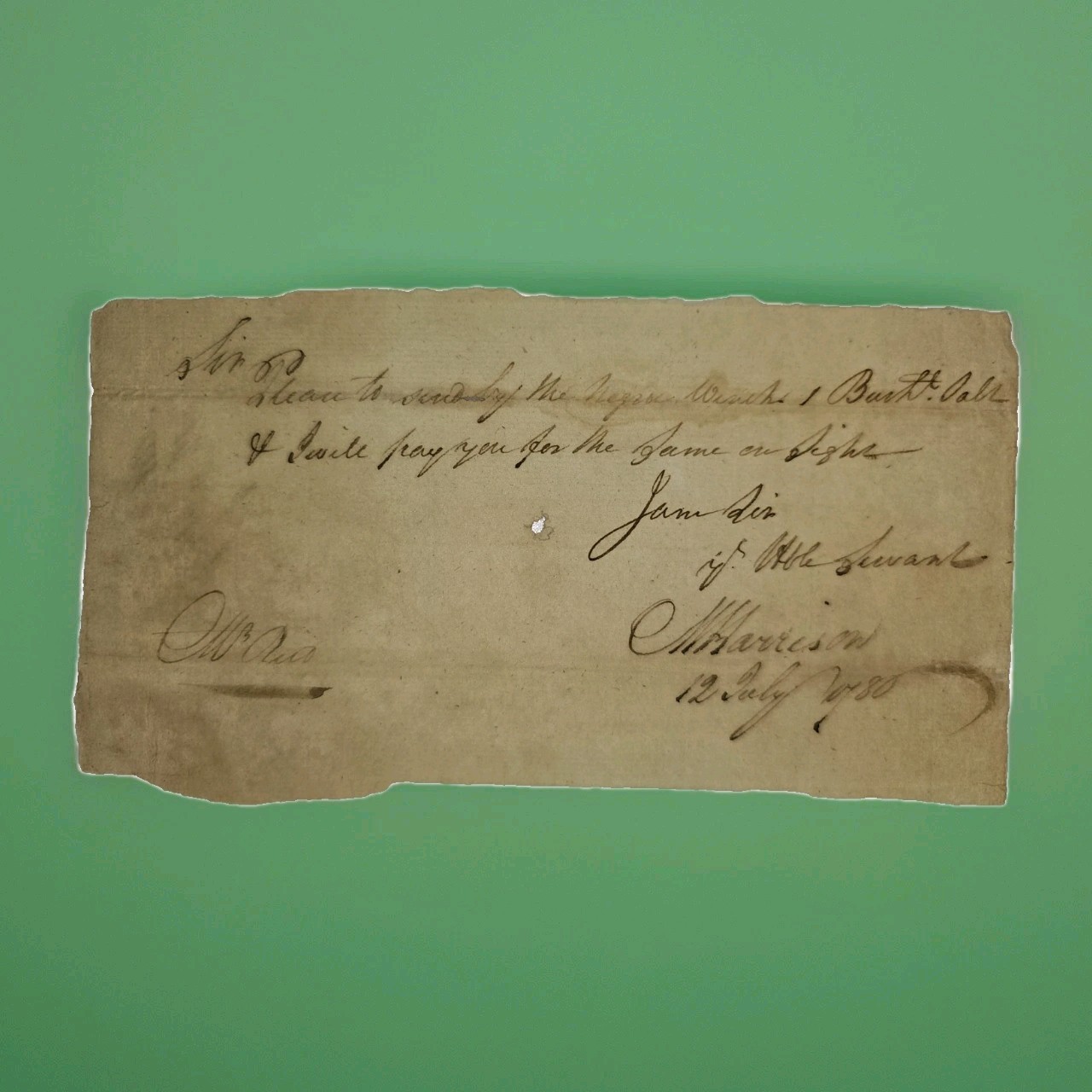
Original 12 July 1780 handwritten Colonial era supply note addressed to Mr. Reid, a merchant active during the Revolutionary War period, and signed by M. Harrison. This rare working document records a request for one butt of salt, to be delivered by enslaved couriers, providing a seldom preserved window into the logistics and labor systems of the eighteenth century.
The note reads:
“Please to send by the Negro wenches 1 Butt Salt. I will pay you for the same on sight. I am Sir, Yr Obt Servt, M. Harrison.”
The reverse notes the name of the sender and date for filing.
Size of a Butt of Salt
A “butt” was a very large eighteenth century cask. One butt equaled 126 gallons, or two hogsheads. Filled with salt, the total weight would be approximately 1,300 to 1,400 pounds, more than half a ton. The request for such a quantity confirms large-scale plantation or merchant-level operations and underscores the economic importance of salt for preservation during wartime scarcity.
Historical Significance
This document is notable for its reference to enslaved women used as couriers, a rarely documented role in surviving manuscripts. Informal working notes like this were commonly discarded, making any example referencing enslaved labor in daily transportation uncommon and historically important.
The sheet is written on laid paper with a clear Crown over GR watermark (George Rex). GR-marked British paper was widely used in the American colonies throughout the eighteenth century and is highly desirable for collectors of early Americana and Revolutionary era manuscripts.
Biographies of Individuals Mentioned
M. Harrison (Author)
Most consistent with Major Matthew Harrison (1742 to 1795) of Virginia, a Revolutionary War militia officer involved in regional supply movements, plantation oversight, and civil affairs. His writing style matches known examples and the closing “Yr Obt Servt” is typical of his period and social class.
Mr. Reid (Recipient)
Likely George Reid, a merchant known in the 1770 to 1790 Tidewater and Chesapeake region. Reids with this spelling appear frequently in salt, grain, and commodity ledgers in Virginia. Merchants like Reid handled large casks of provisions and were central to plantation and military economy. His presence in this transaction reflects an active commercial link with Harrison.
Enslaved Couriers
The line “Negro wenches” refers to enslaved women tasked with transporting goods. These individuals are unnamed but the reference provides direct primary evidence of roles enslaved people performed in the supply chain. Such mentions are scarce because they usually appear only in working notes that rarely survived.
Condition
Original eighteenth century laid paper with visible chain lines and a clear GR watermark. Strong brown ink with excellent legibility. Light toning, expected folds, and one tiny pinhole. Well preserved for a 245 year old manuscript.
Dimensions
Approximately 9 inches by 4 inches.
A rare Revolutionary era document combining early American manuscript interest, plantation economy history, and a seldom recorded reference to enslaved couriers transporting more than half a ton of salt.