When you click on links to various merchants on this site and make a purchase, this can result in this site earning a commission. Affiliate programs and affiliations include, but are not limited to, the eBay Partner Network.
1759 Colonial Maryland Tobacco Bill of Exchange – Thomas Ringgold, Samuel Galloway & Joseph Nicholson Jr.
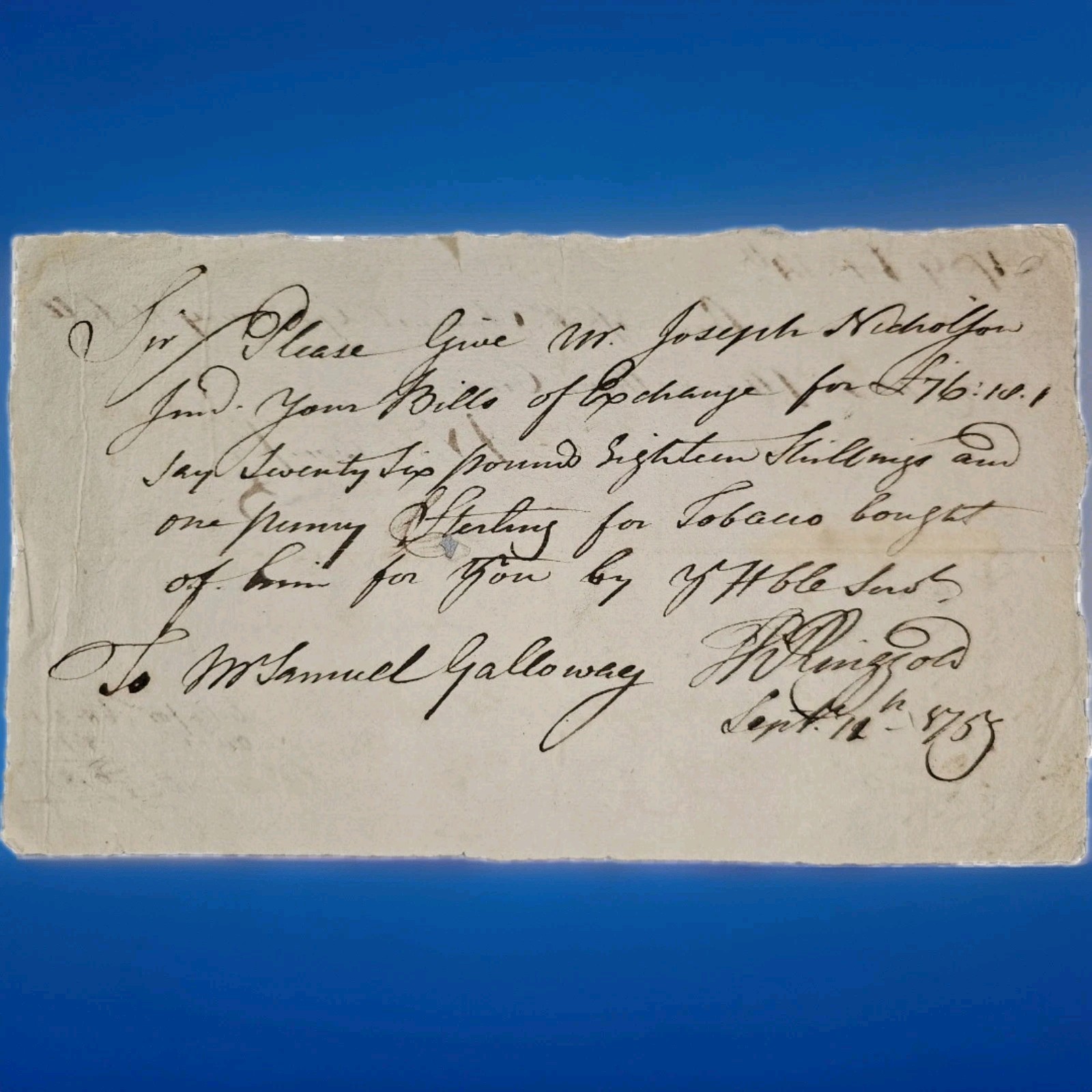
Original 1759 handwritten colonial American tobacco trade document bearing the signature of Thomas Ringgold (1715–1772), prominent Maryland merchant, planter, slave trader, and future delegate to the historic 1765 Stamp Act Congress.
Dated September 12, 1759, with a September 14, 1759 receipt endorsement, this original manuscript records a tobacco transaction involving three historically significant figures in colonial Maryland: Thomas Ringgold, Samuel Galloway III, and Joseph Nicholson Jr.
The document instructs Samuel Galloway to provide Joseph Nicholson Jr. with bills of exchange totaling £76, 18 shillings, and 1 penny sterling in payment for tobacco purchased on Galloway\'s behalf.
The manuscript is an important surviving example of pre-Revolutionary Chesapeake commerce, documenting the financial dealings of merchants whose business activities extended across the Atlantic world and whose careers intersected with the political developments leading to American independence.
Extensive contemporary newspaper research further documents Ringgold\'s association with Benjamin Franklin\'s printing partnership, his tobacco-exporting operations with Samuel Galloway, and their participation in the transatlantic slave trade.
Original Manuscript – September 1759
Date: September 12, 1759
Receipt endorsement: September 14, 1759
Origin: Colonial Maryland
Primary signatory: Thomas Ringgold
Recipient: Samuel Galloway
Additional named party: Joseph Nicholson Jr.
Transaction: Tobacco purchase and sterling bills of exchange
Amount: £76 18s 1d sterling
Period: British Colonial America, prior to the American Revolution
The principal manuscript reads in substance:
\"Sir, Please Give Mr. Joseph Nicholson Junr. Your Bills of Exchange for £76:18:1 ... Seventy Six pounds Eighteen Shillings and one Penny Sterling for Tobacco bought of him for You ...\"
Addressed to Mr. Samuel Galloway and signed by Thomas Ringgold, September 12, 1759.
The reverse contains a September 14, 1759 acknowledgment and additional accounting notations, including figures totaling £76 18s 1d.
The document preserves the original handwritten signatures, eighteenth-century spelling conventions, and commercial accounting practices of the colonial Chesapeake.
Historical BiographiesThomas Ringgold (1715–1772)
Maryland Merchant, Planter, Slave Trader & 1765 Stamp Act Congress Delegate
Thomas Ringgold was born December 5, 1715, in Kent County, Maryland, into an established colonial family. Based primarily in Chestertown, he became one of the Eastern Shore\'s prominent merchants and landowners.
Trained in law and admitted to the bar during the 1740s, Ringgold increasingly concentrated on commercial enterprises, including tobacco exporting, land acquisition, and the importation of enslaved Africans, indentured servants, and transported convicts.
Beginning around 1750, he developed a major business partnership with Samuel Galloway of Anne Arundel County. Their operations connected Maryland\'s agricultural economy with merchants and shipping interests in Britain and the wider Atlantic world.
The partnership became heavily involved in the transatlantic slave trade, importing and selling enslaved Africans in the Chesapeake. Contemporary advertisements identify Ringgold and Galloway as sellers of enslaved men, women, and children transported from Angola aboard the ship Jenny.
Ringgold also served in Maryland\'s colonial legislature.
His most notable political achievement came in 1765, when he represented Maryland at the Stamp Act Congress in New York City, an important early gathering of colonial representatives protesting British taxation without colonial consent.
The Congress helped establish the framework for coordinated colonial resistance that eventually developed into the American Revolution.
Ringgold subsequently became associated with opposition to British imperial policies and the growing Patriot movement.
At his death on April 1, 1772, he reportedly controlled approximately 30,000 acres of Maryland land, along with substantial commercial and personal property.
He married Anna Maria Earle in 1743. Their surviving son, Thomas Ringgold Jr. (1744–1776), married Mary Galloway, daughter of Samuel Galloway, further strengthening the two merchant families\' relationship.
Historical importance: The present manuscript predates Ringgold\'s participation in the Stamp Act Congress by six years and preserves evidence of his commercial career before his emergence as a significant colonial political figure.
Samuel Galloway III (1720–1785)
Prominent Maryland Merchant, Tobacco Planter & Builder of Tulip Hill
Samuel Galloway III was born May 23, 1720, in Anne Arundel County, Maryland, the son of John Galloway and Mary Thomas Galloway.
Descending from a prominent Maryland family of Quaker origins, Galloway became a wealthy planter, merchant, and participant in the Atlantic slave trade.
His commercial activities included tobacco cultivation and exporting, imported merchandise, landholding, and the buying and selling of enslaved people.
His partnership with Thomas Ringgold was among the significant mercantile enterprises operating in the mid-eighteenth-century Chesapeake.
Galloway owned substantial agricultural properties, including Hilton and the historic Tulip Hill plantation near the West River in Anne Arundel County.
Tulip Hill\'s Georgian mansion, completed during the 1750s, survives as an important example of colonial Maryland architecture and is listed on the National Register of Historic Places.
The plantation\'s agricultural operations depended upon enslaved labor. Enslaved people represented a substantial portion of Galloway\'s wealth and estate.
Galloway was also involved in Maryland\'s colonial horse-racing and breeding circles.
He married Anne Chew in 1745. Their children included Mary Galloway, who married Thomas Ringgold Jr., uniting the two merchant families through marriage.
Samuel Galloway died in 1785.
Connection to this document: Galloway is the merchant to whom Ringgold directed the September 1759 payment instructions. The manuscript documents the financial arrangements supporting their tobacco business.
Joseph Nicholson Jr. (c. 1735–1786)
Colonial Attorney, Maryland Revolutionary Leader & Continental Congress Electee
Joseph Nicholson Jr. was born in colonial Maryland, a son of Colonel Joseph Nicholson, a prominent Chestertown merchant and militia officer.
Educated in law, Nicholson practiced in several Maryland counties, including Kent, Queen Anne\'s, Cecil, and Anne Arundel.
He served as Sheriff of Queen Anne\'s County from approximately 1760 to 1763.
During the growing conflict between Britain and the American colonies, Nicholson became active in Maryland\'s Revolutionary political movement.
His public service included participation in the Queen Anne\'s County Committee of Correspondence, Maryland revolutionary conventions, and the Eastern Shore Council of Safety.
Following independence, he served in the Maryland State Senate from 1776 to 1781.
In December 1777, Nicholson was elected to the Continental Congress, although he did not take his seat and resigned shortly afterward.
He married Elizabeth Hopper in 1757.
Their descendants included Joseph Hopper Nicholson (1770–1817), who became a United States congressman and Maryland judge.
Joseph Nicholson Jr. died in 1786.
Connection to this document: Nicholson is identified as the seller of tobacco for which Ringgold instructed Galloway to issue £76 18s 1d in sterling bills of exchange.
The manuscript documents Nicholson\'s participation in Maryland\'s commercial economy before his later service in the Revolutionary government.
Important Benjamin Franklin ConnectionBenjamin Franklin (1706–1790)
Founding Father, Printer, Scientist, Diplomat & Statesman
Contemporary colonial newspaper advertisements establish an additional historically significant association between Thomas Ringgold and the printing partnership of Benjamin Franklin and David Hall.
Franklin was one of eighteenth-century America\'s most influential figures, achieving international prominence as a printer, publisher, inventor, scientist, diplomat, and political leader.
He played major roles in the American Revolution, the Declaration of Independence, the alliance with France, and the United States Constitution.
Before independence, Franklin developed an extensive network of printing and commercial interests throughout the colonies.
A surviving advertisement published under the name Franklin and Hall specifically identifies:
\"Thomas Ringgold, Esq; of Chester Town\"
as the authorized agent for collecting newspaper subscription balances on Maryland\'s Eastern Shore.
The advertisement confirms that Ringgold was entrusted with financial responsibilities for Franklin\'s printing enterprise.
This establishes a documented commercial association between the manuscript\'s signatory and Benjamin Franklin\'s business network.
The Franklin connection is established through independent contemporary newspaper evidence; Franklin is not a signatory or named participant in the 1759 manuscript.
David Hall (1714–1772)
Colonial Printer and Business Partner of Benjamin Franklin
David Hall was a Scottish-born printer who became Benjamin Franklin\'s business partner in Philadelphia.
Hall played an important role in the operation of Franklin\'s printing interests, including the Pennsylvania Gazette.
The partnership operated an influential newspaper and printing business serving readers throughout the colonies.
The advertisement naming Thomas Ringgold as an authorized subscription-collection agent provides direct evidence of Ringgold\'s participation in the firm\'s commercial network.
Contemporary Newspaper Evidence of the Ringgold–Galloway Partnership
Extensive historical newspaper research provides independent documentation of the merchants named in the manuscript.
1761 – Transatlantic Tobacco Shipping
An Annapolis newspaper advertisement dated August 6, 1761, announces the departure of the snow Alexander, commanded by Captain John Neilson, for Bristol, England.
The advertisement specifies that the vessel would load tobacco at Chestertown, with freight charged at £8 sterling per ton.
Merchants seeking passage or freight arrangements were directed to Samuel Galloway or Thomas and William Ringgold.
This advertisement directly confirms the merchants\' participation in international tobacco shipping just two years after the present manuscript.
Ship Jenny – Tobacco Trade with Liverpool
Another contemporary advertisement identifies the ship Jenny, commanded by Captain John Wilkinson, accepting tobacco freight for Liverpool, England.
Samuel Galloway and Thomas Ringgold are named as commercial contacts.
This provides further evidence of their role in the British Atlantic tobacco trade.
The Angola Slave Trade – Ship Jenny
Additional contemporary advertisements identify Thomas Ringgold and Samuel Galloway as merchants involved in the sale of enslaved Africans brought directly from Angola aboard the ship Jenny, commanded by Captain John Wilkinson.
The advertisements announced the sale of enslaved men, women, boys, and girls at South River Ferry in Maryland.
They specifically offered payment through bills of exchange, sterling, or colonial currency.
These advertisements are historically important evidence of the partnership\'s involvement in the transatlantic trafficking of enslaved Africans.
Although the present 1759 manuscript concerns tobacco rather than the sale of enslaved people, it illustrates the same system of commercial credit and bills of exchange used by the merchants in their broader Atlantic business operations.
Thomas Ringgold and Enslavement in Colonial Maryland
A separate colonial runaway advertisement concerning an enslaved man named Tom identifies Thomas Ringgold as one of his former enslavers.
The advertisement records Tom\'s movement between several Maryland enslavers and describes his attempted escape.
This surviving newspaper notice provides additional evidence of Ringgold\'s direct involvement in Maryland\'s system of slavery.
Together, these newspaper records establish the commercial, political, and social environment in which the 1759 manuscript was created.
Historical Significance
This document is notable for several reasons.
1. Original pre-Revolutionary manuscript: Created in 1759, sixteen years before the outbreak of the American Revolutionary War.
2. Stamp Act Congress association: Signed by Thomas Ringgold, who subsequently represented Maryland at the important 1765 Stamp Act Congress.
3. Three historically identifiable participants: Connects Ringgold, Galloway, and Nicholson, each associated with Maryland\'s colonial commercial or political leadership.
4. Chesapeake tobacco economy: Documents a genuine tobacco transaction during the period when tobacco remained one of colonial Maryland\'s principal exports.
5. Atlantic financial history: Illustrates the use of British sterling bills of exchange in colonial commerce.
6. Benjamin Franklin business association: Contemporary newspaper evidence establishes Ringgold\'s separate relationship with Franklin and Hall\'s printing enterprise.
7. Transatlantic slave-trade context: Independent advertisements document the Ringgold–Galloway partnership\'s participation in the trafficking and sale of enslaved Africans.
8. Revolutionary-era political connections: Both Ringgold and Nicholson later became associated with important colonial resistance and Revolutionary political institutions.
9. Original handwriting and signatures: Preserves an eighteenth-century commercial instruction and subsequent receipt endorsements.
10. Documented historical network: The manuscript can be interpreted alongside surviving colonial newspaper advertisements identifying the same merchants and their business activities.
Condition
Original eighteenth-century laid-paper manuscript exhibiting expected signs of age, including toning, fold lines, scattered spotting, edge irregularities, and minor areas of wear.
The manuscript remains substantially intact, with the principal writing and signatures clearly visible.
The reverse retains additional contemporary handwritten endorsements and accounting notations.
Please examine all photographs carefully for the precise condition and completeness of the document.
Collector Interest
A desirable historical manuscript for collectors of:
Colonial American manuscripts and Maryland history
Stamp Act Congress delegates
Early American political figures
Chesapeake tobacco and merchant bills of exchange
Benjamin Franklin-associated commercial history
Atlantic trade and the history of slavery
Colonial financial and business records
American Revolutionary-era Americana
Offered is the original 1759 handwritten document shown in the photographs. The historical newspaper advertisements are supporting research material and are not represented as original items included in the sale.
An uncommon opportunity to acquire an original colonial commercial manuscript connecting three identifiable Maryland merchants and political figures, including a future Stamp Act Congress delegate, with extensive contemporary documentation of their activities in the eighteenth-century Atlantic world.