When you click on links to various merchants on this site and make a purchase, this can result in this site earning a commission. Affiliate programs and affiliations include, but are not limited to, the eBay Partner Network.
Thank you!
If you do not wish to have your item(s) delivered on data disc(s), I can provide them on a flash drive and other means as well. Just let me know if a disc does not work for you and we can discuss delivery by other methods.
COMBINING SHIPPING COSTS
Are you purchasing multiple items? I will: a) combine all invoices before payment and charge shipping equivalent to one item, or b) refund all shipping costs in excess of one item after payment.
NOTE: This is a photo book in PDF copied to data CD - no paper copy of the book is provided or exists - I own the copyright to the compilation of these public domain works.
All derivative (i.e. change in media; by compilation) work from this underlying U.S. Government public domain/public release data is COPYRIGHT © GOVPUBS
$5.00 first class shipping in U.S.; $20.00 for air post outside of United States. I will combined sales for reduced postage prior to payment - simply ask for a combined invoice!
See numerous images of actual pages within manual.
Be sure to see my many other eBooks and manuals on CD sales.
This is an eBook in PDF format copied to blank CD.
Image Content by Theme:
German Occupation of Normandy Prior To D-Day
The Channel
Normandy Beach and Miscellaneous - U.S. Navy
Color - NARA
Signal Corps
National Archives - Canada
Album description
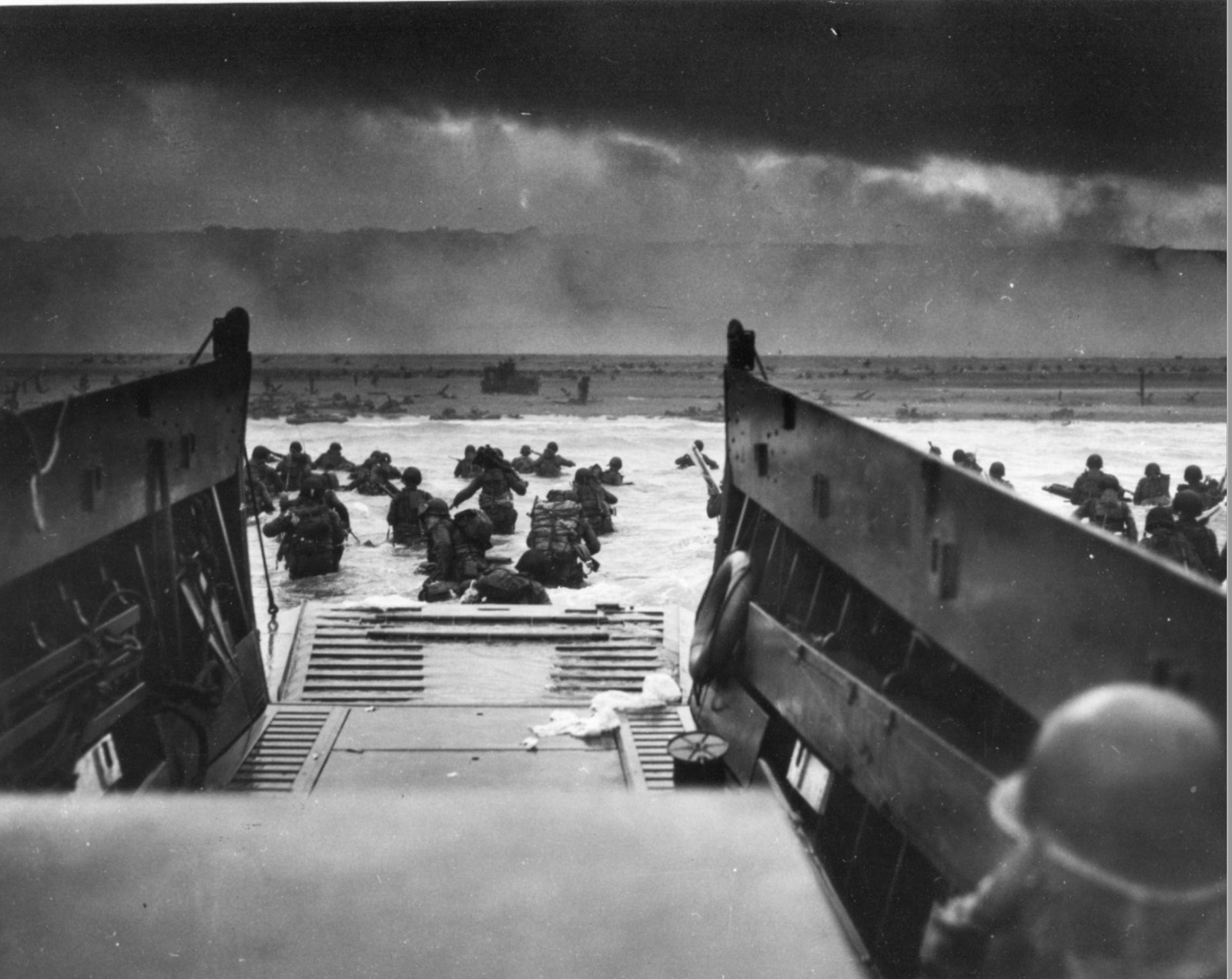
On June 6, 1944, more than 160,000 Allied troops landed along a 50-mile stretch of heavily-fortified French coastline, to fight Nazi Germany on the beaches of Normandy, France. Gen. Dwight D. Eisenhower called the operation a crusade in which, “we will accept nothing less than full victory.” More than 5,000 Ships and 13,000 aircraft supported the D-Day invasion, and by day’s end, the Allies gained a foot-hold in Continental Europe. The cost in lives on D-Day was high. More than 9,000 Allied Soldiers were killed or wounded, but their sacrifice allowed more than 100,000 Soldiers to begin the slow, hard slog across Europe, to defeat Adolf Hitler’s crack troops.
The Normandy invasion took place in the Bay of the Seine, on the south side of the English Channel between the Cotentin Peninsula and the port of Le Havre. Some fifty-five miles broad and twenty deep, its waters were shallow, had a considerable tidal range, and, when the wind blew from the northward, could be very choppy. The planned landing beaches covered about forty-five miles of the Bay's shoreline. Westernmost was "Utah" Area, stretching eight miles southward along the low-lying southeastern coast of the Cotentin Peninsula. Directly to the east was "Omaha" Area, covering twelve miles of generally hilly terrain. United States forces were assigned to take both of those areas, with important assistance from the navies of Great Britain and other Allies. British and Canadian troops would assault the areas code-named "Gold", "Juno", and "Sword", which ran twenty miles eastward from "Omaha". This sector ended at the mouth of the Orne River, some fifteen miles west of Le Havre, where the German Navy based a group of potentially very dangerous torpedo boats.
The actual landing beaches occupied a fraction of the width of each area, but were intended to provide sufficient initial footholds to allow rapid reinforcement and expansion inland, with the attacking soldiers joining their flanks to create a continuous beachhead perimeter before the enemy could mount a major counterattack. Each area would be assaulted by approximately one army division, with initial landings being made by much smaller units at 6:30AM in the American areas and about an hour later in the British. Their arrival on the shore was to follow a bombardment by ships' guns and aircraft ordnance, kept relatively brief to maintain as much as possible of the element of surprise. As a result, German shore defenses frequently remained intact, and would prove troublesome to both the landing forces and ships offshore.
To protect the invasion zone's western extremity, and to facilitate the "Utah" landing force's movement into the Cotentin Peninsula, the U.S. 82nd and 101st Airborne Divisions descended by parachute and glider in the small hours of "D-Day", 6 June 1944. Though badly scattered and lacking much of their equipment, these brave paratroopers kept the Germans occupied and helped ensure that the "Utah" Beach assault went relatively easily. The British and Canadian attacks, assisted by an air-dropped division on their eastern flank and a longer naval bombardment, generally also went well.
Not so in the "Omaha" area, where deep beaches backed by steep hills meant that the U.S. troops landing there were exposed to withering fire from enemy small arms, machine guns and artillery. Casualties were very heavy and the assult only succeeded after a day of brutal fighting, with warships coming in close to provide direct gunfire in support of the hard-pressed soldiers.
By nightfall on the sixth of June, the situation was favorable, even on Omaha. Entered the popular culture as THE "D-Day", a name it has retained ever since.