When you click on links to various merchants on this site and make a purchase, this can result in this site earning a commission. Affiliate programs and affiliations include, but are not limited to, the eBay Partner Network.
Measurements & Weight
Weight
95.7 g
0.0957 kg
3.38 oz
0.211 lb
478.5 carats
Dimensions
Longest side
58.06 mm
5.81 cm
2.29 inches
This piece comes from my personal collection, carefully kept as a natural mineral display specimen.
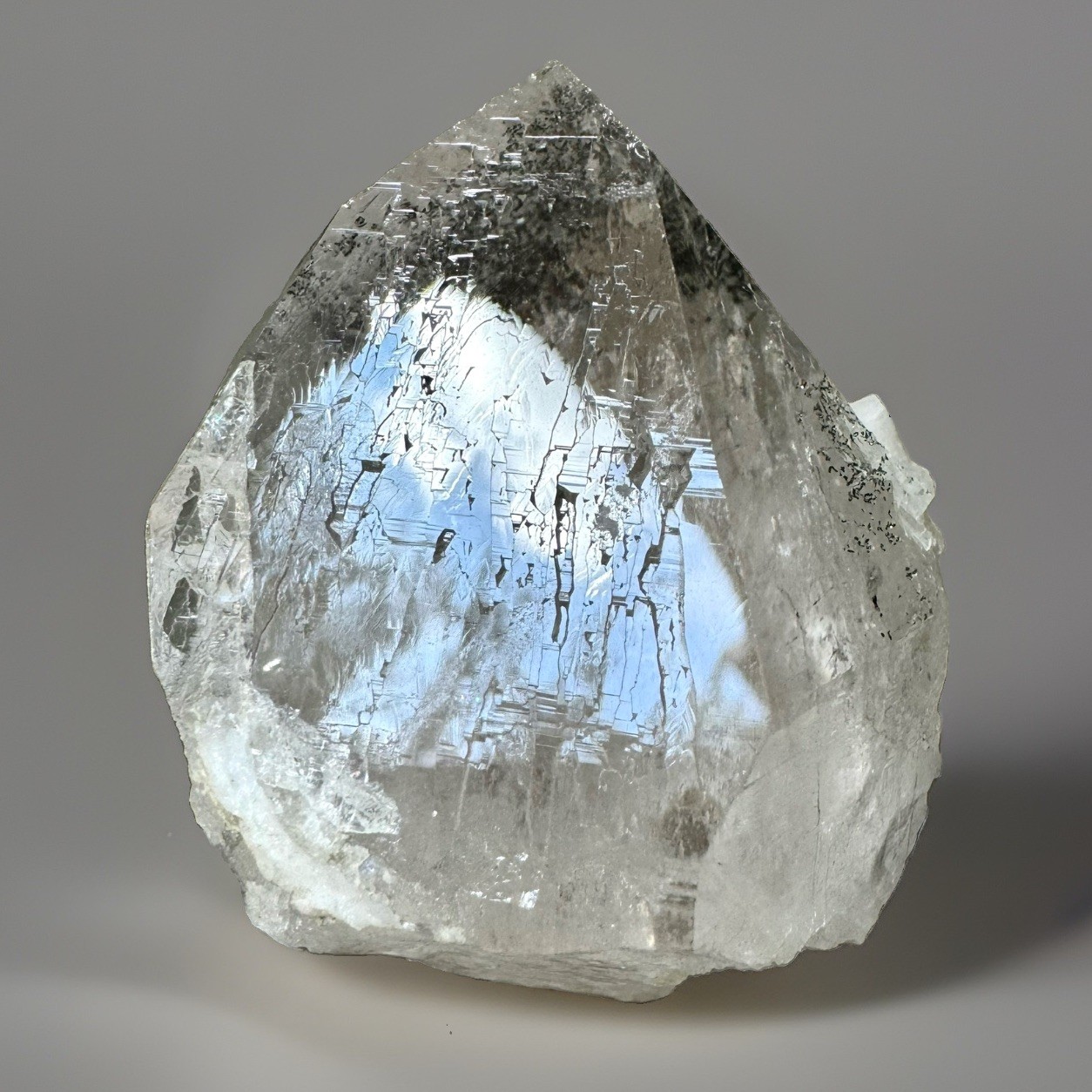
“Phantom Window” is a natural Himalayan quartz specimen from the Ganesh Himal region of Nepal, combining a highly transparent white quartz body with a striking dark green phantom zone, a large natural viewing face, complex layered growth textures, and strongly etched natural surfaces. Its most distinctive feature is the relationship between the front and back of the crystal: the broad transparent face acts almost like a natural window, allowing the darker phantom growth near the rear and upper portion of the crystal to appear suspended within the clear body.
The crystal has a strong, architectural form with a well-defined pointed termination and broad shoulders. Much of the upper body remains remarkably transparent, creating considerable visual depth when viewed under direct or transmitted light. The clearer areas allow the eye to travel through the quartz rather than stopping at the surface, revealing mineral growth and darker phantom-like scenery farther inside and behind the crystal.
Across the large front face is an unusually complex field of natural growth and dissolution textures. Fine horizontal Akashic-line growth patterns intersect with stepped terraces, angular geometric markings, circuit-board-like structures, and layered record-keeper-like forms. Some areas appear as small rectangular platforms stacked above one another, while others develop into irregular angular boundaries and mountain-like relief. Together they create a dense, almost topographic surface rather than a simple smooth termination face.
One of the most beautiful effects appears when the crystal is slowly rotated. At certain angles, the large face becomes highly reflective and the layered surface structures dominate the view. At other angles, those markings become more transparent and the darker mineral growth behind them becomes visible through the quartz. This creates a layered visual sequence of surface texture, transparent crystal, and deeper phantom scenery.
The dark green to nearly black mineral growth is concentrated especially around the upper and rear portions of the specimen. Rather than appearing as a single flat band, it forms irregular branching, moss-like and fragmented patterns that extend around portions of the termination and shoulder. Seen through the clearer front of the crystal, this darker growth produces a three-dimensional phantom-like landscape and gives the upper termination a distinctive dark mineral crown.
A contrasting white crystalline mineral association is present along one side of the specimen. The white material includes raised crystalline growth rather than appearing only as a flat coating, creating a strong contrast against both the transparent quartz and the darker phantom zone. Additional pale mineral material remains along portions of the lower natural surface.
The different sides preserve noticeably different geological textures. Some faces retain clearer reflective growth surfaces with fine horizontal lines, while others display dense stepped etching, irregular dissolution pits, and deeply textured relief. The rear and lower natural areas are particularly rugged, with pronounced dissolution features that contrast dramatically with the bright, transparent viewing face on the front.
The specimen also preserves evidence of multiple stages of crystal growth and later surface alteration. Fine growth lines, angular terraces, overlapping geometric structures, deeply etched areas, and irregular dissolution boundaries occur together across the crystal. These changing textures give each side a different appearance and make the specimen especially rewarding to examine from multiple directions.
Small localized rainbow flashes can also be seen along internal fractures and near portions of the termination when the light reaches the crystal from the correct angle. They are subtle secondary details rather than the dominant feature, but add another point of interest to the already complex interior.
Overall, this is a highly dimensional Ganesh Himal specimen whose character comes from the interaction of transparency, phantom mineral growth, and exceptionally complex natural surface architecture. The large viewing face, layered record-keeper-like and circuit-board textures, mountain-like stepped relief, dark green phantom scenery, white mineral association, and deeply etched reverse combine into a specimen that changes substantially as it is turned in the light.