When you click on links to various merchants on this site and make a purchase, this can result in this site earning a commission. Affiliate programs and affiliations include, but are not limited to, the eBay Partner Network.
Measurements & Weight
Weight: 15.2 g
0.0152 kg | 0.54 oz | 0.034 lb | 76 carats⸻Dimensions
Longest axis: 59.11 mm⸻Converted Dimensions
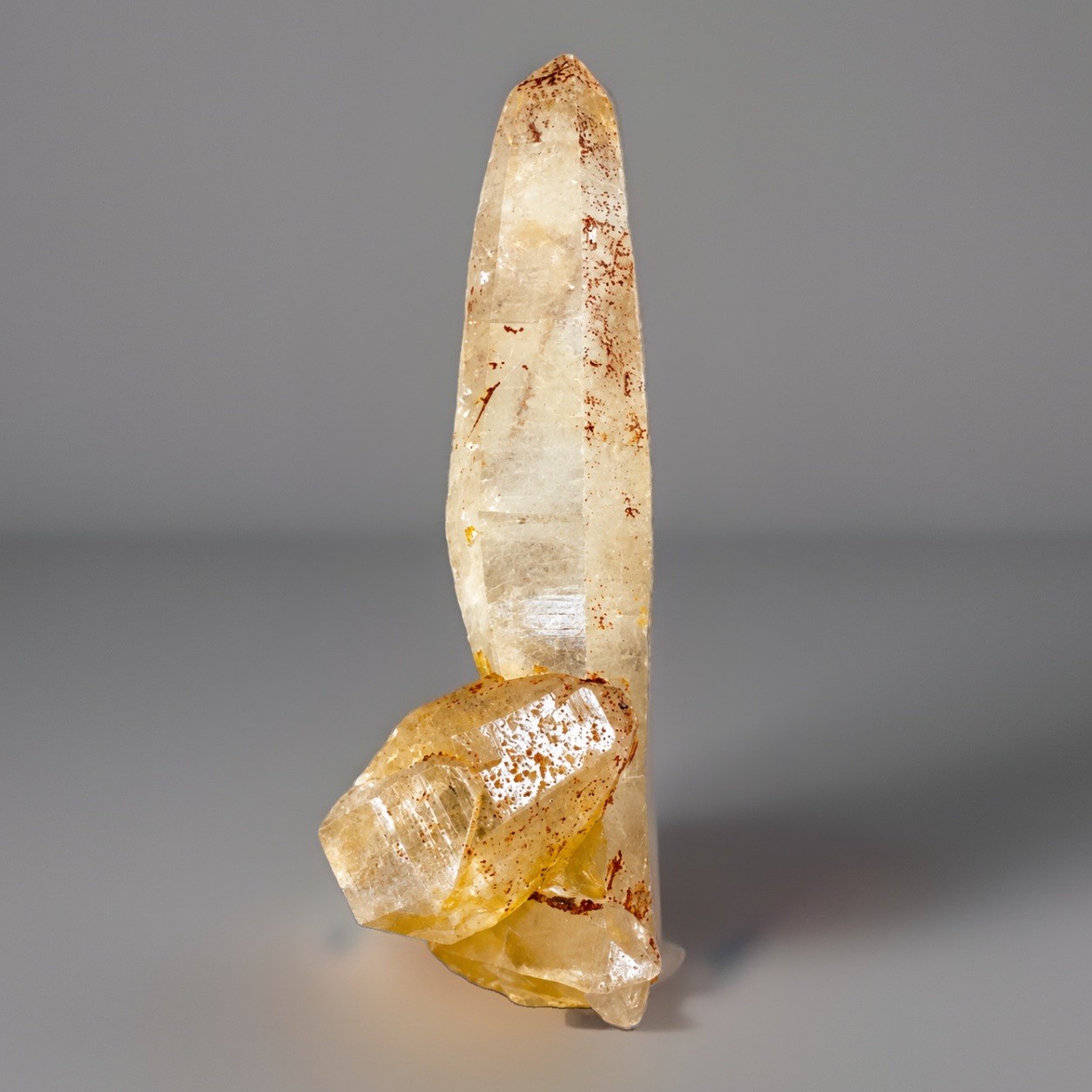
Longest axis: 5.91 cm | 2.33 in⸻This piece comes from my personal collection, carefully kept as a natural mineral display specimen.“Golden Afterglow” is a naturally formed quartz specimen from Hashupi, Pakistan, featuring a tall prismatic main crystal rising above a group of warm golden companion crystals. Its character comes from the contrast between the pale frosted upper crystal, deeply textured growth surfaces, golden mineral staining, and subtle iridescence near the base.The main crystal has an elongated natural form with a developed termination. Rather than being uniformly high-clear, it combines translucent, frosted, and locally clearer areas. Some flatter faces reflect light strongly, while the more heavily textured surfaces diffuse the light into a softer, mist-like appearance.Across the prism are pronounced horizontal growth striations, especially around the upper faces and termination. These range from fine parallel lines to broader stepped bands. Diagonal and intersecting growth lines cross other areas, creating complex layered patterns that resemble overlapping mountain ridges.Natural dissolution has strongly shaped several surfaces. Irregular etched depressions, shallow pits, recessed sections, and stepped relief run along the main crystal. Some areas resemble miniature cliffs, ridges, and weathered mountain terrain. The combination of growth and dissolution gives the crystal a highly sculptural surface that changes noticeably from one viewing angle to another.Golden to rusty-golden mineral staining appears selectively along crystal edges, etched pits, recessed areas, and growth boundaries. The color becomes stronger toward the lower portion, producing a natural transition from the pale, misty upper crystal into the warmer golden base.Several naturally associated quartz crystals grow around the base of the main prism. These companion crystals retain recognizable crystal faces and their own fine surface textures. Their outward growth creates a strong contrast with the tall vertical main crystal and gives the specimen a naturally architectural silhouette.The larger golden companion crystal has a softly frosted, finely textured surface. Under directional light, a small area displays subtle green, blue-green, pink, and golden iridescent flashes. This appears as localized surface iridescence associated with a thin mineral/oxide film and becomes more visible as the viewing angle changes.This delicate rainbow effect against the golden base inspired the name “Golden Afterglow”—like the last traces of color remaining across a mountain landscape after the light begins to fade.Natural Features• Elongated prismatic main crystal
• Natural crystal termination
• Frosted and translucent surfaces
• Locally clearer reflective faces
• Strong natural dissolution textures
• Etched depressions and dissolution pits
• Stepped growth relief
• Horizontal growth striations
• Diagonal growth lines
• Intersecting growth patterns
• Mountain-like and ridge-like textures
• Cliff-like etched surface relief
• Golden to rusty-golden mineral staining
• Golden coloration concentrated toward the base
• Multiple naturally associated companion crystals
• Golden frosted companion crystal
• Fine textured crystal faces
• Localized iridescent surface film
• Green, blue-green, pink, and golden flashes
• Natural pale-to-golden color transition
• Natural, untreated, unpolished, and not artificially shaped