When you click on links to various merchants on this site and make a purchase, this can result in this site earning a commission. Affiliate programs and affiliations include, but are not limited to, the eBay Partner Network.
Measurements & WeightWeight: 36.0 g
Ounces: 1.27 oz
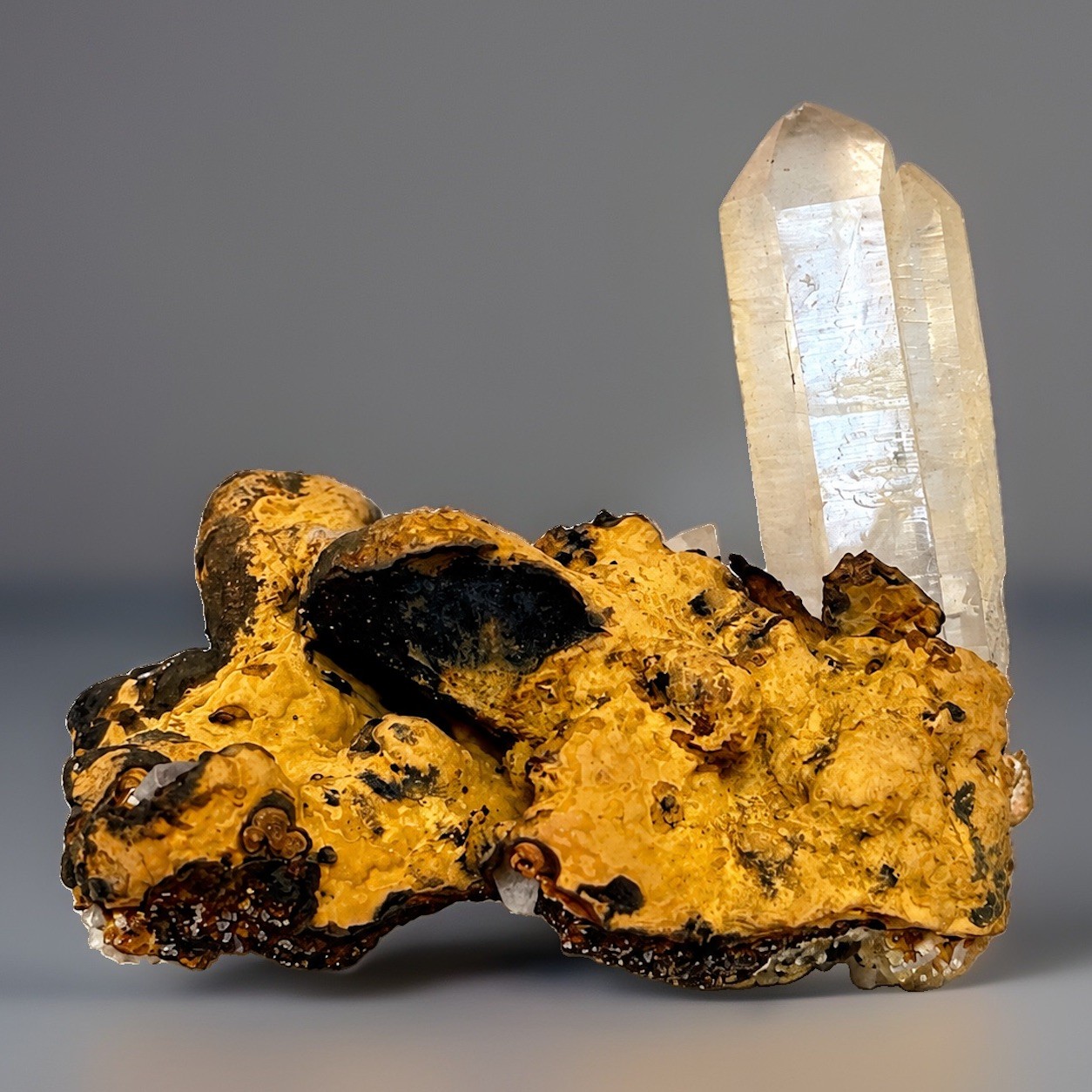
Carats: 180 ct⸻DimensionsLongest dimension: 54.87 mm⸻Converted Dimensions5.49 cm / 2.16 in⸻DescriptionThis piece comes from my personal collection, carefully kept as a natural mineral display specimen.“Cookie Ridge” comes from the Hashupi area of Pakistan, presenting a distinctive quartz cluster rising directly from a substantial natural iron-rich matrix. Its warm ochre-yellow and deep brown base has an unusually textured, baked appearance that inspired the name “Cookie Ridge,” while the upright quartz crystals rise above it like a pair of small peaks along a rugged ridge.The focal point is a closely intergrown pair of quartz crystals forming the main upright structure. Rather than appearing as a single isolated prism, the two crystals grow tightly together, creating a double-prismatic profile with individually visible natural terminations. Their slightly different heights and closely joined growth give the main crystal a strong architectural appearance.The main quartz combines clearer transparent areas with naturally frosted and translucent surfaces. Light passes through portions of the crystal while other areas remain softly misted, creating a noticeable clear-to-frosted contrast. Fine horizontal growth striations can be seen across the prism faces, preserving evidence of the crystal’s natural growth.A particularly subtle feature is the natural iridescent oxidation film visible across portions of the main crystal faces. Under changing light and viewing angles, this thin surface film produces delicate rainbow reflections rather than a heavy metallic coloration. The effect is understated and is most visible when light moves across the crystal surface.Surrounding the main intergrown crystals are numerous smaller secondary quartz crystals. Several grow at oblique and contrasting angles rather than forming a uniformly vertical cluster. This multi-directional growth creates a natural progression from the tall central crystals to smaller clear and translucent points around the base. Some of these secondary crystals retain well-defined terminations, while others merge naturally into the surrounding matrix.One of the strongest visual characteristics of this specimen is its unusually prominent ochre-yellow iron-rich matrix. Large areas are covered by an earthy yellow to golden-ochre material consistent in appearance with limonitic iron-oxide/iron-oxyhydroxide material. Rather than identifying the coating as a single specific mineral species without testing, it is best described as a limonitic, iron-rich matrix.The yellow material has an earthy, matte, naturally irregular texture, with folds, cavities, raised areas and rounded formations running across the matrix. Scattered through it are contrasting dark brown to nearly black iron-rich areas and small nodular textures. Together, the yellow, brown and dark surfaces create a strong natural color contrast against the pale quartz.The specimen retains a substantial portion of its natural host-rock matrix, rather than presenting the quartz as an isolated crystal removed from its original base. The underside and edges remain rugged and irregular, preserving the raw matrix-hosted character of the piece. Quartz crystals, iron-rich material and the host matrix remain visually interconnected throughout the specimen.Natural Features• Closely intergrown double quartz main crystal
• Two distinct upright crystal profiles
• Natural quartz terminations
• Clear-to-frosted crystal surfaces
• Transparent and softly misted areas
• Fine horizontal growth striations
• Subtle natural iridescent oxidation film
• Soft rainbow reflections under changing light
• Multiple secondary quartz crystals
• Obliquely oriented crystal growth
• Multi-directional quartz cluster structure
• Small naturally terminated quartz points
• Large ochre-yellow iron-rich matrix area
• Limonitic iron-oxide/iron-oxyhydroxide appearance
• Earthy and matte yellow matrix texture
• Deep brown to nearly black iron-rich areas
• Rounded and locally nodular matrix textures
• Strong quartz-to-matrix color contrast
• Substantial natural host-rock base
• Rugged, irregular matrix morphology
• Natural matrix-hosted mineral associationThe specimen is natural, untreated, unpolished, and not artificially shaped. Natural surface texture, matrix irregularities, contact areas, growth marks, small cavities, and other marks associated with its formation and recovery are preserved as part of the specimen.