When you click on links to various merchants on this site and make a purchase, this can result in this site earning a commission. Affiliate programs and affiliations include, but are not limited to, the eBay Partner Network.
[COLLECTION OF AUTOGRAPHED DOCUMENTS - POLAND INSURRECTION OF 1830-1832 -ADOLPHE THIERS - 1830/1840 - JULY MONARCHY]
-
We know almost nothing about Jules Poulain,
author of:An Episode of the Polish Uprising, 1830 to 1832 — written in French, ed. original by Ambroise Dupont (Paris, 1839).
Work always cited as a reference text, republished many times, this is the testimony (almost unique) of a Frenchman recently established in Poland,(as a textile industrialist) and who attends events live tragedies unfolding before his eyes
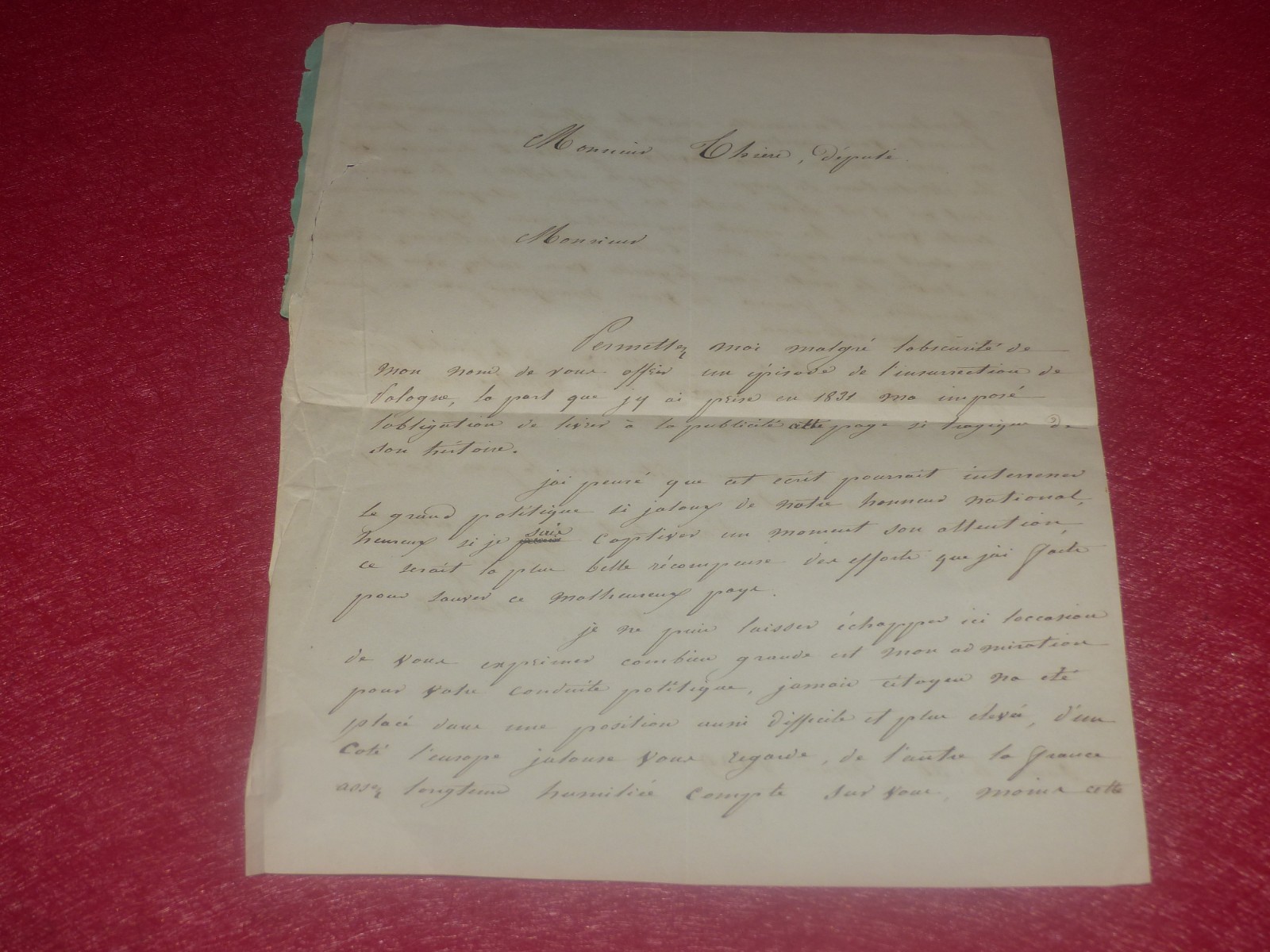
it even seems thatno letters or manuscripts from this author is not archived anywhere...hence the importance and great rarity of the one he addresses has Mr Thiers, MP, March 30, 1839:original letter, dated and signed by us that we offer here for sale
We know nothing about him apart from the biographical elements he gives in his work (First experience in Pondicherry in India, then installation in Poland, witness to the unrest, etc...)
We sell here
An extremely rare and very desirable letter signed J. Poulain,dated March 30, 1839 and addressed to Mr. Thiers, deputy(to whom he also seems to have offered the work he has just published)
"Allow me, despite the obscurity of my name, to offer you an episode of the insurrection from Poland, the part I took in 1831 imposed on me the obligation to publish this page so tragic of its history; I thought this writing might be of interest to big politician so jealous of our national honor, happy if I know how to captivate a moment his attention, that would be the greatest reward the efforts I made to save this unfortunate country.
I cannot let escape here the opportunity to express to you how great my admiration for your political conduct. Never was a citizen placed in a more difficult and exalted position; on the one hand, jealous Europe looks at you, on the other, long-humiliated France is counting on you, minus this shameful Camarilla whose impotent efforts tend to ruin you... but those times have passed when a Machiavellian goddess could bring the illustrations of the country into disrepute (La Fayette and Laffite), the weapons that were used against these great citizens will become dull against you; minds today more thoughtful today are no longer [?unclear...] slander...Continue sir to follow the road you enter with so much honor, you will not miss France on the day of recognition
I would be happy if the little episode I am addressing to you could earn me an audience, when the interest of the country allows you some rest
I have the honor to be, with the highest consideration, your most devoted servant. - signature - Paris, March 30, 1839"
1 sheet, 2 handwritten pages(Recto/Verso)
Very rare piece
1 free sheet, size approximately 27 x 20.7 cm,folded in the center
Good general condition, barely yellowed, own,almost without foxing, existence of minor usual creases or rubbing,slight creasing on left margin
Small tear in length on the left edge of the sheet, the page was detached (not by me, I found it that way) from the autograph book by Adolphe Thiers currently sold in my store, remnants of blue paper stuck to the left edge of the sheet
cf. visuals...
Very rare letter, sold in described condition, as found
-
Historical context: The Polish Uprising (1830–1832)
Extract from the text of the work by Jules Poulain (introduction):
“Called by chance to support the sublime momentum of the Poles, I received the counter-blow from the persecutions that the outcome of this heroic drama earned most of its actors. Almost all, alas! Still languish in exile, deprived of their goods, become the prey of the victors or the prize of betrayal. (…) MBut I thought that the simple and true story of this very tragic page in contemporary history would be interesting in more than one way. »
Jules Poulain, French textile industrialist from Pondicherry (French town in India), where he was installed initially, for Poland, finds itself taken in the Polish uprising of 1830–1831. Witness to the battles, persecutions and exile of Polish patriots, he draws a sincere account of them and empathetic, published in 1839, which constitutes a valuable source on the life of the insurgents and strangers present in Poland at that time.
The uprising, known as the November Uprising, broke out in Warsaw on November 29, 1830 against Russian rule, sparked by the attempted arrest of General Piotr Wysocki at the Belvedere Palace
A war ensued between the Patriotic Polish Army and the Tsar's forces. Despite initial victories, the Russians regained control in 1831, with the fall of Warsaw in September
Military failure led to brutal repression: abolition of the Diet, dissolution of university and cultural institutions (Warsaw, etc.), and massive emigration of the Polish elite (~4,800 families) to France in particular
-
The Polish insurrection of 1830–1831 and the exile of the insurgents had a direct impact in France, And Adolphe Thiers (then JEUNE MP, then a minister) played a political and symbolic role there.
1. Thiers and the “Polish cause”
From 1831, Thiers sat in the government of Louis-Philippe as Minister of the Interior, then Minister of Commerce and Public Works.
The liberal clubs and a part of public opinion urged the July monarchy to support Poland militarily against Russia.
Thiers and his government colleagues refuse direct armed intervention, so as not to risk a major conflict with Austria and especially with Russia.
Nevertheless, Thiers' France welcomed numerous Polish refugees: officers, intellectuals, artists. This is the famous “Great Polish Emigration”, established in Paris, Besançon, Lyon, etc.
2. Exiled Poles and French opinionIn France, the Polish cause was very popular: people shouted “Long live Poland!” » in the streets of Paris, the liberal press exalted the insurgents.
Thiers had to deal with this pressure from public opinion, while maintaining the line prudent diplomacy of the government.
In 1833, under its responsibility, the State encouraged humanitarian initiatives and tolerated THE Polish committees (to support refugees), but prevents any military expedition.
The figure of Thiers therefore appears as the man of “armed non-intervention”, but also the one which allowed the massive reception of exiles.
European context: 1839 is also the year of the Treaty of London (independence of Belgium). In this game of diplomatic balance, Poland remains a moral cause, but is not a diplomatic priority for Thiers.
In summary:In 1839, Thiers appeared as a sympathizer of the Polish cause, but in line throughout his career: he supports the reception of exiles and the moral defense of their cause, while refusing to engage France in a war against Russia. For the Poles exiled in France, Thiers is therefore both a protector (land of asylum) and a disappointment (no military uprising
November 1830 to September 1831 Kingdom of PolandCase belli: Non-compliance with the Constitution of the Kingdom by the Tsar
The November Uprising was an uprising in the Kingdom of Poland against Tsar Nicholas I. king of Poland, and against the abuses of Russian tutelage. The insurrection began on November 29, 1830 and ended with the fall of Warsaw in September 1831, after an eight-month war between the Russian imperial army and the army of the kingdom.
The defeat of the Poles was followed by severe repression and a drastic reduction in the autonomy of the Kingdom of Poland. Several thousand Poles were then driven into exile: this massive exodus was known as the “Great Emigration”.
Historical contextThe Polish state, officially called the Republic of the Two Nations, disappeared in 1795 during the third partition of Poland, carried out by Russia, Prussia and Austria.
In 1807, after the Prussian and Polish campaign, Napoleon reestablished a Polish state under French supervision, the Duchy of Warsaw, from territories which had been annexed by Prussia, adding, in 1809, territories which had been annexed by the Austrian Empire. Russia, “ally” of Napoleon by the treaties of Tilsit, retained all of its previous annexations. It even includes the Białystok region.
After the fall of Napoleon, the Congress of Vienna allocated the territory of the duchy to Russia and Tsar Alexander I becomes “king of Poland”.
The Kingdom of Poland inherits the institutions of the duchy, notably its civil code, the Napoleonic Code. It has its own constitution, its government (Diet and Council of State), its administration and its army. Alexander I grants the new kingdom a liberal constitution which guarantees freedom of the press, of speech and associations. General Józef Zajączek, who served Napoleon in the Grande Armée but later sided with the Tsar, was appointed viceroy (namiestnik). However, it was the tsar's brother, Grand Duke Constantine, commander-in-chief of the Polish army, who played a decisive role in Poland, assisted by Count Nikolai Novossiltsev, the tsar's personal representative.
Political tensionsThe main cause of the November uprising was the tsar's failure to comply with the provisions of the constitution of 1815. Already in 1819, Alexander I abolished press freedom and introduced preventive censorship. From 1820, patriotic societies were formed, particularly among students and soldiers, who suffered police repression. In 1821, freedom of assembly was suspended and Freemasonry was banned. In October 1822, Freemason Walerian Łukasiński, head of the Patriotic Society, is arrested.
Tensions worsened after the accession in 1825 of Nicholas I, who, the day after his access on the throne, must face the Decabrist insurrection. Eager to obtain liberal reforms, Russian officers attempted to raise the garrison of Saint Petersburg. Their failure freezes Russia in absolutism and conservatism. After bringing his people back into line, the tsar became the defender of monarchical legitimacy throughout Europe and viewed freedoms unfavorably enjoyed by the Kingdom of Poland.
In 1825, the new emperor abolished the transparency of the sessions of the Polish Diet. At the same time, the persecution of Polish independence organizations intensified. In 1827, members of the Patriotic Society were arrested.
Growing repression meets increasingly strong opposition. On December 15, 1828, a number of patriots united on the initiative of Lieutenant Piotr Wysocki, instructor at the Warsaw Infantry Officers' School, for the defense of the Constitution. This patriotic group which prepared the assassination of Grand Duke Constantine Pavlovich of Russia went down in history as “the Wysocki conspiracy”.
On May 24, 1829, in accordance with constitutional rules, Nicholas I is crowned king of Poland in Warsaw.
Poland and the European revolutions of 1830The year 1830 was marked in Europe by two revolutionary events: the July Revolution in France, then the Belgian revolution in August, whose population rose up against the authoritarianism of the United Kingdom of the Netherlands. These events call into question the order established after the Congress of Vienna by the three powers of the Holy Alliance: Russia, Prussia and Austria.
In addition, the dethronement of William I of Orange by the Belgians is welcomed in Saint Petersburg as a personal offense to the Tsar, given that Nicholas I's sister, Anna, had been the wife of William, eldest son of the King of the Netherlands, since 1816.
In Warsaw, Polish patriots were convinced that the Tsar would intervene militarily and they feared that the Polish army would be sent against the revolutionaries of France and Belgium.
In fact, in response to the “revolutionary anarchy” in Belgium, the tsar ordered October 17, 1830 has his Minister of War Alexander Chernyshev and Marshal Sacken to put the army on war footing. This order also concerns the Polish army which must follow the Russian imperial army to the west to quell the Belgian revolution. The Emperor personally recommended to Secretary of State, General Stefan Grabowski, to transmit the order of October 17, 1830 to the Polish Minister of Finance, Prince Drucki-Lubecki, so that he could raise the necessary funds. The date set for putting the army on a war footing was December 22, 1830.
The beginnings of the insurrection (November 29, 1830 – January 30, 1831)The announcement, on November 19 and 20, 1830, of the order to put the Russian armed forces on alert and Polish forces decide the leaders of Lieutenant Piotr Wysocki's secret organization to take immediate measures to trigger the uprising.
The events of November 29, 1830On the evening of November 29, 1830, a group of twenty-four students from the School of Infantry Candidates led by Wysocki, including Ludwik Nabielak and Seweryn Goszczyński, attacks the palace of the Belvedere where Grand Duke Constantine resides.
During their journey, a group meets General Hauke, Deputy Minister of War, accompanying the carriage where his family is. Asked to join the insurrection, Hauke refuses and instead tries to convince the aspirants to return to their barracks. He was killed by gunfire, then his Russian decorations were torn off, but not the Polish or French decorations.
At the Belvedere, the Grand Duke narrowly escaped the attackers. Despite this, they managed to train the population of Warsaw and take control of the city. Wysocki's group seizes the Warsaw arsenal and distributes 30,000 rifles to the city's population. The next day, the city was under the domination of the insurgents. Their standard bears the words “For our freedom and for yours”. Units of the Polish army stationed outside the city joined the insurgents. However, no general, despite requests, joined the insurrection. Only radical politicians, notably Joachim Lelewel and Maurycy Mochnacki, grouped in the Patriotic Society, supported the uprising.
On the night of November 30, Prince Lubecki, unfavorable to the insurrection and one of the few in Warsaw capable to discuss on an equal footing with the Grand Duke Constantine, contacted the prince and begged him to crush the disturbances in order to be able to present the event as an unimportant mutiny. But the duke refuses to act.
The provisional government (December 3-18, 1830)Count Lubecki then worked to form an Administrative Council bringing together conservatives hostile to the idea of the uprising. Prince Adam Czartoryski, General Józef Chłopicki, Prince Michał Radziwiłł and the writer Julien-Ursin Niemcewicz are among them. The council begins negotiations with the insurgents.
On December 3, 1830, the Administrative Council co-opted a few radicals and took the name Provisional Government of the Kingdom of Poland, whose presidency is given to Prince Czartoryski. On December 5, General Chłopicki, a veteran of the Napoleonic wars who was quite popular but not in favor of disorder, proclaimed himself "dictator of the insurrection", that is to say commander-in-chief of the Polish army. Grand Duke Constantine is authorized to leave the kingdom with the Russian troops, flags at the head and prisoners unharmed. During this time, new officers were promoted, notably from the management of the Warsaw infantry school, loyal to Wysocki, such as Hieronim Dębicki.
On December 12, 1830, Prince Lubecki left as an emissary to Saint Petersburg to appease the Tsar. He is content to ask for respect for the promises and already established constitutional rights of the Poland: respect for the constitution, the end of the stationing of Russian troops in the kingdom, its reunification with the former territories of the Grand Duchy of Lithuania with which it formed the Republic of the Two Nations. But Tsar Nicholas I refused to negotiate and demanded the unconditional surrender of the insurgents. The Russian army prepares for an attack on the kingdom. Prince Lubecki then wrote to General Chłopicki asking him to try to put down the rebellion with Polish forces since this was the only way to avoid Russian intervention.
The government of General Chlopicki (December 18, 1830 – January 18, 1831)If the government was conciliatory, the Diet meeting on December 18, 1830 was more radical. She proclaimed national insurrection and confirmed Chłopicki as its commander-in-chief. The provisional government was replaced by the “Supreme National Council”, still chaired by Prince Czartoryski, responsible for assisting the dictator.
A special committee of the Diet developed a text which was published on January 5, 1831, but dated December 20, 1830, the “Diet manifesto” (Manifest Sejmowy) in which were expressed the grievances of the insurgents against the tutelage of the Tsar.
Faced with the intransigence of Nicholas I, Chłopicki resigned on January 18, 1831, leaving power the responsibility of the Diet. He was replaced at the head of the army by General Radziwill.
The dismissal of the Tsar and the national government (January 25-30, 1831)On January 25, 1831, the Diet voted to remove Nicholas I from the Polish throne, which amounted to a proclamation of independence and a declaration of war.
There followed an intense political debate within the Diet on the nature, methods and objectives of the insurrection. Diet rules that Poland will be a hereditary constitutional monarchy and that it is up to the Diet to choose the king.
On January 30, 1831, the National Government was established, again under the presidency of Adam Czartoryski, Minister of Foreign Affairs until August 16. Joachim Lelewel represents the radical republican current.
The Russo-Polish War
While the radicals want a “people’s war” against Russia, the government of Czartoryski hoped that a successful military campaign would force Nicholas and the Great Powers to revise the clauses of the Treaty of Vienna concerning Poland.
First Russian offensive (February 1831)On February 4, 1831, a Russian army of 127,000 men, commanded by General Diebitsch, crossed the border of the Kingdom of Poland. The Polish army has only 53,000 men.
The offensive was carried out on a broad front with 11 columns, but an early thaw forced Diebitsch to fall back on the Brest-Litovsk road, occupying, after the difficult crossing of the Bug, the Siedlce region.
After the victorious battles of Stoczek (February 14), Dobre (February 17), Kałuszyn (February 17) and Wawer (February 19), the Poles confront the Russians near Grochów, 2 km east of Warsaw, on the right bank of the Vistula.
Halting of the Russian offensive at the Battle of Grochów (February 24-25)The Battle of Grochów is the most important battle fought in Europe since Waterloo. It saw 40,000 Poles and 60,000 Russians clash.
The Polish army was officially commanded by Prince Michał Radziwiłł, but the latter left the military initiative to General Józef Chłopicki, appointed on February 22, 1831, first-line commander. This change in Chłopicki's status had a negative impact on the course of the battle. Chłopicki arrives on the battlefield as a civilian. He took command of the entire Polish forces, but some of his subordinates did not recognize his authority and Jan Krukowiecki and Tomasz Łubieński refused to carry out his orders at key moments in the battle. This means that we lose a chance to definitively break the Russian cavalry.
Chłopicki having been seriously wounded during the battle, it was General Jan Skrzynecki, another veteran of the Napoleonic wars, who replaced him at the head of the army. The Poles resisted for a long time and inflicted significant losses on the Russians (10,000 men), dissuading them from continuing the offensive towards the capital.
Although the battle was indecisive, the Russian offensive was stopped. The Polish army regroups in a defensive position around the suburb of Praga, a bridgehead on the Vistula, while Diebitsch puts his troops, also affected by illness, into winter quarters.
Jan Skrzynecki's command and the Polish counter-offensiveSkrzynecki is confirmed as commander-in-chief of the uprising in place of Michał Radziwiłł, resigned, February 26, 1831. However, he does not believe in the success of the insurrection, he shows exceptional passivity. He missed several chances for successful offensives in the spring of 1831, then began a "purge" in the army, replacing the retired old staff with younger junior officers. He surrounds himself with his followers. Wojciech Chrzanowski is promoted to chief of staff, while Ignacy Prądzyński is appointed advisor. He placed disciplined officers: Maciej Rybiński, Antoni Giełgud, Kazimierz Małachowski and Henryk Milberg at the head of the divisions and he reorganized the structure of the Polish army, the strength of which in March 1831 was estimated at 70,000 soldiers.
The month of March 1831 was a period without notable military engagements, except for the last day. Diebitsch is awaiting reinforcements, with the operational Russian army reduced to 67,000 men earlier this month. Towards the end of the month, an insurrection broke out in the former Grand Duchy of Lithuania (annexed by Russia), which weakens Russian communications. Under pressure from the Tsar, Diebitsch agreed to launch a new offensive at the beginning of April and began preparations to cross the Vistula south of Warsaw.
Prądzyński then proposed attacking the VI Corps commanded by General Rozen and established not far from Warsaw, then the bulk of the Russian army. Polish troops crossed the Vistula on the night of March 30-31 and confronted the Russians at Dębe Wielkie. The Russians suffered heavy losses and their positions are dismantled.
But the proceedings were suspended for a week by Skrzynecki, giving Diebitsch time to return to Siedlce. On April 10, 1831, Prądzyński won at Iganie (2 km west of Siedlce), but again the commander-in-chief ordered him to give up attacking the town and to retreat to a defensive position while the Russian army was decimated by the cholera epidemic.
Defeat at the Battle of Ostrołęka (May 26)
Under pressure from political power concerned about the morale of the population and the army, Skrzynecki then decides an attack by the imperial guard stationed northeast of Warsaw, between Łomża and Ostrołęka, 25,000 men commanded by Grand Duke Michael.
On May 14, 44,000 Poles were gathered in Serock, north of Warsaw, then sent against the Grand Duke following the Narew. The guard evacuated Ostrołęka, which was taken on the 24th by the Poles. But on the morning of the 26th, they found themselves facing Diebitsch's Russian army coming up from Siedlce. Passing on the left bank of the river, they will fight fiercely to prevent the passage of the Russians. In the evening, Skrzynecki decided to abandon the position and return to Warsaw. The Russians, who had suffered considerable losses, did little to prevent this retreat.
Losses are also high on the Polish side. According to General Skrzynecki, 5,000 men are out of action, including generals as well as 30 staff officers and 125 of lower ranks.
Overall, this battle was a defeat for the Polish army, which returned to its starting point. Despite everything, it still had 80,000 men at the beginning of June.
The Polish army then suffered several setbacks. General Wacław Sierakowski defeated in Wronow and Kazimierz Dolny, General Józef Dwernicki, sent to Volhynia in March to incite an insurrection, was forced at the end of April to take refuge in Austria where his corps of 4,000 men was disarmed and interned. Sent to his aid with 6,000 men, General Wojciech Chrzanowski then decides to stay in Zamość.
The death of General Diebitsch (June 10)Considering attacking Warsaw from the north, Diebitsch first established himself in Pułtusk, closer to Warsaw (30 km). But he died of cholera on June 10.
During this phase unfavorable to the Russian army, Skrzynecki ordered the attack of the corps commanded by generals Kreutz and Rüdiger. The first attack led by General Ludwik Bukowski failed, the Russians refusing combat. The second, led by General Antoni Jankowski, succeeded in surrounding Rüdiger at Łysobyki on June 19, but, receiving an order to return to Warsaw, Jankowski immediately obeyed. and does not complete his attack. Bukowski and Jankowski are arrested on their return and imprisoned at Warsaw Castle.
Another setback concerns the expedition of General Antoni Giełgud to Lithuania, where he was sent in June with 12,000 men to support the insurrection. But, around July 15, Giełgud and his 8,000 men found themselves forced to take refuge in Prussia, where they were interned. A unit of 4,000 men under General Henryk Dembinski managed to return to Warsaw.
On the Russian side, Diebitsch is replaced by Ivan Paskevitch, who took effective command on June 26.
The second Russian offensive (July-early August)Paskevitch decides to move away from Warsaw in order to cross the Vistula. The movement begins on July 4. The crossing took place on July 21, without Polish intervention, in Osiek nad Wisłą, a little upstream from Toruń. Paskevitch is then able to attack Warsaw from the west. Furthermore, General Rüdiger crosses the Vistula at Józefów, south of Warsaw.
On August 1, Skrzynecki established a defense line at Sochaczew and on the Bzura, 35 km west of Warsaw. Given its passivity, the government sent a commission of inquiry to the headquarters located in Bolimów. After questioning officers, the commissioners relieved Skrzynecki of his command on August 10 and appointed General Henryk Dembinski in his place, on a temporary basis. But this does not appear to be more effective. On August 14, he ordered them to leave the Bzura line to return to Warsaw.
The fall of the national government and the assumption of command by Jan KrukowieckiOn August 15, 1831, the prospect of defeat and suspicion of betrayal of the national cause caused riots in Warsaw. The insurgents broke into several prisons and hanged dozens of people accused of espionage, including generals Antoni Jankowski and Ludwik Bukowski.
Prince Czartoryski suggests seeking protection from the Austrians, which triggers the fury of Joachim Lelewel and the radicals who urge the creation of an egalitarian republic. The national government of Prince Czartoryski resigned on August 16, 1831 and the next day, full powers were given by the Diet to General Jan Krukowiecki, governor of Warsaw, who mercilessly suppressed the riots and restored order in the city.
Appointed President of the Council of Ministers, Krukowiecki appoints six ministers and chooses the general Kazimierz Małachowski as Deputy Commander-in-Chief. Krukowiecki tries to negotiate with Marshal Paskiewicz, but he refuses.
On August 19, the war council decided to send two expeditions: one towards the north to supply the capital and the second, 20,000 men commanded by General Ramorino, to attack Rozen's corps, of only 11,000 men, to the east, on the road to Brest.
The fall of Warsaw (September 6-8)
By August 18, the Russian army was near Warsaw, but Paskevich suspended operations while awaiting reinforcements. When they arrived, he found himself at the head of 80,000 men. On the Polish side, the capital is defended by 28,000 soldiers and 10,000 armed civilians.
On September 4, Paskevitch proposed to the defenders to capitulate, which was categorically refused.
On September 6, 1831, the Russian army attacked the first line of defense, the main element of which is the Wola fort, defended by General Józef Sowiński with 1,300 men against 11 Russian battalions. The fort fell around noon. The attack against the second line of defense is suspended by Paskevitch, who accepts a truce until 1 p.m. the next day. The Poles again refuse to capitulate.
On September 7, the Russian offensive resumed early in the afternoon and the second line of defense fell. after hard fights. At 10 p.m., General Małachowski ordered his army to move to the right bank of the Vistula, at Praga. Then he obtained a truce to evacuate Warsaw to the north. The Polish government and army leave the capital.
On September 8, 1831, General Krukowiecki, who remained in Warsaw and deprived of command, capitulates and is taken prisoner.
Last fightsMałachowski's army assembled at Modlin, where it was decided to continue the fight. On September 9, Małachowski resigned and was replaced by General Maciej Rybiński. The leadership of the government is attributed to Bonaventura Niemojowski.
The Polish forces still available then amounted to 70,000 men: 33,000 with Rybiński, 20,000 with Ramorino, 10,000 with General Karol Różycki in Kielce, plus the garrisons of Modlin and Zamość. It is planned to join the columns of Rybiński, Ramorino and Różycki.
But General Ramorino decides on his own to abandon the fight and passed into Austria on September 17.
On September 23, the last session of the Diet took place. MEPs announce suspension of the uprising. Most decide to emigrate.
On October 5, most of Rybiński's army crossed into Prussia.
The fortresses of Modlin and Zamość fell last, respectively on October 9 and 21.
-
Foreign reactions to the insurrection
The Polish insurrection is popular in France and Belgium, at least in public opinion liberal or republican. She also has the support of the British and Americans in the United States.
The Polish national government sends emissaries to certain governments, but without great results. In Paris, the Polish legation is headed by General Kniaziewicz. and Louis Plater (they were appointed in February 1831); the lawyer Louis Wolowski is appointed first secretary. Although they did not have official diplomatic status, Kniaziewicz and Plater were received on numerous occasions by Foreign Minister Horace Sébastiani, but without him ever making a positive commitment in favor of the insurgents. The French government, resulting from the July Revolution, has in principle sympathy for the Polish cause, but does not want to take sides against Russia and aligns with the attitude of the Prussians and Austrians.
Russia is represented in Paris by a real embassy, headed by the diplomat of Corsican origin Charles Pozzo di Borgo. We can also note that, since 1827, France has had a consul in Warsaw, Raymond Durand, appointed during the reign of Charles before the insurrection, a very bad opinion.
After the defeat of Ostrolenka, no one abroad believed in a victory for the insurgents.
The Austrian and Prussian governments, directly concerned, because they have a fairly a large number of Polish subjects, some of whom participated in the insurrection (for example, Louis Sczaniecki and General Uminski for Prussia), remained neutral. They do not (it seems) provide aid to either Russia or the insurgents, but when Polish soldiers take refuge in Austrian or Prussian territory, they are disarmed and interned.
Support from French public opinion
The Society of Friends of the People takes part in demonstrations in favor of support to the Poles which took place in November 1830 in Paris.
At the beginning of 1831, Casimir Delavigne, author in 1830 of La Parisienne, wrote in honor Polish insurgents The Warsaw, set to music by Auber and sung in public on March 1, 1831 by Adolphe Nourrit. Its text was almost immediately adapted into Polish by Karol Sienkiewicz under the title Warszawianka, sung in Warsaw at the National Theater on April 5.
Support committees are founded. On January 23, 1831, General La Fayette created the Central Committee French in favor of the Poles, known as the “La Fayette Committee”, present in Paris and in several provincial towns. La Fayette is the president and Charles de Lasteyrie the vice-president. Among the members we find Béranger, Armand Carrel, Leonard Chodźko, Adolphe Crémieux, Pierre Daunou, David d'Angers, Casimir Delavigne, Victor Hugo, General Lamarque, Emmanuel de Las Cases, Odilon Barrot, Destutt de Tracy, the Duke of Valmy, etc.
The French capital is also the seat of an American-Polish Committee led by the writer Fenimore Cooper and in which Samuel Gridley Howe participates. His committee was founded in Boston at the end of 1830 or beginning of 1831.
There is also a committee founded in June 1831 in Lyon, the Polish Bazaar Society.
Public opinions in other countries Frédéric Chopin, who left Warsaw on November 2, 1830 for purely professional purposes, feels a certain hostility from the Viennese towards the insurgents. This pushed him to leave this country earlier than planned to come to France (he traveled from July to September, being in Stuttgart at the time). where he learned of the fall of Warsaw).
Volunteer foreign fighters
A certain number of volunteers come to fight alongside the insurgents. The best known example is that of General Gerolamo Ramorino. We can also cite the commander of the French army Georges Frédéric Langermann.
In total, the sending of international volunteers, which passes through the networks of European international activism, amounts to tens rather than thousands of men.
In France, thanks to the collections of the Central Committee in favor of the Poles, Colonel Fabvier charters a ship, the Jules-et-Julie, on which volunteer soldiers embark to fight in the Polish army. It is probably only a few dozen people.
Arriving in Poland, these men took part in the great offensive of spring 1831 in Lithuania and subsequent retirement.
Medical assistance to the insurrectionMedical aid is provided to the Polish army, mainly from France. Volunteers were recruited by the La Fayette Committee, at the request of the national government and in liaison with the Polish legation in Paris, which signed employment contracts for the year 1831. Two main groups were formed in March 1831: the first, of eight doctors, was led by Dr. Jean-Baptiste Charreyre (departure on March 24); the second, led by Dr. Joseph-François Malgaigne (1806-1863), included a health officer, a surgeon, two pharmacists and seven medical students (departure on April 2). Other smaller groups were formed subsequently, some leaving from Germany or Switzerland. In total, it is estimated that around forty medical volunteers reached Poland during the war. The Charreyre and Malgaigne groups were held for quite a long time in Berlin, where their medical qualifications were examined: passage was notably refused to those who were only medical students.
Once they arrived in Poland, several French doctors encountered a certain amount of hostility from their Polish colleagues; the Warsaw newspaper Kurier Polski even published criticisms against them, presented as less competent than German doctors. So on May 12, the Polish government ordered the Paris legation to put an end to the recruitment of medical volunteers.
However, a new development occurred in April with the start of the cholera epidemic in Poland. in April 1831, Russia having already been affected for several months (Grand Duke Constantine died in Vitebsk in June 1831). The French government then decided to send a specific mission to Poland, with the agreement of Pozzo di Borgo: six doctors, under the direction of Dr Charles Londe (1795-1862), who arrived in Warsaw at the beginning of June. At this time, the Prussian and Austrian authorities established a sanitary cordon on the borders of the Kingdom of Poland in order to prevent the spread of the epidemic.
The consequences of defeat
RepressionAfter the capture of Warsaw, the constitution of the kingdom was suspended and all officers who had served the national government were automatically broken and deprived of their property, while the remaining soldiers were incorporated into the Russian army and sent to the Caucasus. Military courts condemn all the rebels with their families in forced labor in Russia and some 80,000 Poles in chains are heading to Siberia. Thousands more are fleeing abroad.
Martial law and occupation are introduced in the Kingdom. Political crimes are tried by military courts.
A huge contribution is imposed on Poland, a customs barrier is also established on the Polish-Russian border.
The Great Emigration
Thousands of fugitives, intellectuals and soldiers, big owners or simple workers, seek to escape repression by taking refuge in different European countries. After an obligatory stay in Austria or Prussia, they are, with some exceptions, authorized to choose a destination. It is France that attracts the majority of them, and despite the distance, around 10,000 Poles come to take refuge there.
The committees in favor of supporting the insurrection transformed into committees supporting refugees, particularly in France, where this time the government took action: a daily allowance was paid to all Polish refugees and their accommodation was organized. The large masses of military refugees arriving in February-March 1832 were directed to provincial centers, Paris being reserved for refugees the most important.
Institutional changes: the Organic Statute of the Kingdom of PolandIn 1832, Nicholas I put an end to the constitution of 1815, replaced by the Organic Statute of the Administration of the Kingdom of Poland which would be in force until 1841. It maintains the administrative autonomy of the kingdom by reappointing the Administrative Council. The Diet is abolished and the Polish army dissolved. The Kingdom of Poland, however, retains its governing bodies. General Ivan Paskevich receives the title of Prince of Warsaw and is appointed Viceroy of Poland. Although Polish is still the official language of the kingdom, Russian power attacks all Polish cultural institutions: the University of Warsaw, the Warsaw high school, the Society of Friends of Sciences are closed.
Reactions in FranceThe capitulation of Warsaw on September 8, 1831 was the cause of violent emotion and triggered even a riot in Paris. A little later, people were outraged by a clumsy remark attributed to the Minister of War, General Horace Sébastiani: “Order reigns in Warsaw”.
“All of France is Polish,” says General La Fayette in the Chamber of Deputies on September 10, 1831. Volunteers were recruited by the La Fayette Committee, at the request of the national government and in liaison with the Polish legation in Paris, which signed employment contracts for the year 1831. Two main groups were formed in March 1831: the first, of eight doctors, was led by Dr. Jean-Baptiste Charreyre (departure on March 24); the second, led by Dr. Joseph-François Malgaigne (1806-1863), included a health officer, a surgeon, two pharmacists and seven medical students (departure on April 2). Other smaller groups were formed subsequently, some leaving from Germany or Switzerland. In total, it is estimated that around forty medical volunteers reached Poland during the war. The Charreyre and Malgaigne groups were held for quite a long time in Berlin, where their medical qualifications w Recommended products Provided by [COLLEC. ADOLPHE THIERS] RARE AUTOGRAPHE SIGNE Ca 1839 CHARLES MIRBEL Botaniste View product [COLLEC. AD. THIERS] Rare Autograph Signed Ca 1840 Prof. Achille Valenciennes View product [COLLEC AD. THIERS] RARE "LETTRE D'UN BERGER AUX RENTIERS" Ca 1830/1840 Pamphlet View product [COLLECTION ADOLPHE THIERS] Superb Signed Autograph Document Emile Babeuf 1840 View product [COLLECTION ADOLPHE THIERS] FAC SIMILE AUTOGRAPH COLIGNI / Ed. 1830 (Litho) View product [ADOLPHE THIERS COLLECTION] FAC SIMILE AUTOGRAPH BIRAGUE / Ed. 1830 (Litho) View product [COLLECTION ADOLPHE THIERS] FAC SIMILE AUTOGRAPH DUMOURIEZ / Ed. 1830 (Litho) View product [COLLECTION ADOLPHE THIERS] FAC SIMILE AUTOGRAPH BUFFON / Ed. 1830 (Litho) View product