When you click on links to various merchants on this site and make a purchase, this can result in this site earning a commission. Affiliate programs and affiliations include, but are not limited to, the eBay Partner Network.
Item came from a large maritime collection including several articles from the USS Yosemite. NO CLAIM OF A POSITIVE AFFILIATION WITH THE USS YOSIMITE HAS BEEN CONFIRMED. ONLY THE CARD DISPLAYED WITH IT AS WELL AS IT BEING WITH DOCUMENTED ITEMS FROM THE USS YOSIMITE WERE USED TO FORM THE ITEM'S POSSIBLE ORIGIN.
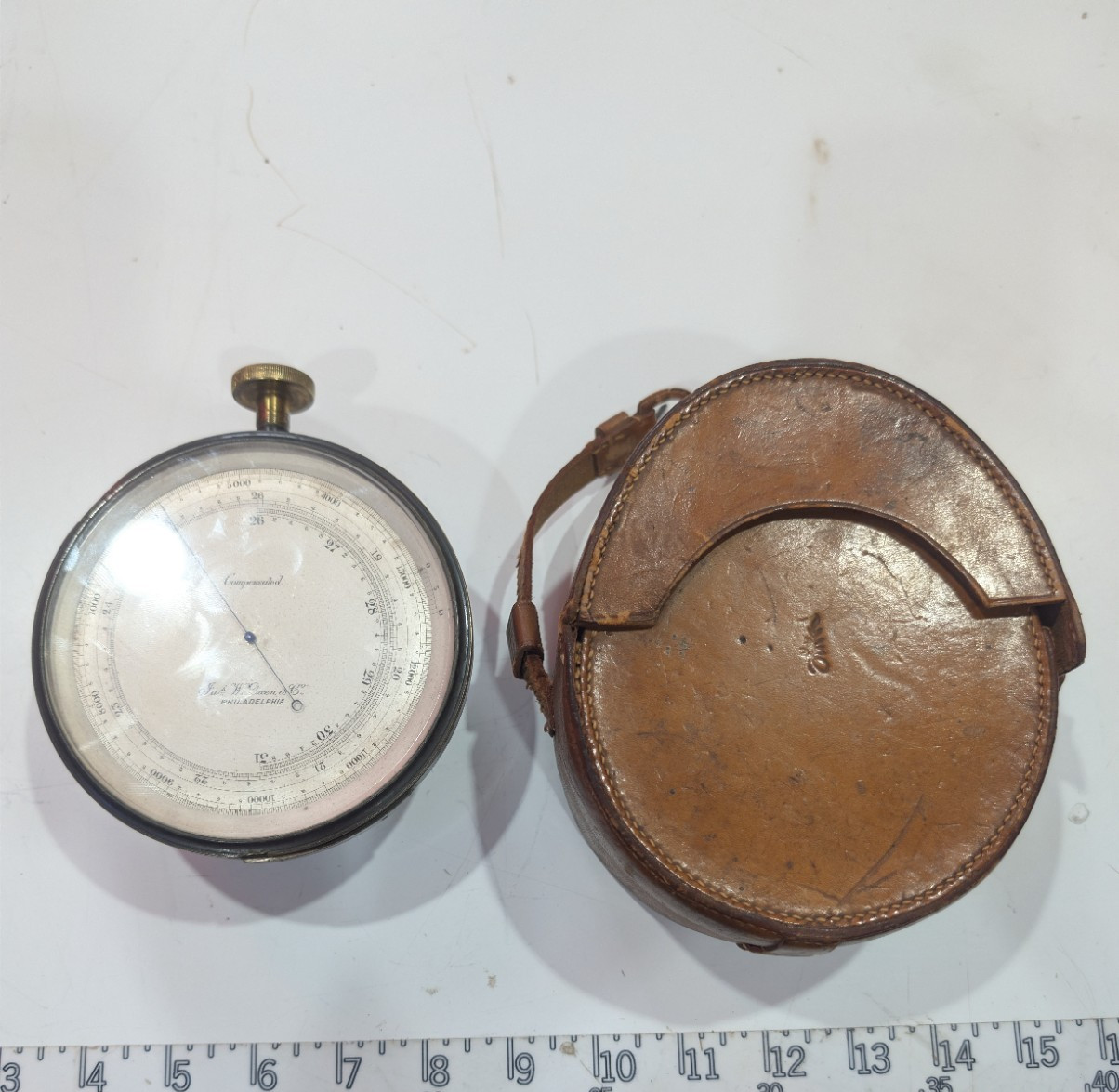
Original late-19th-century Jas. W. Queen & Co., Philadelphia compensated aneroid barometer/altimeter, complete with its original fitted leather carrying case. The instrument is believed to have an association with the USS Yosemite, and several characteristics of the piece are consistent with the type, period, manufacture, and use expected of a professional maritime instrument of that era.
The silvered dial is prominently marked:
“JAS. W. QUEEN & CO. / PHILADELPHIA”
This is not a simple household weather barometer. It is a precision compensated aneroid instrument incorporating finely divided barometric and altitude scales. Instruments of this class were intended for professional use where changes in atmospheric pressure needed to be measured accurately.
Why This Instrument Fits a Late-19th-Century Naval/Maritime Context
During the late 1800s, accurate barometric readings were extremely important aboard naval and commercial vessels. Long before modern electronic forecasting, radar, satellites, and digital weather instruments, ship officers depended heavily upon the barometer to recognize developing changes in weather and atmospheric pressure.
A falling barometer could provide advance warning of approaching storms or deteriorating conditions, while changes in pressure were recorded and compared as part of routine shipboard meteorological observations. This was particularly important for ships operating far from shore, where there was no immediate access to land-based weather information.
The instrument's compensated aneroid design was particularly well suited to professional field and maritime use. Unlike a traditional mercury barometer, an aneroid barometer does not require a long fragile glass mercury column. Its relatively compact construction made it much easier to transport, protect, and use aboard ships or during field operations.
The word “Compensated” on the dial refers to the instrument being designed to reduce errors caused by changes in temperature—an important consideration for a precision instrument moving between different climates and environmental conditions.
The inclusion of an altitude scale further demonstrates that this was a professional scientific instrument rather than an ordinary decorative household barometer. Aneroid barometers could be used to calculate approximate changes in elevation from differences in atmospheric pressure, making instruments of this type useful to surveyors, engineers, military personnel, explorers, and maritime professionals.
Jas. W. Queen & Co. — Philadelphia
Jas. W. Queen & Co. was an important American supplier of scientific, surveying, engineering, optical, and precision instruments during the 19th century. Its Philadelphia identification places this instrument firmly within the American scientific-instrument trade of the period.
That Philadelphia connection is especially interesting in relation to the believed USS Yosemite association.
The USS Yosemite associated with the Spanish-American War was the former commercial steamship El Sud. The vessel was acquired by the United States Navy in 1898, converted for naval service, and commissioned as the auxiliary cruiser USS Yosemite.
The dating of this Queen instrument is consistent with that period. In other words, the manufacturer, construction, technology, and overall style are all appropriate for an instrument that could have been in professional maritime or naval service during the 1890s and Spanish-American War era.
Possible Shipboard Identification Mark
The precise meaning of this marking has not been established, and it is therefore not being represented as a confirmed U.S. Navy property number. However, individually marking valuable precision instruments was common practice in institutional, military, surveying, and professional environments where equipment needed to be identified, inventoried, assigned, or matched with other equipment.
It is another interesting feature worthy of further research.
Original Leather Case
Of particular importance, the instrument retains its original fitted leather protective/carrying case.
The survival of the original case greatly enhances the completeness of the piece. Precision scientific instruments were commonly transported and stored in fitted protective cases, and these cases were frequently discarded, damaged, or separated from their instruments during the following century.
Having the barometer and its original case together provides a much more complete representation of how the instrument would originally have been stored and transported.
USS Yosemite Association
This barometer is believed to have been associated with the USS Yosemite.
Although additional research regarding that association is ongoing, the instrument itself fits the anticipated historical context particularly well:
Correct late-19th-century period
Professional-grade compensated aneroid construction
Appropriate for marine and naval meteorological observation
Compact, rugged design suitable for shipboard use
Made/supplied by a respected Philadelphia scientific-instrument company
Period consistent with USS Yosemite's 1898 U.S. Navy service
Philadelphia connection consistent with the vessel's acquisition and fitting-out era
Period hand-scribed identification/inventory-type marking
Original fitted leather carrying case remains with the instrument
None of these characteristics by themselves prove the USS Yosemite association, but collectively they demonstrate that there is nothing technologically or chronologically inconsistent with such an attribution. The instrument is exactly the type and generation of professional scientific equipment that could have been utilized within a late-19th-century maritime environment.
Condition is as photographed, showing expected surface wear, oxidation, scratches, patina, and aging from well over a century of existence. The silvered dial remains remarkably attractive and readable. The original leather case displays expected age-related wear.