When you click on links to various merchants on this site and make a purchase, this can result in this site earning a commission. Affiliate programs and affiliations include, but are not limited to, the eBay Partner Network.
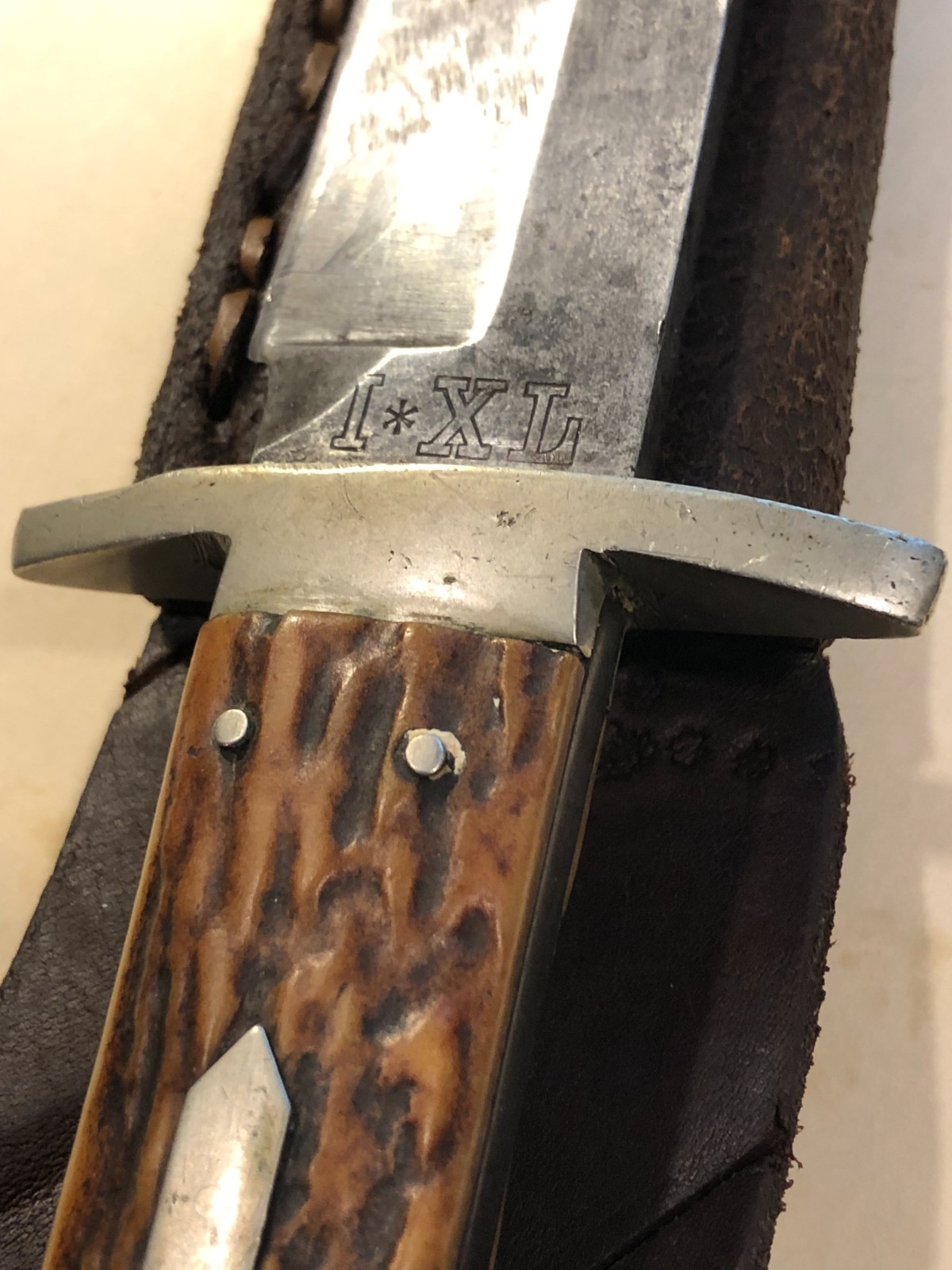
c. 1890 George Wostenholm & Son IXL Bowie Knifefixed-blade featuring a clip-point blade and a textured stag-antler handle with a central shield inlay.Blade Length: 7.25"Overall Length: 12.325"Crossguard: Simple metal crossguard separating the blade and handle.Handle: Textured stag-horn (or bone) scales secured with small pins and a diamond-shaped German silver escutcheon plate in the center.Manufactured by cutlers in Sheffield, England, during the mid-to-late 19th century (Victorian and American Civil War eras) and exported widely.
Highly collectible mid-to-late 19th-century George Wostenholm & Son IXL Bowie Knife. "I*XL" stamp weathered into the steel ricasso right above the crossguard in photo.
History & Significance: The "I*XL" Trademark: George Wostenholm acquired the famous "I*XL" mark (a clever play on "I excel") in 1826. It quickly became synonymous with the highest possible cutlery quality. The American Connection: Wostenholm was deeply enamored with the United States and traveled across the Atlantic roughly 30 times to promote his wares. Because of this, his factory, built in Sheffield in 1848 to handle skyrocketing demand, was named the Washington Works. The Peak Era: Wostenholm became the most prolific manufacturer of Bowie knives during the 1850s and the American Civil War. These knives were heavily carried by soldiers and frontiersmen alike.
Wostenholm's Early HistoryIn the mid-1700’s, there was reputedly a cutler by the name of George Wolstenholme (b 1717) working in the village of Stannington, near Sheffield (the supposed birthplace of the Barlow pocket knife). However it took three generations and one name change for the company to really make its mark on Sheffield’s cutlery history.
George’s son Henry was apprenticed to his father and in the 1750s was granted the use of the words “spring knife” by the Company of Cutlers in Hallamshire – spring knife being the term of the day for what is known now as a folding pocket knife. Henry’s son, a second George (b 1775), after having been apprenticed to another cutler, John Mickelthwaite, joined his father’s concern and the two continued in cutlery production until Henry died in 1803.
Originally the family name was spelt ‘Wolstenholme’ but, story has it that the second George found this name too long for smaller knives so he omitted the letters ‘l’ and ‘e’. The name has been spelt Wostenholm ever since.
The second George moved production to Sheffield where he built the fabled Rockingham Works (known locally as the Rockingham Wheel) in around 1810. Knives made in this factory and marked “Rockingham Works” are highly prized by knife collectors to this day.
George Wostenholm 1800-1876The third George Wostenholm (1800 – 1876) served his apprenticeship under his father at Rockingham Works. The first entry in The Sheffield City Directory (which incorrectly spells the name!) confirming the father and son partnership comes from 1825;
“WOLSTENHOLME, GEORGE & SON, manufacturers of table knives and forks, pen, pocket and sportsman’s knives, and general dealers in cutlery, 78 Rockingham Street.”
In 1834, following is father’s death, the third George Wostenholm took the company reins. Although the company had achieved considerable success under his father, it was the third George that catapulted Wostenholms to the head of Sheffield knife making. He was an incredibly astute and fiercely determined businessman.
George Wostenholm, The third George Wostenholm: Wostenholm and the USAWostenholms were selling knives to America as early as 1830 through a partnership with a William Stenton. George’s sales trips to America began soon after, and subsequently he established offices from New York across to San Fransisco through which he could service growing demand for his craftsmen made I*XL knives.
George himself is reported to have made a great many visits to America at a time when trans-Atlantic passage would have been arduous to say the least.
Washington WorksThe company, driven by George’s domination of the American market, expanded rapidly such that it was moved, in 1848 to the larger Washington Works on Wellington Street. This left the firm perfectly placed to cope with demand from the following decade; the 1850s would prove to be the peak of the great American Bowie knife era.
The name of the factory was a clue to how enamoured George had become with America. Earlier, in 1845, he had built his home, Kenwood Hall, amongst leafy streets of Sharrow and Nether Edge which he also designed, in collaboration with a Thomas Steade, to replicate those of Kenwood Village by Oneida Lake in New York State.
Washington Works was the largest cutlery works of its time, placing cutlery manufacture under one roof of a reported 800 employees and breaking with the established method of small scale cutlery production by Sheffield’s “Little Mesters”.
Washington WorksThe Great Exhibition Bowie KnivesBowie Knives designed by Alfred StevensIt is important to note that expansion was never to the detriment of quality. To demonstrate his firm’s mastery of the art of cutlery, for The Great Exhibition of 1851, Wostenholm made three exquisite Bowie Knives which he had commissioned the eminent English artist Alfred Stevens to design. The company won the highest prize medal; the first of many awards bestowed upon Wostenholms throughout the world for outstanding quality.
George served as Master Cutler to the Company of Cutlers in Hallamshire in 1856. His dedication to his company had meant that he had previously declined the role on two separate occasions. Sheffield lost one of its most famous sons George died in 1876 but his legacy lives on and Wostenholm is still one of the world’s most instantly recognisable knife brands to this day.
Notable Design Details: Knife features the classic "clip point" blade profile that defined the American frontier Bowie. The handles are genuine stag horn split-scales, which are pinned directly to a thick, sturdy full tang. The diamond-shaped silver plate on the side is an escutcheon plate, designed so owners could engrave their initials into their prized tool.sale Appriasal:7.25 in. clip point blade, 4.32 in. false edge, 12.32 in. overall length. Blade marked in three lines above the median ridge: "G. Wostenholm & Son / Washington Works / Sheffield England." Ricasso marked "I*XL" (blemishes to blade). German silver hilt with two piece stag grips and narrow guard. Brown leather sheath (not original) with scuffing and surface wear throughout sheath, including some damage to back and front. Appraised value $700-1050. From private ownership and never sold publicly.