When you click on links to various merchants on this site and make a purchase, this can result in this site earning a commission. Affiliate programs and affiliations include, but are not limited to, the eBay Partner Network.
59 x 16 cm (23.1 x 6.2 in.)
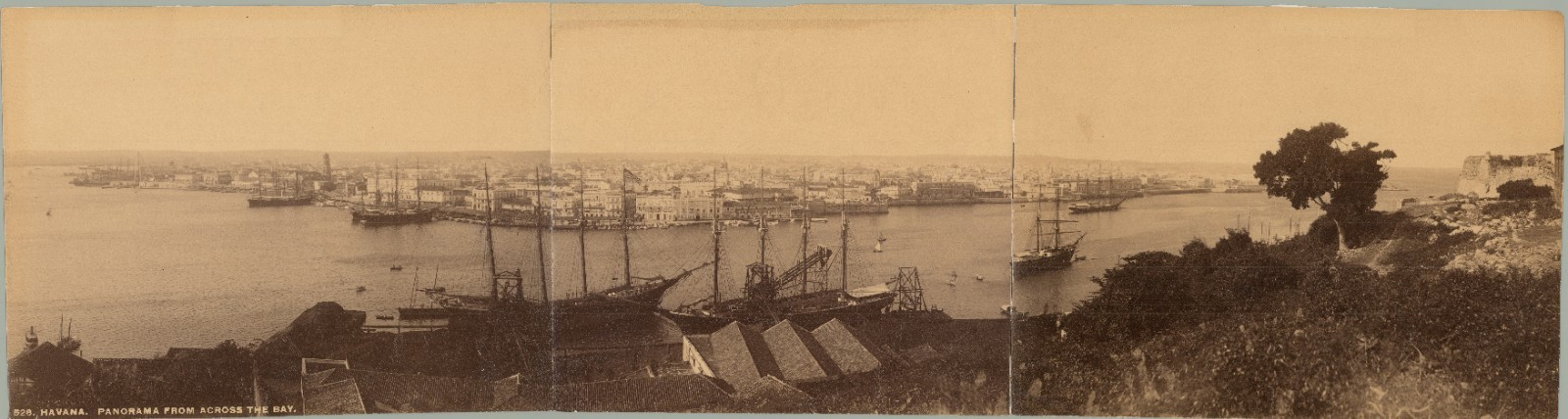
528. Havana. Panorama from across the Bay.
This sweeping c. 1890 three-part photographic panorama shows the harbor and waterfront of Havana from the heights on the east side of the bay, looking across the water to the old city. It shows Havana in the last decade of Spanish colonial rule, a busy commercial port and one of the wealthiest cities in the Americas, a few years before the final war of independence. The image has the calm, unhurried look of a commercial travel panorama, with a working harbor in the foreground and a low pale city across the water, and it preserves the waterfront as it stood before the upheavals of 1895–98 and the American occupation.The Map in Detail
This panoramic is oriented towards the west, taken from the east bank of the Canal de Entrada. Its long horizontal format lets the harbor unfold as a continuous strip. The stone ramparts of a fortification at the far right edge are probably part of the Fortaleza de San Carlos de la Cabaña. Below the slope, a cluster of tile-roofed sheds and warehouses stands beside a wharf, and a dark mound at left may be a coal pile. At the wharf, three- and four-masted schooners (one flying the Stars and Stripes) are moored with their rigging rising into the sky, and the derricks and loading gear beside them suggest cargo or coal being handled. Beyond, the water is dotted with boats of various sizes. Across the bay, the city runs in a low band from the commercial docks at left to the harbor entrance at right, with piers, warehouses, and the long façades of the waterfront buildings, a tall tower or steeple near the left, and domes and church towers rising above the roofline.Historical Context
Around 1890 Havana was the capital of Spain’s richest remaining colony. The city’s old defensive walls had been taken down in the 1860s, allowing it to spread into new districts, and its harbor was the commercial center of an economy built on sugar and tobacco. The United States was by far the largest customer for Cuban sugar, and American vessels, including the schooners that fill the foreground of this view, carried coal, lumber, manufactured goods, and other cargo to Cuban ports. Slavery had been abolished only in 1886, the Ten Years’ War had ended in 1878 without independence, and the tensions that led to the 1895 uprising were building. American tariff policy, including the McKinley Tariff of 1890 and the reciprocity arrangement that followed, shaped the island’s economy. The harbor shown here would soon be a focus of world attention, as the USS Maine exploded in it in February 1898, so the photograph also carries a retrospective interest as a record of Havana a few years before those events.