When you click on links to various merchants on this site and make a purchase, this can result in this site earning a commission. Affiliate programs and affiliations include, but are not limited to, the eBay Partner Network.
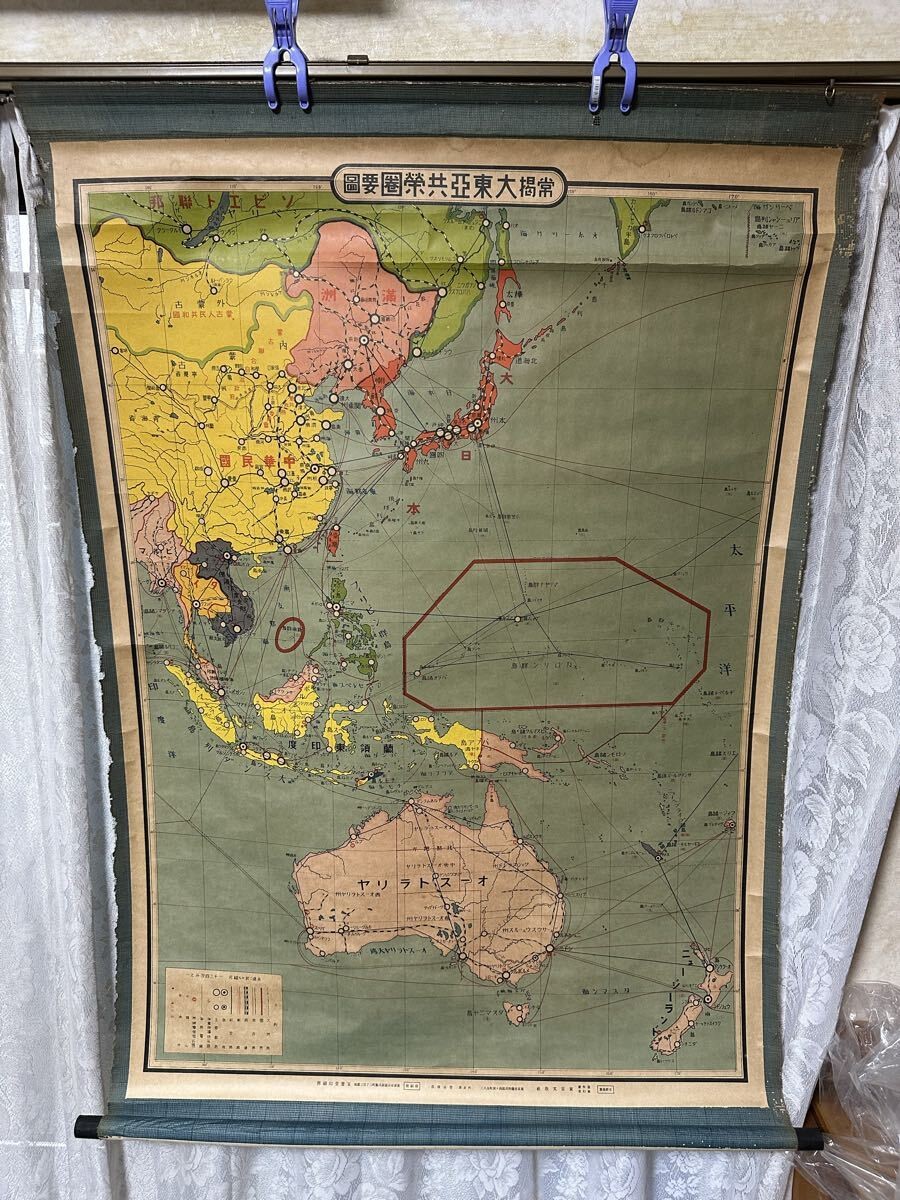
DescriptionA World Map from an Empire That No Longer Exists.Imagine looking at a map of the world and discovering that its borders, countries, and vision of the future are very different from the ones we know today.This is an original-period Japanese wall map believed to date from World War II, titled “Greater East Asia Co-Prosperity Sphere General Map” by Tokyo Bunkyosha, it depicts Japan, China, Manchukuo, Southeast Asia, Australia, and the Pacific, with territories distinguished by color and a network of cities and transportation routes.But this is more than an old map.It is a fascinating window into how wartime Japan presented its vision of Asia and the Pacific.What Was the Greater East Asia Co-Prosperity Sphere?During the early 1940s, Japan promoted the idea of a “Greater East Asia Co-Prosperity Sphere.”The official vision was one of Asian nations cooperating and prospering together, free from Western colonial domination.In practice, however, this vision was closely tied to Japan’s military expansion and political control. Across occupied territories, millions of people experienced warfare, hardship, and oppression.This map offers a valuable historical record of how that wartime vision was represented to the Japanese public.A Map Intended to Be Seen Every DayOne particularly interesting detail is the Japanese word “Jokei” (常掲) in the title, meaning “for permanent display.”Unlike an ordinary map folded away in a book, this example was designed as a hanging wall map.It was meant to be displayed and viewed regularly.Imagine the people who may have stood before a map like this, studying distant countries, following the course of the war, or wondering what the future might bring.Its exact original place of display is unknown, but its format tells us something important about its intended purpose.A Country That Disappeared from the MapAmong the territories shown is Manchukuo, a Japanese-controlled state established in northeastern China in 1932.Manchukuo ceased to exist in 1945, following Japan’s defeat in World War II.For collectors and students of history, seeing such a short-lived state represented on a contemporary map is particularly compelling.Compare this map with a modern one, and you will discover just how dramatically the political geography of Asia changed during the twentieth century.An Artifact of History, Not an Endorsement of WarThis map is historically important because it documents the political ideas and geographical representations of its time.It is not presented as an endorsement of Japanese wartime expansion or ideology.Instead, it offers an opportunity to examine how governments communicated their ambitions and how maps themselves could become instruments of political messaging.Item Details* Original Japanese title: 常掲大東亞共榮圈要圖
* English title: Greater East Asia Co-Prosperity Sphere General Map
* Publisher: Tokyo Bunkyosha (東京文教社)
* Estimated period: Early 1940s, World War II era
* Format: Large hanging wall map with roller mounting
* Regions depicted: Japan, Manchukuo, China, Southeast Asia, Australia, and the Pacific
* Publication date: Not confirmedCondition and AuthenticityThis is an old historical map showing considerable signs of age and use.There are visible creases, discoloration, stains, wrinkles, and wear to the paper and mounting. The roller and outer covering also show age-related deterioration.Based on its cartographic content, printing, construction, and overall appearance, it is believed to be an original wartime publication rather than a modern reproduction.However, the exact publication year has not been established, and no formal authentication has been performed.Please examine all photographs carefully to understand the condition.Own a Piece of History.The political world depicted on this map changed dramatically with Japan’s defeat in 1945.Yet the map itself has survived.For collectors of WWII memorabilia, antique maps, Japanese history, and historical propaganda, this is an opportunity to study the past through an object created during the period itself.History is not preserved only in books or official records.Sometimes, it survives on a map that someone once hung on a wall.Own a Piece of History.Shipping
FedEx or Japan Post
International Buyers - Please Note:
Import duties, taxes, and charges are not included in the item price or shipping cost.These charges are the buyer's responsibility.Please check with your country's customs office to determine what these additional costs will be prior to offerding or buying.
Provided by HARU