When you click on links to various merchants on this site and make a purchase, this can result in this site earning a commission. Affiliate programs and affiliations include, but are not limited to, the eBay Partner Network.
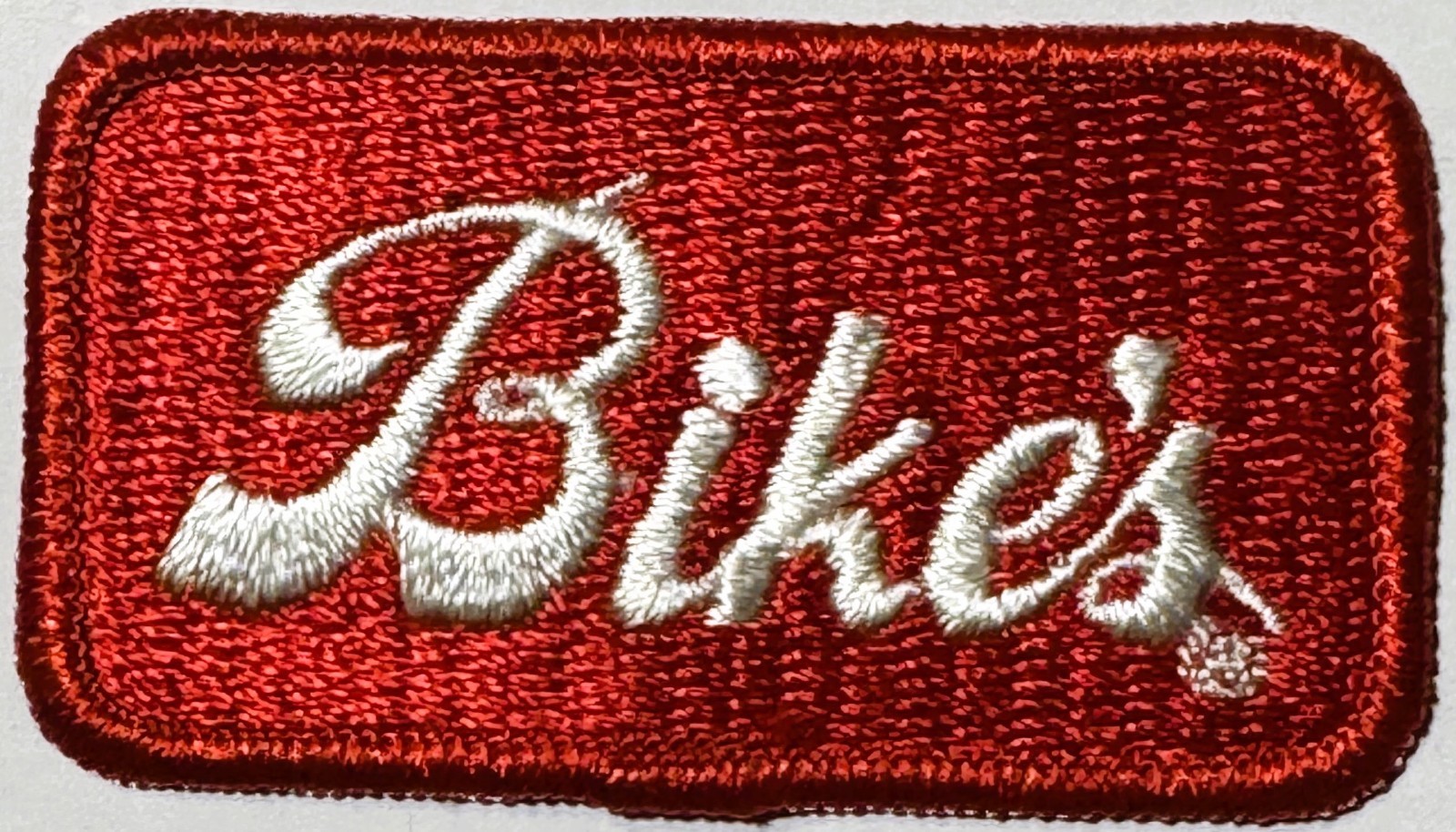
Vintage mid-century \"Bike\'s\" bike shop name patch — NOS, full-coverage embroidery, merrowed border, sew-on.
SPECIFICATIONS
- Type: shop / work-uniform name patch
- Text: \"Bike\'s\" in white signwriter\'s script
- Size: approx 3\" x 1 3/4\" — photographed beside a US quarter (24.26mm) for scale
- Colours: deep red field, white script, darker red border
- Construction: FULL-COVERAGE embroidery — no ground fabric visible anywhere
- Edge: MERROWED, continuous, clean around all four rounded corners
- Attachment: SEW-ON. No adhesive, no iron-on film
- Era: 1960s (mid-century) — see below
- Markings: none — no maker\'s tag, backstamp, union label or town
CONDITION — NEW OLD STOCK
Unused. Never sewn to anything — no needle holes through the border. Red deep and even with no sun-fade, white script bright and unyellowed, merrowed edge tight and intact the whole way round.
That matters on a shop patch in particular. They were made to go straight onto a shirt or a jacket, so the survivors are nearly always attached, washed out, or cut off something.
THE SHOP
Note the apostrophe: Bike\'s is possessive — a shop named after its owner or the name everybody called him, the way they all were. Ed\'s, Mac\'s, Sully\'s, Bike\'s. A shop called Bike\'s sold and fixed bikes, motorcycles and bicycles often under one roof.
The name patch went over the mechanic\'s pocket, and from there onto riders\' jackets and vests, where a shop patch was a statement of allegiance — where you bought the machine and who did your work.
ERA — MID-CENTURY, 1960s
This patch came in a single find of unused patches. The datable pieces in that find run from 1950s–60s felt-ground state and youth-baseball emblems to a Bundy Corporation company patch that cannot predate 1967, the year that company took the name. A full-coverage, merrowed shop patch in signwriter\'s script sits right in those years. No printed date on the object.
THE WORLD IT CAME FROM
- WWII — Harley-Davidson supplied more than 90,000 motorcycles to the US armed forces; thousands of servicemen learned to ride and kept riding when they came home.
- 3 July 1947 — about 4,000 riders arrive in Hollister, California (population 4,500, seven police officers). Life runs a photo of a drunk rider among bottles, widely described since as staged, and the outlaw-biker image is born.
- 1951 / 1953 — Frank Rooney\'s \"The Cyclists\' Raid\" in Harper\'s becomes The Wild One, with Marlon Brando, who was already a Hollywood star after A Streetcar Named Desire.
- The one-percenter legend — the AMA supposedly said 99% of riders were law-aoffering; outlaw clubs took the \"1%er\" patch as a badge of honour. The AMA says it has no record of ever saying it; historian William L. Dulaney has suggested it grew out of letters to Life. True or not, it shaped what a patch on a vest means.
- 1956 — an Indian dealership in Brockton, Massachusetts was considered high volume for selling thirty motorcycles in the year. That is the scale a shop like Bike\'s worked at.
- 1960s — custom shops around Los Angeles and San Francisco; builders such as Arlen Ness and Ben Hardy, and the chopper.
WAS BIKE\'S YOUR SHOP?
No town, state or trade is stitched on the patch, and a small shop that closed decades ago rarely leaves more than a line in a phone book — which is how shop history disappears. If Bike\'s was the shop in your town, we would love to hear it.
SHIPPING
Packed flat and protected. Ships from a smoke-free home.