When you click on links to various merchants on this site and make a purchase, this can result in this site earning a commission. Affiliate programs and affiliations include, but are not limited to, the eBay Partner Network.
Do You Remember the Morning You First Saw That Green Block-Headed Boy Move? 🟢
There is a specific kind of happiness that comes with holding one of these. It is not just nostalgia — though there is plenty of that — it is the tactile confirmation that a thing you watched flicker across a black-and-white or early-color television screen was real enough to hold in your hand. Gumby and Pokey were never just characters to those of us who grew up with Saturday-morning television humming in the background of our childhoods. They were neighbors. They were constants. They showed up every weekend without fail, bendable and bright and entirely their own kind of magic. And now, decades later, here they are again — solid, whole, exactly as remembered — waiting in your palm like a small green miracle.
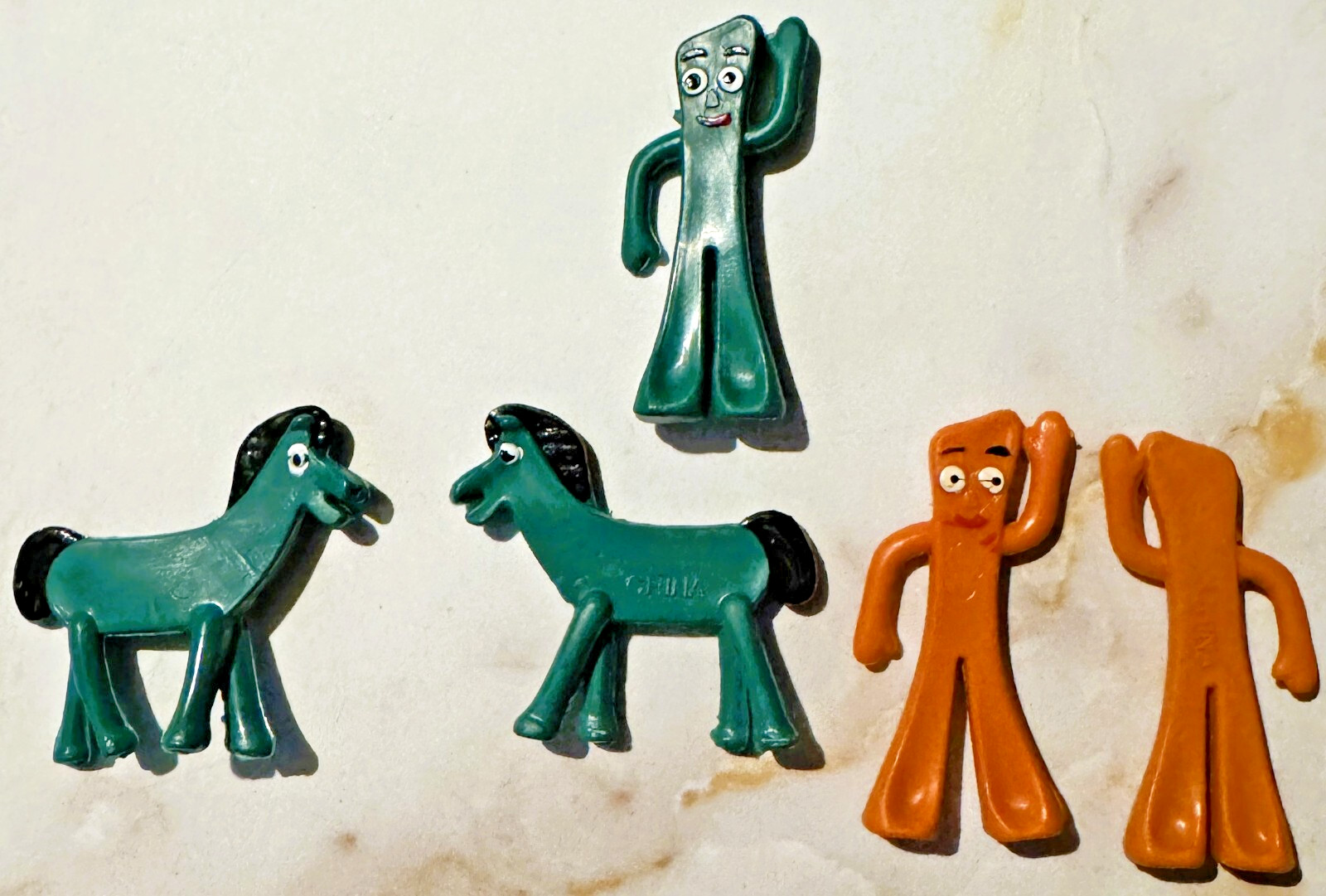
These vintage Gumby and Pokey molded plastic mini figurines are the real thing: New Old Stock pieces from the golden window of licensed Gumby merchandising, spanning the 1970s through the 1980s. Each figure stands approximately 2 inches tall, molded in solid-colored bendable rubber with painted facial details — the green Gumby with his signature block-shaped head tilted just so, the orange Gumbys with their expressive eyes and one arm raised as if waving hello across forty years of time, and the teal four-legged Pokey figures. Nothing on them says who made them: the only marking moulded into these figures is CHINA, on a Pokey\'s flank. They have never been played with, never been opened into a child\'s rough and tumble world. They arrived here from that era intact, which is precisely what New Old Stock means and why it matters so deeply to serious collectors.
🎬 Art Clokey, Stop-Motion Magic, and the Character That Refused to Fade
Gumby and Pokey were not just cartoon characters. They were Art Clokey\'s life\'s work — a stop-motion universe he built frame by painstaking frame, beginning with his 1953 experimental short Gumbasia, a piece he created as a graduate student at USC. That film, loosely inspired by Walt Disney\'s Fantasia and composed entirely of abstract clay shapes moving to jazz music, caught the eye of NBC and set in motion one of the most durable and beloved creative legacies in American animation history. Clokey went on to develop Gumby as a character — first appearing on the Howdy Doody Show in 1956, then headlining his own series — and what he created was something genuinely unlike anything before or since: a green clay boy with a lopsided rectangular head, a heart as wide as the frame, and a best friend who happened to be an orange pony named Pokey.
The stop-motion technique Clokey used — moving clay figures incrementally between individual camera exposures, sometimes shooting only a few seconds of finished footage per day — demanded a patience and physical commitment that modern animation audiences can scarcely imagine. Every episode was a feat of craft. Every frame was a fingerprint. And when those characters became popular enough to license into physical merchandise, the transition from clay to molded plastic was its own kind of art: the challenge of capturing something loose, handmade, and alive in a medium that is mass-produced and permanent. The best of those licensed figures — and these are among them — managed it beautifully.
🏭 Lakeside Toys, Jesco, and the Licensing Story Behind the Figure
Lakeside Toys was a Minneapolis-based toy company with a strong track record of producing affordable, well-made character merchandise during the 1960s and 1970s. Their licensing relationship with the Clokey studio produced a range of Gumby-related products, and the small molded plastic mini figures from that era represent some of the most straightforward and honest translations of the characters into three-dimensional form. There were no gimmicks. No electronics. No moving parts to break. Just solid-colored bendable rubber, a painted face, and the essential silhouette of a character so well-designed that even two inches of material communicates exactly who it is.
When the Gumby revival came in the mid-to-late 1980s — driven in no small part by Eddie Murphy\'s now-legendary Saturday Night Live impression and a renewed cultural appetite for the innocent, handmade aesthetic of early television — Jesco stepped in as the new manufacturer and license holder. Jesco produced their own runs of Gumby merchandise with a similar spirit, and the NOS figures from both the Lakeside tail-end era and the Jesco revival years now occupy the same warm, sought-after corner of the character collectibles market. Collectors who know the difference appreciate both. Collectors who are just beginning often discover, to their delight, that both periods produced pieces of genuine charm and quality.
Lore passed down among longtime Gumby collectors holds that the original Lakeside mini figures were sometimes included as premiums or pack-ins with larger toy sets, and that many of the figures that survived in NOS condition did so precisely because they were tucked inside unsold or warehouse-stored retail packaging from the period — effectively time-capsulated by the economics of an era when small toy departments were transitioning product rapidly. Whether every NOS figure on the market today has that kind of origin story is impossible to verify, but the lore is consistent enough that it has become part of how serious collectors understand the survival rate of these pieces.
🎨 The Design Language of Gumby — Why These Colors Still Stop You Cold
It is worth pausing to appreciate what Art Clokey got right with the visual design of these characters, because it explains directly why the molded plastic figures work as well as they do even in miniature. Gumby is green — not a naturalistic green, not a military green, but a bright, almost impossible green that reads clearly on any background and against any companion color. His head is a skewed rectangle, tilted at an angle that suggests both movement and personality simultaneously. In this set Pokey is teal, and two of the Gumbys are orange — warm, vivid, the ideal contrast to the cool teal. Together, they are a color palette that a designer today would call bold and intentional. Clokey arrived at it intuitively, working in clay, and it has never needed updating because it was right from the beginning.
When those colors and those silhouettes were translated into solid-colored molded plastic with painted details, what the manufacturers captured was the essence rather than the detail. And that is exactly correct. Gumby at two inches tall does not need fine texture work or elaborate paint masking. He needs to read as Gumby immediately, from across a shelf, in a child\'s hand, through the window of a display cabinet forty years later. These figures do that. They have always done that. Local legend has it that Clokey himself was particular about how his characters were rendered in licensed merchandise, and that the simplicity of the molded plastic mini figures — their refusal to over-elaborate on the original design — was part of why they met with approval from the studio. That story circulates warmly among collectors at shows, though its documentary basis, like much good lore, floats free of a single confirmed source.
🖼️ Display Ideas for Your Gumby & Pokey Mini Figures
- 🟢 Saturday Morning Shrine — Group Gumby and Pokey alongside other NOS character figures from the same era on a dedicated shelf with period TV Guide covers or vintage cartoon paperbacks as backdrop. The effect is immediate and deeply satisfying.
- 📺 Mid-Century Media Console Styling — Place the figures atop or beside a restored vintage television set — a period-correct 1960s or 70s console or portable — for a display that feels like a living time capsule of American Saturday morning culture.
- 🧩 Collector Flat-Lay Vignette — Arrange with other Art Clokey-era ephemera: vintage coloring books, original lobby cards, or period comic adaptations. Photograph against a warm wood or aged paper surface for an archival feel.
- 🎁 Framed Shadow Box — Mount the figures inside a deep shadow box frame with a period-printed background or a reproduction of original Gumby promotional art. These figures are small enough that a standard shadow box accommodates the whole cast beautifully.
- 🏡 Kitchen or Playroom Nostalgia Corner — In the spirit of the way these figures originally lived — close to children, close to life — a small kitchen windowsill or vintage-styled playroom shelf lets them inhabit domestic space the way they were always meant to.
- 🎨 Artist\'s Studio or Animation Reference Collection — For working animators, illustrators, or stop-motion artists, these figures carry both historical and professional resonance. They belong in the company of maquettes, reference books, and tools of the trade.
🎁 Who Collects These — and Why They Look So Hard to Find Them
The collectors who seek out vintage Gumby and Pokey mini figures are a varied and passionate group, and understanding who they are helps explain why NOS examples in clean condition are genuinely treasured rather than merely purchased. At the center of the collecting community are the generational devotees — people who watched The Gumby Show as children in the late 1950s through the 1970s, and who now, in their adult years of considered collecting, want to recover not just a toy but a specific texture of their own past. For them, holding a two-inch green figure is not a small thing. It is an act of reclamation.
Alongside them are the animation historians and stop-motion enthusiasts — a community that has grown considerably as documentary coverage of early television and independent animation has expanded. For these collectors, Gumby figures represent a physical artifact from one of the most significant chapters in American animation craft, and Art Clokey\'s biography gives them weight beyond mere character merchandise. Then there are the character toy generalists — serious collectors of mid-century and late-century American licensed character merchandise — for whom Gumby and Pokey occupy a specific and irreplaceable position in the broader landscape of Saturday-morning television culture. And finally, there are the gift-givers: people who know someone who lights up at the mention of Gumby, who want to give something that is genuinely old and genuinely real rather than a reproduction, and who understand that New Old Stock is the gold standard of that ambition.
All of these people are looking for the same thing: a piece that is honest, intact, and exactly as described. That is what NOS means. That is what this is.
❓ Frequently Asked Questions — Gumby & Pokey Molded Plastic Mini FiguresWhat exactly does \"New Old Stock\" mean for these figures, and why does it matter?
New Old Stock — NOS — means that these figures were manufactured during the original production run in the 1970s–1980s and have remained unsold and unplayed-with since that time. They were not used, not removed from packaging into a child\'s toy box, not subjected to the normal wear of play. They survived in warehouse or retail storage from their era of manufacture to the present day. For collectors, this matters enormously because it means the figures represent their original manufactured condition rather than a played-with or restored version of it. The paint details are as applied, the colors are as molded, and the surfaces have not been handled into softening or scuffing. NOS is always the preferred condition in character figure collecting, and genuine NOS pieces from the 1970s–80s become progressively harder to find as time passes and existing supply is absorbed into collections.
Who made these figures?
Nobody knows, and this listing will not guess. The only marking moulded into them is CHINA, on a Pokey\'s flank — no maker, no licence line, no date. Gumby merchandise over the years came from several licensed houses, Lakeside and Jesco among them, but no source ties these particular CHINA-marked minis to any of them, and the Hong Kong-marked minis collectors usually attribute are a different size from these.
Are these figures the bendable rubber Gumby toys, or something different?
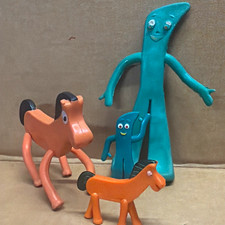
These are bendable rubber figures in the small two-inch size, rather than the larger Lakeside bendables with wire armatures that are the most widely recognized form of Gumby merchandise. Each is molded in solid-colored bendable rubber approximately 2 inches tall, with painted facial details. They will pose — but they are best left as they are: the rubber has aged, and working an arm or a leg repeatedly will misshape it. They are display-oriented objects — shelf pieces, shadow box candidates, desk companions — more than they are play toys at this age, and they occupy a distinct and separately collected category within the broader world of Gumby merchandise.
How can I tell these are from the 1970s–80s and not a later reproduction?
The molding characteristics, plastic composition, and paint application methods of mass-market character figures from the 1970s and 1980s are distinct from later production in ways that experienced collectors learn to read quickly. The weight and feel of period plastic, the specific palette of paint colors used for facial details, and the style of the molded silhouette all reflect manufacturing norms of the original era. NOS condition preserves these characteristics without the softening or patina that comes with age and handling, which paradoxically makes authentication cleaner — you are seeing exactly what left the factory. If you have specific questions about the manufacturing details of a piece you are considering, this seller engages genuinely with collector inquiries.
What is the best way to clean or preserve these figures without damaging them?
For NOS figures in clean condition, the best approach is almost always minimal intervention. A very soft, dry brush — a clean watercolor brush or a photographer\'s lens brush — is sufficient to address any surface dust that may have accumulated during storage. Avoid liquid cleaners, solvents of any kind, or abrasive materials near the painted facial details, as paint from this era is applied without the protective topcoats common in later manufacturing and can be sensitive to moisture or friction. Display in stable indoor conditions, away from prolonged direct sunlight, which can affect both the plastic and the paint over time. These figures have survived decades without intervention; the goal of preservation is to continue that record rather than introduce new variables.
Do these figures come as a set, and which characters are included?
The figures in this listing include a teal Gumby with the block-shaped head, two orange Gumbys with expressive painted eyes and a raised arm, and two teal Pokeys in four-legged form. The specific configuration of figures included is described in the listing details above. These characters represent the core of the Gumby universe as it was presented in licensed merchandise during the 1970s–80s, and together they make a complete and visually compelling display grouping.
Is Gumby merchandise from this era still actively collected, or has interest faded?
Interest in Art Clokey\'s work and in Gumby merchandise from the original and revival eras has remained consistently strong, and in some segments of the character collectibles market it has grown as the generation that watched the show in its original run and 1980s revival has entered its peak collecting years. Stop-motion animation has also experienced a significant cultural resurgence of appreciation, with documentary coverage and critical reappraisal of early television animation bringing new audiences to Clokey\'s legacy. NOS character figures from the 1970s–80s in any condition are desirable; in clean, unplayed NOS condition they represent the upper tier of what is available, and that position does not diminish with time.