When you click on links to various merchants on this site and make a purchase, this can result in this site earning a commission. Affiliate programs and affiliations include, but are not limited to, the eBay Partner Network.
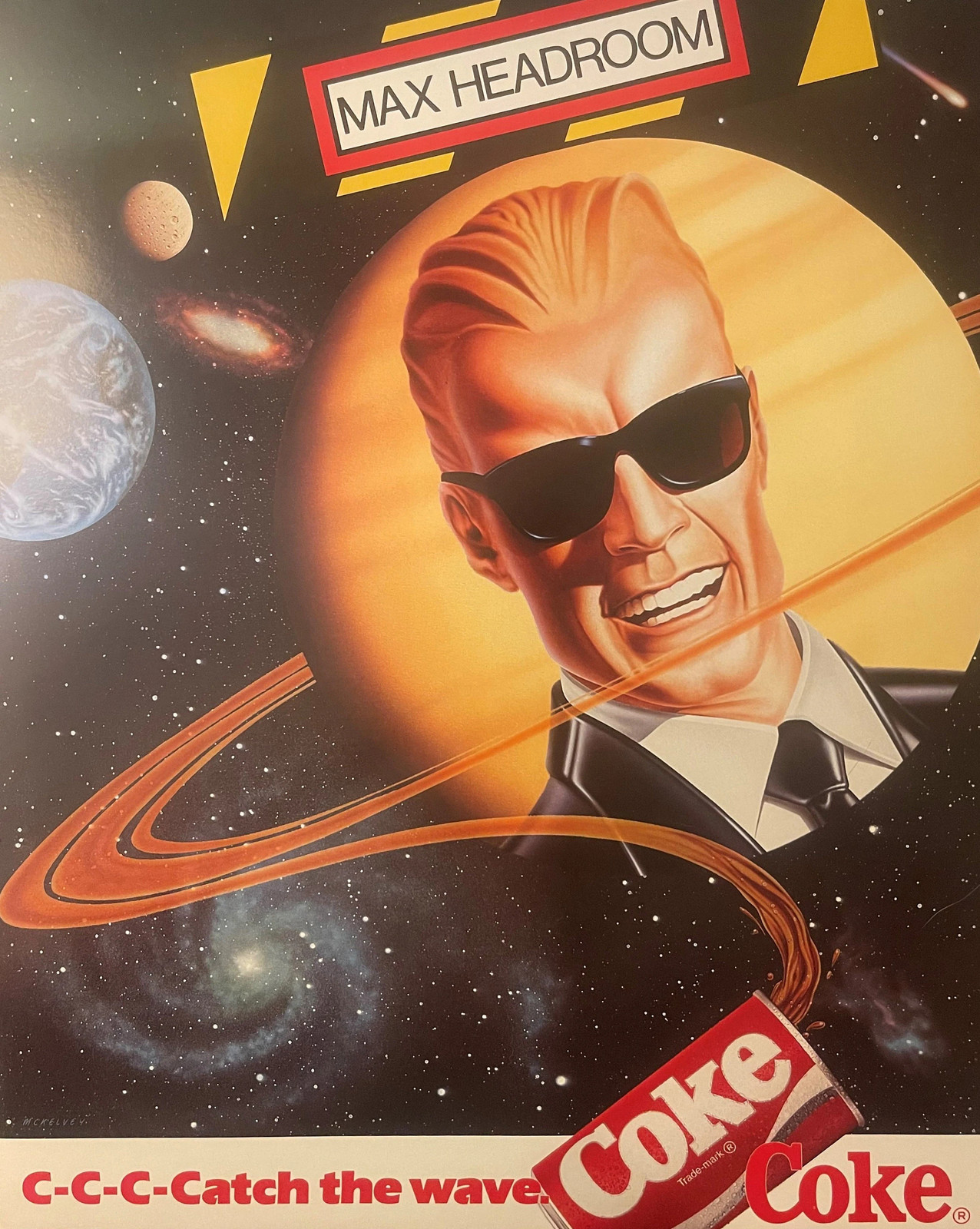
Max Headroom - dark sunglasses, dark suit, that permanent grin - floats in front of a huge ringed orange planet, with Earth, a moon and a spiral galaxy scattered around him in the starfield. A Coke can tips forward at the bottom and pours a stream of cola that curls up into the planet\'s own ring. \"MAX HEADROOM\" sits in a red-bordered box at the top; \"C-C-C-Catch the wave.\" runs along the bottom next to the can and the Coke script logo. The artwork is signed in the plate, lower left: McKelvey.
Size: 17\" x 14\"
🥤 One Word on the Can
Take a good look at the can. It says \"Coke.\" It does not say Coca-Cola Classic. In 1986 that one word told you which of two different colas you had in your hand, and this poster was selling the new one.
Here\'s how that happened. On April 23, 1985, Coca-Cola went public with a new recipe for its flagship drink. Nobody had touched that formula in 99 years. The work was done quietly under a code name, \"Project Kansas.\" Two men ran it: Sergio Zyman, the marketing vice president, and Brian Dyson, president of Coca-Cola USA. People hated the new taste, and they let the company hear about it. On July 11, 1985, just 79 days in, the old recipe came back on sale as Coca-Cola Classic.
The new recipe never left the shelf, though. Both drinks sold side by side, and each one got its own ad campaign. Coca-Cola Classic got \"Red, White & You.\" Plain Coke got \"Catch the Wave.\"
Coke also needed a new face. Bill Cosby had spent years in Coke commercials talking up the original as less sweet than Pepsi. He quit doing them, saying the ads for the new formula had hurt his credibility. So early in 1986 the marketing team went after the crowd it had wanted from the start: young people who liked Pepsi better. Their pick to replace Cosby was a stuttering TV \"computer\" named Max Headroom, and his line was \"C-c-c-catch the wave!\"
The new formula hung on for years. In 1990 it got a new name, Coke II. In 1995, ten years after the switch, Coca-Cola held an event for its employees, and chairman Roberto Goizueta told them: \"We set out to change the dynamics of sugar colas in the United States, and we did exactly that -- albeit not in the way we had planned.\"
📺 A TV Star Before He Ever Sold a Soda
Coca-Cola didn\'t invent Max. Three British video directors and artists did: George Stone, Annabel Jankel and Rocky Morton. Max first showed up on April 4, 1985, in a Channel 4 TV movie called \"Max Headroom: 20 Minutes Into the Future.\" Chrysalis Visual Programming produced it, and Stone built the story with screenwriter Steve Roberts.
Channel 4 sold him as the first computer-generated TV presenter, and plenty of viewers bought it. The truth was a lot more low-tech. Max was really actor Matt Frewer, wearing foam-latex prosthetic makeup and a molded fiberglass suit, sitting in front of a blue screen. He kept going from there, with his own show on Cinemax and then an ABC series that ran in 1987 and 1988.
🎬 The Ads Were a Smash
Max turned out to be a terrific salesman. Ridley Scott, the director of Alien and Blade Runner, shot two of the spots. Newsweek said Max\'s ads might be \"the most cleverly structured pitches ever aimed at the under-30 viewer.\" John Reid, Coke\'s senior vice president of marketing, said 76 percent of teenagers had heard of Max after the first round of ads.
More people phoned Coke\'s consumer hotline about Max than about any spokesman before him. Some of them only wanted to know whether he had a girlfriend. Video Storyboard Tests, a research firm in New York, picked Coca-Cola\'s Max ads as the best of 1986. The commercials stayed on the air through 1987.
🎂 Coke Turned 100 That Year
Max joined Coca-Cola in a big year. 1986 was the company\'s hundredth. It all started in downtown Atlanta on May 8, 1886, when Dr. John Stith Pemberton carried his new syrup over to Jacobs\' Pharmacy. The first glass of Coca-Cola went on sale there for five cents. His bookkeeper, Frank M. Robinson, picked the name. He thought the two Cs would look good in ads, and he wrote it out in Spencerian script, a fancy, flowing style of handwriting. Pemberton sold the last of his share in 1888, the same year he died. Asa Candler, an Atlanta pharmacist, owned the whole business by 1891, and on January 29, 1892, he incorporated The Coca-Cola Company.
A hundred years on, in May 1986, the company threw itself a four-day birthday party in Atlanta and wrapped it up with a parade down Peachtree Street. That same year, Max was on TV telling teenagers to catch the wave.
👻 The Night Someone Borrowed His Face
This last bit has nothing to do with Coke, but I can\'t leave it out. On November 22, 1987, somebody in a Max Headroom mask broke into two Chicago TV signals. First it was the sports report on WGN\'s evening news. About two hours later it was WTTW, in the middle of an episode of Doctor Who. Whoever did it was never identified, and the case was never solved.
📦 What You Get
These are New Old Stock, which means they were printed decades ago and never used. They come from a stack, they were never hung, and the backs are blank. The art is signed in the plate, lower left: McKelvey. Signed in the plate means the artist\'s signature was part of the artwork and got printed right along with it. The can carries Coke\'s script with \"Trade-mark ®,\" and the Coke logo shows up again in the lower right corner with its own ®.
SPECIFICATIONS
- Subject: Max Headroom for Coca-Cola\'s \"Catch the Wave\" campaign (1986)
- Condition: New Old Stock, never hung
- Signature: McKelvey (plate-signed, lower left)
- Reverse: blank
- Material: paper poster