When you click on links to various merchants on this site and make a purchase, this can result in this site earning a commission. Affiliate programs and affiliations include, but are not limited to, the eBay Partner Network.
Vintage 1960s Pursuit Brand Crate Label, Exeter Fruit Association, Exeter, California
Size: 13 x 4 inches, lug-box format
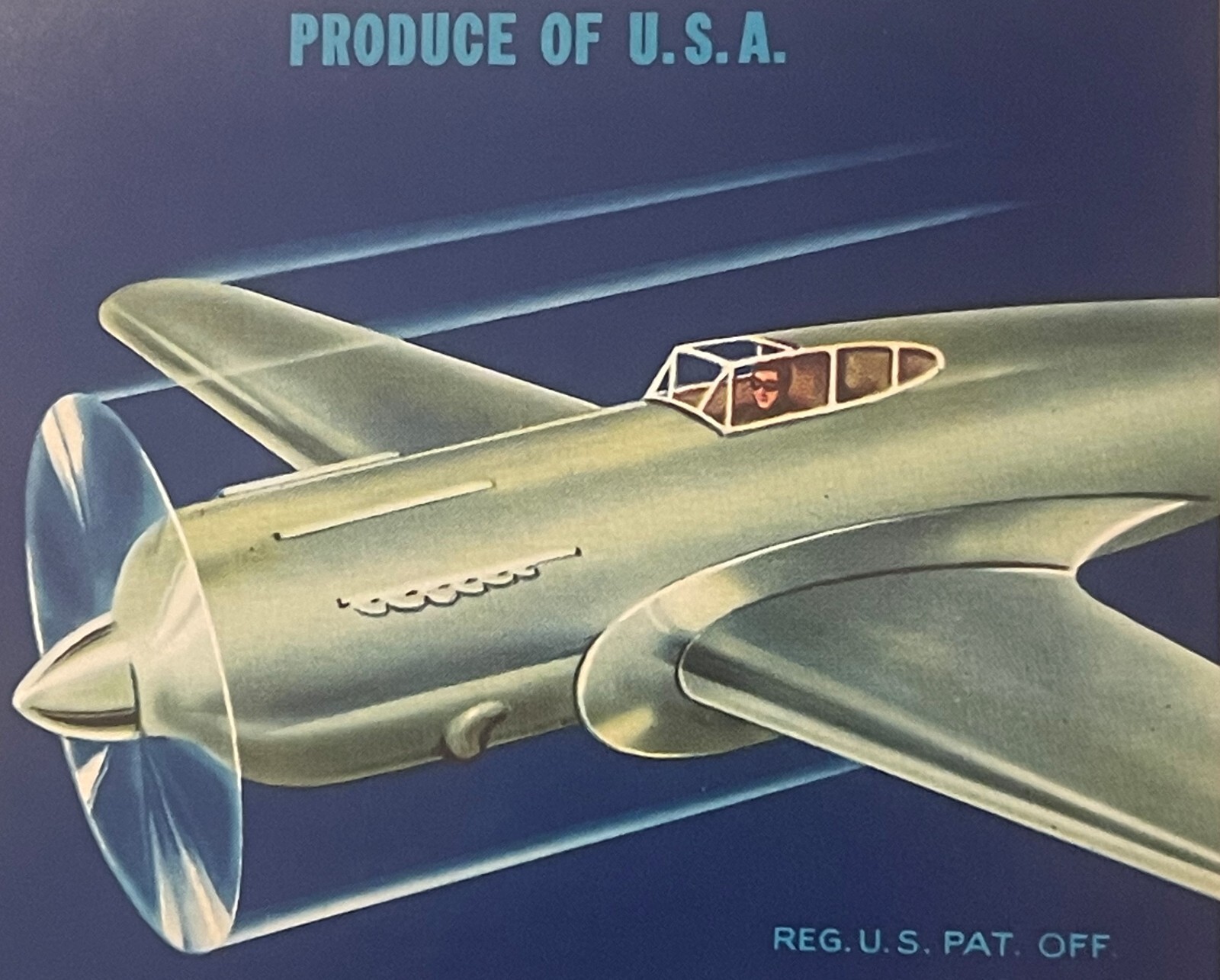
Unused fruit crate label with a propeller fighter plane, the word PURSUIT in giant shaded letters, and the California Fruit Exchange Blue Anchor. Printed with a ZIP code, so it dates from 1963 or later, long after the Air Force had retired the word \"pursuit.\"
I love the little joke hiding in this one. \"Pursuit\" was the old military word for a fighter plane, and the Air Force threw it out in 1948. Now look at the address line. It ends with a five-digit ZIP code, and ZIP codes didn\'t exist before July 1, 1963. So an Exeter fruit house was still shipping under a pilot\'s word at least 15 years after the Air Force quit using it. It\'s San Joaquin Valley pride with a propeller on it, made to ride on the end of a fruit box.
SPECIFICATIONS
- Brand: Pursuit
- Shipper: \"Grown and Packed by Exeter Fruit Association, Exeter, California,\" followed by the town\'s ZIP code
- Cooperative: California Fruit Exchange, Blue Anchor emblem
- Also printed: Produce of U.S.A. and Reg. U.S. Pat. Off.
- Format: the long, skinny lug-box shape. A lug is the shallow wooden box grapes and tree fruit were shipped in, and this label was made to fit across its end.
- Material: printed paper label, blank back
- Date: 1960s, from the ZIP code (introduced July 1, 1963) and the \"California Fruit Exchange\" name (used until 1969)
- Art: silver-green single-engine propeller fighter with a spinning prop disc and pilot, plus cream, yellow and red shaded lettering on a navy sky
CONDITION
New old stock, never applied to a crate. New old stock (NOS) means it was printed back then and simply never used. The back is blank cream with only a faint ghost of the front print. See photos. It\'s an original label made for a fruit box, not a reproduction.
WHO PACKED IT AND WHO SOLD IT
This label tells you two things about the fruit that rode under it. The Exeter Fruit Association grew it and packed it. The yellow Blue Anchor badge in the middle tells you who sold it. That\'s the California Fruit Exchange, one of the big grower co-ops of the West.
It started in 1901, when growers from all over California incorporated the California Fresh Fruit Exchange. Growers\' associations from Loomis, Newcastle and Penryn were in it from day one, May 1, 1901. In 1903 the name got trimmed to the California Fruit Exchange. By then one of the founders, George H. Cutter, was already pitching an anchor as its symbol. The anchor went into use in 1904 and caught on, bit by bit, as the company\'s emblem. In 1923 it was registered as a trademark to mark the Exchange\'s top-quality fruit.
Sacramento was home base. At its peak the Exchange sold tree fruit and table grapes for about 1,000 growers. It handled papayas, kiwi and European cucumbers too, grown in California, Arizona, Hawaii, Chile, Mexico and New Zealand. Its main markets stretched across more than 300 towns and cities in North America. By 1981 gross sales were over $60 million, and it was called the world\'s largest deciduous fruit marketing cooperative. Deciduous fruit is just the trade\'s word for tree fruit like peaches, plums, pears and cherries, the trees that lose their leaves every winter. In 1969 the Exchange turned its trademark into its company name and became Blue Anchor, Inc. In 2000 it announced it was packing it in, after nearly 100 years.
The Exchange\'s headquarters, the Blue Anchor Building in Sacramento, went up in 1931. The firm Starks and Flanders designed it in the Spanish Colonial Revival style, with stucco walls and a low red tile roof. The Exchange worked out of it from 1932 to 1966, its fastest years of growth. It was added to the National Register of Historic Places on February 3, 1983.
THE BRAND IS OLDER THAN THIS PRINTING
That \"Reg. U.S. Pat. Off.\" down in the corner is the real thing. The Exeter Fruit Association started using the name PURSUIT on October 20, 1939. The U.S. Patent Office registered it for fresh grapes on January 20, 1942, as registration No. 392,984, and that registration stayed alive until 2002. So the brand was born while \"pursuit\" was still the Army\'s own word for a fighter plane. This printing came along later, in the ZIP code years. Pursuit wasn\'t their only grape brand, either. The association\'s Setter brand was in use from May 1928 and was registered in 1950.
DATING IT
There\'s no year printed anywhere, so the words do the dating. The ZIP code means it wasn\'t printed before July 1, 1963. The anchor still says California Fruit Exchange, and that name was retired in 1969. Put those two together and you\'ve got a 1960s label.
EXETER, CALIFORNIA
Exeter is a railroad town. Tracks reached this part of the San Joaquin Valley by 1888. D.W. Parkhurst, a Southern Pacific Railroad representative, bought land from an early settler named John Firebaugh and started a town there. He named it after his own hometown, Exeter, England. It incorporated on March 2, 1911. Exeter sits in Tulare County, close to the Sierra Nevada foothills, and ranching there ran big. The Gill Cattle Company, based in the area, was once the largest cattle business in the whole United States.
The town has a hard chapter too. In October 1929 a mob attacked a Filipino work camp in Exeter. They beat 50 Filipino laborers and burned the camp to the ground. It\'s part of the story of the people who worked the valley\'s harvests. Today 31 murals of local history cover the walls downtown, and the 2020 census counted 10,321 people.
TWO EXETER PACKING HOUSES, NOT ONE
People mix these two up a lot, so here it is straight. Local growers formed the Exeter Citrus Association in October 1925. In 1954 it was one of the first packing houses to switch from wooden boxes to cardboard cartons. That switch changed fruit packing for good and put the paper crate label out of a job. The citrus house is part of the Sunkist family. In 2000 it merged into today\'s Exeter-Ivanhoe Citrus Association, which sells all of its citrus through Sunkist. The Exeter Fruit Association on this label was a different company, and its grapes went to market under the Blue Anchor. Part of the trouble is the names. Sunkist was called the California Fruit Growers Exchange until 1952, which sounds an awful lot like California Fruit Exchange.
WHY \"PURSUIT\"?
In the First World War, American fighter pilots flew what the Army called pursuit planes. The American Expeditionary Forces, the U.S. troops sent over to France, formed the 1st Pursuit Group on May 5, 1918, at Toul-Croix de Metz Aerodrome. Eddie Rickenbacker became an ace over the Toul sector that spring and finished the war with 26 victories. Quentin Roosevelt, the youngest son of Theodore Roosevelt, flew with the group\'s 95th Aero Squadron. He was shot down and killed on July 14, 1918. The group became the 1st Fighter Group on May 15, 1942. Then on June 11, 1948, the brand-new U.S. Air Force renamed its P-80C jets F-80Cs. P for Pursuit was out. F for Fighter was in.
The artist didn\'t paint any particular model. There\'s no insignia and no marking that names it. It\'s simply a single-engine propeller fighter going flat out, sitting right next to a brand name that means speed. Fast plane, fast word. That\'s good advertising.
THE ZIP CODE STORY
The number that dates this label has a story of its own. In May 1943 the Post Office set up postal zones in 124 big cities. Experienced postal clerks were going into the army, and the zones let new clerks sort mail without learning every carrier\'s route. In 1944 a postal inspector named Robert A. Moon proposed one code system for the whole country, and he\'s remembered as the father of the ZIP Code. ZIP stands for Zone Improvement Plan. Five-digit codes went nationwide on July 1, 1963, and at first nobody had to use them. To sell the idea, the Post Office rolled out a cartoon mascot called Mr. ZIP. Postal executive D. Jamison Cain came up with the name. Mr. ZIP turned up in the margins of stamp sheets and in all kinds of promotions, including a variety show with a band called the Swingin\' Six. In 1967 the codes became mandatory for second- and third-class bulk mailers, and before long nearly everybody was using them. The number printed after \"Exeter, California\" on this label is one of those codes.
HOW UNUSED LABELS SURVIVED
Paper crate labels first showed up in the United States in the 1880s. Better lithography (color printing from stone or metal plates) and longer railroad lines let growers ship fruit a long way, and they wanted boxes that stood out when they got there. Cardboard cartons with the brand printed right on the box slowly pushed the paper label aside. A label with a ZIP code comes from the very end of that run, when some packing houses were still ordering paper labels for wooden lugs. When the cartons won, big stacks of unused labels got left behind in packing sheds and print shops. Those leftovers, plus printers\' proofs and warehouse finds, are the backbone of crate label collecting today. These Pursuit labels never got pasted on a box.
GOOD FOR
- Crate label collections, especially San Joaquin Valley and Blue Anchor labels
- Aviation and pilot decor
- Exeter and Tulare County history
- Framing over a desk, doorway or shelf
- A gift for pilots, veterans and fruit growers
- Anyone who loves bold old commercial lettering