When you click on links to various merchants on this site and make a purchase, this can result in this site earning a commission. Affiliate programs and affiliations include, but are not limited to, the eBay Partner Network.
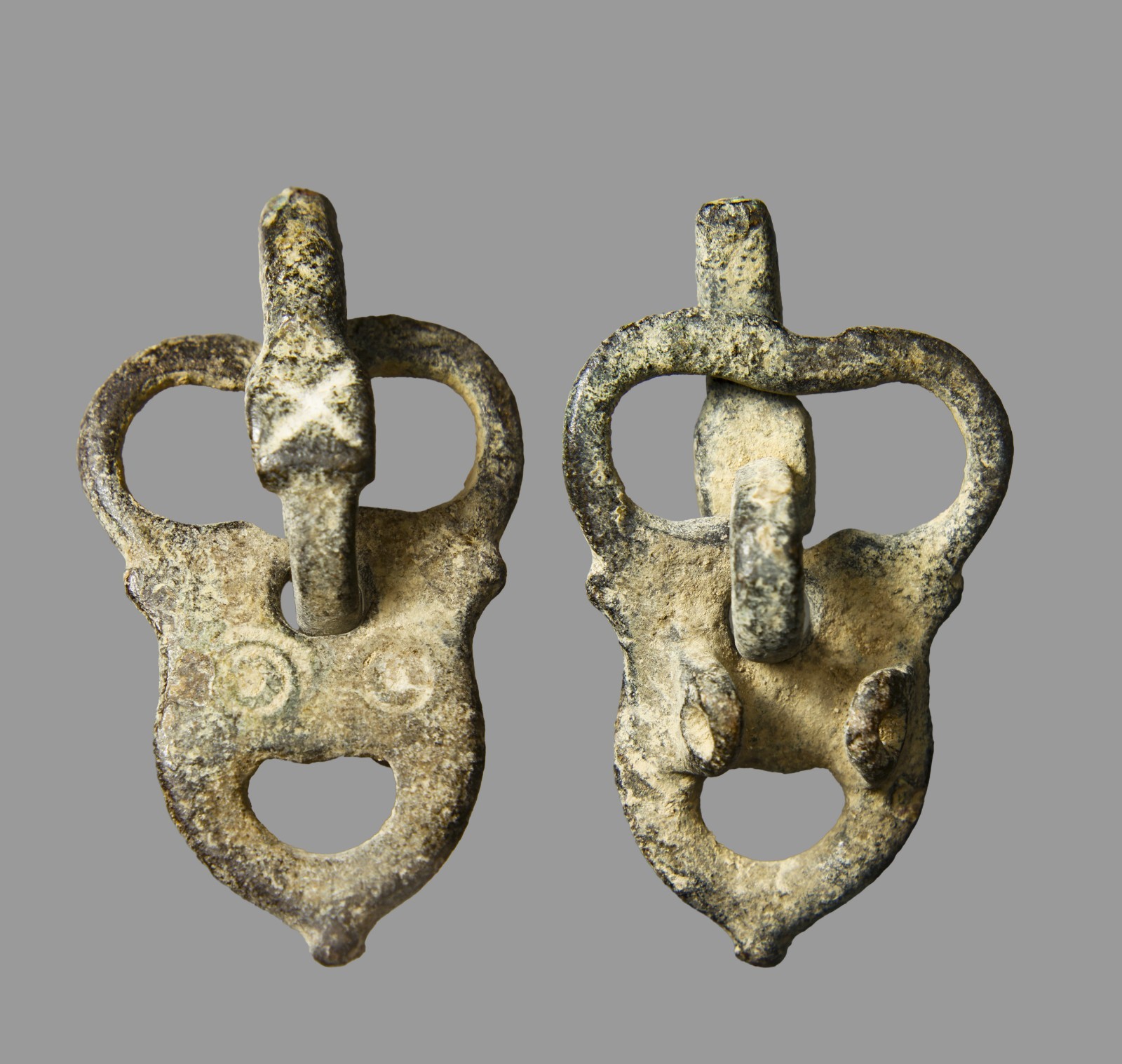
Ancient Roman Legionary Belt / Harness Fitting – Inscribed "Legio X" & Apotropaic "Magic Eyes"
Authenticity & Guarantee
Item Specifications
Object: Military Cingulum Strap Loop / Harness Fastener with Articulated Hook
Culture / Period: Ancient Roman Empire (Judaea / Roman Near East)
Date Range: Circa 1st Century AD – 3rd Century AD
Dimensions: 4.1 cm (approx. 1.6 inches)
Material: Heavy Cast Bronze (Copper Alloy)
Inscriptions & Markings: Deeply incised Roman numeral "X" on central tongue stem; twin punched ring-and-dot ("magic eye") motifs on body plate
Condition: Exceptional intact archaeological state. Articulated hook remains completely intact; features a crisp, untouched olive-green and desert-sandy burial patina.
Historical Context & Legionary Significance
Legio X Fretensis in Roman Judaea
The deeply incised "X" on the hook stem links this piece directly to Legio X Fretensis (Tenth Legion of the Strait). Deployed to Judaea during the First Jewish-Roman War (66–73 AD), Legio X played a central role in the sieges of Jerusalem and Masada (Ref: Gichon & Vita, IEJ 41, 1991; Bishop & Coulston, Roman Military Equipment, 2006). Following the destruction of Jerusalem in 70 AD, the legion was permanently stationed as the principal garrison of Aelia Capitolina (Jerusalem) for over two centuries. Personal military gear stamped or incised with unit designations served to identify government-issued property and signify soldier pride (Ref: Stiebel, Bar Kokhba Military Equipment, 2003).
Apotropaic "Magic Eyes" & Soldier Superstition
The twin ring-and-dot stamps on the lower body plate create a distinct face-like pattern. In Roman military culture, these were not merely decorative—they functioned as apotropaia (protective talismans) (Ref: Dasen, Probaskania: Amulets and Magic, British Museum Pub. 177, 2015). Roman soldiers regularly wore gear featuring eye motifs, phallic symbols, or Gorgon heads intended to "stare back" at harmful forces, deflect the "evil eye" (invidia), and protect the wearer from injury on the battlefield (Ref: Elliot, Beware the Evil Eye: Greece and Rome, 2016).
Typological Analysis & Comparable Museum Accession Parallels
Military Harness Assembly & Construction
Designed as part of the cingulum militare (soldier's military belt) or horse harness suspension system (balteus) (Ref: Oldenstein, Zur Ausrüstung römischer Auxiliareinheiten, 1976). The cast loop frame held leather strapping securely, while the central hinged hook attached to weapon scabbards or secondary utility straps. The original articulated joint remains preserved without modern restoration.
Comparable Archaeological Examples & Museum Accession Numbers
British Museum (Accession No. 1990,0112.1): 1st–2nd Century AD Roman copper-alloy military belt fitting with hinged hook attachment and openwork strap plate.
British Museum (Accession No. 1881,0802.94): Roman military harness mount featuring articulated hook joint and stamped ring-and-dot decoration.
London Museum (Accession ID: 19367): Roman copper-alloy military belt fitting and strap plate with incised border geometry and stud attachment mechanics.
Amgueddfa Cymru / Museum Wales (Item No. 31.78/4.10): Roman cast copper-alloy military belt mount recovered from legionary fortress contexts (Caerleon Military Collection).
Oldenstein Typology Reference: Matches the openwork frame and hinged hook construction published by J. Oldenstein (1976), Zur Ausrüstung römischer Auxiliareinheiten, Taf. 41–43 (Type 612–618).
TRN-1-2