When you click on links to various merchants on this site and make a purchase, this can result in this site earning a commission. Affiliate programs and affiliations include, but are not limited to, the eBay Partner Network.
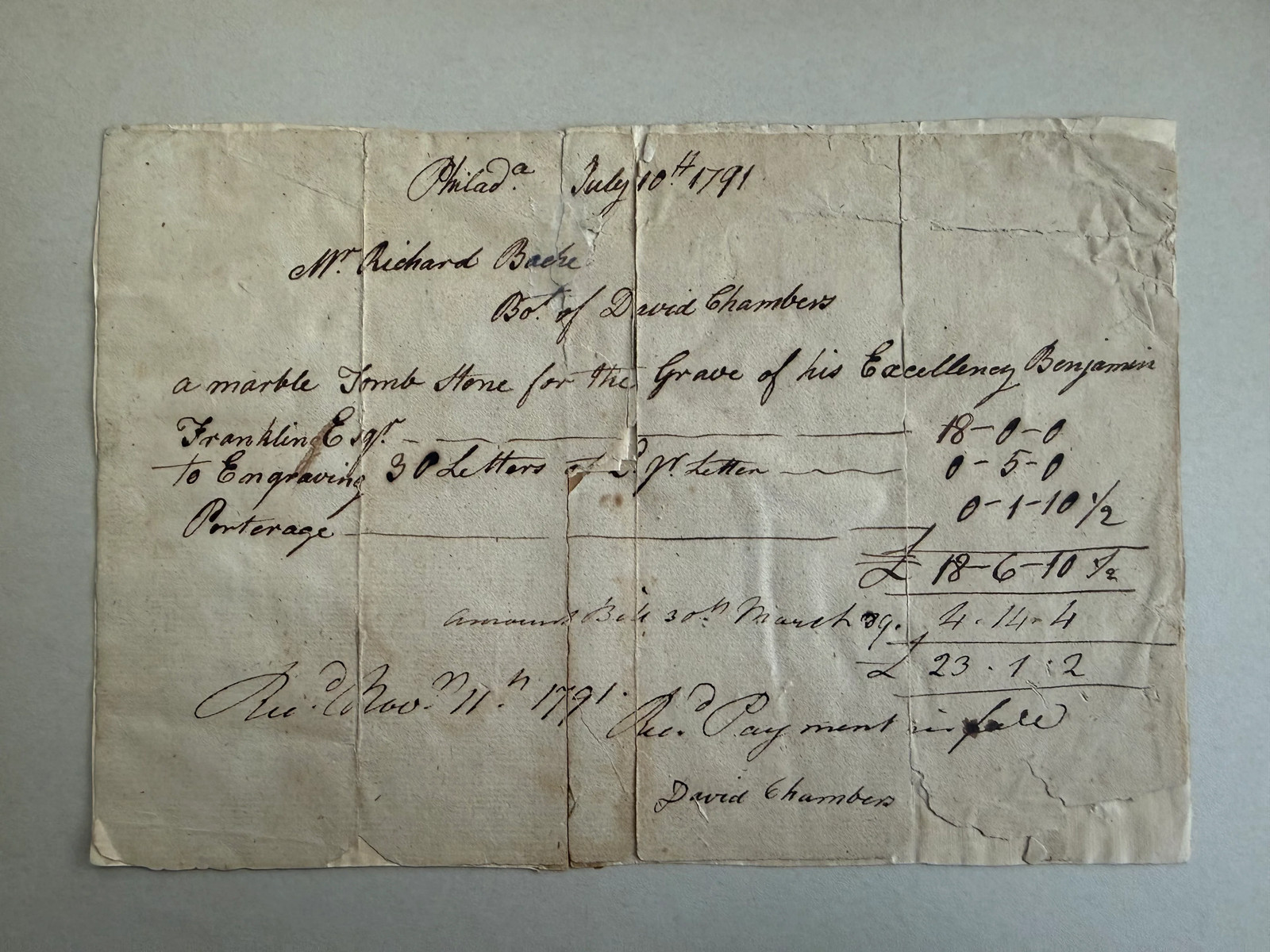
Dated July 10, 1791, the manuscript account was prepared by stonecutter David Chambers for Richard Bache, husband of Franklin’s daughter Sarah and former postmaster general of the United States. Its principal entry reads:
“A marble Tomb Stone for the Grave of his Excellency Benjamin Franklin Esqr.”
Chambers charged £18 for the marble stone, together with separate amounts for engraving and porterage. Most remarkably, the invoice specifies the engraving of “30 Letters.” The familiar inscription still appearing on Franklin’s grave—“Benjamin and Deborah Franklin 1790”—contains exactly 30 letters and numerals when its spaces are omitted. This correspondence provides compelling evidence that the document records the creation of the historic marble slab still seen by visitors to Philadelphia’s Christ Church Burial Ground.
At the bottom, Chambers acknowledged receiving payment in full on November 17, 1791, and signed the document “David Chambers.”
Benjamin Franklin died in Philadelphia on April 17, 1790. Four days later, an estimated 20,000 mourners attended or witnessed his funeral procession. Rather than receive an elaborate monument, Franklin was commemorated by the simple marble slab documented by this surviving account—a fitting marker for the printer, scientist, diplomat and statesman who shaped the founding of the United States.
The manuscript shows extensive original folds, central paper loss affecting portions of several words, scattered fold separations, creasing, edge wear, toning and minor staining. The historically essential wording, Franklin’s name, monetary entries, receipt and Chambers signature remain substantially intact and legible.
A museum-worthy document connecting Benjamin Franklin, his immediate family and the physical creation of one of the most visited gravesites in American history.