When you click on links to various merchants on this site and make a purchase, this can result in this site earning a commission. Affiliate programs and affiliations include, but are not limited to, the eBay Partner Network.
Thanks for looking! Please be awarethat I only ship once a week, so please allow up to 5 DAYSuntil you receive your tracking number. My storesettings reflect this amount of time for shipping and handling. Ifyou need something sooner, please let me know upon purchase, and Iwill expedite shipping.
ITEM DETAILS
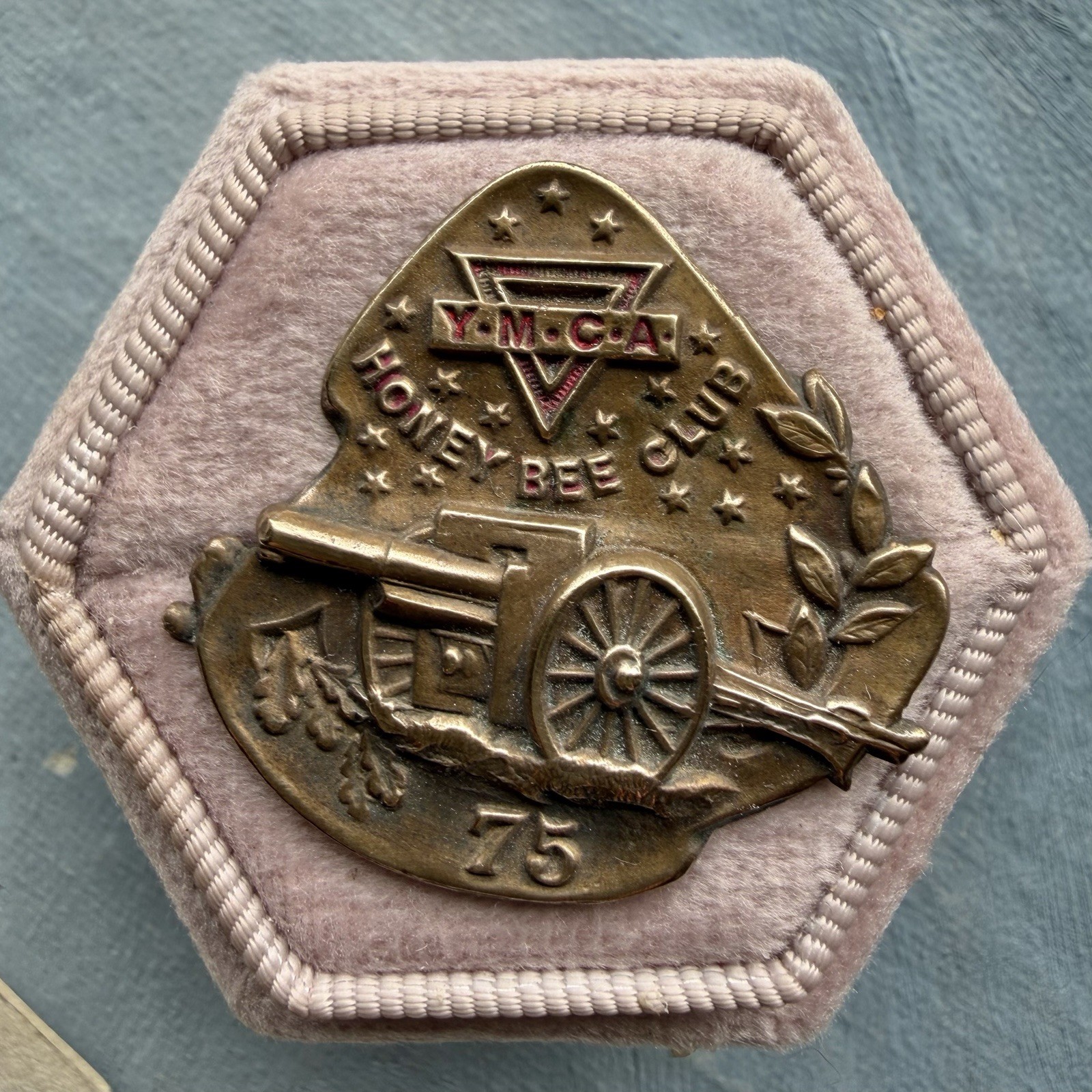
Stamped brass (?) metal badge, may have once been a pin. YMCA and triangle still have some red paint. 1.25". The badge also shows a French 75, the most famous French field weapon of WWI.
The YMCA's Honey Bee Club was founded with the stated goals of protecting Black interests, improving morals, and providing welfare support for African American troops serving during the war. However, because it was an independent effort focusing explicitly on Black soldiers' advocacy, the club and its organizers faced intense surveillance and suspicion from military intelligence and authorities who feared racial organizing or political friction within the ranks.
The club's existence is famously highlighted in historical documentation regarding the systemic discrimination, surveillance, and legal challenges faced by Black "doughboys" under the American Expeditionary Force.From the Project Gutenberg website, "Sidelights on Negro Soldiers" by Charles H. Williams,Special Investigator of Conditions among NegroSoldiers in the World War, published in 1923:"A [Black] soldier who was sentenced to death,just a few days before his execution asked a “Y” secretary at Brest [France] tocome and pray with him. After four days of struggle with the soldierand himself, the secretary felt that he too was changed and shouldwork in some large way for the good of the [Black] men. He began withprayer meetings among small groups that had been somewhat neglected,and at one such meeting he told the story of the Honey Bee thatwas busy and successful and another about birds that preyed on theundesirable things of the world. Using with telling effect the lessondrawn from the experience of the soldier who paid with his life forthe undesirable, he asked, “How many of you would like to be theHoney Bee?” All responded with raised hands. Soon afterwards he wasgiven permission by the Paris office to devote all his time to theorganization of Honey Bee clubs. When it became known, however, thatmembership was to be limited to [Black] soldiers, opposition developed.The [Black] men felt that if the club was capable of doing so much forthem, white soldiers in France should not be denied a share in itsblessings. The original idea was undoubtedly to help the [Black] soldierin France, but the method by which the idea was developed did not meetwith approval, and accordingly, in most cases, it was either opposed ortreated with indifference."