When you click on links to various merchants on this site and make a purchase, this can result in this site earning a commission. Affiliate programs and affiliations include, but are not limited to, the eBay Partner Network.
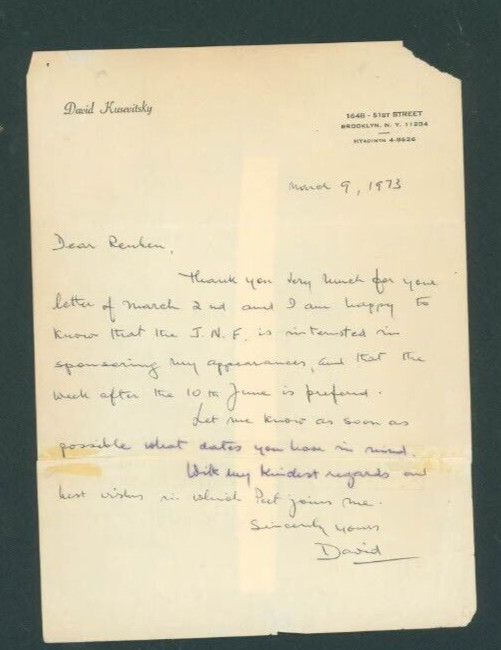
Rare Fully Handwritten & Signed Letter in English by Renowned Cantor David Kusevitsky
This exceptional piece of Judaica is an original letter, entirely handwritten and signed in English by the legendary Cantor David Kusevitsky, one of the most iconic chazzanim of the 20th century.
Kusevitsky was known for his commanding voice, impeccable technique, and deep spiritual expression. He served major synagogues in Europe and the United States, most notably Temple Beth El in Brooklyn, and was part of the famed Kusevitsky cantorial dynasty.
📜 Item Highlights:
Entirely handwritten and signed by Cantor David Kusevitsky
Language: English
Original letter – not a copy or reproduction
Very Good Condition – clean, clear, and well-preserved
A rare historical document from a towering figure in Jewish liturgical music
🎶 About the Cantor:
David Kusevitsky (1911–1985) was a world-renowned Jewish cantor whose voice and style influenced generations of chazzanim. His recordings remain beloved to this day, and his legacy continues in the world of traditional synagogue music.
📚 Keywords:
David Kusevitsky, Cantorial Letter, Chazzan Autograph, Jewish Music, Judaica Collectible, Temple Beth El, Brooklyn Chazzanut, Handwritten Judaica, Cantorial Manuscript, Yiddishkeit, Signed Jewish Document, Vintage Synagogue History
David Kusevitsky 1911 – 1985 David Kusevitsky was the youngest of four world-renownedcantorial brothers; the other three were Moshe, Jacob, and Simcha. Each of thebrothers was a unique and original artist, and each made significantcontributions to the art of hazzanut. David’sown vocal style, in addition to its seemingly effortless virtuosity, wasespecially marked by refined elegance, graceful dignity, and warmth. In manyways he exemplified the 19th-century Viennese ideal, as established there bythe architect of modern cantorial art, Salomon Sulzer, whose delivery possesseda profoundly emotional character fused with classical taste and musicalintelligence. This synthesis also informed David Kusevitsky’s compositions. Kusevitsky was born in Smorgon, now in Belarus, near theLithuanian border. His father was an amateur violinist, and David’s ownintroduction to music making was on that instrument. After the First World War,the family moved to Vilna (Vilnius), where his brother Moshe became a boychorister at the Vilna Khor Shul and eventually brought David there to sing asan alto. Later, when Moshe assumed a major cantorial post in Vilna, both Simchaand David sang in his choir. By the age of fourteen David had mastered therudiments of music, apparently largely on his own, and he notated cantorialchants for Simcha when his older brother began officiating as a cantor. David’s original interest lay primarily in conducting. Intendingto become a choirmaster, he studied at the gymnasium in Vilna and at the localconservatory. When his brother Jacob was appointed to a cantorial pulpit inLemberg (L’vov), Galicia, he brought David to direct the choir. Andsubsequently, when Simcha accepted a cantorial position in Rovno (RussianPoland, now Ukraine), David went there as well to become choirmaster. FollowingDavid’s service in the Polish army during the interwar years, where he alsoconducted a large chorus, Moshe, then a successful cantor in Warsaw, persuadedhim to refocus on hazzanut ratherthan conducting. “You have a treasure in your voice,” Moshe was later quoted asadvising, “so why work with your hands?” David studied voice in Warsaw andbegan officiating as a cantor at individual Sabbath services, but his formaldebut as a solo cantor was in 1933–34 at the Philharmonic Hall in Łódź, wherehe was accompanied by a forty-voice choir. At a concert performance in Hebrew of Haydn’s oratorio The Creation at the TłomackieSynagogue in Warsaw, as part of an anniversary celebration for Hazzan PinchasSherman, Moshe sang the tenor role, and David performed the part of Gabriel,which was originally written for soprano. Although that synagogue was one ofEurope’s leading liberalized khorshuls, female voices were considered religiously inappropriate andtherefore unacceptable even for a nonliturgical concert. A review of theconcert predicted a brilliant cantorial career for David, humorously observingthat he “suffers from the ‘Koussevitzky disease’: he will one day be a major hazzan.” When his brother Simchavacated the Rovno pulpit, David took his place as the chief cantor for threeyears, after which he went to London to serve as the cantor of the HendonSynagogue. He remained in London throughout the Second World War, and he also lecturedat Jews College there. In 1948 Kusevitsky emigrated to America and became the cantor ofTemple Emanu-El in the Boro Park section of Brooklyn, one of New York’s majorConservative movement synagogues at that time, where he served until his death,in 1985. From 1952 until his own death in 1966, his brother Moshe (who retainedthe earlier spelling of his name as Koussevitzky) was the cantor of theprestigious orthodox synagogue Temple Beth El of Boro Park, just around the corner. For a number of years, the annual Saturday midnight or postmidnightevent that inaugurates the daily recitation of the penitential liturgy (S’liḥot) prior to Rosh Hashana (andbetween Rosh Hashana and Yom Kippur) with a formal, often musically elaboratechoral service—known as “The First S’liḥot”—was timed by the two congregationsin order to enable aficionados to hear both cantors in succession. Fanssometimes affectionately dubbed that marathon as “the annual S’liḥot doubleheader.” In America, David Kusevitsky was presented with a world ofconcert opportunities not available to him in London, where the orthodoxleadership (cantorial as well as rabbinic) at that time considered concertappearances inappropriate and religiously undignified for cantors as clergymen.A famous Carnegie Hall concert in New York featured all four brothers, inensembles as well as solo renditions. One of David’s fourteen tours of Israeloccurred just after the Six-Day War, in 1967, when he sang for Israeli soldierson the banks of the Reed Sea (Red Sea) at Suez, performing a setting of thewords from the liturgy—hamma’avirbanav bein gizrei yam suf— that refer to the biblical account inExodus of God’s splitting that sea for the ancient Israelites’ escape fromEgypt. Kusevitsky was also a dedicated teacher of hazzanut in New York—first atthe Herzliah Institute and then for many years at the Cantors Institute (nowthe H. L. Miller Cantorial School) of the Jewish Theological Seminary, where hewas able to influence many of today’s most accomplished cantors. His cantorialand choral compositions were written primarily for his own rendition, and manyappear on his numerous recordings. Most of them remain in manuscript. By: Neil W. Levin