When you click on links to various merchants on this site and make a purchase, this can result in this site earning a commission. Affiliate programs and affiliations include, but are not limited to, the eBay Partner Network.
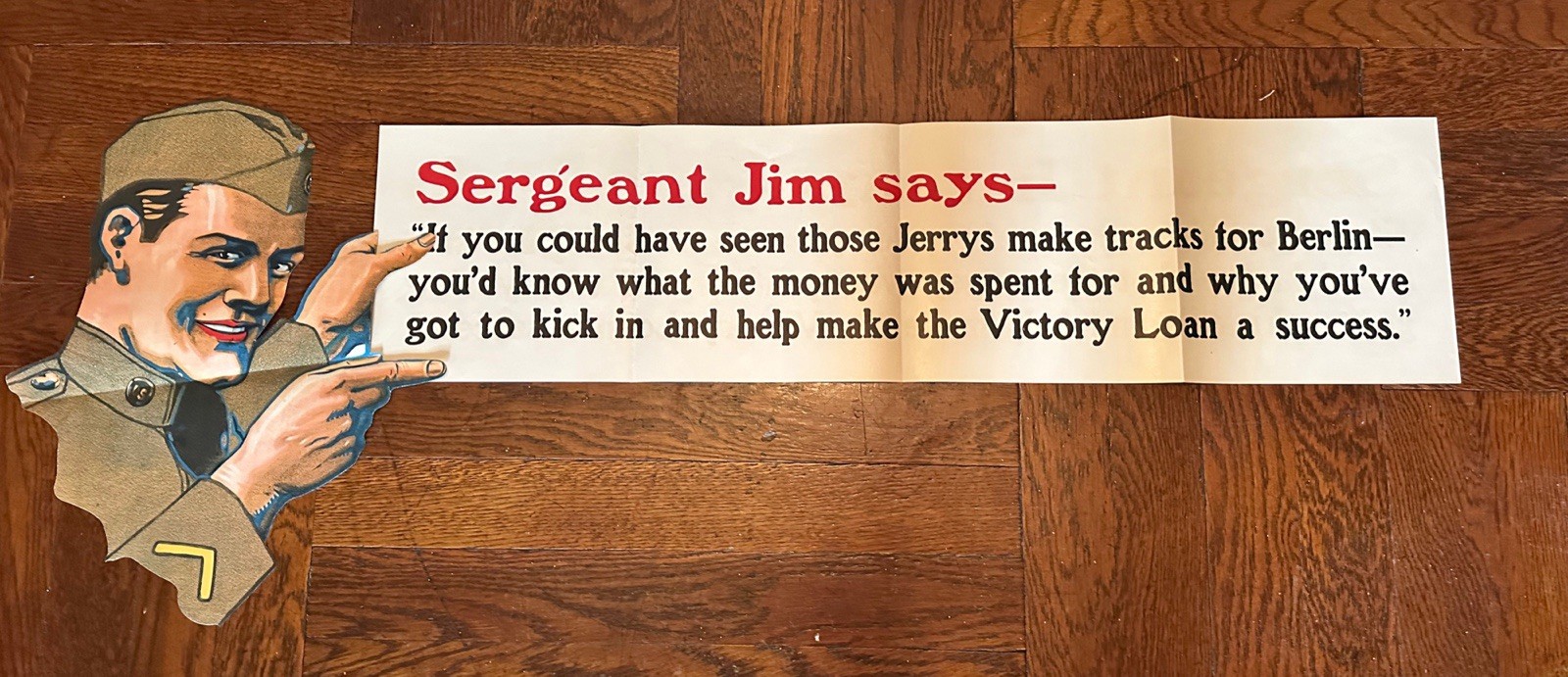
An exceptionally scarce surviving original 1919 World War I Victory Liberty Loan “Sergeant Jim Says—” die-cut paper window display, measuring approximately 36 inches wide when fully opened. New old stock, never used.
This striking display depicts a smiling American soldier pointing toward the large printed message:
“Sergeant Jim says—
‘If you could have seen those Jerrys make tracks for Berlin—you’d know what the money was spent for and why you’ve got to kick in and help make the Victory Loan a success.’”
Produced for the Victory Liberty Loan campaign of 1919, this was a temporary promotional display intended for placement in store or public windows during the final major U.S. war-loan campaign following World War I.
Museum & Institutional References
The historical importance and identification of this exact design are supported by examples preserved in major institutional collections.
An identical “Sergeant Jim Says—” window display is held by the Smithsonian Institution’s National Museum of American History as part of the Princeton University Poster Collection. The Smithsonian identifies the display with the Victory Loan campaign and dates it specifically to April 21–May 10, 1919.
Another example is documented in the New York State Library’s World War I poster collection, catalogued as US GEN 1089, with dimensions of approximately 35 × 92 cm (13.8 × 36.2 inches).
These institutional examples provide excellent documentation for this unusual surviving piece of American WWI-era ephemera.
Construction & Remarkable Survival
What makes this example particularly noteworthy is its extremely fragile construction.
This is not cardboard or cardstock. The soldier and accompanying message are made from relatively thin printed paper, intricately die-cut around the figure’s silhouette, including his projecting hands and individual pointing fingers.
The display was an inherently ephemeral object—created for a short-lived 1919 fundraising campaign and intended for temporary display rather than long-term preservation.
Despite that, this example has survived for more than a century remarkably complete.
The large message panel retains its full printed slogan, while the soldier retains the vulnerable projecting portions of the die-cut design. The colors also remain exceptionally vivid, particularly the olive uniform, flesh tones, blue outlining and bold red “Sergeant Jim says—” heading.
The message portion was made to fold, allowing this unusually long paper display to be stored compactly. The surviving folds are part of the object’s historic construction and use.
Condition
Remarkable condition considering its approximately 107-year age, thin-paper construction and original temporary advertising purpose.
The display remains substantially complete with strong, vibrant graphics.
As expected with an original piece of fragile 1919 paper ephemera, there are original/period folds, creasing, small tears, minor edge wear, age toning and other evidence of handling and use. There is localized creasing/short tearing around some of the particularly vulnerable projecting portions of the die-cut figure.
Importantly, the intricate soldier figure remains remarkably intact, including the projecting hands and fingers, and the complete printed message survives.
The reverse is unprinted and shows expected age and handling.
No restoration has been undertaken. It is being offered in its surviving original state.
Please examine all photographs carefully, particularly the close-up photographs of the folds, edges and projecting portions, as they form an important part of the condition description.
Dimensions
Overall width when opened: approximately 36 inches
Comparable institutional example recorded by the New York State Library: approximately 13.8 × 36.2 inches (35 × 92 cm).
Historical Context
The Victory Liberty Loan was launched in April 1919, after the Armistice had ended the fighting in Europe. The campaign was intended to help finance the enormous costs incurred by the United States during World War I.
Unlike conventional posters that could be framed or stored relatively easily, promotional window pieces such as this were disposable advertising materials. Their large size, folds, thin paper and elaborate die-cut construction made them especially susceptible to destruction.
The survival of this example in such complete and visually impressive condition more than a century later is therefore particularly remarkable.
A wonderful piece for an advanced collection of World War I memorabilia, Liberty Loan material, American advertising, propaganda, military ephemera or early 20th-century paper Americana.
A museum-documented design and an unusually scarce survivor from America’s 1919 Victory Liberty Loan campaign.