When you click on links to various merchants on this site and make a purchase, this can result in this site earning a commission. Affiliate programs and affiliations include, but are not limited to, the eBay Partner Network.
- Found at the family's estate.
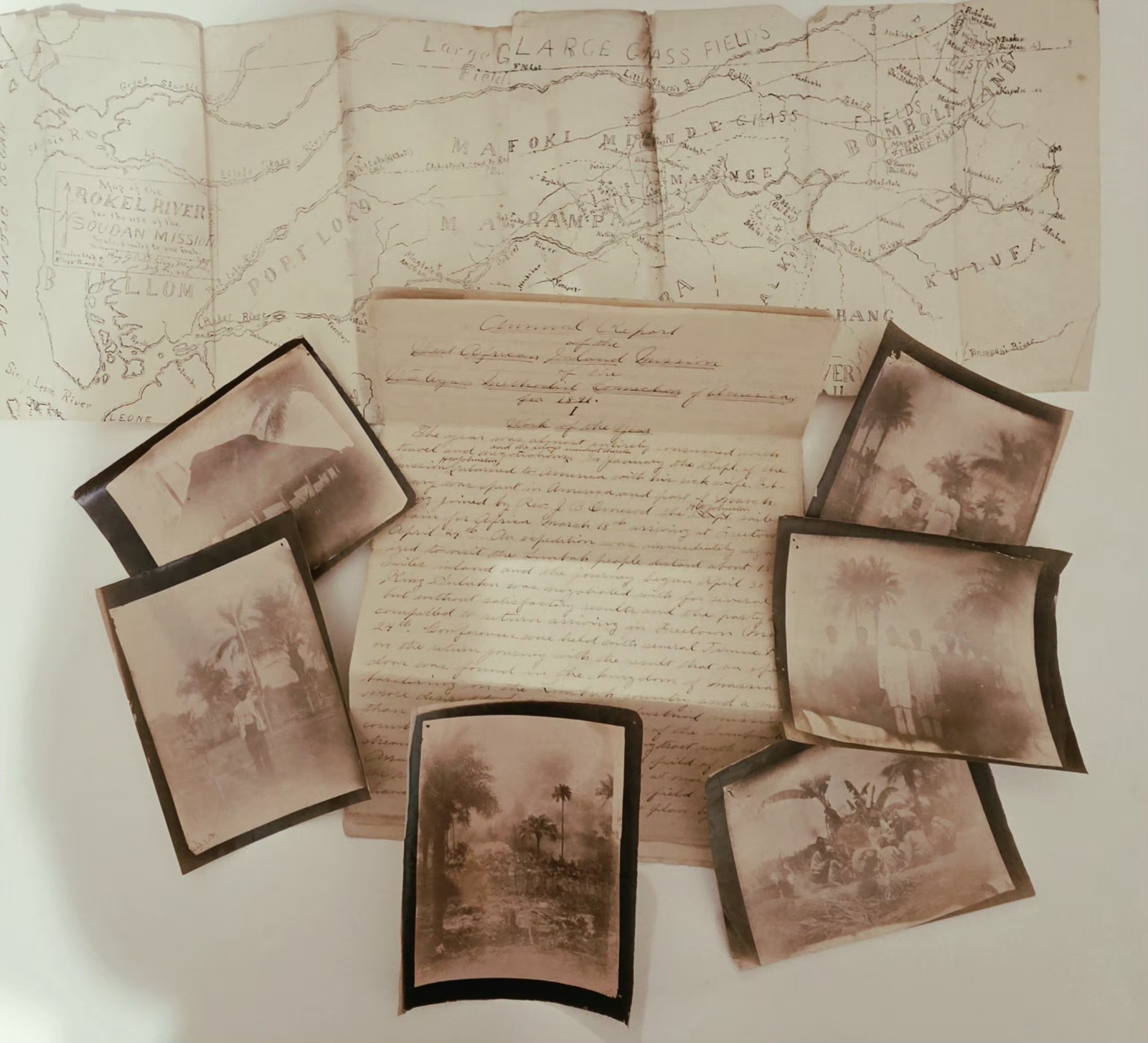
Complete 9-Page Hand-Written Annual Report (1891): Written by the Superintendent (H.W. Johnston), this report chronicles the entire year's operations. It details an expedition 150 miles inland to the Limbah people, intense land negotiations with King Massinda for a 40-acre tract at Rokunso, local illnesses/fevers, conflicts with local trustees, and the sudden termination of fellow laborers.
- Complete Financial Ledger & Property Invoice: Pages 3–5 contain an exhaustive financial accounting of the mission. It lists exact expenditures (down to the price of an 8-oared canoe and rigging) and a fascinating asset inventory featuring items like a "Sedan Chair," a Smith & Wesson revolver, an aneroid barometer, pocket compasses, and missionary quilts.
Map (shown in 2 photos, Dated July 4, 1892): of the Rokel River (Sections I and II) detailing coastal Freetown, Port Loko, and the deep interior chiefdoms (Mafoki, Marampa, Mange, Asimera, Kulufa). Key mission stations and "Johnston’s road to Rokun" are explicitly mapped.
- Six (6) 19th-Century Photographs: Rare, I don't know if they are original sepia-toned prints. They were found with the letter, showing the actual thatched-roof Mission House/workshop constructed in December 1891, the lush "field of palms" landscape described in the text, and portraits of the missionaries, local children, and residents on the ground.
Key Historical Figures Named:
- H.W. Johnston (Mission Superintendent)
- Alice Harris, M.D. (Notable early female medical missionary left alone in Freetown)
- Rev. J. Augustus Cole (Subject of a bitter financial and pastoral dispute detailed in the text)
- J.B. Omerod, Sunder Wright, and Brother N. Wright (Liberian missionary laborer)
- King Massinda & Chief Commander (Local Sierra Leonean rulers)
Condition Report
This archive is over 130 years old and is in good antiquarian condition overall.
- Manuscripts & Maps: The hand-written pages and maps show expected age-toning, light fraying along the edges, and minor splitting along the original fold lines, but the paper remains stable and the cursive ink handwriting is incredibly dark, clear, and perfectly legible.
- Photographs: The prints exhibit standard 19th-century silvering, curling, and fading, typical for images developed in tropical environments during this era. They retain excellent historical clarity and Indigenous Infrastructure.
Microhistory of Local African-American & Creole Church Dynamics
The dispute involving Rev. J. Augustus Cole and St. John's Church highlights the delicate institutional friction between Western missionary boards and local West African congregations.
- Resistance to Imperial Control: The "Agreement of Amalgamation" which required the "unconditional acceptance of the usages and polity of the Wesleyan Methodist Connection of America and outright transfer of church and property" shows how American boards tried to consolidate control.
- Local Autonomy: The local Trustees' refusal to sign and their subsequent independent hiring of Rev. Cole demonstrates local agency and resistance against surrendering their properties and autonomy to a foreign board.
African Geopolitics and Indigenous Labor (The Kroo Conflict)
The mention of Finley Wright fleeing to Freetown after being "driven out and robbed by the Kroo people of Nana Kroo" provides a direct look at local conflicts down the coast in Liberia. The Kroo (or Kru) people were famously resistant to both Western missionary interference and Americo-Liberian governance, fiercely defending their coastal trade monopolies and regional autonomy.
The section on Donkeys and Cattle provides valuable economic history data regarding inland African infrastructure before the widespread introduction of railways or motor vehicles:
- Pre-Colonial Trade Routes: It documents the Sangara tribe operating active, long-distance trade caravans using "pack-asses" from 75 miles inland down to the coast at Port Loko (Port Lokoh).
- Colonial Logistics & Costs: It gives exact numbers on the logistical economy of the era, contrasting human porterage ("A Port Lokoh carrier costs $2.00... and carries 50 lbs") with animal labor ("The African donkey carries about 200 lbs"). This math illuminates why missions and colonial entities prioritized animal transport to drastically cut the overhead of inland expeditions.
Please review the high-resolution images carefully to assess the physical condition.