When you click on links to various merchants on this site and make a purchase, this can result in this site earning a commission. Affiliate programs and affiliations include, but are not limited to, the eBay Partner Network.
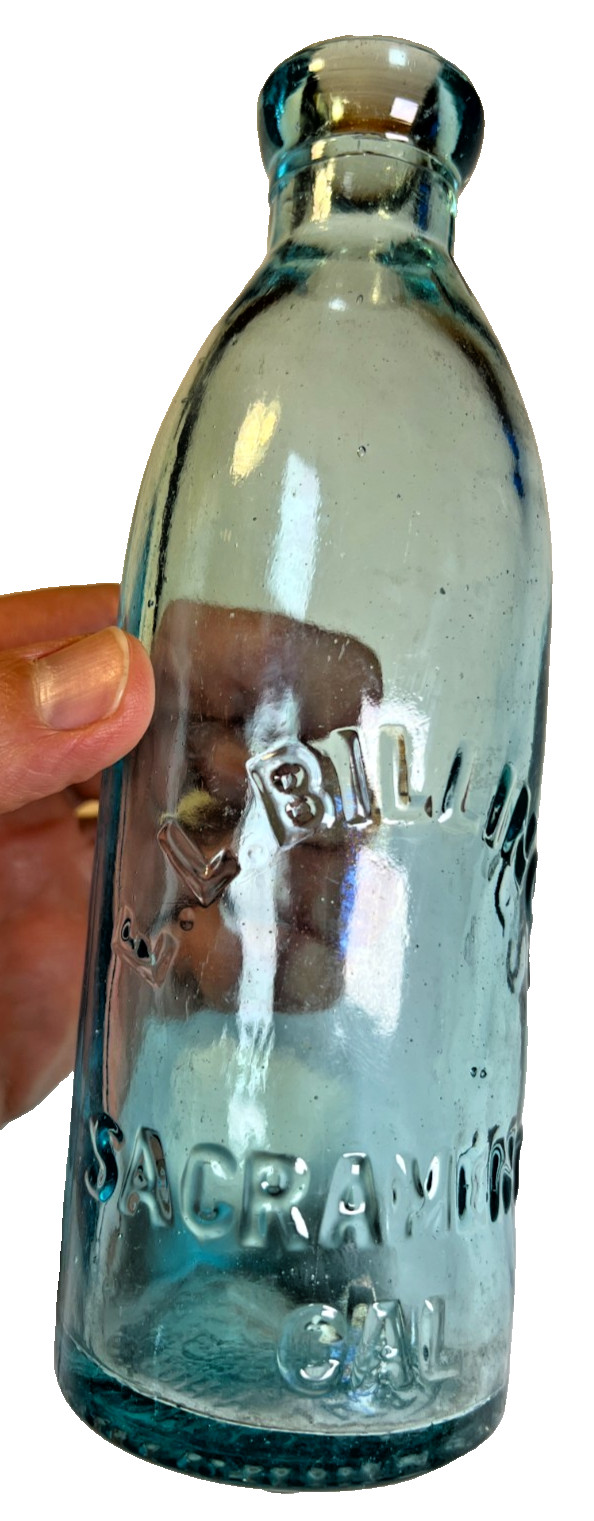
Rare E.L. Billings Sacramento, California Blob Top Soda BottleJohn Matthews Patent October 1864 Gravitational Stopper – Early California Soda
The California Gold Rush created fortunes overnight, but it also created an enormous thirst. By the 1860s, Sacramento had become one of the booming commercial centers of the American West, packed with merchants, miners, politicians, and travelers pouring through the city. Local bottlers rushed to supply mineral waters and carbonated beverages, and few surviving relics tell that story better than an embossed blob-top soda bottle like this one.
This handsome aqua example is boldly embossed "BILLINGS" across the shoulder and "SACRAMENTO CAL." across the lower body, firmly placing it among the desirable early California soda bottles collected today.
Even more impressive, the base proudly carries the embossing:
"MADE BY JOHN MATTHEWS NEW YORK PAT OCT 1864 GRAVITATIONAL STOPPER"
John Matthews was one of the most influential figures in the American soda industry. Often called the "Father of the Soda Fountain," Matthews revolutionized carbonated beverage bottling and dispensing technology. His patented gravitational stopper system allowed bottles to retain pressure while remaining reusable, representing cutting-edge engineering during the Civil War era.
The applied blob top displays a wonderfully drippy hand-finished edge, reminding us that every bottle was individually finished by a glassworker before automatic machinery existed. No two examples are exactly alike.
The glass itself has a beautiful light aqua color with scattered seed bubbles and the subtle irregularities expected from 19th-century manufacture. It has survived remarkably well.
Condition
- Approximately 7⅜ inches tall
- Original applied blob top with attractive drippy finish
- Embossed E.L. Billings – Sacramento, Cal.
- Base embossed John Matthews New York Patent Oct. 1864 Gravitational Stopper
- No chips
- No cracks
- Bright, clean, and shiny overall
- Only a small localized patch of haze to the right of the slug plate (see photographs) & and a small one on the back (see pics)
- Displays beautifully with outstanding eye appeal
Why Collectors Love It
Early California embossed sodas occupy a special niche in bottle collecting. Sacramento bottles are considerably scarcer than examples from San Francisco and eastern cities, and bottles tied to the John Matthews gravitational stopper system represent an important chapter in the evolution of carbonated beverages.
This example combines multiple desirable traits:
- Early applied blob top
- Strong, bold embossing
- Sacramento, California origin
- John Matthews patent base
- Attractive aqua color
- Excellent overall condition
- Civil War-era technology preserved in glass
Holding this bottle is like holding a piece of frontier California itself—a survivor from the years when Sacramento was still growing from Gold Rush outpost into one of the West's great cities.
The John Matthews Gravitational Stopper was one of the most ingenious—and short-lived—attempts to solve one of the biggest problems of the 19th-century soda industry: how do you keep highly pressurized carbonated water sealed without relying on an unreliable cork?
A Bottle That Sealed Itself
Unlike ordinary blob-top bottles that used a cork and wire, the Matthews system used a heavy glass stopper inside the bottle itself.
The stopper was an elongated piece of glass with a flared head fitted with a rubber gasket. When the bottle was inverted during filling, gravity caused the stopper to fall into the neck where the gasket seated tightly against an internal shoulder. Once carbonated liquid was added, the internal pressure actually forced the stopper even tighter against the seal, making leaks extremely difficult.
Think of it as a 19th-century version of a self-locking valve.
How Was It Opened?
Opening one was surprisingly simple.
The drinker merely pushed the glass stopper downward with a finger or tool, breaking the seal. The stopper then dropped into the body of the bottle, allowing the soda to be poured normally. When empty, the stopper could be removed, cleaned, fitted with a new rubber ring if necessary, and reused over and over again.
This made the entire system economical for bottlers who collected and refilled their bottles.
Why the Patent Says "John Matthews"
Interestingly, John Matthews was not actually the inventor.
The gravitating stopper was patented on October 11, 1864 by Albert Albertson, but Matthews—already America's leading manufacturer of soda fountains and bottling equipment—acquired or controlled the rights and aggressively marketed the invention nationwide. His name became so closely associated with the closure that collectors still commonly call it the "Matthews Patent" or "Matthews Gravitating Stopper."
Matthews' genius wasn't just engineering—it was salesmanship. He sold complete bottling systems, filling equipment, and the specially designed bottles to soda manufacturers across America.
Why Your Bottle Is Special
Your E.L. Billings Sacramento bottle was manufactured specifically for this closure system. Several clues prove it:
- The distinctive steep, rounded shoulder guides the stopper into position.
- The applied blob top is oversized to accommodate the internal mechanism.
- Most importantly, the base is boldly embossed:
MADE BY JOHN MATTHEWS
NEW YORK
PAT OCT 1864
GRAVITATIONAL STOPPER
That embossing isn't merely decorative—it advertises the patented technology built into the bottle itself. In effect, the base is a permanent patent label cast directly into the glass.
An Engineering Marvel That Lost the Race
Although brilliant, the gravitational stopper was complicated and relatively expensive. It required:
- A specially shaped bottle
- A precision-made glass stopper
- A rubber gasket
- Specialized filling equipment
By the late 1870s and 1880s, simpler systems such as the Hutchinson spring stopper gained favor because they were easier to manufacture and operate. Eventually, all of these reusable closures were displaced by the inexpensive crown cap at the end of the century.
Patent Date ≠ Bottle Date
The base reads:
"Made by John Matthews New York Pat Oct 1864 Gravitational Stopper"
That is advertising the patent on the closure system, not the date the bottle was blown. Manufacturers often left patent dates on molds for years or even decades after the patent was granted.
Think of it like seeing "Pat. Pending" or "Patented 1957" on a tool made in 1965.
So when was your bottle actually made?
Based on the combination of features:
- ✅ Applied blob top (not tooled)
- ✅ John Matthews gravitating stopper base
- ✅ Aqua hand-blown glass
- ✅ Bold slug embossing
- ✅ Sacramento, California embossing
- ✅ Overall form and proportions
I would estimate:
Likely: 1866–1872
with the sweet spot being around 1867–1870.
Why not 1864 exactly?
Because:
- The patent wasn't issued until October 11, 1864.
- Matthews then had to manufacture and market the new system.
- Bottlers like E.L. Billings in Sacramento had to order the specialized bottles and equipment from New York.
- Those bottles then had to be shipped all the way around Cape Horn or across the Isthmus of Panama (the Transcontinental Railroad wasn't completed until 1869).
It's unlikely that many, if any, Sacramento examples were in use immediately after the patent was granted.
The transportation clue
Before 1869, getting heavy glass bottles from New York to California was a major undertaking.
A shipment could take:
- Months by sailing ship around South America, or
- A combination of ship and rail across Panama.
That lag alone suggests most California Matthews bottles entered service a year or more after the patent date.
The E.L. Billings connection
E.L. Billings appears to have been active during the late 1860s in Sacramento, right when Matthews was aggressively expanding his bottling technology into western markets. Your bottle fits that historical window perfectly.
My best (possible, but 1875★☆☆☆☆In short:
Although the base proudly bears "Pat Oct 1864," I would date the bottle itself to approximately 1867–1870, making it an authentic post–Civil War, Gold Rush-era California soda. That timing actually enhances its story: it represents one of the earliest waves of advanced soda bottling technology reaching the rapidly growing American West.
Life in Sacramento, California (1867–1870): The World Your Bottle Knew
If your E.L. Billings soda bottle dates to roughly 1867–1870, it existed during one of the most exciting and transformative moments in California history. Sacramento was no longer a rough-and-tumble Gold Rush camp, but it also wasn't yet the polished capital city we know today. It was a place where muddy streets, horse-drawn wagons, steam whistles, and cutting-edge technology all collided.
🚂 The Railroad Was Changing Everything
The biggest story in Sacramento was the Transcontinental Railroad. Construction of the western half had begun in the city in 1863, and by May 10, 1869, the rails met at Promontory Summit, Utah, linking the Atlantic and Pacific coasts for the first time. Sacramento became the headquarters and workshop of the Central Pacific Railroad, filling the city with engineers, blacksmiths, machinists, carpenters, and laborers.
For someone drinking from your bottle, the shriek of locomotives and the constant movement of freight cars would have become part of daily life.
🏗️ The Entire City Was Being Raised
Perhaps the most astonishing sight was happening under everyone's feet.
After catastrophic floods in the early 1860s, Sacramento undertook one of America's boldest engineering projects: raising the elevation of downtown streets and buildings by several feet. Entire brick buildings were jacked upward while businesses sometimes continued operating inside, and dirt was hauled in to create higher streets.
Many first floors became basements—the famous Sacramento Underground that still exists today. Someone could have purchased soda from E.L. Billings while workers and horses hauled fill dirt just outside the door.
🐴 Horses Outnumbered Almost Everything Else
There were no automobiles, no electric streetcars, and no traffic lights.
The streets were filled with:
- Freight wagons loaded with supplies
- Horse-drawn omnibuses
- Stagecoaches heading into the Sierra
- Delivery carts for merchants
- Riders on horseback
After rain, many roads became muddy quagmires. In summer, dust coated everything.
🥤 Soda Water Was a Luxury—and a Health Drink
Carbonated water wasn't viewed merely as a refreshing beverage.
Many people believed mineral waters and soda had medicinal qualities. Soda fountains were fashionable gathering places, and bottled soda was considered cleaner and safer than questionable well water in many locations.
An embossed bottle like yours represented an investment by the bottler. Customers paid deposits and returned bottles repeatedly for washing and refilling.
The use of the John Matthews gravitating stopper advertised that E.L. Billings was employing some of the most advanced bottling technology available in America.
💰 Gold Was Still Shaping Daily Life
Although the frenzy of 1849 had faded, the effects of the Gold Rush were everywhere.
Miners still came through town. Merchants supplied mountain camps. Banks financed mining ventures. Hardware stores sold picks and blasting powder alongside household goods.
Many fortunes made in the mines were being reinvested into Sacramento businesses and real estate.
🌎 A Truly International City
Sacramento was remarkably diverse for the era.
You would hear:
- English
- German
- Chinese dialects
- Spanish
- French
- Italian
Chinese laborers were instrumental in building the Central Pacific Railroad, while immigrants from Europe and Latin America operated businesses and worked throughout the city.
🏛️ California's Capital Was Taking Shape
Sacramento had become California's permanent capital, and during these years the impressive State Capitol building was still under construction. Government officials, lawyers, legislators, and lobbyists mingled with railroad executives and merchants in hotels and saloons.
The city was evolving from a frontier supply depot into the political and economic heart of California.
💡 Technology Was Moving at a Blistering Pace
To a resident of 1868, the world seemed to be changing almost monthly:
- Telegraph lines could send messages across the continent in minutes instead of weeks.
- Railroads were replacing wagon trains.
- Steam-powered factories and mills multiplied.
- Patented inventions like the John Matthews Gravitating Stopper promised cleaner, more efficient food and beverage distribution.
Your bottle was, in its own way, a piece of that technological revolution.
🌙 After Dark
When the sun set, Sacramento did not go dark—but it glowed softly.
Gas lamps illuminated portions of the streets and storefronts. Hotels, gambling halls, theaters, saloons, and restaurants stayed busy into the evening. The sounds of piano music, conversations, and horse hooves echoed through the city while steamboat whistles drifted in from the river.
Imagine Your Bottle's Journey
Picture a warm summer afternoon in 1869. A railroad worker, his boots dusty from the yards, steps into E.L. Billings' establishment and orders an ice-cold soda. The clerk reaches for this very bottle, presses the gravitating stopper free, and pours the sparkling drink into a glass. Outside, wagons rumble by carrying bricks for the rising streets, while in the distance the whistle of a Central Pacific locomotive announces another train arriving from the east.
Your bottle wasn't just present for history—it was part of a city reinventing itself. It witnessed Sacramento's transition from a Gold Rush boomtown into the rail-connected capital of the American West, at the precise moment the nation itself was being stitched together by iron rails and industrial innovation.