When you click on links to various merchants on this site and make a purchase, this can result in this site earning a commission. Affiliate programs and affiliations include, but are not limited to, the eBay Partner Network.
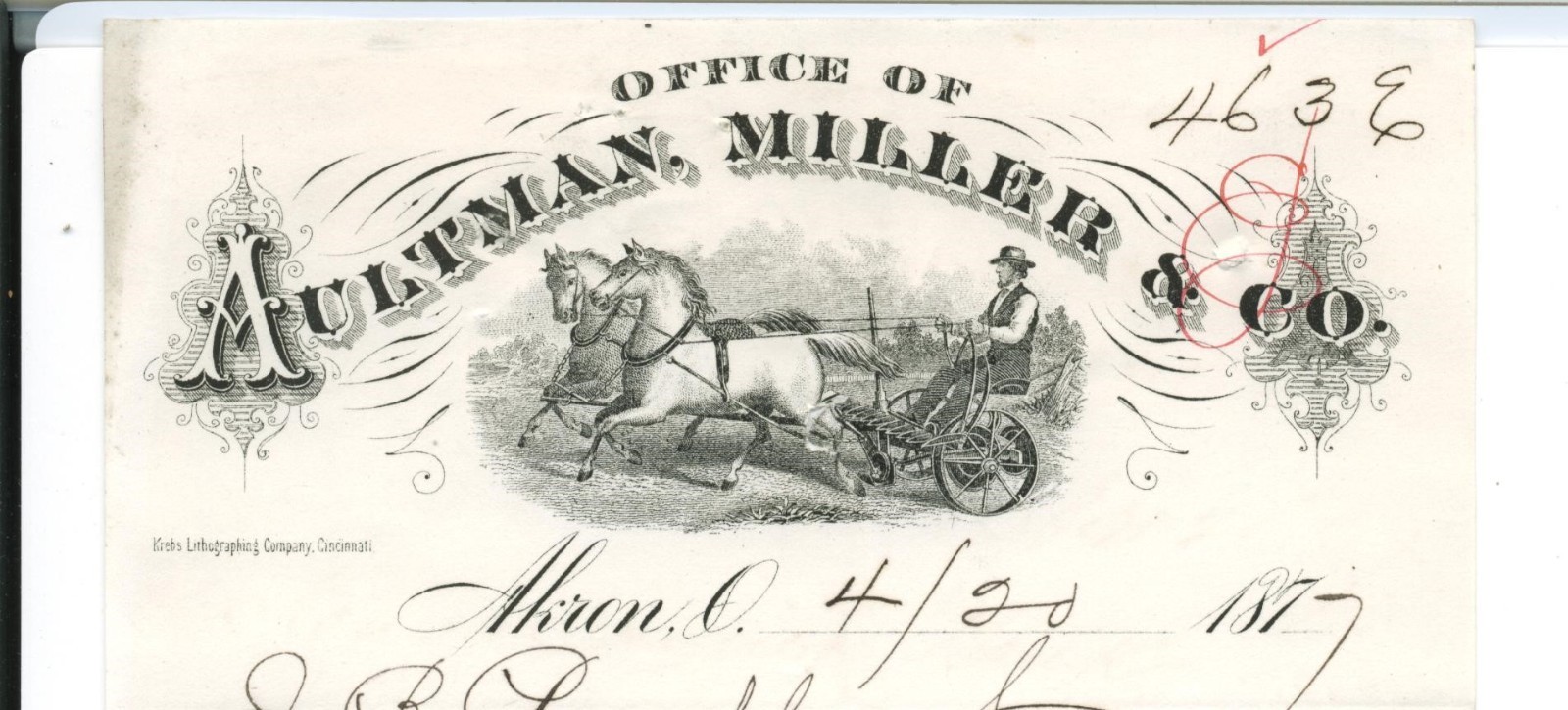
Antique paper which has been stored on a bank spike file for over 100 years.
See photos for condition.
8.5 inches x 5.5 inches
Aultman, Miller & Co., based in Akron, Ohio, was one of the most prominent agricultural implement manufacturers in the United States during the late nineteenth century. The firm originated from the earlier Aultman & Taylor enterprise, founded by brothers-in-law Cornelius Aultman and Lewis Miller in the 1850s, and later reorganized as Aultman, Miller & Co. as the business expanded. Akron, still a developing industrial center at the time, benefited from its access to canals, railroads, and proximity to Midwestern farming regions, allowing the company to grow into a major producer of threshing machines, traction engines, and other farm equipment. Their products were central to the mechanization of American agriculture during a period of rapid rural transformation.
The company became especially well known for its threshing machinery, which dramatically reduced the labor required to separate grain from chaff. By the 1870s and 1880s, Aultman, Miller & Co. had developed a national and even international reputation, exporting equipment to Europe and beyond. Their introduction of steam-powered traction engines further expanded their influence, as these machines could power threshers and perform other heavy farm tasks. Like other leading manufacturers of the era, the firm relied on a network of agents and distributors who demonstrated equipment in rural communities, often traveling from farm to farm during harvest seasons. This hands-on sales approach helped build trust and familiarity among farmers who were transitioning from manual to mechanized methods.
Despite its success, Aultman, Miller & Co. operated in a highly competitive and volatile industry. Agricultural implement manufacturers faced constant pressure from rivals such as McCormick and Case, as well as economic fluctuations tied to crop prices and broader financial cycles. The Panic of 1873 and subsequent downturns affected farm incomes and demand for machinery, creating challenges for even well-established firms. Nevertheless, Aultman, Miller & Co. remained a significant industrial presence in Akron through the 1880s, contributing to the city’s early identity as a manufacturing hub. Its legacy reflects the broader story of American industrialization, where innovation in machinery played a crucial role in increasing agricultural productivity and shaping the economic landscape of the Midwest.