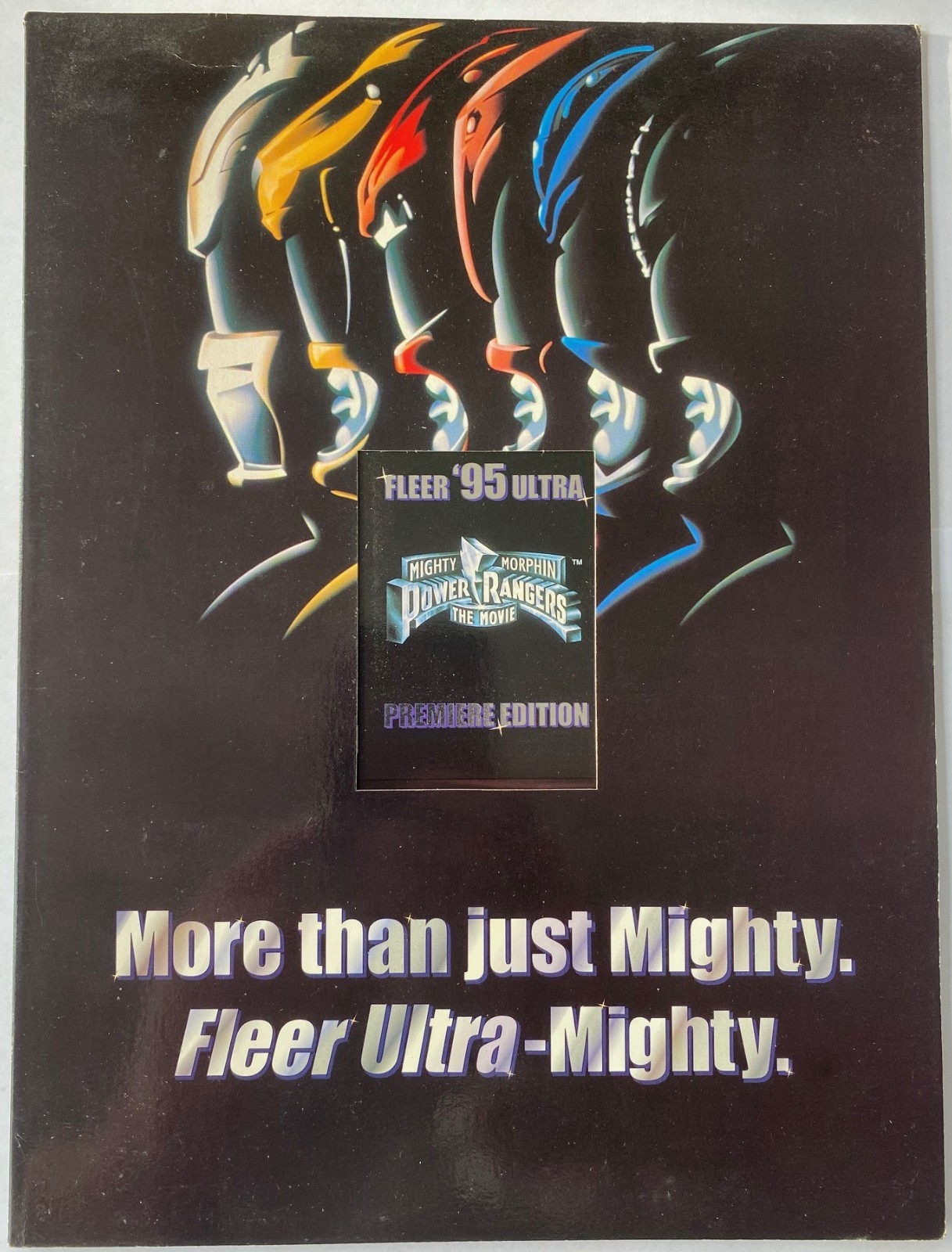
When you click on links to various merchants on this site and make a purchase, this can result in this site earning a commission. Affiliate programs and affiliations include, but are not limited to, the eBay Partner Network.
ALWAYS SHIPPED SAFELY AND SECURELY.
COMBINED SHIPPING GLADY APPLIED TO MULTIPLE ORDERS.WHY COLLECT PROMO CARDS?
Over the years, like most trading card collectors, I began to amass hundreds and then thousands of cards to complete various sets. However, as my collection grew, an inverse relationship developed between the space available in my house and the room I needed to keep these little pieces of cardboard in. Sound familiar? Candidly, I also started getting a little tired of seeing 100 pictures of the same TV show, movie, superhero, or actor.
Then, by chance, I discovered the promo card.
Approximately 35 years ago, I became acquainted with the sample cards manufacturers sent to card dealers and distributors throughout the United States and abroad to promote their upcoming releases. Shop owners could look at and feel a sample of the product before deciding whether to order it by the case, by the box, or not at all.
Back then, a store might receive only a handful of these cards. Owners would give one or two to their best customers, perhaps keep one for themselves, and often discard the rest. After all, these were free samples for a series that would soon be available. Few people gave much thought to their potential as collectibles in their own right.
For me, however, they opened the door to an entirely different way of collecting.
Promo, prototype, sample, premium—the terminology varies, and a purist may quite reasonably distinguish among these categories. Broadly speaking, their common purpose is to promote a product, event, or card set. Some were supplied directly to dealers; others reached collectors through magazines, conventions, product purchases, and numerous other venues.
Collecting promos was the perfect solution to the overcrowding and growing boredom I was experiencing with traditional card collecting. Why not collect just the one or two promotional cards issued for a particular set rather than all 100 regular cards? I could enjoy a much wider variety of subjects without needing another room to house them.
This task, however, was easier said than done.
There was no comprehensive guidebook telling me which companies had issued promos or how those cards had been distributed. To complicate matters, some announced sets were cancelled. Their promotional samples survived as the only cards from releases that never reached production.
Imagine the challenge in the early, pre- 1990s. First, you had to find a dealer who had received the cards. Then you had to hope that dealer had kept them. Finally, you somehow had to discover which manufacturers had circulated samples for sets that were never produced. There was no convenient online search to bring those answers together.
As if that weren\'t enough, some promotional samples differed only slightly from their regular-set counterparts. Many were clearly marked as promotional; others had no obvious identification and could be distinguished only by small differences in printing, text, numbering, or design. Heated telephone conversations (NO INTERNET YET) about whether a particular card was or wasn\'t a promo took place in many parts of the world.
Then arrived, making it possible for collectors to find material far beyond their local shops and shows. In 1997, a dedicated collector—thank you, Todd Jordan!—published the Promo Card Encyclopedia and Price Guide. At last, collectors had a reference devoted to this specialized field. Subsequent editions, through 2008, shed much more light on the hobby, and an expanded and updated online version appeared in mid-2026.
Yet the discoveries have never stopped.
Previously undocumented promos produced by legitimate manufacturers under official licenses continue to surface. Meanwhile, collectors who thought their favorite set was complete learn that a promotional card exists and begin searching for that last elusive addition to their “master” set.
One of the most compelling aspects of early promo collecting is the uncertainty surrounding how many cards actually survived.
Manufacturers generally did not disclose production quantities for those early issues. Around 2004, some began using promos as incentives for volume purchases, introducing a different model in which quantities or distribution requirements were sometimes specified. Those later practices should not be confused with the circumstances surrounding the early dealer samples.
With many early promos, collectors have neither a published production figure nor a reliable surviving population. The cards were created as advertising material, and their preservation was often an afterthought. Some were saved. Others were discarded, damaged, forgotten in dealers\' files, or lost when businesses closed.
Even those that survived were often handled and stored as advertising material rather than protected as collectibles. Finding an elusive early promo is one challenge; finding it in Near Mint or better condition can be another.
Their scarcity today can therefore reflect decades of neglect rather than a deliberately advertised limitation. A manufacturer may once have distributed a substantial number, yet finding even one surviving example can now be extraordinarily difficult.
That is part of the fascination—and part of the challenge.
Do your homework. Use price guides and online resources for what they were meant to be: guides.
Many promos remain unlisted. Of course, absence from a guide does not automatically make a card scarce. Nor does an ambitious asking price establish its value. Learn as much as possible about the history of the particular card you are considering.
Were a hundred thousand manufactured and widely distributed, or did only a handful leave the manufacturer\'s offices before the remainder were destroyed? Was the card recalled? Was the proposed set cancelled? Was it handed out at a convention, inserted into a publication, or supplied only to selected people within the industry?
And what has happened since?
How many examples have you actually seen offered for sale? Over what period? Have you searched for years without finding one, or does it appear regularly once you know where to look?
These questions matter because an original production quantity, even when known, cannot tell the whole story. Distribution, Survival and Condition must also be considered. A card\'s popularity helps determine demand, but understanding its scarcity requires looking beyond the subject pictured on the front.
Despite the enormous volume of trading cards offered online, some promos make only a cameo appearance every few years. Others remain known through collections, old records, or the recollections of people who received them, with no readily traceable public sale.
For the collector who enjoys research and discovery, that is a considerable attraction. There are still mysteries to solve, distribution histories to reconstruct, and overlooked cards to identify.
Promo card collecting remains one of the less thoroughly explored areas of the hobby. Its appeal encompasses far more than the possibility of finding something valuable: variety, history, the satisfaction of completing a difficult search, and the pleasure of recognizing something others have overlooked.
After more than 35 years, I still believe many early promos receive far less attention than their scarcity and historical significance warrant. Broader recognition may bring stronger prices for some issues, but the opportunity to discover and understand these cards is already here.
If you enjoy the thrill of the hunt, the satisfaction of discovery, and owning something few others have—or even know exists—start exploring promo cards. You may find that the smallest addition to your collection becomes the most interesting.
Bear in mind: condition is king at PRO-MO-KING2.
Buy with confidence.
SEE CURRENTLY AVAILABLE PROMO CARDS IN THE STORE\'S CATEGORY LISTINGS.