When you click on links to various merchants on this site and make a purchase, this can result in this site earning a commission. Affiliate programs and affiliations include, but are not limited to, the eBay Partner Network.
Please note there will be signature delivery. I’m sorry but it’s not negotiable. TY for y’all’s interest.
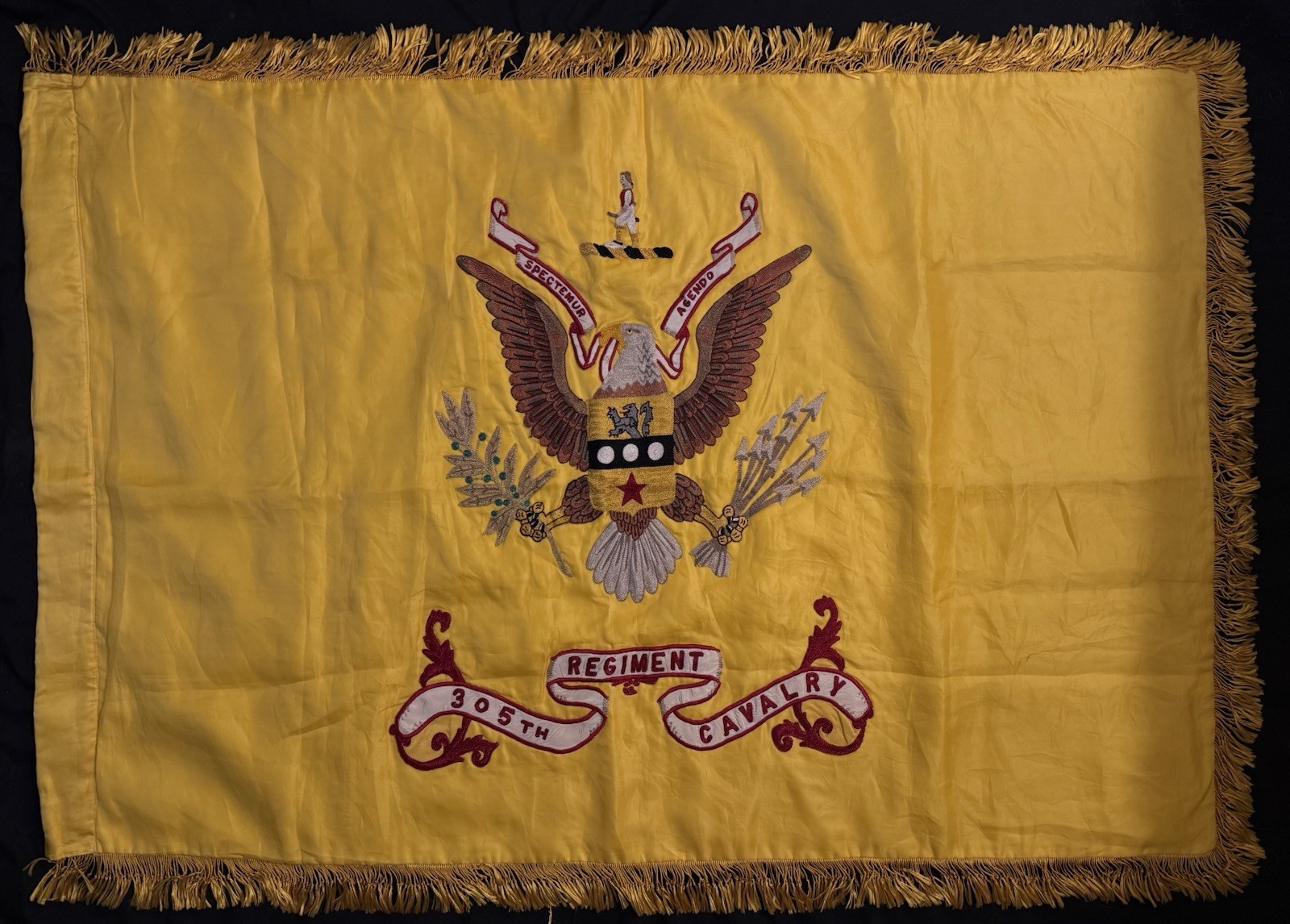
This is absolutely a Silk Banner. This banner was constructed at 1925.
Original Item:
Only One Available. The 305th Regiment, U.S. Cavalry Organized Reserves was a cavalry unit of the United States Army during World War I and the interwar period. It was activated in early 1918 but broken up in the middle of the year to form new artillery units. The unit was recreated as a Pennsylvania Organized Reserve unit during the interwar period, and was disbanded after the United States entered World War II.
DESCRIPTION OF SILK BANNER
This is a flag that represents the 305th Cavalry Regiment, also known as the "Regimental Colors".
In the Army, regiments, battalions and separate battalions have a standard of colors.
The first colors is the National Color, which is a version of the national flag trimmed with a 2+1⁄2 inch-wide (6.4 cm) gold fringe. It is equivalent to the King's Color in the British Army.
The second color is the Organizational Color, which is the same dimensions as the National Color but is of a single color representing the branch of the service that the unit is from. Each branch also has its own fringe color, which the Organizational Color is trimmed with. For instance, this flag represents a Cavalry Regiment, and therefore, the colors are yellow.
For regiments, the eagle from the Great Seal of the United States is in the center of the color, with the regimental coat of arms in the shield, much like this flag. The eagle holds a scroll bearing the regimental motto (Spectemur Agendo), with the crest of the regiment's coat of arms above it, and the regiment's name below.
Organization: 305th Cavalry Regiment.
Commander: Lieutenant Colonel Robert D. McCullough (January–26 August 1941)
Part Of: 62nd Cavalry Division (1921–1942)
Branch: United States Army
Active: 1917–1918 & 1921–1943
Motto: Spectemur Agendo (“Let Us Be Judged By Our Actions”)
Coat of Arms: The 305th's coat of arms was approved on 29 October 1924, and its distinctive unit insignia was approved on 30 January 1925. Both were rescinded on 2 February 1959. The distinctive unit insignia included a 1 1/8 in (2.86 cm) gold colored metal and enamel device, which consisted of a yellow shield divided by a black stripe with three plates in the center. A lion rampant was depicted above the stripe, and a red star with yellow border below it. The shield's color symbolized the cavalry, the stripe and lion were taken from William Penn's coat of arms, and the red star symbolized the 305th's initial organization in Texas and its artillery service. The regimental coat of arms was of a similar design to the distinctive unit insignia but included the Organized Reserve's Minuteman crest above the shield.
Flag Measurements (Without Fringe): 50” x 33”
CONDITION OF SILK BANNER
Upon close inspection, it is evident that the overall condition of the flag is quite impressive. The chain-stitched details on the yellow background are particularly striking, with the contrast adding a lovely touch to the piece. It is worth noting that these flags were rarely seen on the battlefields, as they were reserved for ceremonial purposes, which explains the exceptional condition.
While a few tangles in the fringe are present, there are only very minor stains on the flag. Apart from that, it is in very good condition, with no significant damage present. The hoist side still retains its tabs for attachment purposes, indicating that it was well-maintained and possibly stored appropriately. Overall, this is a remarkable piece that is sure to be a valuable addition to any collection.
305th Regiment, US Cavalry, Organized Reserves
The 305th Cavalry Regiment was a cavalry unit of the United States Army during World War I and the interwar period. It was activated in early 1918 but broken up in the middle of the year to form new artillery units. The unit was recreated as a Pennsylvania Organized Reserve unit during the interwar period, and was disbanded after the United States entered World War II
HISTORY of 305th CAVALRY REGT
Shortly after the United States entered World War I, the regiment was constituted in the National Army on 18 May 1917, and organized on 3 February 1918 at Camp Stanley, Texas. However, it was broken up on 15 August and its men were used to create the 44th and 45th Field Artillery Regiments, and the 15th Trench Mortar Battery. The 44th and 45th Field Artillery and the 15th Trench Mortar Battery were demobilized on 17 February 1919 at Camp Stanley.
On 15 October 1921, the 44th and 45th Field Artillery and the 15th Trench Mortar Battery were reconstituted in the Organized Reserve as the 305th Cavalry Regiment, part of the 62nd Cavalry Division in the Third Corps Area. The 305th was initiated (activated) in December with the entire regiment located in Philadelphia and headquarters at Schuylkill Arsenal. It became part of the division's 153rd Cavalry Brigade. In July 1928, it conducted training with units of the 52nd Cavalry Brigade at Mount Gretna, Pennsylvania. On 11 December 1929, it became a three-squadron regiment, with the new 3rd Squadron being activated at Philadelphia.
The 305th usually held its inactive training period meetings at the armories of either the 103rd Cavalry Regiment or the First City Troop. It conducted regular equestrian training on the horses of the Valley Forge Military Academy and often participated as a mounted unit in Philadelphia's Army Day parade. The regiment conducted summer training at Fort Myer and Fort Belvoir with the 3rd Cavalry Regiment. As an alternate form of training, the 305th provided basic military instruction to civilians under the Citizens' Military Training Camp program at Fort Myer. Its designated mobilization training station was the York Concentration Area in Pennsylvania.
After the United States entered World War II, it was disbanded on 18 October 1943 due to most of its officers being called up for active duty. An unrelated reserve unit, the 305th Armored Cavalry Regiment, briefly existed after the war in Indiana.
EVOLUTION OF REGIMENTAL COLORS
1918-1939
• Regimental colors evolution (1918-1939)
The period between World War I and World War II saw changes to regimental colors, or standards, and their associated elements across different armies. This shift was largely influenced by the realities of modern warfare and the decreasing tactical importance of these flags on the battlefield.
• Design changes:
In 1920, following World War I, US Army regulations stated that a unit's coat of arms would be placed on the breast of the eagle in the central device, and the crest would be distinctive to the unit. However, standardized regimental colors, like those issued during World War I, were no longer authorized by the War Department.
• Approval and manufacturing:
All designs required War Department approval, and only the U.S. Quartermaster could manufacture flags.
• Guidons for identification:
New Army Regulations in 1923 provided for issuing guidons to all company-sized units. These guidons, unlike their Civil War counterparts, were not intended for battle formations, but rather for identification purposes, according to the Connecticut General Assembly website.
• Branch colors:
The US Army utilized various colors to represent different branches of service. For example, infantry was represented by light blue, while artillery was represented by red.
• Marine Corps colors:
The Marine Corps officially adopted the colors gold and scarlet in 1918, although a flag with these colors wasn't designated until around 1939.