When you click on links to various merchants on this site and make a purchase, this can result in this site earning a commission. Affiliate programs and affiliations include, but are not limited to, the eBay Partner Network.
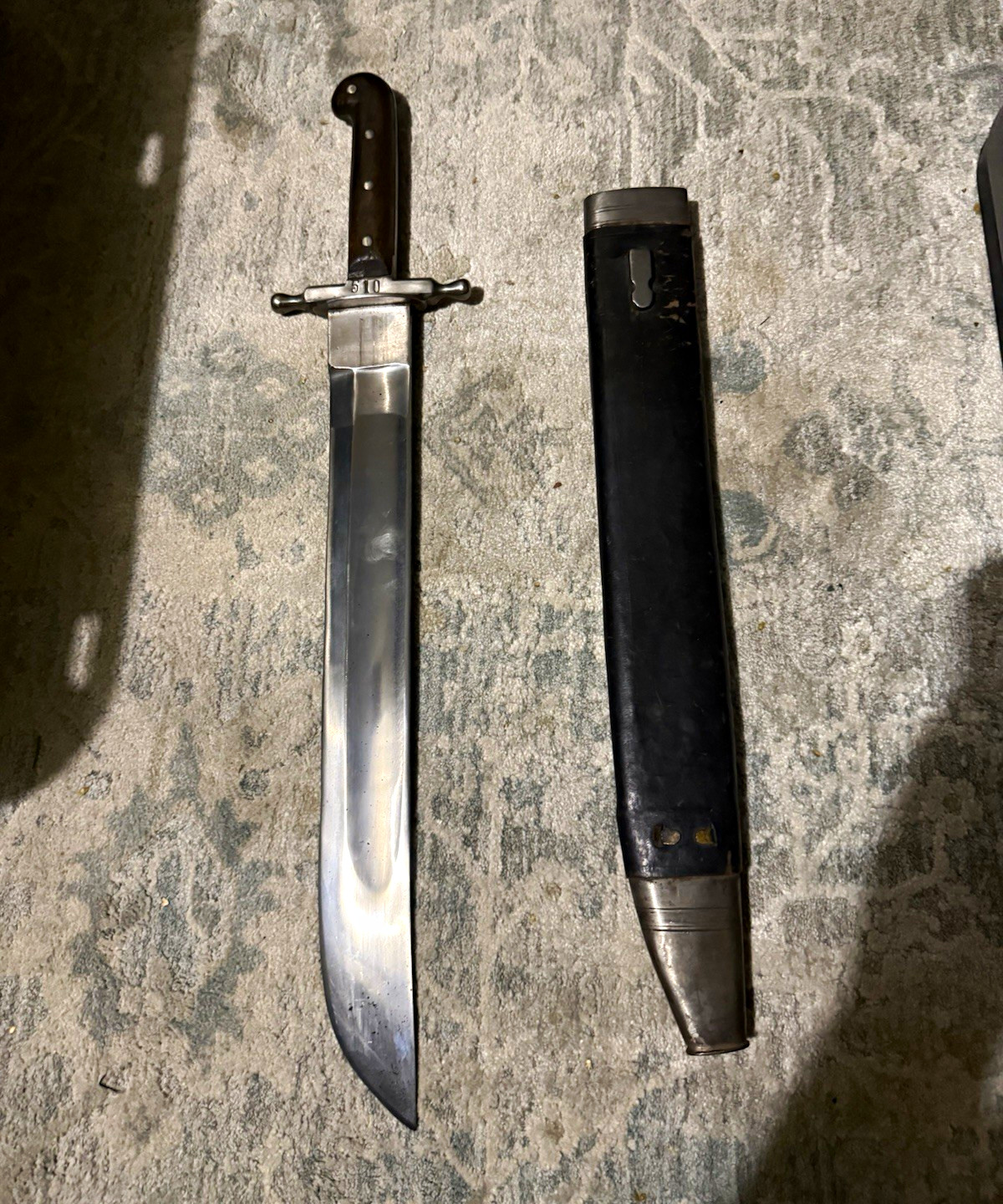
Best production era circa is between 1853-1885. Comes with original scabbard, great condition given age.Full tang short sword.This is an **Austro-Hungarian Model 1853 Pioneer\'s Short Sword** (German: *Pioniersäbel M.1853* or *Faschinenmesser M.1853*).It served a dual purpose in the Imperial Austro-Hungarian Army: as a formidable heavy sidearm and as a rugged field utility tool.---## Key Identifying Features* **The Blade:** It features a thick, heavy single-edged blade terminating in a distinct hatchet/falchion point designed for chopping. Notice that it is **asymmetrical**—one side has a wide, single fuller (groove) running down its length while the opposite side is flat.
* **Hilt & Guard:** The hilt has a straight iron crossguard with teardrop or ball finials at the ends. The **\"510\"** stamped into the crossguard is an inventory or unit tracking number.
* **Grip Material:** The contoured \"pistol grip\" handle consists of wood scales secured by steel rivets. *Original 1853 models used horn grips, but in 1889 (designated M1853/89), the military switched to wood for better durability and lower production costs.*
* **Scabbard:** The piece includes its original black leather-covered wooden scabbard featuring a steel throat (with a frog stud for belt attachment) and a steel drag/chape at the tip.---## Historical Context* **Who Used It:** Issued primarily to \"Technical Troops\"—including **Pioneers, Engineers, Sappers, and Artillery crews**. Later in the century, it was also issued to Medical Corps personnel and train drivers.
* **Primary Use:** While intimidating in hand-to-hand combat, it was mainly used like a heavy machete or hatchet to clear brushwood, construct gun emplacements, chop timber, and build field fortifications.
* **Service Life:** This design was so effective and durable that it remained in active military service from **1853 through World War I**.