When you click on links to various merchants on this site and make a purchase, this can result in this site earning a commission. Affiliate programs and affiliations include, but are not limited to, the eBay Partner Network.
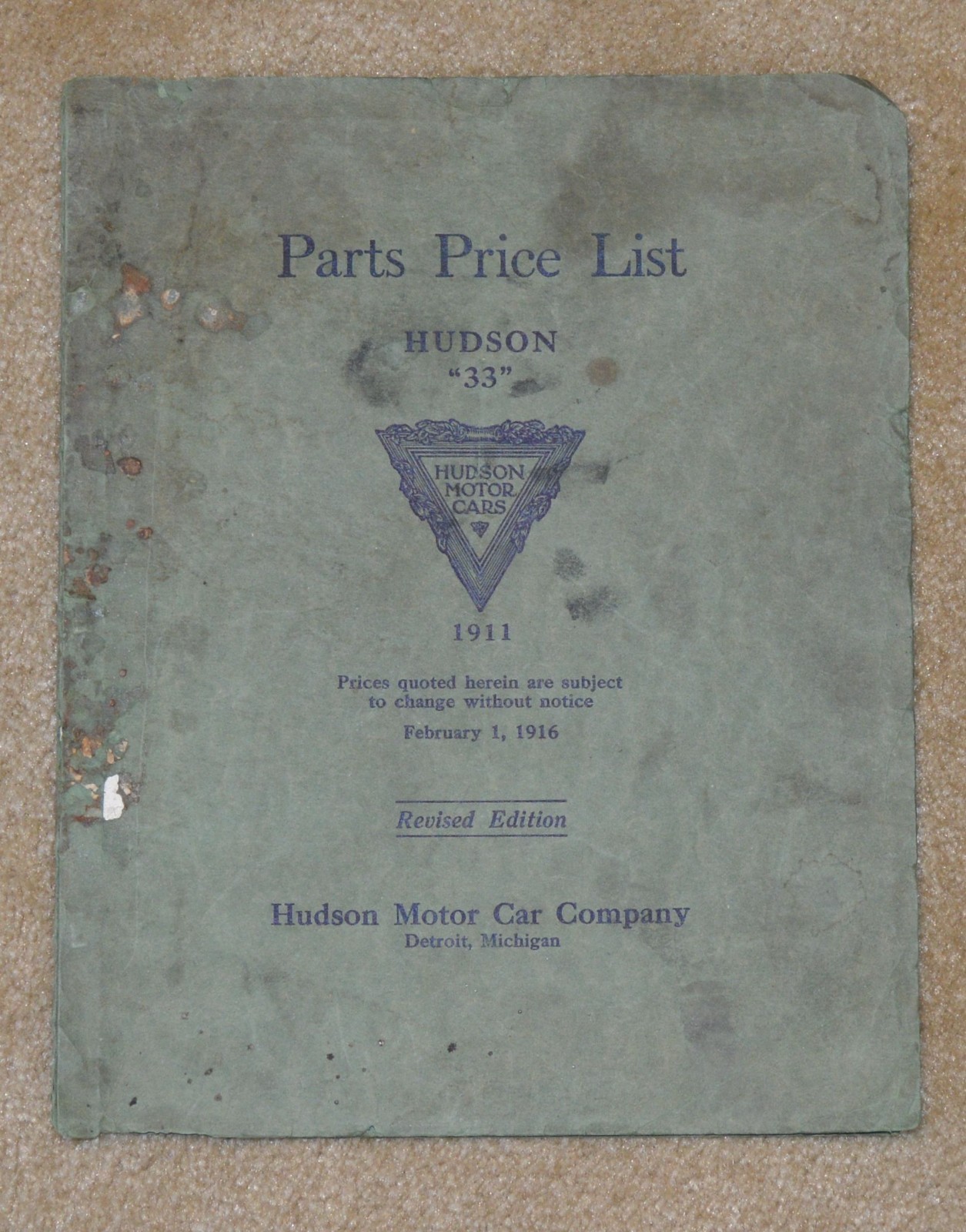
An extremely rare and well used 1916 HUDSON MOTOR PARTS 33 price list brochure measuring approximately 10 x 12 1/2 inch and in fair condition. The cover is dirty (see pics) probably from use at a dealership but the insides faired better (see pics). The inside features great pics of parts from Hudson and of course the prices for various parts.This 1911 Hudson 33 speedster was originally used to promote Hudson sales in Puerto Rico. It was driven for several days at 60 miles per hour in Puerto Rico to prove its reliability.The Hudson speedster is custom built on a race car chassis. A 33 horsepower, four-cylinder Buda engine powers the speedster-Hudson began producing their own engines just a couple years after this 1911 Hudson was built. It features a cork-faced clutch that is enclosed in oil bath.While playing golf in Puerto Rico in 1987, a Pennsylvania doctor found out his golf partner owned a few automobiles, including this 1911 Hudson speedster. Shortly after, the doctor bought this Hudson, a Pierce-Arrow and a Lincoln from his golf-friend and had them shipped to the United States. The current owner became interested in the Hudson at the Hershey show and bought it from the doctor about 20 years ago.
The 1912 Hudson 'Mile-a-Minute' Roadster was faster than its '60-mph' name implied. It was a very advanced vehicle though minimalist in design. It had a 100-mph Warner Auto-meter, Demountable rims with an extra rim in the back, lamps, Prest-O-Lite tank, and luggage carriers. It had a thirty gallon fuel tank and an additional tank for 10 gallons of oil. It was very well balanced and could travel the roads and raceways in better form than most other vehicles.It was a dual-purpose vehicle with both road and racing in mind. It had quick-fill oil and gas filler caps. For intense racing situations, the fenders could be removed to reduce weight even further.The Hudson Motor Car Company of Detroit, Michigan began producing vehicles in 1910 and would remain in production until 1954. Their first vehicles had a 20-horsepower, four-cylinder engine that promised speeds of 50 MPH. During their first year, around 4,000 examples were sold. The four-cylinder engine would remain in the Hudson line-up until 1916 when it was dropped in favor of a one-model policy. Their sole offering had a 4730cc Super-Six engine.The company was started by Roy D. Chapin with financial backing by J.L. Hudson, head of Detroit's famous department store that bore the same name.Hudson Motor Car company was founded by auto pioneers Howard Coffin, George W. Dunham, and Roy E. Chapin, and largely funded by department store owner Joseph L. Hudson. In 1910, just one year after it was created, Hudson was the eleventh-largest auto company in America — a country then rife with automakers.Hudson roasterHudsons were advanced for the times. Even their early cars were mainly closed models, sealing out the weather, which helped popularity. Hudson quickly put the steering wheel on the left and hand levers in the center, their modern positions, and adopted GM’s self-starter earlier than most makers, making cars easier and safer to start.Hudson carHudson had the first balanced crankshaft, used in their straight-six engine, which helped to increase smooth idling and allowed the engine to rev higher.1910 Hudson roadsterOther firsts included dual brakes — using mechanical parking brakes automatically when the pedal traveled lower than the hydraulic brakes’ normal maximum point — and mounting oil pressure and generator warning lights in the dashboard. Hudson’s early cork clutch was both smooth and, surprisingly, durable.1917 Hudson factoryIn 1919 Hudson brought out the Essex line, inexpensive but steel-bodied, to compete with Ford and Chevrolet (Chrysler and Plymouth had not yet been created). The Essex was one of the first affordable cars with an enclosed cab, and sold well, with its advanced all-steel body. Even with the 1919-20 recession, the new line quickly established itself, and within ten years, the brand was challenging Chevrolet.The car was launched as a four cylinder in 1919, but by 1924, it was a six-cylinder. Essex had factories in Canada, England, and Belgium, and made Hudson the third-largest automaker in the United States by 1929, behind Ford and Chevrolet.dual-cowl Hudson phaetonHudson’s peak was in 1929, when the company produced no less than 300,000 Hudson and Essex cars worldwide. But, despite the popular, inexpensive Essex and Essex-Terraplane (1932-38), the Great Depression mortally wounded Hudson.1929 hudson essexAn optional eight cylinder engine was launched in 1932, but sales remained slow due to the economy. Hudson began to eliminate Essex in favor of the Terraplane brand; restyled cars brought out in 1932 were named Essex-Terraplane, and starting in 1934 they were just Terraplanes. In 1938, though, the line was renamed to Hudson 112; and Hudson began building cars in Canada through a contract with Canada Top and Body in Tilbury, Ontario.Essex TerraplaneSome 1935-38 Essex/Terraplane and Hudson models came with a column-mounted electro-mechanical shifter, called the Electric Hand, a Bendix unit which replaced the floor shift. (Drivers still had to use the clutch.)1935 rumbleseat roadsterIn 1936, Hudson brought out its “radial safety control” or “rhythmic ride” suspension, which used two steel bars as well as leaf springs to suspend the front axle; this let Hudson use longer and softer leaf springs for a smoother ride, while maintaining directional stability. The cars were also much larger inside than other cars. The 1936 engines ranged from 93 to 124 hp, and had a column-mounted gearshift lever to free front seat space.hudson eightIn 1938, production numbers dropped from 111,342 (in 1937) to just 51,078. More than half of the production in 1938 was the 112, which had a 175-cubic-inch L-head six that was destroked from 5 inches to 4.5 inches. The 112 had a suspension like the larger Hudsons, a forward-hinged “alligator” hood, and a wheelbase 5 inches shorter than the Terraplane. However, the two-year offering wasn't completely new – it used Terraplane body parts whenever possible. And despite the cost-cutting efforts Hudson made with the 112, it still cost $25-45 more than its Chevrolet, Ford, and Plymouth competitors.In 1940, Hudson replaced the radial safety control suspension with an independent front suspension, unusual in its price range; two years later, Hudson brought out the Drive-Master transmission, which gave the driver a choice of manual shifting, manual shifting with automatic clutch, and fully automatic shifting (in essence, a manual transmission with complex vacuum-powered clutching and automatic shifting). The system was also dubbed Super-Matic when coupled to the automatic overdrive. The system was used until 1951, when Hudson started buying GM automatic transmissions to replace the expensive, complicated feature.Hudson enginesThe Commodore was introduced in 1941. The next year, it was redesigned and had the option of the “Drive-Master” vacuum-assisted clutch. Production of the Commodore resumed in 1946 after World War II with designing very similar to its prewar versions. In 1948, the Commodore line received “step-down” styling. 1952 was the Commodore’s last year of production.Hudson won a number of competitive events, stressing economy, speed, and hill climbing, to no avail. Then, for World War II, Hudson converted its factories to make war materials; many military boats were powered by Hudson Invader engines.After World War II, each automaker brought out their new and restyled models; Chrysler’s stodgy styling belied strong engineering. Hudson’s advanced engineering and styling helped it to compete at first, at least until V-8 engines and constant styling changes became essential.In 1946, the Hudson Super came with either a 103-horsepower, 212-cubic-inch six or a 128-horsepower, 254-cubic-inch eight and had a 121-inch wheelbase. Hudson manufactured a cross between a car and truck, the Carrier Six, which weighed 3,000 pounds. Only 2,917 Carrier Sixes were made, and it was a one-year-only offering.The new 1948 Super Six had unit-body construction; the “monobilt” cars were a foot lower than most competitors, but kept the same interior room; the design was a major advance because it lowered the center of gravity, improving cornering and safety.1953 Hudson HornetThe new Hudson Hornet, based on the Commodore, ran with the look, using a bored-out version of the standard L-head straight-six (308 rather than 262 cid). The low center of gravity and advanced design made cornering superior, and the dual-carbed engine provided power that could go up against the GM V8s. The Hornet was successful in NASCAR for years, and may have kept sales of Hudson’s largest car going. (During 1953-54, Hudson also sold the Wasp, a slightly shorter-wheelbase car with the same basic unit-body shell, and they also sold the Jet, a compact car. — thanks, Phil Waldrop)twin-H powerThe standard Hudsons were an excellent design for a mid-to-upper range car, but over time the lack of money for restyling hurt sales; the same basic look was maintained for years, while the Big Three made annual styling changes.Hudson tried to get into a new segment with the compact Hudson Jet, but the costly investment in what became a poor-selling car hurt the company. The Jet had styling unlike other Hudsons, but had the same “armored car” engineering as the larger Hudsons, and received a minor makeover in 1954. Its 105-inch wheelbase made it about the same size as the Nash Rambler and Plymouth’s smaller 1949 Deluxe, and in 1954, it also was available with Twin-H Power. But its not-so-compact weight of 2,700 pounds and high list price ($2,057) compared to its competition contributed to it being dropped in favor of the Nash Rambler in the AMC merger.Hudson’s refusal to bring out a modern V-8 engine also hurt the company; even stodgy Chrysler had brought out its “dual rocker” (Hemi) V8 in 1951. Despite low performance, Ford’s V-8 had been a major asset for salesmen for years, and wins on the track didn’t seem to overcome the American desire for more cylinders. The old straight-eight was smaller in displacement than the company’s own six-cylinder, and correspondingly less powerful.1953 Hudson HornetHudson, given its bleak long term outlook and continuing losses, agreed to merge with Nash, while Studebaker merged with Packard, with the final goal of putting together all four automakers to cover all segments of the market, share engineering, and have the economies of size they needed to compete with GM and Ford. Hudson’s main demand appears to have been keeping their name alive — their cars were dropped almost immediately, though.1953 ramblerThe plan was not to be; Studebaker and Packard eventually faded, still separate. Hudson and Nash coupled in 1954 to become American Motors Corporation (AMC), but the combined company was both too small and too erratic to succeed, though it did survive.Hudson proudly introduced a new line of Wasps and Hornets in 1955, “new from stem to stern,” but sales fell as customers found that the “new Hudson” was in fact an old but restyled Nash. The corporate leaders gave up on pretense in 1957, calling all cars Nash, shortly afterwards dropping Nash as well, and renaming all their cars Rambler after their most popular car. Eventually, they switched to the corporate name, AMC.Chrysler bought AMC in 1989 and put its engineering chief in charge of the once-leading-edge Chrysler Engineering staff. In the end, the remnants of Hudson, Nash, and Willys helped to lead Chrysler Corporation to a new, albeit brief, golden age.1955 Hudson Wasp
Hudson performance (by Denzil Palmer)A standard 1937 Hudson Eight went to Utah and broke the 1,000-mile record in its class (and also the unlimited record for closed cars) averaging 88.9 mph including stops for petrol. By comparison the Hudson Terraplane Six did the same distance averaging 86.5 mph. That gives you an idea of their top speed under good conditions and well tuned.The Eight also broke the 24-hour record at 87.67 mph covering 2,104 miles at top speed. So the Hudsons were the top speed winners at this time over a sustained distance, for standard sedans. These figures are taken from an article on pages 20-23 of Automobile magazine of November 2002.The 1938 Hudson Eight did 0-60 in 15.0 secs. The 1936 Hudson Eight did it in 18.6 secs, top speed 86.7 mph and SS 1/4 mile in 21.2 secs but this was probably a low compression motor. By comparison, the 1934 Ford V8 sedan (85 hp) had a measured top speed of 81.8 mph and a 0-60 mph on 16.8 secs. [Webmaster note: to be fair, the Hudson was a luxury sedan, considerably larger and probably heavier than the Ford. Supporting this comparison is a 1935 test, in which the Ford V8 was soundly beaten by a Plymouth Six. The Ford did the full mile in 68 seconds, the Plymouth in 60; the top speed for the Ford was 82 mph, the Plymouth 90 mph! No Hudsons were tested that time. Hudson did make two versions of their engine through at least some of the 1930s, a higher performance and a lower compression version.]The Hudson’s immediate predecessor the 1933 Essex Terraplane Eight was the car that really made Hudson company’s performance image in the 1930s. It was the original factory hot-rod sedan with 0-60 mph in 14.4 secs, top speed 85 mph, 10-30 in top gear in 6 seconds, 10-60 in top gear in 18 secs and broke numerous records including many hillclimbs and the standing kilometre record in its class (36.3 secs) which it held for 17 years. These figures were staggering in 1933 for a standard affordable family sedan. I have one and it is a great car to drive. It was significantly lighter than the later cars with a better power/weight ratio.
AD
Finally a Browser that Gets Rid of Unnecessary Distractions
Sponsored by Microsoft Edge
Microsoft Edge, the recommended browser for Windows 10, comes with a new Reading View that makes distractions a thing of the past. See for yourself.
The 1936 Hudson lineIn 1936, Hudson’s launched new six and eight cylinder models with elegant styling. New features were impressive, including hydraulic brakes - the first ones with a separate safety system that automatically took control in emergencies - as well as a more cushioned ride, draft elimination, and “tru-line steering,” which “enables the car to hold its direction, without swerving or wandering, unaffected by spring action, braking, or road conditions.”1936 Hudson Custom Six BroughamThree models were available (arguably a single car with three variants): buyers could choose a six with a 120-inch wheelbase (at 93 and 100 horsepower, coincidentally the same ratings as Chrysler’s later 2.2 and 2.5-liter fuel-injected engines), or an eight on a 120 or 127-inch wheelbase, boasting 113 and 124 horsepower.inside the 1936 Hudsonsinside Hudson Motor CarsThe Hudson’s interior boasted considerable space for six passengers, with a full 145 cubic feet - compared to 121 cubic feet in “the largest of other popular cars.” The rear seats have what seems like incredible leg room, and though the sloping roof looks like it would cut into headroom, there is still plenty of room for even tall passengers. Each seat was 56 inches wide above the armrests, 53 inches wide at shoulder level. Upholstery was done in mohairs and worsteds, with new two-tone fabrics never before used in cars. The driver's seat was adjustable, which was still unusual; the steering wheel was also adjustable, a feature not to be common for many years.Hudson called “radial safety control” one of the greatest engineering advancements of all time, perhaps a bit of hyperbole. In essence, the front axle was held in place by two large forged steel arms, so that axle movement could not affect the sprints, and steering or braking would not move the axle. They claimed it was “one great step beyond independent springing which motor car engineers have been seeking,” perhaps not quite getting the point. The axle was supported up-and-down by leaf springs, with the large two arms being able to move up and down but not side to side.(D. Palmer added:) The radius-rod front suspension had a further important benefit of anti-dive braking which was promoted at the time by Hudson - I can vouch for the fact that they are very powerful brakes with zero dive under maximum tyre-squealing retardation.Rhythmic ride was also touted. This is essentially due to the use of oil-cushioned shock absorbers and softer leaf-springs (since the steel arms helped to keep the axle in place, springs could be softer). The springs were also made longer for a more comfortable rhythm. Adding to that were “air wheels and big pillowing tires,” in Hudson’s words.The same system brought “Tru-Line Steering,” otherwise known as the ability to keep the steering centered (or return to center). Again, since the axle was held in place left-to-right by two arms, rather than being attached by springs, the car could be stopped in a straighter line, and hitting bumps had little effect on the steering direction.draft freeDuo-automatic hydraulic brakes were a key safety feature. The regular service brakes were normally used, with a separate channel “in the rotary equalized reserve system” coming into play at the bottom of the brake pedal travel; if the primary brakes failed, the secondaries would be used. D. Palmer wrote: “The dual action brakes were hydraulic on the primary circuit and cable on the emergency circuit. If the hydraulics failed, you always had cable back-up working on the rear brakes only, ie the park brake circuit.”The automatic draft eliminator was one of those clever features used in the days before full-blown climate control. The system included weather-tight doors and a wide cowl ventilator; fresh air was drawn in by the cowl, and sent out through a small opening in the floor by the rear of the car. The fresh air actually was passed through a filter, not unlike the system used in many cars today, though the filter then was in bag form.When lots of fresh air was desired, the Hudson featured sliding rear quarter windows and draft deflectors that operated when front windows were opened. “Turn the handle and they are windscoops, turn again and they roll right down into the door with the rest of the window.” (These were essentially a split window, with the forward portion being used as a wind deflector or scoop.)Storage space was quite good even by today’s standards, due partly to a design which today could be called a modified hatchback; the car looked like a wagon, with no separate trunk, and a very large rear hatch opening with 17 cubic feet of space in the trunk. (If the spare tire was carried inside, that went down to a meager 12.5 feet.) In “trunk models,” cargo space went up to a full 21 feet (16.5 with the spare), good by today's standards. The main difference appears to be a cargo door that bulged outwards rather than a flat door.Hudson trunksHudson also bragged about their engines, with gas mileage of 18-20 mpg (20.1 mpg in a national economy test), and a built in oil cooler that allowed oil to last longer. Another drivetrain feature was the Electric Hand option, which “shifts gears at finger touch.” The Hudson apparently set economy records at Bonneville Salt Flats, and, according to the company, was used extensively by law enforcement.Both the six and eight cylinder were in-line, L-head designs (not V6 and V8, but I-6 and I-8). Durabilty features included a six-blade water pump impeller, new thermostatic control that provided heat in winter without overheating the engine, a downdraft carburetor with anti-vapor lock and backfire arrestor, oversized generator, molybdenum alloy steel rear axle with wide-toothed gears and oversized bearings and shafts for durability and quietness, a crankshaft with forged counterweights (made by Hudson itself), a well-sealed oil-cushioned clutch, heavy duty battery, roller cam tappet design, cooled and forced lubrication, high-chrome alloy cylinder block (without the need for special valve seats), and silicon aluminum alloy pistons with four pinned rings for lower wear and lighter weight. D. Palmer wrote that the 1936 Hudson Eight was tested by the English Motor magazine at 86 mph top speed and 0-60 in 15.6 seconds.1910 HudsonsWhile Dodge Brothers was known for being the first automaker to use only all-steel bodies, Hudson claimed both the world's safest chassis and the first car body made entirely of steel, noting “Hudson is the only automobile manufacturer making its own steel bodies.” After 27 years in operation, Hudson said they had 2.25 million cars on the road.Models made in 1936 included: Super Straight 8 Sedan (six passengers, DeLuxe and Custom series, 127 inch wheelbase)
Super Straight 8 Brougham (six passengers, DeLuxe and Custom series, 120 inch wheelbase, Touring option with curved hatch cover)
Super Striaght 8 Coupe (DeLuxe and Custom series, rumble seat or baggage space, 120 inch wheelbase)
Super Straight 8 Convertible Coupe (with rumble seat and optional "trunk," 120 inch wheelbase)
Six Four Door Sedan (six passengers, Custom, DeLuxe, or Touring [with “trunk”])
Six Custom Brougham (essentially the same as above, but no DeLuxe model)
Six Custom Coupe (with rumble seat or baggage space)
Six Custom Convertible Coupe (with rumble seat)building Hudson cars
1936 Hudson cars: specifications Weight: 2,930 - 3,280 lb
Six cylinder: 3" bore, 5" stroke, 212 cubic inches, 6.25:1 compression
Eight cylinder: 3" bore, 4.5" stroke, 254 cubic inches, 6:1 compression
Peak horsepower, standard engines, reached at 3,800 rpm
Optional engines: compression ratio 7:1
Ignition: metric plugs, full automatic advance
Battery: 105 / 125 amp-hour (six and eight cylinder)
Transmission: three-speed manual with optional Electric Hand for “pre-selective power-controlled gearshifting.”
Hudson was based in Detroit, Michigan.The Hudson Motor Car Company made Hudson and other brand automobiles in Detroit, Michigan, from 1909 to 1954. In 1954, Hudson merged with Nash-Kelvinator Corporation to form American Motors (AMC). The Hudson name was continued through the 1957 model year, after which it was discontinued.Contents 1 Company strategy
2 Essex and Terraplane
3 Hudson Eight
4 1936–1942
5 Female designer
6 World War II
7 1946–1954
8 1954–1957
9 End of the line
10 South Africa
11 Legacy
12 References
13 External linksCompany strategy
1910 Hudson Model 20 Roadster
1917 Hudson Phaeton
1919 Hudson Phantom, 1919 photoThe name "Hudson" came from Joseph L. Hudson, a Detroit department store entrepreneur and founder of Hudson's department store, who provided the necessary capital and gave permission for the company to be named after him. A total of eight Detroit businessmen formed the company on February 20, 1909,[1] to produce an automobile which would sell for less than US$1,000 (equivalent to approximately $26,337 in today's funds[2]). One of the chief "car men" and organizer of the company was Roy D. Chapin, Sr., a young executive who had worked with Ransom E. Olds. (Chapin's son, Roy Jr., would later be president of Hudson-Nash descendant American Motors Corp. in the 1960s). The company quickly started production, with the first car driven out of a small factory in Detroit on July 3, 1909.The new Hudson "Twenty" was one of the first low-priced cars on the American market and very successful with more than 4,000 sold the first year. The 4,508 units made in 1910 was the best first year's production in the history of the automobile industry and put the newly formed company in 17th place industry-wide, "a remarkable achievement at a time" because there were hundreds of makes being marketed.[3] Because of this sales success a new plant was built on a 22-acre parcel at Jefferson Avenue and Conner Avenue in Detroit's Fairview section that was diagonally across from the Chalmers Automobile plant. The land was the former farm of D. J. Campau. It was designed by the firm of renowned industrial architect Albert Kahn with 223,500 square feet and opened on October 29, 1910.[4] Production in 1911 increased to 6,486.[5] For 1914 Hudsons for the American market were now left hand drive.The company had a number of firsts for the auto industry; these included dual brakes, the use of dashboard oil-pressure and generator warning lights, and the first balanced crankshaft, which allowed the Hudson straight-six engine, dubbed the "Super Six" (1916), to work at a higher rotational speed while remaining smooth, developing more power for its size than lower-speed engines. The Super Six was the first engine built by Hudson, previously Hudson had developed engine designs and then had them manufactured by Continental Motors Company. Most Hudsons until 1957 had straight-6 engines. The dual brake system used a secondary mechanical emergency brake system, which activated the rear brakes when the pedal traveled beyond the normal reach of the primary system; a mechanical parking brake was also used. Hudson transmissions also used an oil bath and cork clutch mechanism that proved to be as durable as it was smooth.On 1 July 1926, Hudson's new 10 million dollar body plant was completed where the automaker could now build the all-steel closed bodies for both the Hudson and Essex models.At their peak in 1929, Hudson and Essex produced a combined 300,000 cars in one year, including contributions from Hudson's other factories in Belgium and England; a factory had been built in 1925 in Brentford in London.[6] Hudson was the third largest U.S. car maker that year, after Ford Motor Company and Chevrolet.[7]
Essex and Terraplane
1929 Hudson Roadster
1929 Hudson Model R 4-Door Landau Sedan
1931 Hudson 4-Door Sedan
1934 Hudson Eight Convertible Coupé
1934 Hudson Terraplane K-coupeIn 1919, Hudson introduced the Essex brand line of automobiles; the line was originally for budget minded buyers, designed to compete with Ford and Chevrolet, as opposed to the more up-scale Hudson line. The Essex found great success by offering one of the first affordable sedans, and combined Hudson and Essex sales moved from seventh in the U.S. to third by 1925.[8]In 1932, Hudson began phasing out its Essex nameplate for the modern Terraplane brand name. The new line was launched on July 21, 1932, with a promotional christening by Amelia Earhart. For 1932 and 1933, the restyled cars were named Essex-Terraplane; from 1934 as Terraplane, until 1938 when the Terraplane was renamed the Hudson 112. Hudson also began assembling cars in Canada, contracting Canada Top and Body to build the cars in their Tilbury, Ontario, plant. In England Terraplanes built at the Brentford factory were still being advertised in 1938.[9]An optional accessory on some 1935-1938 Hudson and Terraplane models was a steering column-mounted electric gear pre-selector and electro-mechanical automatic shifting system, known as the "Electric Hand", manufactured by the Bendix Corporation. This took the place of the floor-mounted shift lever, but required conventional clutch actions. Cars equipped with Electric Hand also carried a conventional shift lever in clips under the dash, which could be pulled out and put to use in case the Electric Hand should ever fail. Hudson was also noted for offering an optional vacuum-powered automatic clutch, starting in the early 1930s.
Hudson EightFor the 1930 model year Hudson debuted a new flathead inline eight cylinder engine with block and Crankcase cast as a unit and fitted with two cylinder heads. A 2.75 inch bore and 4.5 inch stroke displaced 218.8 cubic inches developing 80 HP at 3,600 RPM with the standard 5.78:1 Compression ratio. The 5 Main bearing Crankshaft had 8 integral counterweights, an industry first, also employed a Lanchester vibration damper. Four rubber blocks were used at engine mount points. A valveless oil pump improved the Hudson splash lubrication system.The new eights were the only engine offering in the Hudson line, supplanting the Super Six, which soldiered on in the Essex models.[4]
1936–1942
1938 Hudson 112 coupe
1939 Hudson Country Club Six Series 93 Convertible Coupé
1941 Hudson Coupé
Hudson dealer in Louisiana, ca. 1930-1945In 1936, Hudson revamped its cars, introducing a new "radial safety control" / "rhythmic ride" suspension which suspended the live front axle from two steel bars, as well as from leaf springs. Doing this allowed the use of longer, softer leaf springs ("rhythmic ride"), and prevented bumps and braking from moving the car off course. The 1936 Hudsons were also considerably larger inside than competitive cars — Hudson claimed a 145-cubic-foot (4.1 m3) interior, comparing it to 121 cubic feet (3.4 m3) in the "largest of other popular cars." (According to United States Environmental Protection Agency (EPA) measurements, the cavernous Chrysler LHS only reached 126 cubic feet or 3.6 cubic metres) With the optional bulging trunk lid, the Hudsons could store 21 cubic feet (0.59 m3) of luggage (the LHS, 19 cubic feet or 0.54 cubic metres), though that might have been an optimistic measurement. The 1936 engines were powerful for the time, from 93 to 124 horsepower (69 to 92 kilowatts; 94 to 126 metric horsepower).The 1939 models joined other American cars in the use of a column-mounted gearshift lever. This freed front-seat passenger space and remained the industry standard through the 1960s, when "bucket seats" came into vogue. Hudson became the first car manufacturer to use foam rubber in its seats. The Hudson Terraplane was dropped. For 1940 Hudson introduced coil spring independent front suspension, aircraft style shock absorbers mounted within the front springs and true center-point steering on all its models, a major advance in performance among cars in this price range. Despite all these changes, Hudson sales for 1940 were lower than 1939 and the company lost money again. The advent of military contracts the following year brought relief.The 1941 Hudsons retained the front end styling of the 1940 models but the bodies were new with 5.5 inches added to their length giving more legroom. A new manual 3 speed syncromesh transmission was quieter with all helical gears. Wheelbases increased by 3 inches, with offerings of 116, 121 and 128 inches, and height was decreased with flatter roofs. Convertibles now had a power operated top. Big Boy trucks now used the 128 inch wheelbase. In 1942 in response to General Motors' Hydramatic automatic transmission, Hudson introduced its "Drive-Master" system. Drive-Master was a more sophisticated combination of the concepts used in the Electric Hand and the automatic clutch. At the touch of a button, Drive-Master offered the driver a choice of three modes of operation: ordinary, manual shifting and clutching; manual shifting with automatic clutching; and automatic shifting with automatic clutching. All this was accomplished by a large and complicated mechanism located under the hood. They worked well, and in fully automatic mode served as a good semi-automatic transmission. When coupled with an automatic overdrive, Drive-Master became known as Super-Matic. Re-engineering of the frame rear end to use lower springs reduced car height by 1.5 inches. Sheet metal "spats" on the lower body now covered the running boards and new wider front and rear fenders accommodated this.
Female designerHudson Motor Company, wanting a female perspective on automotive design, hired Elizabeth Ann Thatcher, who later became Betty Thatcher Oros, in 1939. A graduate of the Cleveland School of Arts, now Cleveland Institute of Art,[10] and major in Industrial Design, she became America's first female automotive designer.[10][11][12] Her contributions to the 1941 Hudson included exterior trim with side lighting, interior instrument panel, interiors and interior trim fabrics.[10] She designed for Hudson from 1939 into 1941, leaving the company when she married Joe Oros, then a designer for Cadillac. He later achieved renown as head of the design team at Ford that created the Mustang.
World War II
Hudson Motor Car Co. factory in Detroit, circa 1930-1945As ordered by the Federal government, Hudson ceased auto production from 1942 until 1945 in order to manufacture materiel during World War II, including aircraft parts and naval engines, and anti-aircraft guns. The Hudson "Invader" engine powered many of the landing craft used on the D-Day invasion of Normandy, June 6, 1944.During World War II Hudson had also an aircraft division which produced ailerons for one large eastern airplane builder.[13][14] The plant was capable of large scale production of wings and ailerons as well as other airplane parts. On May 22, 1941, Hudson was given a contract for the Oerlikon 20 mm cannon with the Jefferson Avenue Plant responsible to convert the original Swiss drawings to American production standards.[15] The company produced 33,201 Oerlikons for the United States Navy with the original mechanism continued in use without major change and with complete inter-changeability of parts until the end of the war.[15] Hudson also manufactured millions of other weaponry and vehicle parts for the war effort. Hudson ranked 83rd among United States corporations in the value of World War II military production contracts.[16]
1946–1954
1947 Commodore Eight Convertible
1949 Hudson Commodore 4-Door Sedan
1952 Hudson
Hudson Hornet race carProduction resumed after the war and included a 128-inch (3,251 mm) wheelbase 3/4-ton pickup truck.[17]In 1948, the company launched their "step-down" bodies, which lasted through the 1954 model year. The term step-down referred to Hudson's placement of the passenger compartment down inside the perimeter of the frame; riders stepped down into a floor that was surrounded by the perimeter of the car's frame. The result was not only a safer car, and greater passenger comfort as well, but, through a lower center of gravity, good-handling car. In time almost all US automakers would embrace it as a means of building bodies. Automotive author Richard Langworth described the step-down models as the greatest autos of the era in articles for Consumer Guide and Collectible Automobile.[citation needed]For the 1951 model year the 6 cylinder engine got a new block with thicker walls and other improvements to boost Horsepower by almost 18% and torque by 28.5% making Hudson a hot performer again. The GM-supplied 4 speed Hydramatic automatic transmission was now optional in Hornets and Commodore Custom 6s and 8s.Hudson's strong, light-weight bodies, combined with its high-torque inline six-cylinder engine technology, made the company's 1951–54 Hornet an auto racing champion, dominating NASCAR in 1951, 1952, 1953, and 1954.Herb Thomas won the 1951 and 1954 Southern 500s and Dick Rathmann won in 1952. Some NASCAR records set by Hudson in the 1950s (e.g. consecutive wins in one racing season) still stand even today. Hudson cars also did very well in races sanctioned by the AAA Contest Board from 1952 to 1954 with Marshall Teague winning the 1952 AAA Stock Car Championship and Frank Mundy in 1953. Often Hudsons finished in most of the top positions in races. Later, these cars met with some success in drag racing, where their high power-to-weight ratio worked to their advantage. Hudsons enjoyed success both in NHRA trials and local dirt track events.As the post-war marketplace shifted from a seller's to a buyer's market the smaller U.S. automakers, such as Hudson and Nash, found it increasingly difficult to compete with the Big Three (Ford, GM and Chrysler) during the 1950s.[18] The sales war between Ford and General Motors conducted during 1953 and 1954 had left little business for the much smaller "independent" automakers trying to compete against the standard models offered by the domestic Big Three.[19] The Big Three could afford constant development and styling changes, so that their cars looked fresh every year, whereas the smaller manufacturers could only afford gradual change. Hudson's once innovative "step-down" unit body construction, while sturdy and innovative, also made restyling difficult and expensive. Although Hudsons dominated racing during this period, their feats did little to affect showroom traffic. Sales fell each year from 1951 to 1954 and only Korean War military contracts kept the company afloat. After the company's high-priced Jet compact car line failed to capture buyers in its second straight year, Hudson was acquired by Nash-Kelvinator (makers of Nash and Rambler) automobiles in 1954.
1954–1957
1951 Hornet Club Coupé
1957 Hornet Series 80 4-Door SedanOn May 1, 1954, Hudson merged with Nash-Kelvinator Corporation to become American Motors. The Hudson factory, located in Detroit, Michigan, was converted to military contract production at the end of the model year, and the remaining three years of Hudson production took place in Kenosha, Wisconsin.For 1955, both Hudson and Nash senior models were built on a common automobile platform using styling themes by Pinin Farina, Edmund E. Anderson, and Frank Spring. Common-body shell production for competing makes of automobiles was a manufacturing technique that had been used by the Big Three for decades. Although the 1955 Hudson used the inner body shell of the Nash, the car incorporated a front cowl originally designed by Spring and the Hudson team to be put on the 1954 Step-Down platform. The 1955 models also used the Hudson dashboard, "triple safe brakes" and Nash Weather Eye heater with Harrison Radiator Corporation-supplied lower cost Freon/compressor type air conditioning.Hudson dealers also sold Rambler and Metropolitan models under the Hudson brand. When sold by Hudson dealers, both cars were identified as Hudson vehicles via hood/grille emblems and horn buttons. Hudson Ramblers also received "H" symbols on fuel filler caps (and, in 1956, also on hubcaps). For 1957, Rambler and Metropolitan became makes in their own rights, and no longer were identified as Hudson or Nash.For 1956, design of the senior Hudsons was given over to designer Richard Arbib, which resulted in the "V-Line" styling motif, a combination of "V" motifs that carried Hudson’s triangular corporate logo theme. Sales fell below 1955 figures. For 1957, Hudson dropped the shorter-wheelbase Wasp line, selling only the Hornet Custom and Super, which featured a lowered profile and slightly updated styling.With a wider front track than Nash used, Hudson was the better handling car, and was powered by the famed 308 cu in (5.0 L) Hornet Six with the optional high-compression cylinder head and dual-carburetor manifold ("Twin-H Power"); the Twin H would disappear at the end of the 1956 model year.[20]The Wasp used the 202 cu in (3.3 L) L-head Jet Six engine (up to 130 hp (97 kW)) and this model (in sedan version) was Hudson's top seller. For 1955, for the first time Hudson offered a V8 engine, a Packard-designed and -built[21] 320 cu in (5.2 L) engine rated at 208 hp (155 kW) purchased by Hudson and Nash. All cars with the Packard V8 also used Packard's Ultramatic automatic transmission.[22][23] as an option costing $494 (equivalent to approximately $4,300[2]);[21] the Nash 3-speed manual was also available at US$295.[24]
End of the lineThe last Hudson rolled off the Kenosha assembly line on June 25, 1957. There were no ceremonies, because at that point there was still hope of continuing the Hudson and Nash names into the 1958 model year on the Rambler chassis as deluxe, longer-wheelbase senior models. The combined Nash and Hudson production volume was not sufficient to justify all new design and tooling, so the Rambler's platform was expected to be adopted to the longer cars.[25] One major trade magazine said rumors of discontinuance were false and the 1958 Hudsons and Nashes "would be big and smart". Factory styling photographs show designs for a 1958 Hudson (and Nash) line based on a longer-wheelbase 1958 Rambler. Front-end prototype photos show separate Hudson and Nash styling themes.AMC's President George W. Romney came to the conclusion that the only way to compete with the "Big Three" (General Motors, Ford, and Chrysler) was to stake the future of AMC on a new smaller-sized car line.[26] Neither Hudson nor Nash brand names had as much positive market recognition as the successful Rambler and their sales were lagging. Together with AMC's chief engineer Meade Moore, Romney had completely phased out the Nash and Hudson brands at the end of 1957. The decision to retire the brands came so quickly that preproduction photographs of the eventual 1958 Rambler Ambassador show both Nash- and Hudson-badged versions. The Rambler brand was selected for further development and promotion while focusing exclusively on compact cars.[27]Eventually, however, something close to the Hudson design was chosen for the 1958 Rambler Ambassador. Hudson brand enthusiasts will note the triangular grille guard and 1957-like fender "gun sights" and the fast-selling 1958 Rambler Customs wore 1957 Hudson-styled front-fender trim.
South Africa
Panel delivery van, Hostetler collection, Gilmore Car MuseumHudson cars were assembled from complete knock down (CKD) kits in South Africa by Stanley Motors in Natalspruit (Gauteng).[12]
LegacyFor the 1970 model year, American Motors revived the "Hornet" model name for its new series of compact cars (the AMC Hornet). AMC was later purchased by Chrysler, which at one time considered reintroducing the Hornet name in the Dodge model line (See: Dodge Hornet).The last Hudson dealership in the world was Miller Motors in Ypsilanti, Michigan,[28] which is now part of the Ypsilanti Automotive Heritage Museum.A collection of restored Hudson cars is located at the Hostetler Hudson Auto Museum in Shipshewana, Indiana.[29] Eldon Hostetler was an inventor who had a Hudson as a teenager and later started buying Hudson cars and restoring them.[30]A restored Hudson Dealership sign still occupies its original site on Highway 32 in Chico, California.[31]The 2006 film, Disney/Pixar's Cars, features a character named Doc Hudson, represented as a 1951 Hudson Hornet.