When you click on links to various merchants on this site and make a purchase, this can result in this site earning a commission. Affiliate programs and affiliations include, but are not limited to, the eBay Partner Network.
Andean Shawl Pins from Peru, Ecuador and Bolivia are also known by the Quechua names Tupu or Tupo..sometimes Topo. They are rarely worn now and have been replaced by safety pins! But even the first humans in South America crafted pins to hold their shawls together.
I have collected more than 250 of these unique indigenous jewelry over a period of 20 years. This is one of the loveliest ones from the museum quality collection. If you are interested in acquiring the whole collection, message me.
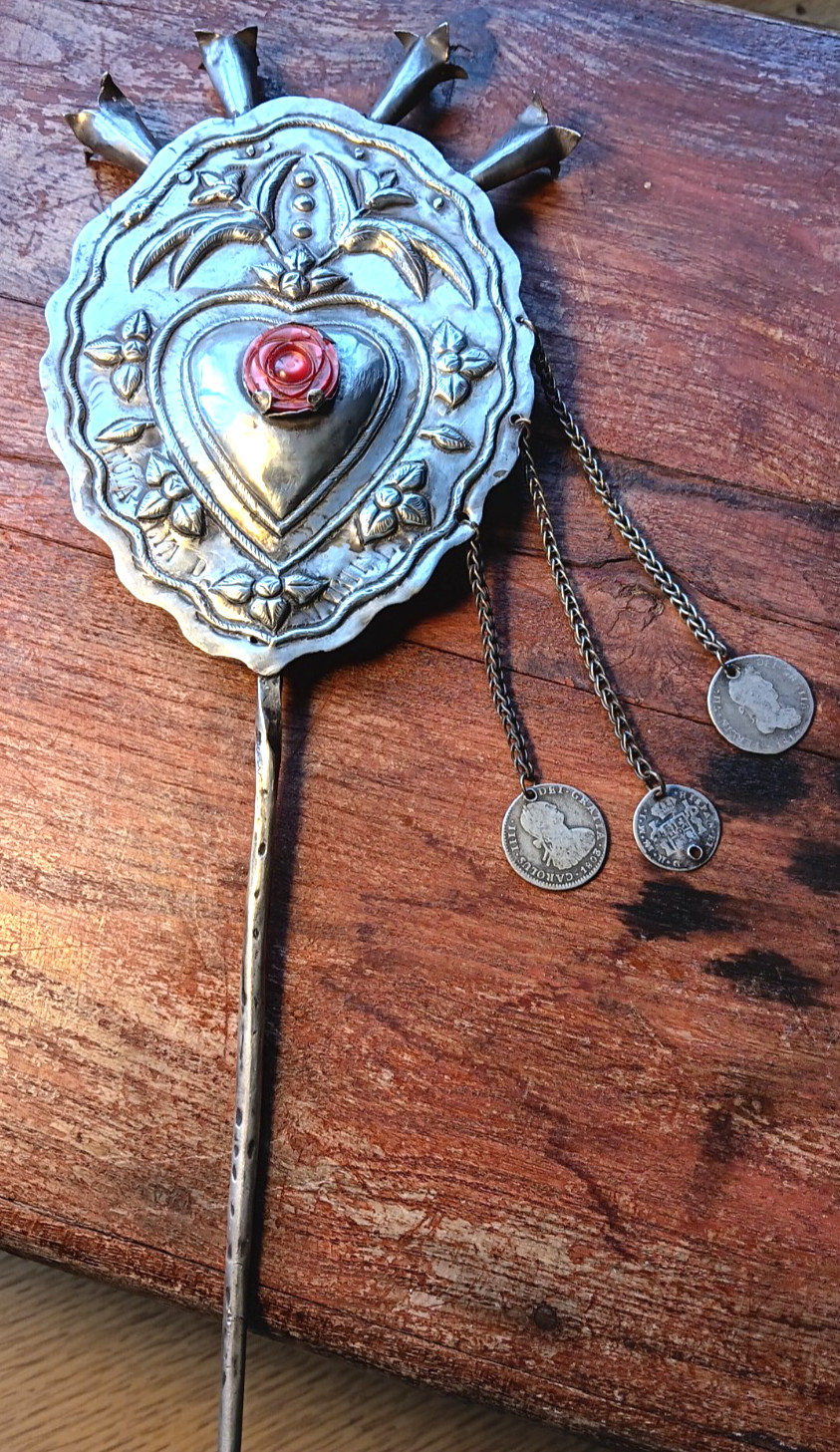
It is sterling silver but not marked as was the custom. The length is 13.25\", width is 4\". Weighs about 5 ounces. The pendants are two early Spanish silver coins dated 1803 and 1815 and a fish charm. The fluted finials are Cantutas...Datura flowers. The name of the owner is hand stamped in the lower quarter: Eulalia D, Martinez. The rivets in the Cantutas dates it to around 1850-1890.
I will continue to list more of these of all shapes, sizes and prices so you can start or add to your own collection! Please message me with any question! Thank you for checking out my other listings! Free shipping in US only. Limited international shipping.How I started
Many years ago, a collector friend showed me a photo of an extremely large and rare and Tupo from the Otavalo area of Ecuador he had been seeking for years. Modern copies were common but I had never seen one like this, the size of my hand--a spectacular regional example. I looked everywhere with no luck. I showed the paper to an Otavalan Indian friend. He said he might be able to find one...with time. Two years later, he flagged me down in the Plaza de Ponchos. He had finally found one. More than three years had passed. And also he wanted me to be a godmother to his new baby. I was hooked and started collecting and continued for 20 years. This art form was rapidly disappearing. Women were replacing their beloved Tupos with safety pins. By 1995, I only saw a few old women wearing Tupos. Unusual examples were becoming rarer and rarer, the metals melted down and reused or lost. I met only a few other collectors along the way. I felt it was imperative to save examples of these wonderful objects. Every Tupo tells a story. The kinray examples with their hanging charms and coins are both whimsical and meaningful good luck charms. The color of the stone denotes the marital status of the wearer; some are double sided with two different colored stones. Some utilize Vick\'s Vaporub cobalt glass shards for adornment. Peruvian crest Tupos celebrate independence. Lions, monkeys, peacocks and other animals were copied from foreign lithographs and imported pottery to make a fashion statement. Jungle Indians are represented. The spoon type were originally made from silver spoons and probably doubled as spoons. The motif was later elaborated into a dozen different variations.Women often told me that the Tupo could even be used as a weapon if need be. Just as weaving style indicates a woman\'s village, her Tupo also indicated her cultural identity. Some also incorporate symbols of Catholicism. Her silver Tupo was also a bank account and could be melted down or handed down. The largest, showiest examples were matrimonial Tupos, shared with all the brides within a village or family. You often see pairs: one for the lliclla and one to hold the outer manta. These graceful expressions of Andean identity and personal adornment that date back to the very first cultures in the South America are almost completely unknown in the United States.