When you click on links to various merchants on this site and make a purchase, this can result in this site earning a commission. Affiliate programs and affiliations include, but are not limited to, the eBay Partner Network.
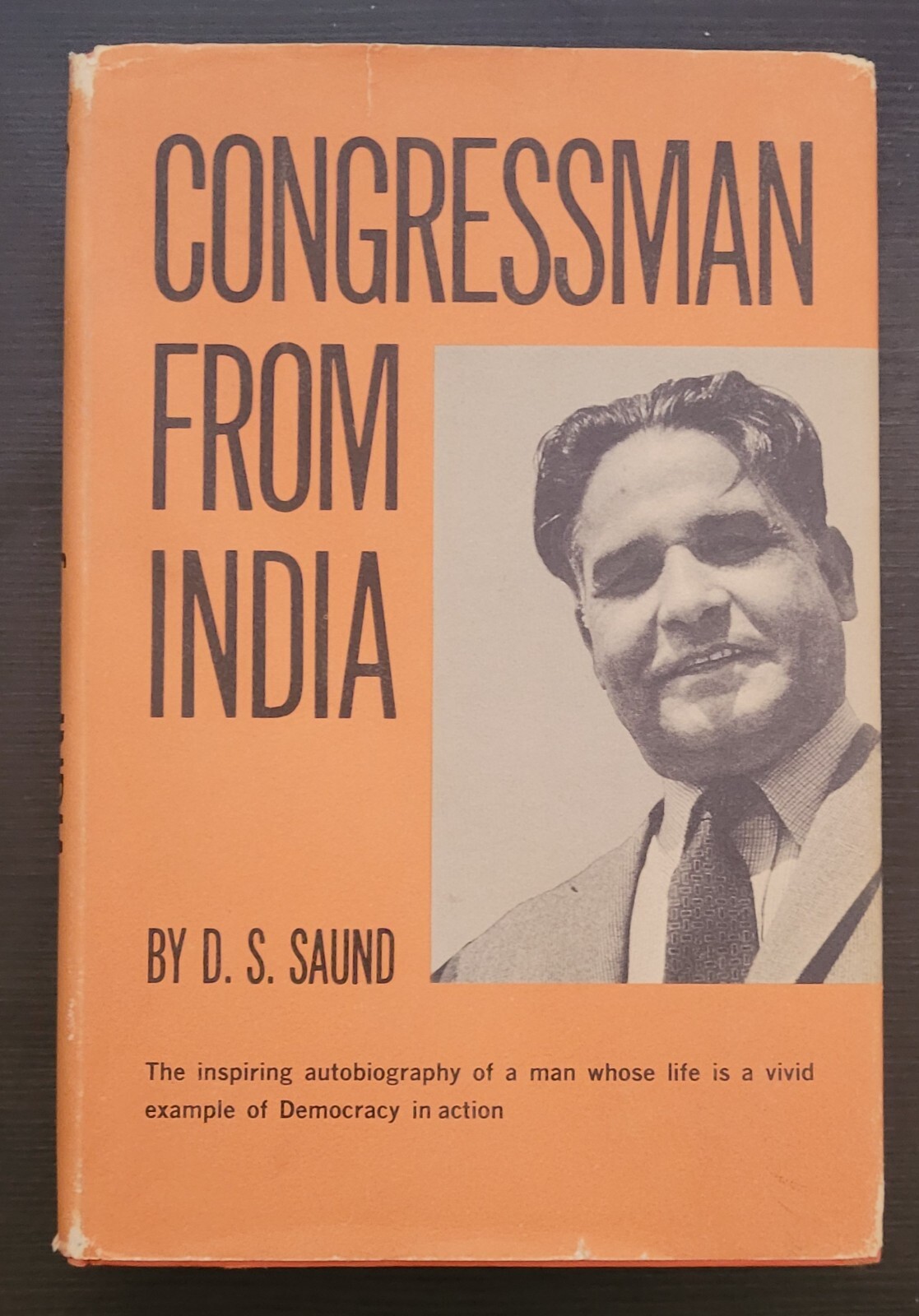
DALIP SINGH SAUNDCONGRESSMAN FROM INDIAHardcoverPublisher: Dutton, 1960Used. Dutton. Fine in Fair dust jacket. 1960. First Edition; First Printing. Hard Cover. A few minor scratches to cover.; vi, 192 pages . First edition.
signed/inscribed \"To my beloved friend M.Emil Corsillo with Sincerest regards, D.S. Saund.\" Interior is very clean and tight with slight yellowing of pages. dj good. there is a minor closed tear at top front and facing at edges. price intact.Dalip Singh Saund (September 20, 1899 – April 22, 1973) was an American politician who was a member of the United States House of Representatives. He served the 29th District of California from January 3, 1957 to January 3, 1963. He was the first Asian American, the first Indian American and the first member of a non-Abrahamic faith to be elected to the United States Congress. He was re-elected twice, becoming the first Sikh American, the first Asian American, the first Indian American and first member of a non-Abrahamic faith to be elected to Congress. On May 1, 1962, Saund suffered a severe stroke on an airplane flight which left him unable to speak or walk without assistance.The world took note when in 1956 Dalip Singh Saund, native of India, waselected to the U.S. Congress from the 29th California District, which thencomprised Riverside and Imperial counties. He was the first Asian to beelected to the Congress.There\'s no telling how far Saund might have risen in public life if he hadn\'tsuffered a disabling stroke early in his campaign for a fourth term. Heremained an invalid until he died in 1973.Earned Mathematics DegreeSaund was born in 1899 in a village called Chhajulwadi, Punjab Province,lndia, to an uneducated but industrious and successtul family with abackground of Sikh reformism and activism he went through a local schoolwhich in the absence of public schools. was financed by his father and uncles.1-3 graduated from the University of the Punjab in Amritsar, earning abachelor\'s degree in mathematics.Like many others of his status Saund was inspired by British promises ofindependence for India to follow World War I and was chagrined when thatpromise was abandoned. He was inspired by the writings of Abraham Lincoln,Woodrow Wilson and Theodore Roosevelt He was favorably impressed by thepreachments of Mohandas K. Gandhi, the great Hindu exponent of non-violentstruggle for independence.The young Saund persuaded his family to support him in a plan to study foodcanning in America with the intention of returning and starting an Indiancanning industry.\"l assured my family,\" he wrote in a 1960 book entitled Congressman FromIndia, \"that I would study in the United States for at least two and not more thanthree years and would then return home.\"At the University of California, Berkeley, where he studied at first in the Collegeof Agriculture, he lived in a clubhouse maintained by a Sikh temple group inStockton--evidence that there was already a complement of refugees andvisitors from India to California, most of them having arrived during World War Ias agricultural laborers.Stockton was the political and intellectual center of the colony. Imperial Valleywas one of its concentration areas.The Hindustani Association of America was active in Berkeley. After two years,young Saund was elected as its national president.\"AII of us,\" he wrote later, \"were ardent nationalists and we never passed up anopportunity to expound onIndia\'s rights.\" Here he learned at least one lesson in tactics. A political scienceprofessor was invited to speak. \"First,\" wrote Saund, \"I delivered a half-hour talkon the right of India to independence and the inequities of English rule. Hefloored me with questions that I couldn\'t promptly answer.\"From such defeats smart politicians learn. By the time he had launched hiscareer in American politics, Saund was usually in possession of more relevantfacts than were his opponents.He spent summers working for canneries, for McNeill, McNeill and Libby andfor California Packing Corporation (Del Monte), in Sacramento and Emeryville.According to his own later recollection, he was highly rated as a managementprospect in canning but downgraded because he expressed a consuminginterest in Indian liberation.Added Master\'s and Doctorate In addition to technical studies in the College ofAgriculture, Saund took courses in mathematics, his major field at Amritsar.The upshot was that, on invitation, he switched to that field, eaming both amaster\'s and a doctor\'s degree.The doctorate was granted in May 1924. Having over-stayed his intended timelimit, he later wrote: \"Even though life for me did not seem very easy, it hadbecome impossible to think of life separated from the United States... The onlyway Indians in California could make a living at that time was to join with otherswho had settled in various parts of the state as farmers.\"Although his later account didn\'t say so, it seems likely that he changedcourses and spent the necessary time to earn a doctorate in hope of a teachingcareer. He did mention offers from two universities in India but he was evidentlydetermined to stay in the U.S. at all costs. It was a year after receiving thedoctorate that he resorted to farming.Probably Saund had long been in touch with Hindus in Imperial Valley some ofwhom, despite menial beginnings, had become wealthy farmers. One of themoffered him a summer job as foreman of a cotton-picking crew. \"And so,\" hewrote, \"in the summer of 1925 I decided to go to the Southern California desertvalley and make my living as a farmer. \"He went still wearing a turban but there he launched his political career amongthe dominant Anglo society.As foreman of the cotton-picking crew, Saund earned a percentage of theamounts paid to the pickers. \"By the end of the season,\" he wrote, \"I hadmanaged to save quite a sum. I borrowed a little more from my friends andventured into the growing of lettuce.The crop that year was outstanding in quantity and quality, but because lettucehad been profitable in recent years the crop was over planted and the price waslow. He suffered a loss (but lettuce would again be profitable, to him and toothers).\'I had not heard of Saund until his political campaign in Riverside County waswell under way, in 1956, but I was doubly interested because of familybackground. My maternal grandparents and a host of uncles, aunts andcousins were living or had lived in Imperial Valley. Aubrey Lee, then my brotherin law, later recalled Saund\'s role in and around Westmorland in the late1920s:Typical Hindu\"He was a typical Hindu at the time, with his turban on, and he dressed with hisrobe. He was farming maybe two miles north and maybe two miles west ofWestmorland. At that time he was raising alfalfa. We called him the wild Indianbecause he came tearing by in that old Ford of his...Later on, when he was inthe Lions Club and getting into politics he said he was going to be the firstHindu congressman in the United States. He had a purpose.\"It was about 1937 when I organized a Current Events Club. Saund was amember. It was strictly liberal people, most of them being Democrats \"Of the local forum organizations, Saund remembered most fondly theToastmasters\' Club of Brawley, where the purpose was not only mutual selfenlightenment on current issues but practice in speech-making itself. It wasone of a chain of such clubs. He became it’s district governor, visiting memberclubs in Imperial and San Diego counties and becoming further acquaintedand further skilled.If he was irrigating on Toastmaster nights he would \"...take my dress suit in mycar to the field with me. At 6 o\'clock I would change into my suit, set my water forthree hours, go to the meeting, come back to the field, change to my workclothes and go on with my irrigating.\" A real American hero out of Horatio Alger,Jr.! Strive and Succeed!Saund often spent time in Los Angeles, especially in libraries and sometimesin speech-making.Early in his Imperial Valley years he wrote the first of his two books, titled MyMother India. It was a response to one by Katherine Mayo titled Mother India, anegative version of the sordid and poverty-ridden aspects of Indian society.As a result of a talk he gave at the Unitarian Church of Los Angeles he met theKosa family, immigrants from Czechoslovakia: Mr. and Mrs. Emil Kosa Sr., EmilKosa Jr. and Marian. Both Kosa men were artists. Marian was a student at theUniversity of California, Los Angeles.Saund became a close friend of the family and in 1928 he married MarianKosa. She gave up her UCLA career (temporarily, it developed) and joined himin Westmorland.She shared his life in politics and political activity. She became active inwomen\'s organizations including, in time, the Parent-Teachers Association.She and Dalip were active tennis players on the courts at the Westmorlandschool. Within the family she was given (and retains today) the nickname of\"Maize\" in consequence of a time when she stood guard with a noisemakinggun to frighten birds from their crop of milo maize.Dalip Jr., first of their three children, was born in 1930, followed by lulie andEllie.Discrimination SurfacesWhile Saund had considerable acceptance, he also had rejections. Onerecollection from the Valley is that of Enoch Gullett, my uncle by marriage, whohad arrived in Imperial Valley in1901, the year of first irrigation there.He was an associate of Saund in the Westmorland Chamber of Commerce.They and others of that organization went together to the Grand Canyon for ameeting. According to Gullett\'s daughter, Geraldine Plumb, Saund was deniedadmittance to the hotel where they had made reservations. Both he and Gullettslept in an automobile.In 1991 I asked Marian Saund if she recalled that incident. She said he hadn\'tmentioned it but she did recall a similar incident in Stockton. He wasscheduled to speak at a meeting there. She registered in a hotel for herself,Saund and their son, then their only child. When Saund arrived after themeeting he wasn\'t admitted. All three left.The family life of the Saunds was altered by what was described as MarianSaund\'s allergy for the pollen of Bermuda grass. On account of the allergy, asshe explained it to me in 1991, she and the three children moved to LosAngeles in 1942 and took up residence in their old neighborhood. The familyreassembled frequently in Los Angeles or Riverside.Effie Lee, my sister, and her then husband, Aubrey Lee, had played tennis withthe Saunds and mingled with them socially. She recalled: \"Marian told me thatshe hadn\'t realized what the prejudice could be and that the children wouldn\'tbe accepted. It was commonly understood that the allergy was expedient andthat the treatment of the children in the Westmorland schools was the realreason they moved to Los Angeles. \"Geraldine Plumb agreed and so did her father, Enoch Gullett. At age 90 hisrecollections were tape recorded. Asked about the treatment of the Saundchildren, he replied: \"Well, they first went over to the Mexican school and theywere asked if they could speak English.\" Here Gullett laughed, presumably atthe thought that they couldn\'t speak English, and continued, \"You know that\'sthe thing that ran Mrs. Saund up to Los Angeles.\"Theoretically there was no \"Mexican school\" in Westmorland. Harding School,in the minority-poverty neighborhood, was nominally intended to give specialattention to children who didn\'t speak English but, in fact, it was a school forminorities including Blacks who spoke only English.In Los Angeles Marian Saund returned to UCLA, earned a bachelor\'s degreeand teaching credential and taught in the Los Angeles schools.Although my relatives in the Valley had known Saund for some time, I first methim in Riverside early in 1956 during his first campaign in our county seat.\"So you\'re from Westmorland,\" I said to him. \"I have an uncle there, Frank Lyall.\" I didn\'t know that Frank had been justice of peace and that Saund haddefeated him for reelection.\"Oh, Frank Lyall,\" he replied. \"Great friend of mine. Fine man. \"When next I saw Frank, who was a Ieading Westmorland business man, hewas incensed that Saund had professed to be his friend. He considered Saunda shady business man, explaining that he had welshed on a contract for sheepto graze on his alfalfa, making a conflicting lease with another sheep man andtaking money from both.“ Frank\'s wife, Manha Lyall, may have contributed to Marian Saund\'s decision tomove to Los Angeles. My mother, Effie Lyall Patterson, visited the Valley andlater said to me:\"...so I asked Manha,“Well, what kind of person is Mrs. Saund?” and she said, \'”Why Effie, she\'s asnice a person as you\'d ever hope to find. She\'s attractive; she\'s educated. Buther children are half breeds, and we just couldn\'t invite her to the book club.\'\"Although Marian Saund had belonged to two book clubs, in Brawley andWestmorland, there was another, which was considered the \"senior\" book clubof Westmorland. Martha Lyall belonged to it.Saund always accented the positive, claiming that his election and his careerwere demonstrations of American democracy in action. He never complainedof, or even mentioned, discriminatory treatment against himself, much lessmade an issue of it.In 1991 I asked Aubrey Lee and his second wife, Eileen Kirkpatrick Lee, aboutFrank Lyall\'s contention that Saund had welshed on a contract. Eileen Lee hadbeen Frank\'s bookkeeper.Both assumed that the accusation was probably true but, said Aubrey: \"A lot offarmers--this was during the depression and a farmer needed to plant hisalfalfa and he didn\'t have any money to buy seed. So a sheep man, wanting tofeed his sheep, would advance the money. They brought the sheep down fromMontana and Wyoming in late September or early October...and then the farmerwouldsell the feed to someone he didn\'t owe money to. \"Naturalization ProhibitedSaund campaigned for an end to the restrictions prohibiting the naturalizationof India natives as U.S. citizens. His campaign organization became the IndiaAssociation of America with Saund as it’s national head. It became successfulin 1946 when the bill was signed by President Harry Truman.(link to Record forposterity/Setting thescene/Luce-cellar act.)One of the earliest applicants under the revised law was Saund hirnself. Hetook the oath as a citizen on December 16, 1949. In 1950 he ran for justice ofpeace for Westmorland Township. He won in the balloting but a lawsuit byWestmorland business men resulted in a count decision voiding the electionon the ground that he hadn\'t been a citizen for the required year. (He was acitizen by the beginning of the term for which he was elected.)The Imperial County Supervisors appointed Frank Lyall to the position. In 1959Saund ran again and defeated Lyall by a narrow margin.Incidentally, Aubrey Lee confessed that in spite of considering himself a friendof Saund he had helped finance the lawsuit that set aside Saund\'s firstelection. \"I let them pressure me,\" he said of the other business men involved.Saund was no ordinary justice of peace. He refused to go along with thelongtime tradition of allowing the existence of a notorious Westmorland redlight district. Instead of routine fines functioning as license fees, he routinelydecreed jail sentences for prostitutes. He suspended the sentences if itappeared they were discouraged from returning. Since they came mostly fromMexicali, across the border, he encouraged the Border Patrol to raid the housesand charge the prostitutes with vagrancy. He gave the stiffest sentence, a fine of$l,000.00 and a year in the county jail, to the \"vice queen\" of the town. Herhusband, on the same charge, skipped bail and fled. Within Saund\'s time thered light district had disappeared.Through the State Judicial Council Saund was assigned to preside over justicecourts in El Centro and Brawley when judges there were ill.By 1951 Saund was chairman of the Imperial County Democratic CentralComrnittee, in which capacity he had a close-hand experience withcampaigning for Congress. The Democratic candidate in the 29th District wasBruce Shangle of Blythe, Riverside County. Saund managed the ImperialCounty pan of the campaign.It was good exercise in a losing cause. John Phillips, Republican, of Banningin Riverside County, had been the district\'s Congressman for many years, hisreelection becoming almost routine. He won in 1954, but in the following yearannounced that he wouldn\'t be a candidate in 1956.By that time Saund was well known in Imperial County for four major activities.He was an active Democratic politician. He was Westmorland justice of peaceand commonly referred to as Judge Saund. He was a major farmer and healso had a distributorship for chemical fertilizer, a business that was said tohave grossed $250,000 per year.In November, 1955, he announced his campaign for election to Congress byresponding to the endorsement of a gathering of Democratic activists, meetingin Indio, Riverside County.In preparation for the campaign the Saunds rented an apartment in Riverside.All of them, including Fred Fisher, Julie\'s husband, and Dorothy Saund, wife ofDalip Jr., took part in intensive house-to-house canvassing.The opponent in the Democratic Party was Karl Kegley, previously anunsuccessful candidate for state attorney-general with the support of one of theseries of inflationary pension plans for the elderly. He laid heavy stress onSaund\'s foreign-born status and on the fact that Saund had been sued byseveral creditors.Having been ardent in praising American democracy since his arrival in 1920,Saund apparently had no difficulty on the \"foreigner\" charge. He explained thelawsuits as the result of major loss during a bad farming year. It had happenedto other Valley farmers at the time, some of whom solved the problem bybankruptcy. He had declined to take that route and eventually had paid off thecreditors.Saund easily won the Democratic primary, enhancing the interest in hisunusual candidacy, well beyond California\'s borders.The Republican primary winner, Jacqueline Cochran Odlum, had been ,operator of a beauty salon in Chicago and was now a noted aviator and wife ofFloyd Odlum, financier and organizer of General Dynamics Corporation. TheOdlums lived in Coachella Valley, Riverside County. She had won the primaryby a rightwing attack on her leading opponent, Fred Eldridge of Corona,concentrating especially on Eldridge\'s association with the World Federalists, amovement looking toward world govemment.Eldridge declined to endorse Odlum for the November election. This, plus thefact that Phillips had not run again, might well have accounted for Saund\'smargin of victory.Odlum, too, stressed Saund\'s foreign-born status and charged that he wouldbe a setback to the district for lack of support for the Republican president,Dwight Eisenhower. She herself, as she emphasized, was personallyacquainted with the president.During a broadcast debate, Saund pointed out that on several issues, includingimmigration law and the soil bank program, he supported Eisenhower\'sposition while she opposed it. He stressed his support for farm subsidies.She campaigned by airplane. He and his campaign party traveled byautomobile.He won by a majority of 3,300 votes out of about 115,000. That thoroughlyconfirmed him as an international celebrity. One consequence of his unusualstatus and of his knowledge of foreign affairs was his appointment to theHouse Foreign Affairs Committee, highly unusual for a freshmanCongressman.Throughout his nearly six years as an active Congressman, Saund espousedwhat might be called a liberal agenda, but certainly not liberalism in extreme.He summarized his position in his book Congressman from India, publishedin 1960 during his second term.He advocated \"adequate national defense,\" explaining in not very specificterms, \"I firmly believe in a balanced budget, but we should never subordinatethe security of the United States for any budgetary considerations. \"He wrote that international Communism was spending far more than the U.S.on its effort to convert the world to its position and urged the U.S. government tospend more.He championed free enterprise, saying that the country\'s strength lies in thefact that Americans throughout history \"have enjoyed equality of opportunity. \"The small business man, he wrote, \"is the backbone of our businesscommunity. \"In his summary, and twice earlier in the book, Saund stressed the need for a\"fair shake\" for the farmer, explaining that they comprised 13 percent of thepopulation and received only six percent of the national income. For anagricultural constituency, that position was virtually required.He supported the 160-acre limit, per land owner, for federally subsidizedirrigation (a limit that has since been increased to 957 acres although in factthat limit is being evaded).,He was diligent in service to people and organizations asking solutions fortheir problems, including flood control and the search for supplemental waterfor Southern California.He said he supported civil rights legislation \"with all the power at my command.Triumph Over PrejudiceIn short, Saund made a case for himself as a working Congressman,representing constituents efficiently. He was, in fact, a successful Congressman, staying within supportable ideological boundaries and working diligently.But the best remembered aspect of his career was his remarkable triumph inspite of prejudice against foreign born, especially against those with darkcomplexions and against non-Caucasians, dark or light. He did it by hard workand evangelism, constantly turning the other cheek. He did it with charisma.His ideological positions and his charisma were best demonstrated when in1957, he visited many of the Far Eastern countries including his native Indiaand was acclaimed everywhere. He went as an official emissary of the Houseof Representatives, accompanied by Mrs. Saund and their daughter Ellie.They stopped in Tokyo and in Riverside\'s sister city, Sendai. They visitedTaiwan, where Saund expressed approval of that state\'s program, which wasinitiated in opposition to the Communist government on the Chinese mainland.They visited Saigon where he was critical of waste he observed in U.S.financedcontracts. U.S. military involvement hadn\'t begun in Vietnam, but U.S. financialand political involvement was manifest. Saund wrote that \"...you can not winminds and hearts by propping up dictators. \" (At the time the U.S. was proppingup President Ngo Dinh Diem.)They visited Indonesia where the flamboyant left-wing dictator Sukarno was inpower. Saund cautiously observed that Sukarno \"was an intense, dedicatednationalist, the kind of man who wanted power and enjoyed exercising it. \" Healso noted impatience among students and concluded that \"...we should doeverything possible to help guide that temper into truly democratic channels. \"He reacted with similar caution to problems he observed in Singapore and thePhilippines.The euphoria was unlimited when he reached his native India. He was cheeredby throngs and entertained by the high and mighty in Calcutta, New Delhi andBombay. The most animated outpouring of enthusiastic people was inAmritsar, where he had graduated from the University of the Punjab, and inChhajalwadi, his birthplace.Saund\'s reelections in 1958 and 1960 were by majorities of more than 60percent.Felled By StrokeHe was beginning his campaign for a fourth term when, in May, 1962, hesuffered a severe stroke while in an airplane approaching Washington. Hisfamily and staff minimized his disability and insisted that he would resumeactive political life. Despite his absence from public view he won theDemocratic Party nomination, but hints of his real condition becamewidespread. At March Air Force Base Hospital, a Congressional delegationvisited him and disclosed that he couldn\'t stand or speak. The fact was widelyreported to the voting public. Pat Minor Martin, the Republican nominee, waselected.Marian Saund, diligent, able and devoted, resumed her teaching career with theLos Angeles schools. With part-time help she cared for her husband during thelast, helpless, decade of his life. Eventually he was able to walk with the aid ofa walker, but he never regained his speech. He died on April 22, 1973.The Saund children did well in school and as adults. Dalip Saund Jr. graduatedfrom California Institute of Technology in mechanical engineering and thenearned a doctorate in anthropology at UCLA. He served as a lieutenant in theKorean War. He was killed in a (civilian) sport flying accident. The daughters,Julie Fisher and Ellie Ford, both became teachers after graduation from UCLA.All three have children and grandchildren. Marian Saund lives in San Diego withdaughter Julie and son-in-law Dr. Frederick Fisher.SOURCESThis account grows out of conversations I had with Dalip and Marian Saundduring his initial campaign for Congress in 1956 and during his subsequentCongressional service. However, all the statements attributed to him, whetherquoted directly or indirectly, are taken from his book, Congressman From India,published by E. P. Dutton & Co., New York, 1960.The Biographical Dictionary of the United States Congress (1774-1989)confirms the major milestones of his life. The files of the Riverside Press,Riverside Enterprise, and The Press-Enterprise contain many accounts thathave been helpful on re-reading.However, the comments of Dalip and Marian Saund in times of theirprominence and even current comments of Marian Saund tell only of oneaspect of the way they were accepted, and rejected, by their neighbors inWestmorland. Their purpose, no doubt, was to speak only good of theirneighbors but it\'s necessary to discount their giving Marian\'s allergy as the solereason she and the children moved to Los Angeles in 1942, where they liveduntil Dalip and Marian Saund became residents of Washington.The apparent real story, or a major part of it, was the Westmorlandmistreatment of the Saund children, especially in school. For this I have reliedon the recollections of my relatives-who lived in Westmorland or visited there--Aubrey Lee, Eileen Kirkpatrick Lee, Effie Patterson Lee, Geraldine GullettPlumb, Enoch Gullett and Effie Lyall Pauerson. As sources of an antagonisticlocal view of Dalip Saund there were two other relatives of mine, Frank andMartha Lyall.
In November 1956, D. S. Saund, who everyone simply called “Judge,” became the first person of Asian descent elected to serve as a United States Representative. He was a tireless champion of his southern California district and the farmers who called it home. But his unique backstory—born in India, naturalized U.S. citizen, successful businessman, county judge—also catapulted him to the international stage. During his career in the House of Representatives, at the height of the Cold War, Saund became something of a transcendent politician who had the singular ability to engage audiences abroad. Although he frequently confronted discrimination during his life in the United States, Saund maintained his belief in the promises of American democracy.
Dalip Singh Saund was born on September 20, 1899, and raised in Chhajjalwaddi in the far-northern province of Punjab, India, which at the time was a British colony. Saund’s father worked as a construction contractor for the government and died when Saund was only a boy. His parents had lived through the period of British colonialism and neither had attended school, but education was a cornerstone of Saund’s life. His father and uncles saved enough money to open a one-room schoolhouse about a half mile from where Saund lived. At the age of eight, his parents sent him to boarding school 16 miles away in the city of Amritsar near the border with modern day Pakistan.1
While in college at the University of Punjab, Saund supported the movement for an independent India led by Mohandas Gandhi.2 Along with his informal lessons in nonviolence and civil disobedience, Saund majored in mathematics, graduated with a BS degree in 1919, and moved to America to further his education. While he waited for his passport, Saund worked to expand his childhood school, planted trees along the roads throughout his village, and helped establish two community banks.3
During World War I, Saund read the speeches of President Woodrow Wilson in the news and later discovered the writings of Abraham Lincoln, especially the moving words of the Gettysburg Address.4 “Lincoln,” Saund later wrote, “changed the entire course of my life.”5 Saund had planned to spend no more than a few years in America learning the fruit-canning business before returning home.6 His trip west took him from Bombay to England and from England to Ellis Island, New York, where he arrived on September 27, 1920. “You are now a free man in a free country,” one of the immigration officers told him.7 Saund made his way west and enrolled in the University of California’s agricultural school and mathematics department as well.8
Berkeley, California, was not the most welcoming of places for Indian and Asian students, and “outside of the university atmosphere,” he later remembered, “it was made quite evident that people from Asia—Japanese, Chinese, and Hindus—were not wanted.”9 Saund, however, became involved with the local community and then earned MA and PhD degrees in mathematics in 1924.
After he finished his studies, Saund’s family informed him that the Indian government had been keeping tabs on his “anti-British utterances in America.” Saund decided to stay in California and later authored My Mother India, a book about his experiences at home and a critique of British imperialism.10 He moved south to California’s Imperial Valley, where a number of other Indians had settled.11 His first job, he said, was as “foreman of a cottonpicking gang at a ranch belonging to some Indian friends.” Saund saved money and quickly went into the business of growing lettuce. The lettuce market tanked, however, and it was a while before he recouped his losses.12
In 1928 Saund married Marian Kosa, the daughter of a close friend and a future teacher in the Los Angeles school system. Together they had three children: Dalip Jr., who served in the Korean War as a lieutenant in the U.S. Army, and two daughters, Julie and Ellie, who both attended the University of California, Los Angeles.13
Initially, Saund’s young family settled on a ranch in Westmorland, California, a dry, windy, and hot region of the state just a few miles south of the Salton Sea. The area specialized in sending melons to market before anywhere else, but the Depression hit the local economy hard. Fruit rotted in the field, and harvest work disappeared.14 Saund came out of the economic collapse relatively unscathed because he grew and baled alfalfa hay and had direct access to Los Angeles.15 Saund owned his own farming equipment, but because California law prevented people of Asian descent from owning or leasing land at the time, a friend in the valley had to put the contracts in his own name.16
As the economy rebounded, Saund stumbled for a spell and plunged into debt. Against advice from friends and business associates, he refused to declare bankruptcy and decided to work his way out of the hole “slowly but surely.” “That decision to follow the dictates of my own heart was one of the best decisions I’ve ever made,” he wrote years later.17 After 20 years of farming, Saund opened his own fertilizer business around 1953, commuting a total of nearly 1,000 miles a week between his home near Los Angeles, where his wife taught and where they raised their children, and his business, headquartered in Westmorland.18
Saund closely followed politics during his time in the west, studying the issues of the 1924 and 1928 presidential contests. “By 1932,” he wrote in his memoirs, “I had positively and definitely become a Democrat by outlook and conviction.”19 During the 1930s, his home county received a number of benefits from federal New Deal programs created to help struggling farmers and people out of work.20
When he was not farming, Saund was a popular speaker in the valley and addressed local groups nearly every week.21 He learned how to think and speak in the moment, unscripted, during his involvement with the Toastmasters Club.22
Saund’s political activities could go only so far, however, because, at the time, federal law prevented him from becoming a U.S. citizen. In the 1940s, he helped organize efforts to open citizenship to people of Indian descent living in the States. He worked long hours to build support, and, eventually, Congress passed a bill allowing Indian immigrants to pursue naturalization.23 Saund became a U.S. citizen three and a half years later on December 16, 1949.24
Saund was elected to the Imperial County Democratic Central Committee in the summer of 1950 and ran for a judgeship in November. He claimed to know every voter in the district and campaigned door-to-door, building momentum. He won, but a higher court vacated his election after it became clear that Saund had not been a U.S. citizen for a full year at the time of his victory.25 Two years later, Saund ran again, and in the buildup to the 1952 judicial election, he faced a barrage of discrimination. Voters, and even old friends, told Saund that they liked him well enough but could never bring themselves to “go for a Hindu judge.”26
As the election heated up, Saund adamantly refused to go negative, his message being, “I am not running against anybody; all I’m asking for is a job, and it’s up to you to judge whether I deserve your support or not.”27
“Doc, tell us, if you’re elected, will you furnish the turbans or will we have to buy them ourselves in order to come into your court?” someone later asked him in the middle of a restaurant. “My friend,” Saund responded, “you know me as a tolerant man. I don’t care what a man has on the top of his head. All I’m interested in is what he’s got inside.”28 On Election Day, Saund won by 13 votes.29
During his four-year judgeship, Saund worked to institute stiff sentencing that helped clean up blighted areas of Westmorland.30 He earned the reputation as a firstrate legal mind, going head to head with more practiced attorneys.31 Saund’s judgeship became a huge part of his identity and served as a springboard to national office. When he ran for the House, he ran as “Judge Saund.”32
In 1954 Saund won election as the head of the Democratic Central Committee for Imperial County. Democrats lost the congressional election that year but made a stronger showing than most political experts expected, encouraging local party officials to go all in for the next race in 1956.33 Saund had met a number of political kingmakers, and by the next fall, California Democrats began pledging support for Saund—whom they reportedly called “the peacemaker”—if he ever decided to run for Congress. It did not take long. By October 1955, Saund resolved to campaign for a seat in the House from California’s 29th District. He knew half of the district well (Imperial County), but anticipated a struggle in neighboring Riverside County. A handful of party leaders from both counties ended up giving him their backing a month later.34
When the incumbent Congressman, Republican John Phillips, announced his retirement from the House, six Republicans and two Democrats—Saund included—jumped into the race by early 1956.35
Saund’s congressional district was created after the 1940 Census, and voters there had elected a Republican to the House ever since. By 1955, however, Democrats had a slight edge in voter registration.36 Geographically it was huge—larger “than Massachusetts, Rhode Island, and Delaware combined,” according to the New York Times—and bordered by Nevada to the east, Mexico to the south, and Los Angeles to the west.37 From a population standpoint, it was one of California’s smaller districts, with a total of 233,021 people in 1950; it grew to 378,296 by 1960.38
Saund’s main opponent in the Democratic primary was a lawyer from nearby Riverside County named Carl Kegley. The race began cordially until Kegley filed legal action to disqualify Saund, arguing the Judge had not been a U.S. citizen long enough to serve in the House.39 Undismayed, Saund saw it as an opportunity. “When he filed suit against me,” Saund remembered a few years later, “it became front-page, headline news in all the Riverside and Imperial County papers. Even if I could have afforded it, I couldn’t have bought that kind of publicity.”40
Saund remained confident in his eligibility throughout the fight, pointing out that, if he won the election, he would take office in January 1957, making him a citizen for just over seven years, as required by the Constitution.41 He stayed on message and refused to attack his opponent, eventually winning the primary by more than 9,000 votes.42
Going into the general election, Saund played catch-up to his Republican opponent, Jacqueline Cochran Odlum. A decorated Army pilot known for her work as the head of the Women Airforce Service Pilots during World War II, Odlum owned a successful cosmetics company and had long been a supporter of President Dwight D. Eisenhower.43 Because of the unique backgrounds of the two leading candidates, the race attracted national attention. “A woman’s ‘smoldering hope’ and the success story of an East Indian immigrant are converging into what is likely to be one of the most colorful Congressional contests of 1956,” reported the New York Times. “Seldom if ever has the American melting pot cooked up a spicier election dish than the contest now simmering in California’s 29th Congressional District,” read another article in the Los Angeles Times.44
Throughout the campaign, Odlum reportedly outspent Saund many times over.45 Saund, however, used a grassroots approach, holding a series of free community barbeques.46 His phalanx of supporters, including members of his own family, campaigned door-to-door while registering voters.47 His wife, Marian, and their college-aged daughter, Ellie, spent summer vacation canvassing Riverside, and Saund’s son and daughter-in-law came home often to help. “We didn’t have time to stop and count how many precincts,” Marian said. “We just worked.”48 House Majority Whip Carl Albert of Oklahoma also campaigned for Saund in California, and Harold Cooley of North Carolina wired his support.49
Saund’s ethnicity and religious beliefs were a constant issue in the race. The Associated Press reminded readers that Saund was “a Sikh Hindu born in India” with “darkhued” skin before noting that he had been “thoroughly Americanized after 36 years here.”50 Saund bought airtime in Southern California to introduce himself to voters throughout the district.51 But as the New York Times told its readers two weeks before the election, Saund ran up against “considerable racial sensitivity in the area.”52 Years later, Odlum still believed that Saund was, as she said, “a card-toting Communist.”53
Ultimately, the issues seemed to outweigh everything else. As a farmer who had once struggled to pull himself out of debt, Saund believed in the necessity of farm subsidies, while Odlum, who also ran her own ranch, took a more conditional approach.54 Odlum touted her connections in Washington, while Saund promised to work hard and used his personal history as proof of his commitment to the district.55 A few years after the election, Saund criticized the idea of campaigning on political connections writing, “My view was that any congressman who expected to get favors from the big boys in Washington got them only by voting the way the big boys wanted him to vote, not the way the interests of his district would lead him to vote.”56
During a last-minute debate broadcast a week before the election, Saund pointed out that his political beliefs as a Democrat were often more in line with the popular Republican presidential administration of Dwight Eisenhower than Odlum’s own stances as the actual GOP candidate.57 Saund built on that momentum going into Election Day. When the dust settled, he won, taking 54,989 votes, or roughly 52 percent.58
Saund credited his victory to his stance on local issues, especially his commitment to small-scale farmers and small businesses.59 With his election, Saund became the first Asian American ever to enjoy full voting rights in Congress (he served as a U.S. Representative whose powers were not circumscribed like those of the Delegates and Resident Commissioners who had preceded him).60
“Californians have not always been hospitable to aliens—and especially to aliens of Asian origin,” the Washington Post’s editorial board observed. “In this election they ignored ancestry and considered the individual.”61 “He’s growed cotton. He’s growed lettuce and beets. He’s worked in hay and he’s worked for wages. And he won’t let any smart aleck lawyers trick him,” a district farmer told the culture magazine Coronet. “That’s why we sent him to Washington.”62
For the duration of his House career, Saund faced modest competition back home. He won re-election handily in 1958, taking 62 percent of the vote and crushing his Republican opponent, John Babbage, by almost 26,000 votes.63 In 1960, although he said he was “running scared,” Saund coasted to victory over Republican Charles H. Jameson.64
Saund, the New York Times wrote shortly after his first election, “is a stocky, dynamic, perpetually grinning man whose walnut skin threatened to handicap him in a raceconscious section where there was some informal school segregation until a couple of years ago. This evidently was more than offset by his manifest dedication to American ideals and by his articulateness—he speaks in a highpitched, urgent tone, with just a faint alien accent. He looks like an average business man or schoolteacher, and with his serviceable ‘border Spanish’ has occasionally been mistaken for one of the Mexican-Americans numerous in the district.”65
Saund’s ethnicity may have been an issue in the election, but the Congressman-elect did not want it to influence his service in the House. Saund wanted his committee assignments to reflect his district’s interests rather than his personal history and told the press he would like a seat on something other than the Foreign Affairs Committee. “I am not so much concerned with India,” he said about a month before the start of the new Congress. “I am concerned with my district right here in California.” He wanted to see better farm supports. He wanted the Air Force to build a new base in his district, and he wanted a nuclear power plant built in the “big spaces” outside the valley. “I would prefer to be on the Agriculture and the Armed Services Committee,” he had said in late November.66 On the eve of the new Congress, at least one report had Saund pushing for a seat on the Interior and Insular Affairs Committee.67
Saund arrived in Washington on December 17 to look for a home and start organizing his congressional office.68 He was already something of a national star and, in his first term, Democratic leaders placed him on the Committee on Foreign Affairs despite his earlier reluctance. Saund called the appointment a “high honor,” and he remained on the committee for his entire House career. Foreign Affairs was one of the most powerful committees in the House during the Cold War, making it a major coup for a novice lawmaker. In the 86th and 87th Congresses (1959–1963), Saund also served on the Committee on Interior and Insular Affairs.69
His national profile aside, Saund tried to stay out of the spotlight as much as he could in order to learn how the House worked—a difficult problem when television cameras from CBS followed him around on Opening Day. He and his wife ate breakfast in the House cafeteria every morning before he went up to his office to answer mail from his constituents.70 Saund helped veterans and their families access benefits and worked to secure millions in funding for the March Air Force Base and the Naval Auxiliary Air Station and additional money for the Corona Naval Ordinance Laboratory. He collaborated with committee chairmen to fund flood control projects, won funding for irrigation efforts on American Indian land, opened new post offices in his fast-growing district, built new roads, improved airports in the Imperial Valley, and assisted scientists developing new strains of cotton. He worked to protect the Bracero farm labor program, in which immigrants from Mexico took jobs in America’s agricultural sector as part of a guest-worker program. And he helped to settle claims Riverside County had against the federal government for repairs to a regional airport.71
Saund was a fierce supporter of the 1957 Civil Rights bill. The Judge used his own story to advocate its passage, pointing out that, although being born in India did not prevent him from becoming a Member, being born black in Mississippi would have. “No amount of sophistry or legal argument can deny the fact that in 13 counties in 1 State in the United States of America in the year 1957, not one Negro is a registered voter. Let us remove those difficulties, my friends.”72
Midway through his first term, Saund fulfilled a campaign promise by flying home to India for the first time in almost 40 years. When he first floated the idea in the days after the 1956 election, Saund billed the trip as a “goodwill” visit sponsored by the State Department to clear up “misunderstanding between the people of the United States and India.”73 India had more or less stayed out of the conflict between the United States and the Soviet Union during the Cold War, but Saund planned to stress America’s “freedom of opportunity.”74 “Look,” he wanted to tell the world, “here I am, a living example of American democracy in practice.”75
It was not until a year later that Saund returned to India as a representative of the Foreign Affairs Committee, “a one-man subcommittee,” as the Judge called himself.76 Saund was quick to acknowledge that racism still existed in the United States, but he hoped to use his personal story to undercut what he called “the Communist lie that racial prejudice against Asians is rampant in America.”77
Saund, his wife, and their daughter arrived in Calcutta, India, on November 25, 1957, and spent three weeks touring the country. He touted his assignment to the Foreign Affairs Committee as a reflection of America’s genuine desire to reach out to the world. More than anything, wrote one reporter, Saund’s trip “helped to create a new realization among thinking Indians that they have friends in the United States sincerely devoted to advancing the cause of India.”78 Saund also addressed a joint session of the Parliament of India, speaking honestly about America’s failings, but quickly pointing out the steps the United States was taking to correct its wrongs.79
During his two-and-a-half-month world tour, Saund visited a host of other locations : “Japan, Hong Kong, South Vietnam, Singapore, Indonesia, the Philippines, Thailand, Burma, India, Pakistan, Israel … Rome, Paris, and London,” selling American ideals and encouraging cultural exchange.80 Eight months after he returned, Saund told the House that the people he met abroad wanted “freedom and the American way of life. Yet we—a Nation of supersalesman [sic], are failing to sell our way of life.”81
The needs of Saund’s constituents remained at the forefront of his legislative agenda during the 86th Congress.82 His bill to protect the date industry in the valley was perhaps his most hard-fought victory in the House. Date growers from his district had been running up against cheaper imports, and to protect the domestic crop, Saund introduced a bill to subject foreign-grown dates and walnuts to a quality inspection. Although the government already had similar programs for a host of other produce,a number of cabinet departments opposed Saund’s bill, as did the large commercial industries that relied on the cheap fruit. The House Agriculture Committee reported Saund’s bill favorably, but the Rules Committee sat on it, unwilling to bring it to the floor. In late August 1960, Democratic leadership suspended the rules and allowed for a vote. His bill easily cleared the House but failed to become law.83
Using his position on the Interior and Insular Affairs Committee, Saund also helped negotiate a deal between the city of Palm Springs and the residents of the nearby Agua Caliente Reservation. Saund brokered the agreement using two bills (H.R. 8587 and H.R. 6672), whereby existing reservation land would be divided among its residents in a process called “equalization.” The holders of tribal lands could then lease their parcels to the city for a period of 99 years in order to meet commercial lending regulations. “This will make possible the development of valuable Indian property, the expansion of business in Palm Springs and the acquisition of the airport by the city,” Saund said.84
Saund continued to secure funding for flood control in the valley, new infrastructure projects and post offices, and improvements to the military installments in his district. Although he supported the Bracero Program, Saund called for tighter restrictions and criticized the ranchers who exploited the program in order to maximize profit. “American citizens are entitled to jobs on American farms before any imported labor is authorized,” he said.85
Saund maintained his support for Congress’s civil rights legislation and voted in favor of pensions, health insurance for senior citizens, and insurance for the unemployed. On an international scale, Saund wanted to spend less money on military aid and more on cultural exchanges and infrastructure projects in the developing world.86 For one thing, Saund wanted to see America’s huge agricultural surpluses put to use overseas. “A hungry world,” he wrote, “would receive the bounty of American farms with much more gratitude than they do the tons of obsolete military hardware under the Mutual Security Program.”87
Even into the next Congress, Saund remained critical of the federal government’s overseas spending. “We must admit,” he said, “that our efforts to promote democracy and build strong free societies in many of the underdeveloped countries of the world through massive expenditures of U.S. funds have been, to say the least, not successful.”88
In defiance of the John F. Kennedy administration, Saund pushed Congress to more closely monitor its foreign investments. In particular, he wanted to ensure that whatever money America gave to the world actually made it to the farmers and rural villagers who needed it the most. “That has been our mistake all along,” he said during debate on the Foreign Assistance Act of 1961. “We have been identified with the ruling classes. We have been coddling kings and dictators and protecting the status quo. The status quo for the masses of people in many lands means hunger, pestilence, and ignorance.… And we then wonder why the poor people of the underdeveloped areas of the world do not appreciate the help of Uncle Sam.”89
Early in the 87th Congress, Saund was named vice chairman of a large congressional delegation participating in the Mexico-United States Interparliamentary Group. With the goal of strengthening ties between legislators of the two countries, four topics dominated the docket : “foreign investments, foreign trade, border affairs, and cultural exchange.”90 Saund, whose district stretched for miles along the U.S.-Mexico border, first submitted the resolution creating the legislative roundtable in 1959, and it became law a year later.91 He chaired the committee on border affairs at the conference, where the two countries discussed immigration, the Bracero Program, and customs duties.92 In the end, Saund considered the cross-border sitdown a huge success.93
On a flight from Los Angeles to DC on May 1, 1962, the Judge suffered a stroke and was immediately moved to a hospital in Bethesda, Maryland. Saund’s family and doctors kept his condition under tight secrecy. His wife reportedly brought work to his hospital room every day while his staff maintained business at his office on the Hill. Saund nevertheless went on to win the party primary a month after his health crisis, and in September his campaign announced he would stand for re-election in the general contest.94 On Election Day, however, Saund, who had been unable to campaign himself, lost to Republican Patrick M. Martin, taking only 44 percent of the vote.95
Saund remained in the Bethesda hospital for the next month until he was well enough to travel. Doctors moved him to a medical facility in San Diego and then, in January 1963, moved him to one closer to home in Los Angeles, where he made “slow but good” improvement.96 After suffering a second stroke 10 years later, Saund died at his home in Hollywood, California, on April 22, 1973.97
The House was in recess when Saund died, but when it gathered again, Members held a memorial service for the Judge in the Capitol and eulogized him on the floor. Colleagues called him “a classic American success story,” a “pioneer,” and “a gentleman in the best sense of the word.”98 Some said the House was a better place because of his service, which had paved the way for “those generations from and interested in Asian nations.”99 “To chronicle all his legislative achievements and personal successes during his lifetime could not begin to pay Dalip Saund the justice and honor he deserves,” Majority Leader Tip O’Neill of Massachusetts said. “Those of us who knew and admired him in the House, remember him as a man of boundless energy, personal integrity, and strong convictions—consistently and tirelessly fighting for the right of ‘life, liberty, and the pursuit of happiness’ for all Americans.”100
Dalip Singh Saund (September 20, 1899 – April 22, 1973) was an American politician who was a member of the United States House of Representatives. He served the 29th District of California from January 3, 1957 to January 3, 1963. He was the first Asian American, the first Indian American and the first member of a non-Abrahamic faith to be elected to the United States Congress.Contents1 Biography2 Publications authored3 See also4 References and notes5 External linksBiography
Photo of Dalip Singh Saund.Born in Chhajulwadi, Amritsar district, Punjab Province, British India (now Chhajjalwaddi, Punjab, India), to an Indian Punjabi Sikh family, he received his bachelor\'s degree in mathematics from the University of Punjab in 1919.
He emigrated to the United States (via Ellis Island) originally to study agriculture at the University of California, Berkeley. While at the university, he obtained a master\'s degree (1922) and a PhD (1924), both in mathematics. His studies were sponsored by Stockton Gurdwara in Stockton, California as he lived in the gurdwara-owned Guru Nanak Khalsa Hostel. Stockton Gurdwara was \"the first permanent Sikh American settlement and gurdwara in the United States.\"[1] He thereafter remained in the United States, becoming a successful farmer. He married Marian Kosa in 1928. They had three children.[2]
In 1930, Saund was commissioned by Stockton Gurdwara to write a book called “My Mother India\" which pleaded for an end to the British Empire\'s occupation of the Indian subcontinent. Saund wrote that his book was intended to “answer various questions that commonly arise in the minds of the American people regarding the cultural and political problems of India.” His book addressed India\'s caste system as one of those questions and \"pleaded for the civil rights of the downtrodden in India as he compared caste in India to racism in America and elsewhere.\" [3]
Later, he campaigned to allow people of South Asian descent to become naturalized citizens. After the Luce-Celler Act was passed in 1946, he applied for naturalization and became an American citizen in 1949. He ran for election in 1950 as a Justice of the Peace for Westmoreland township, California, and won the election, but his election was thrown out as he had been a citizen for less than a year. He later ran again for the same post and won.[4]
In November 1955, he announced his campaign to run for the House of Representatives as a Democrat and won an election for an open seat against a famous Republican aviator, Jacqueline Cochran. He was re-elected twice, becoming the first Sikh American, the first Asian American, the first Indian American and first member of a non-Abrahamic faith to be elected to Congress.
On May 1, 1962, Saund suffered a severe stroke on an airplane flight which left him unable to speak or walk without assistance. Though unable to campaign, he won the June Democratic primary (running in the newly numbered 38th district) but was defeated for reelection in the November general election by Republican Patrick M. Martin by a 56% to 44% margin.[5]
Following his defeat, his condition slightly improved allowing him to be moved from a hospital in Bethesda, Maryland to California. He had a second stroke about 10 years later and died on April 22, 1973 at his Hollywood home.[5]
In November 1956, D. S. Saund, who everyonesimply called “Judge,” became the first person ofAsian descent elected to serve as a United StatesRepresentative. He was a tireless champion of his southernCalifornia district and the farmers who called it home.But his unique backstory—born in India, naturalizedU.S. citizen, successful businessman, county judge—alsocatapulted him to the international stage. During his careerin the House of Representatives, at the height of the ColdWar, Saund became something of a transcendent politicianwho had the singular ability to engage audiences abroad.Although he frequently confronted discrimination duringhis life in the United States, Saund maintained his belief inthe promises of American democracy.Dalip Singh Saund was born on September 20, 1899,and raised in Chhajjalwaddi in the far-northern provinceof Punjab, India, which at the time was a British colony.Saund’s father worked as a construction contractor for thegovernment and died when Saund was only a boy. Hisparents had lived through the period of British colonialismand neither had attended school, but education was acornerstone of Saund’s life. His father and uncles savedenough money to open a one-room schoolhouse about a halfmile from where Saund lived. At the age of eight, his parentssent him to boarding school 16 miles away in the city ofAmritsar near the border with modern day Pakistan.1While in college at the University of Punjab, Saundsupported the movement for an independent India ledby Mohandas Gandhi.2Along with his informal lessonsin nonviolence and civil disobedience, Saund majored inmathematics, graduated with a BS degree in 1919, andmoved to America to further his education. While he waitedfor his passport, Saund worked to expand his childhoodschool, planted trees along the roads throughout his village,and helped establish two community banks.3During World War I, Saund read the speeches ofPresident Woodrow Wilson in the news and laterdiscovered the writings of Abraham Lincoln, especiallythe moving words of the Gettysburg Address.4“Lincoln,”Saund later wrote, “changed the entire course of my life.”5Saund had planned to spend no more than a few yearsin America learning the fruit-canning business beforereturning home.6His trip west took him from Bombayto England and from England to Ellis Island, New York,where he arrived on September 27, 1920. “You are nowa free man in a free country,” one of the immigrationofficers told him.7Saund made his way west and enrolledin the University of California’s agricultural school andmathematics department as well.8Berkeley, California, was not the most welcoming ofplaces for Indian and Asian students, and “outside of theuniversity atmosphere,” he later remembered, “it was madequite evident that people from Asia—Japanese, Chinese,and Hindus—were not wanted.”9Saund, however, becameinvolved with the local community and then earned MAand PhD degrees in mathematics in 1924.After he finished his studies, Saund’s family informedhim that the Indian government had been keeping tabson his “anti-British utterances in America.” Saund decidedto stay in California and later authored My Mother India,a book about his experiences at home and a critique ofBritish imperialism.10 He moved south to California’sImperial Valley, where a number of other Indians hadsettled.11 His first job, he said, was as “foreman of a cottonpicking gang at a ranch belonging to some Indian friends.”Saund saved money and quickly went into the business ofgrowing lettuce. The lettuce market tanked, however, andit was a while before he recouped his losses.12In 1928 Saund married Marian Kosa, the daughter of aclose friend and a future teacher in the Los Angeles school318 H ASIAN AND PACIFIC ISLANDER AMERICANS IN CONGRESSH dalip singh (judge) saund Hsystem. Together they had three children: Dalip Jr., whoserved in the Korean War as a lieutenant in the U.S. Army,and two daughters, Julie and Ellie, who both attended theUniversity of California, Los Angeles.13Initially, Saund’s young family settled on a ranch inWestmorland, California, a dry, windy, and hot region ofthe state just a few miles south of the Salton Sea. The areaspecialized in sending melons to market before anywhereelse, but the Depression hit the local economy hard. Fruitrotted in the field, and harvest work disappeared.14 Saundcame out of the economic collapse relatively unscathedbecause he grew and baled alfalfa hay and had direct accessto Los Angeles.15 Saund owned his own farming equipment,but because California law prevented people of Asiandescent from owning or leasing land at the time, a friend inthe valley had to put the contracts in his own name.16As the economy rebounded, Saund stumbled for a spelland plunged into debt. Against advice from friends andbusiness associates, he refused to declare bankruptcy anddecided to work his way out of the hole “slowly but surely.”“That decision to follow the dictates of my own heart wasone of the best decisions I’ve ever made,” he wrote yearslater.17 After 20 years of farming, Saund opened his ownfertilizer business around 1953, commuting a total of nearly1,000 miles a week between his home near Los Angeles,where his wife taught and where they raised their children,and his business, headquartered in Westmorland.18Saund closely followed politics during his time in thewest, studying the issues of the 1924 and 1928 presidentialcontests. “By 1932,” he wrote in his memoirs, “I hadpositively and definitely become a Democrat by outlookand conviction.”19 During the 1930s, his home countyreceived a number of benefits from federal New Dealprograms created to help struggling farmers and people outof work.20When he was not farming, Saund was a popular speaker inthe valley and addressed local groups nearly every week.21 Helearned how to think and speak in the moment, unscripted,during his involvement with the Toastmasters Club.22Saund’s political activities could go only so far,however, because, at the time, federal law prevented himfrom becoming a U.S. citizen. In the 1940s, he helpedorganize efforts to open citizenship to people of Indiandescent living in the States. He worked long hours tobuild support, and, eventually, Congress passed a billallowing Indian immigrants to pursue naturalization.23Saund became a U.S. citizen three and a half years later onDecember 16, 1949.24Saund was elected to the Imperial County DemocraticCentral Committee in the summer of 1950 and ran for ajudgeship in November. He claimed to know every voterin the district and campaigned door-to-door, buildingmomentum. He won, but a higher court vacated hiselection after it became clear that Saund had not been aU.S. citizen for a full year at the time of his victory.25Two years later, Saund ran again, and in the buildupto the 1952 judicial election, he faced a barrage ofdiscrimination. Voters, and even old friends, told Saundthat they liked him well enough but could never bringthemselves to “go for a Hindu judge.”26As the election heated up, Saund adamantly refused togo negative, his message being, “I am not running againstanybody; all I’m asking for is a job, and it’s up to you tojudge whether I deserve your support or not.”27“Doc, tell us, if you’re elected, will you furnish theturbans or will we have to buy them ourselves in order tocome into your court?” someone later asked him in themiddle of a restaurant. “My friend,” Saund responded,“you know me as a tolerant man. I don’t care what a manhas on the top of his head. All I’m interested in is what he’sgot inside.”28 On Election Day, Saund won by 13 votes.29During his four-year judgeship, Saund worked toinstitute stiff sentencing that helped clean up blighted areasof Westmorland.30 He earned the reputation as a firstrate legal mind, going head to head with more practicedattorneys.31 Saund’s judgeship became a huge part of hisidentity and served as a springboard to national office.When he ran for the House, he ran as “Judge Saund.”32In 1954 Saund won election as the head of theDemocratic Central Committee for Imperial County.Democrats lost the congressional election that year butmade a stronger showing than most political experts
FORMER MEMBERS | 1957–1992 H 319H dalip singh (judge) saund Hexpected, encouraging local party officials to go all infor the next race in 1956.33 Saund had met a numberof political kingmakers, and by the next fall, CaliforniaDemocrats began pledging support for Saund—whom theyreportedly called “the peacemaker”—if he ever decided torun for Congress. It did not take long. By October 1955,Saund resolved to campaign for a seat in the House fromCalifornia’s 29th District. He knew half of the districtwell (Imperial County), but anticipated a struggle inneighboring Riverside County. A handful of party leadersfrom both counties ended up giving him their backing amonth later.34When the incumbent Congressman, Republican JohnPhillips, announced his retirement from the House, sixRepublicans and two Democrats—Saund included—jumped into the race by early 1956.35Saund’s congressional district was created after the1940 Census, and voters there had elected a Republicanto the House ever since. By 1955, however, Democratshad a slight edge in voter registration.36 Geographicallyit was huge—larger “than Massachusetts, Rhode Island,and Delaware combined,” according to the New YorkTimes—and bordered by Nevada to the east, Mexico to thesouth, and Los Angeles to the west.37 From a populationstandpoint, it was one of California’s smaller districts,with a total of 233,021 people in 1950; it grew to 378,296by 1960.38Saund’s main opponent in the Democratic primary wasa lawyer from nearby Riverside County named Carl Kegley.The race began cordially until Kegley filed legal action todisqualify Saund, arguing the Judge had not been a U.S.citizen long enough to serve in the House.39 Undismayed,Saund saw it as an opportunity. “When he filed suit againstme,” Saund remembered a few years later, “it becamefront-page, headline news in all the Riverside and ImperialCounty papers. Even if I could have afforded it, I couldn’thave bought that kind of publicity.”40Saund remained confident in his eligibility throughoutthe fight, pointing out that, if he won the election, hewould take office in January 1957, making him a citizenfor just over seven years, as required by the Constitution.41He stayed on message and refused to attack his opponent,eventually winning the primary by more than 9,000 votes.42Going into the general election, Saund played catch-upto his Republican opponent, Jacqueline Cochran Odlum.A decorated Army pilot known for her work as the headof the Women Airforce Service Pilots during WorldWar II, Odlum owned a successful cosmetics companyand had long been a supporter of President Dwight D.Eisenhower.43 Because of the unique backgrounds ofthe two leading candidates, the race attracted nationalattention. “A woman’s ‘smoldering hope’ and the successstory of an East Indian immigrant are converging intowhat is likely to be one of the most colorful Congressionalcontests of 1956,” reported the New York Times. “Seldomif ever has the American melting pot cooked up aspicier election dish than the contest now simmering inCalifornia’s 29th Congressional District,” read anotherarticle in the Los Angeles Times.44Throughout the campaign, Odlum reportedly outspentSaund many times over.45 Saund, however, used a grassrootsapproach, holding a series of free community barbeques.46His phalanx of supporters, including members of his ownfamily, campaigned door-to-door while registering voters.47His wife, Marian, and their college-aged daughter, Ellie,spent summer vacation canvassing Riverside, and Saund’s sonand daughter-in-law came home often to help. “We didn’thave time to stop and count how many precincts,” Mariansaid. “We just worked.”48 House Majority Whip Carl Albertof Oklahoma also campaigned for Saund in California, andHarold Cooley of North Carolina wired his support.49Saund’s ethnicity and religious beliefs were a constantissue in the race. The Associated Press reminded readersthat Saund was “a Sikh Hindu born in India” with “darkhued” skin before noting that he had been “thoroughlyAmericanized after 36 years here.”50 Saund bought airtimein Southern California to introduce himself to votersthroughout the district.51 But as the New York Times toldits readers two weeks before the election, Saund ran upagainst “considerable racial sensitivity in the area.”52 Yearslater, Odlum still believed that Saund was, as she said,“a card-toting Communist.”53
320 H ASIAN AND PACIFIC ISLANDER AMERICANS IN CONGRESSH dalip singh (judge) saund HUltimately, the issues seemed to outweigh everythingelse. As a farmer who had once struggled to pull himselfout of debt, Saund believed in the necessity of farmsubsidies, while Odlum, who also ran her own ranch,took a more conditional approach.54 Odlum toutedher connections in Washington, while Saund promisedto work hard and used his personal history as proof ofhis commitment to the district.55 A few years after theelection, Saund criticized the idea of campaigning onpolitical connections writing, “My view was that anycongressman who expected to get favors from the big boysin Washington got them only by voting the way the bigboys wanted him to vote, not the way the interests of hisdistrict would lead him to vote.”56During a last-minute debate broadcast a week beforethe election, Saund pointed out that his political beliefsas a Democrat were often more in line with the popularRepublican presidential administration of DwightEisenhower than Odlum’s own stances as the actual GOPcandidate.57 Saund built on that momentum going intoElection Day. When the dust settled, he won, taking54,989 votes, or roughly 52 percent.58Saund credited his victory to his stance on local issues,especially his commitment to small-scale farmers and smallbusinesses.59 With his election, Saund became the firstAsian American ever to enjoy full voting rights in Congress(he served as a U.S. Representative whose powers were notcircumscribed like those of the Delegates and ResidentCommissioners who had preceded him.)60“Californians have not always been hospitable to aliens—and especially to aliens of Asian origin,” the WashingtonPost’s editorial board observed. “In this election they ignoredancestry and considered the individual.”61 “He’s growedcotton. He’s growed lettuce and beets. He’s worked in hayand he’s worked for wages. And he won’t let any smart alecklawyers trick him,” a district farmer told the culture magazineCoronet. “That’s why we sent him to Washington.”62For the duration of his House career, Saund facedmodest competition back home. He won re-electionhandily in 1958, taking 62 percent of the vote andcrushing his Republican opponent, John Babbage, byalmost 26,000 votes.63 In 1960, although he said he was“running scared,” Saund coasted to victory over RepublicanCharles H. Jameson.64Saund, the New York Times wrote shortly after his firstelection, “is a stocky, dynamic, perpetually grinning manwhose walnut skin threatened to handicap him in a raceconscious section where there was some informal schoolsegregation until a couple of years ago. This evidently wasmore than offset by his manifest dedication to Americanideals and by his articulateness—he speaks in a highpitched, urgent tone, with just a faint alien accent. Helooks like an average business man or schoolteacher, andwith his serviceable ‘border Spanish’ has occasionally beenmistaken for one of the Mexican-Americans numerous inthe district.”65Saund’s ethnicity may have been an issue in the election,but the Congressman-elect did not want it to influencehis service in the House. Saund wanted his committeeassignments to reflect his district’s interests rather than hispersonal history and told the press he would like a seaton something other than the Foreign Affairs Committee.“I am not so much concerned with India,” he said abouta month before the start of the new Congress. “I amconcerned with my district right here in California.” Hewanted to see better farm supports. He wanted the AirForce to build a new base in his district, and he wanteda nuclear power plant built in the “big spaces” outsidethe valley. “I would prefer to be on the Agriculture andthe Armed Services Committee,” he had said in lateNovember.66 On the eve of the new Congress, at least onereport had Saund pushing for a seat on the Interior andInsular Affairs Committee.67Saund arrived in Washington on December 17 to lookfor a home and start organizing his congressional office.68He was already something of a national star and, in his firstterm, Democratic leaders placed him on the Committee onForeign Affairs despite his earlier reluctance. Saund calledthe appointment a “high honor,” and he remained on thecommittee for his entire House career. Foreign Affairswas one of the most powerful committees in the Houseduring the Cold War, making it a major coup for a novice
FORMER MEMBERS | 1957–1992 H 321H dalip singh (judge) saund Hlawmaker. In the 86th and 87th Congresses (1959–1963),Saund also served on the Committee on Interior andInsular Affairs.69His national profile aside, Saund tried to stay out ofthe spotlight as much as he could in order to learn howthe House worked—a difficult problem when televisioncameras from CBS followed him around on OpeningDay. He and his wife ate breakfast in the House cafeteriaevery morning before he went up to his office to answermail from his constituents.70 Saund helped veteransand their families access benefits and worked to securemillions in funding for the March Air Force Base and theNaval Auxiliary Air Station and additional money for theCorona Naval Ordinance Laboratory. He collaboratedwith committee chairmen to fund flood control projects,won funding for irrigation efforts on American Indianland, opened new post offices in his fast-growing district,built new roads, improved airports in the Imperial Valley,and assisted scientists developing new strains of cotton.He worked to protect the Bracero farm labor program,in which immigrants from Mexico took jobs in America’sagricultural sector as part of a guest-worker program. Andhe helped to settle claims Riverside County had against thefederal government for repairs to a regional airport.71Saund was a fierce supporter of the 1957 Civil Rightsbill. The Judge used his own story to advocate its passage,pointing out that, although being born in India did notprevent him from becoming a Member, being born blackin Mississippi would have. “No amount of sophistry orlegal argument can deny the fact that in 13 counties in 1State in the United States of America in the year 1957,not one Negro is a registered voter. Let us remove thosedifficulties, my friends.”72Midway through his first term, Saund fulfilled acampaign promise by flying home to India for the firsttime in almost 40 years. When he first floated the idea inthe days after the 1956 election, Saund billed the trip as a“goodwill” visit sponsored by the State Department to clearup “misunderstanding between the people of the UnitedStates and India.”73 India had more or less stayed out ofthe conflict between the United States and the SovietUnion during the Cold War, but Saund planned to stressAmerica’s “freedom of opportunity.”74 “Look,” he wantedto tell the world, “here I am, a living example of Americandemocracy in practice.”75It was not until a year later that Saund returned to Indiaas a representative of the Foreign Affairs Committee, “aone-man subcommittee,” as the Judge called himself.76Saund was quick to acknowledge that racism still existed inthe United States, but he hoped to use his personal storyto undercut what he called “the Communist lie that racialprejudice against Asians is rampant in America.”77Saund, his wife, and their daughter arrived in Calcutta,India, on November 25, 1957, and spent three weekstouring the country. He touted his assignment to theForeign Affairs Committee as a reflection of America’sgenuine desire to reach out to the world. More thananything, wrote one reporter, Saund’s trip “helped to createa new realization among thinking Indians that they havefriends in the United States sincerely devoted to advancingthe cause of India.”78 Saund also addressed a joint sessionof the Parliament of India, speaking honestly aboutAmerica’s failings, but quickly pointing out the steps theUnited States was taking to correct its wrongs.79During his two-and-a-half-month world tour, Saundvisited a host of other locations: “Japan, Hong Kong,South Vietnam, Singapore, Indonesia, the Philippines,Thailand, Burma, India, Pakistan, Israel … Rome, Paris,and London,” selling American ideals and encouragingcultural exchange.80 Eight months after he returned, Saundtold the House that the people he met abroad wanted“freedom and the American way of life. Yet we—a Nationof supersalesman [sic], are failing to sell our way of life.”81The needs of Saund’s constituents remained at theforefront of his legislative agenda during the 86thCongress.82 His bill to protect the date industry in thevalley was perhaps his most hard-fought victory in theHouse. Date growers from his district had been running upagainst cheaper imports, and to protect the domestic crop,Saund introduced a bill to subject foreign-grown dates andwalnuts to a quality inspection. Although the governmentalready had similar programs for a host of other produce,
322 H ASIAN AND PACIFIC ISLANDER AMERICANS IN CONGRESSH dalip singh (judge) saund Ha number of cabinet departments opposed Saund’s bill, asdid the large commercial industries that relied on the cheapfruit. The House Agriculture Committee reported Saund’sbill favorably, but the Rules Committee sat on it, unwillingto bring it to the floor. In late August 1960, Democraticleadership suspended the rules and allowed for a vote. Hisbill easily cleared the House but failed to become law.83Using his position on the Interior and Insular AffairsCommittee, Saund also helped negotiate a deal betweenthe city of Palm Springs and the residents of the nearbyAgua Caliente Reservation. Saund brokered the agreementusing two bills (H.R. 8587 and H.R. 6672), wherebyexisting reservation land would be divided among itsresidents in a process called “equalization.” The holders oftribal lands could then lease their parcels to the city for aperiod of 99 years in order to meet commercial lendingregulations. “This will make possible the developmentof valuable Indian property, the expansion of business inPalm Springs and the acquisition of the airport by the city,”Saund said.84Saund continued to secure funding for flood control inthe valley, new infrastructure projects and post offices, andimprovements to the military installments in his district.Although he supported the Bracero Program, Saundcalled for tighter restrictions and criticized the rancherswho exploited the program in order to maximize profit.“American citizens are entitled to jobs on American farmsbefore any imported labor is authorized,” he said.85Saund maintained his support for Congress’s civil rightslegislation and voted in favor of pensions, health insurancefor senior citizens, and insurance for the unemployed.On an international scale, Saund wanted to spend lessmoney on military aid and more on cultural exchangesand infrastructure projects in the developing world.86 Forone thing, Saund wanted to see America’s huge agriculturalsurpluses put to use overseas. “A hungry world,” he wrote,“would receive the bounty of American farms with muchmore gratitude than they do the tons of obsolete militaryhardware under the Mutual Security Program.”87Even into the next Congress, Saund remained criticalof the federal government’s overseas spending. “We mustadmit,” he said, “that our efforts to promote democracy andbuild strong free societies in many of the underdevelopedcountries of the world through massive expenditures ofU.S. funds have been, to say the least, not successful.”88In defiance of the John F. Kennedy administration, Saundpushed Congress to more closely monitor its foreigninvestments. In particular, he wanted to ensure that whatevermoney America gave to the world actually made it to thefarmers and rural villagers who needed it the most. “Thathas been our mistake all along,” he said during debate on theForeign Assistance Act of 1961. “We have been identifiedwith the ruling classes. We have been coddling kings anddictators and protecting the status quo. The status quofor the masses of people in many lands means hunger,pestilence, and ignorance.… And we then wonder why thepoor people of the underdeveloped areas of the world do notappreciate the help of Uncle Sam.”89Early in the 87th Congress, Saund was named vicechairman of a large congressional delegation participatingin the Mexico-United States Interparliamentary Group.With the goal of strengthening ties between legislatorsof the two countries, four topics dominated the docket:“foreign investments, foreign trade, border affairs, andcultural exchange.”90 Saund, whose district stretched formiles along the U.S.-Mexico border, first submitted theresolution creating the legislative roundtable in 1959, andit became law a year later.91 He chaired the committee onborder affairs at the conference, where the two countriesdiscussed immigration, the Bracero Program, and customsduties.92 In the end, Saund considered the cross-border sitdown a huge success.93On a flight from Los Angeles to DC on May 1, 1962,the Judge suffered a stroke and was immediately movedto a hospital in Bethesda, Maryland. Saund’s family anddoctors kept his condition under tight secrecy. His wifereportedly brought work to his hospital room every daywhile his staff maintained business at his office on theHill. Saund nevertheless went on to win the party primarya month after his health crisis, and in September hiscampaign announced he would stand for re-election in thegeneral contest.94 On Election Day, however, Saund, who
FORMER MEMBERS | 1957–1992 H 323H dalip singh (judge) saund Hhad been unable to campaign himself, lost to RepublicanPatrick M. Martin, taking only 44 percent of the vote.95Saund remained in the Bethesda hospital for the nextmonth until he was well enough to travel. Doctors movedhim to a medical facility in San Diego and then, in January1963, moved him to one closer to home in Los Angeles,where he made “slow but good” improvement.96 Aftersuffering a second stroke 10 years later, Saund died at hishome in Hollywood, California, on April 22, 1973.97The House was in recess when Saund died, but whenit gathered again, Members held a memorial service forthe Judge in the Capitol and eulogized him on the floor.Colleagues called him “a classic American success story,”a “pioneer,” and “a gentleman in the best sense of theword.”98 Some said the House was a better place because ofhis service, which had paved the way for “those generationsfrom and interested in Asian nations.”99 “To chronicle allhis legislative achievements and personal successes duringhis lifetime could not begin to pay Dalip Saund the justiceand honor he deserves,” Majority Leader Tip O’Neill ofMassachusetts said. “Those of us who knew and admiredhim in the House, remember him as a man of boundlessenergy, personal integrity, and strong convictions—consistently and tirelessly fighting for the right of ‘life,liberty, and the pursuit of happiness’ for all Americans.
Page 1 of 4Congressman from India:The Remarkable Story of Dalip Singh SaundWhat we would like is not to be considered foreigners or strangers at all, but to be accepted byAmericans as friends. . . . We would like to be merely members of the family and not feel we arestrangers or foreigners. D.S. SaundIn 1956, Dalip Singh Saund, a lettuce farmer in Imperial Valley and local judge,originally from India, ran against Jacqueline Cochran Odlum, a world famous aviator,winner of many aviation prizes, leader of women aviators during World War II, and wifeof a multimillionaire, for Congress from the 29th District of California. And he won by3,300 votes—the first Indian and Asian to be elected to the United States Congress.He narrates his eventful life in his autobiography Congressman from India (1960), whichoffers a fascinating account of post-War California on the edge of dramatictransformation and just before the great migrations from Asia and other parts of theworld. Saund was born in Amritsar, India, in 1899 during the British Raj, received hisundergraduate education in India. After graduating from the University of Punjab (A.B.,1919), he came to the United States in 1920 to attend the University of California,Berkeley, and graduated in 1922 receiving M.A. and Ph.D. degrees. He settled down asa lettuce farmer in the Imperial Valley of California in 1930 and became a citizen of theUnited States in 1949. Elected as a judge of the Justice Court, Westmorland JudicialDistrict, Imperial County, he served from 1952-1957. He was elected as a DemocratCongressman to the Eighty-fifth, Eighty-sixth, and Eighty-seventh Congresses (January3, 1957-January 3, 1963).His life, public service, and achievements are a remarkable chapter in the richly variedhistory of this global village called California and provide a fascinating insight into theongoing narrative of diversity, assimilation, and coexistence that informs the very fiberof California culture and society.In the last several decades, a great deal of attention has been devoted to the Chineseand Japanese immigrants in California—understandably so. Stories like that of Saundreveal that Indians from India have also played an important role in the development ofCalifornia and have enriched the life of the state but have not received the sameattention. Such a study is therefore necessary and timely.This research project is only the first step towards a more detailed and comprehensivestudy of the role and contributions of Indians in California. In this project, I will focus onlyon the life and career of Dalip Singh Saund.Page 2 of 4For this project, I propose to study Saund’s autobiography, the Congressional Record,local newspapers, and histories of southern California to learn about his life andachievements and about the relationships among some of the prominent ethnic groupsduring Saund’s professional and public life.This research will lead to the following tangible and specific results:1. A unit on the role of Indians in the culture of California in the Literature ofCalifornia course (English 9) that I regularly teach.2. Revision of the unit on Indians in American culture in the Asian AmericanLiterature course (English 41), the next time I offer the course.3. A database of Indian-Americans, like Saund, who have played a significant rolein the culture of California. This database will be the foundation of a website onIndian-Americans in California that I plan to create for students and the generalpublic.This research project will proceed according to the following schedule.Winter 2018: Objective 1: Overview and ReviewActivity 1: Re-read Saund’s autobiography and compile a working bibliography ofprimary and secondary sources, including Karen Leonard’s Making Ethnic Choices:California\'s Punjabi Mexican Americans (1992) and Jayasri Majumdar Hart’s Roots inthe Sand (2000).Spring 2018: Objective 2: Study Saund’s life—professional and public. (FebruaryApril)Activity 2.1: Take detailed notes from his autobiography; websites, such asActivity 2.2: Read and take additional notes about his career as a judge and hiscongressional campaign and career in newspapers, such as the Los Angeles Times,and in historical records of southern California available at the Huntington Library and inthe public records of the city of Westmorland, CA.Objective 3: More study of the historical context and preparation of a lesson plan(April-May)Activity 3.1: Continuing to read histories of some of the ethnic groups of southernCalifornia.Activity 3.2: Preparation of a one or two-week unit on Saund and Asian Indians insouthern California for use in my Literature of California course (English 9).Page 3 of 4Activity 3.3 (June-July): Preparation of presentations on this subject to professionalorganizations (local and statewide) and the report to be submitted to the Sabbaticalsand Fellowships Committee. Revision of the unit on Indians in the Asian AmericanLiterature course (English 41).Fall 2018-: Compiling the database of Indian-Americans who have played a significantrole and beginning work on the creation of the website.2. Benefits to Students: I regularly teach a course in Literature of California thattransfers to UC, CSU, and other colleges. A historical survey of the literature ofCalifornia from indigenous beginnings to the 1970s, the course does pay attention to thevarious ethnic groups who have made significant contributions to California culture,especially in the decades before and after World War II. Thus, this study will be directlyrelevant to the curriculum and will open a fascinating window into a relatively neglectedarea of California culture.In addition, my study of primary and archival materials will provide interesting lessonsabout research methodology for my students in English 1, which I also regularly teach.As a result, this research will satisfy the following three ILOs:The students will acquire the self-confidence and self-discipline to pursue theirintellectual curiosities with integrity in both their personal and professional lives.Obtain the knowledge and skills necessary to access, evaluate, and interpretideas, images, and information critically in order to communicate effectively,reach conclusions, and solve problems.Respect the inter-relatedness of the global environment, engage with diversepeoples, and acknowledge the significance of their daily actions relative tobroader issues and events3. Sharing the research with the SMC community: I plan to present my findings andshare the story of Dalip Singh Saund with students and colleagues in a lecture duringthe Activity Hour on a Tuesday or Thursday in Fall 2018 or Spring 2019. I am alsowilling to visit any classes to discuss my research if any of my colleagues would like meto.Thus, the project is consistent with one of the Supporting Goals of the institution:Innovative and Responsive Academic EnvironmentPage 4 of 4Continuously develop curricular programs, learning strategies, and services tomeet the evolving needs of students and the community.4. Documenting and disseminating the research: I would like to present my researchin talks to professional organizations (local and statewide) as well as to communitygroups organized by local public libraries. In addition, I hope to write a short article onSaund for popular magazines, such as Los Angeles Magazine. An important goal is tocompile a database of significant Indian-Americans in California, such as Dalip SinghSaund and Bhagat Singh Thind, and create a website to make information about theirrole in and contributions to California history and culture available to students and thegeneral public.
\"Triumph and Tragedy of Dalip Saund\"Written by Tom PattersonPublished originally in California Historian in June 1992(The author is a columnist and Riverside Historical Society Member.)The world took note when in 1956 Dalip Singh Saund, native of India, waselected to the U.S. Congress from the 29th California District, which thencomprised Riverside and Imperial counties. He was the first Asian to beelected to the Congress.There\'s no telling how far Saund might have risen in public life if he hadn\'tsuffered a disabling stroke early in his campaign for a fourth term. Heremained an invalid until he died in 1973.Earned Mathematics DegreeSaund was born in 1899 in a village called Chhajulwadi, Punjab Province,lndia, to an uneducated but industrious and successtul family with abackground of Sikh reformism and activism he went through a local schoolwhich in the absence of public schools. was financed by his father and uncles.1-3 graduated from the University of the Punjab in Amritsar, earning abachelor\'s degree in mathematics.Like many others of his status Saund was inspired by British promises ofindependence for India to follow World War I and was chagrined when thatpromise was abandoned. He was inspired by the writings of Abraham Lincoln,Woodrow Wilson and Theodore Roosevelt He was favorably impressed by thepreachments of Mohandas K. Gandhi, the great Hindu exponent of non-violentstruggle for independence.The young Saund persuaded his family to support him in a plan to study foodcanning in America with the intention of returning and starting an Indiancanning industry.\"l assured my family,\" he wrote in a 1960 book entitled Congressman FromIndia, \"that I would study in the United States for at least two and not more thanthree years and would then return home.\"At the University of California, Berkeley, where he studied at first in the Collegeof Agriculture, he lived in a clubhouse maintained by a Sikh temple group inStockton--evidence that there was already a complement of refugees andvisitors from India to California, most of them having arrived during World War Ias agricultural laborers.Stockton was the political and intellectual center of the colony. Imperial Valleywas one of its concentration areas.The Hindustani Association of America was active in Berkeley. After two years,young Saund was elected as its national president.\"AII of us,\" he wrote later, \"were ardent nationalists and we never passed up anopportunity to expound onIndia\'s rights.\" Here he learned at least one lesson in tactics. A political scienceprofessor was invited to speak. \"First,\" wrote Saund, \"I delivered a half-hour talkon the right of India to independence and the inequities of English rule. Hefloored me with questions that I couldn\'t promptly answer.\"From such defeats smart politicians learn. By the time he had launched hiscareer in American politics, Saund was usually in possession of more relevantfacts than were his opponents.He spent summers working for canneries, for McNeill, McNeill and Libby andfor California Packing Corporation (Del Monte), in Sacramento and Emeryville.According to his own later recollection, he was highly rated as a managementprospect in canning but downgraded because he expressed a consuminginterest in Indian liberation.Added Master\'s and Doctorate In addition to technical studies in the College ofAgriculture, Saund took courses in mathematics, his major field at Amritsar.The upshot was that, on invitation, he switched to that field, eaming both amaster\'s and a doctor\'s degree.The doctorate was granted in May 1924. Having over-stayed his intended timelimit, he later wrote: \"Even though life for me did not seem very easy, it hadbecome impossible to think of life separated from the United States... The onlyway Indians in California could make a living at that time was to join with otherswho had settled in various parts of the state as farmers.\"Although his later account didn\'t say so, it seems likely that he changedcourses and spent the necessary time to earn a doctorate in hope of a teachingcareer. He did mention offers from two universities in India but he was evidentlydetermined to stay in the U.S. at all costs. It was a year after receiving thedoctorate that he resorted to farming.Probably Saund had long been in touch with Hindus in Imperial Valley some ofwhom, despite menial beginnings, had become wealthy farmers. One of themoffered him a summer job as foreman of a cotton-picking crew. \"And so,\" hewrote, \"in the summer of 1925 I decided to go to the Southern California desertvalley and make my living as a farmer. \"He went still wearing a turban but there he launched his political career amongthe dominant Anglo society.As foreman of the cotton-picking crew, Saund earned a percentage of theamounts paid to the pickers. \"By the end of the season,\" he wrote, \"I hadmanaged to save quite a sum. I borrowed a little more from my friends andventured into the growing of lettuce.The crop that year was outstanding in quantity and quality, but because lettucehad been profitable in recent years the crop was over planted and the price waslow. He suffered a loss (but lettuce would again be profitable, to him and toothers).\'I had not heard of Saund until his political campaign in Riverside County waswell under way, in 1956, but I was doubly interested because of familybackground. My maternal grandparents and a host of uncles, aunts andcousins were living or had lived in Imperial Valley. Aubrey Lee, then my brotherin law, later recalled Saund\'s role in and around Westmorland in the late1920s:Typical Hindu\"He was a typical Hindu at the time, with his turban on, and he dressed with hisrobe. He was farming maybe two miles north and maybe two miles west ofWestmorland. At that time he was raising alfalfa. We called him the wild Indianbecause he came tearing by in that old Ford of his...Later on, when he was inthe Lions Club and getting into politics he said he was going to be the firstHindu congressman in the United States. He had a purpose.\"It was about 1937 when I organized a Current Events Club. Saund was amember. It was strictly liberal people, most of them being Democrats \"Of the local forum organizations, Saund remembered most fondly theToastmasters\' Club of Brawley, where the purpose was not only mutual selfenlightenment on current issues but practice in speech-making itself. It wasone of a chain of such clubs. He became it’s district governor, visiting memberclubs in Imperial and San Diego counties and becoming further acquaintedand further skilled.If he was irrigating on Toastmaster nights he would \"...take my dress suit in mycar to the field with me. At 6 o\'clock I would change into my suit, set my water forthree hours, go to the meeting, come back to the field, change to my workclothes and go on with my irrigating.\" A real American hero out of Horatio Alger,Jr.! Strive and Succeed!Saund often spent time in Los Angeles, especially in libraries and sometimesin speech-making.Early in his Imperial Valley years he wrote the first of his two books, titled MyMother India. It was a response to one by Katherine Mayo titled Mother India, anegative version of the sordid and poverty-ridden aspects of Indian society.As a result of a talk he gave at the Unitarian Church of Los Angeles he met theKosa family, immigrants from Czechoslovakia: Mr. and Mrs. Emil Kosa Sr., EmilKosa Jr. and Marian. Both Kosa men were artists. Marian was a student at theUniversity of California, Los Angeles.Saund became a close friend of the family and in 1928 he married MarianKosa. She gave up her UCLA career (temporarily, it developed) and joined himin Westmorland.She shared his life in politics and political activity. She became active inwomen\'s organizations including, in time, the Parent-Teachers Association.She and Dalip were active tennis players on the courts at the Westmorlandschool. Within the family she was given (and retains today) the nickname of\"Maize\" in consequence of a time when she stood guard with a noisemakinggun to frighten birds from their crop of milo maize.Dalip Jr., first of their three children, was born in 1930, followed by lulie andEllie.Discrimination SurfacesWhile Saund had considerable acceptance, he also had rejections. Onerecollection from the Valley is that of Enoch Gullett, my uncle by marriage, whohad arrived in Imperial Valley in1901, the year of first irrigation there.He was an associate of Saund in the Westmorland Chamber of Commerce.They and others of that organization went together to the Grand Canyon for ameeting. According to Gullett\'s daughter, Geraldine Plumb, Saund was deniedadmittance to the hotel where they had made reservations. Both he and Gullettslept in an automobile.In 1991 I asked Marian Saund if she recalled that incident. She said he hadn\'tmentioned it but she did recall a similar incident in Stockton. He wasscheduled to speak at a meeting there. She registered in a hotel for herself,Saund and their son, then their only child. When Saund arrived after themeeting he wasn\'t admitted. All three left.The family life of the Saunds was altered by what was described as MarianSaund\'s allergy for the pollen of Bermuda grass. On account of the allergy, asshe explained it to me in 1991, she and the three children moved to LosAngeles in 1942 and took up residence in their old neighborhood. The familyreassembled frequently in Los Angeles or Riverside.Effie Lee, my sister, and her then husband, Aubrey Lee, had played tennis withthe Saunds and mingled with them socially. She recalled: \"Marian told me thatshe hadn\'t realized what the prejudice could be and that the children wouldn\'tbe accepted. It was commonly understood that the allergy was expedient andthat the treatment of the children in the Westmorland schools was the realreason they moved to Los Angeles. \"Geraldine Plumb agreed and so did her father, Enoch Gullett. At age 90 hisrecollections were tape recorded. Asked about the treatment of the Saundchildren, he replied: \"Well, they first went over to the Mexican school and theywere asked if they could speak English.\" Here Gullett laughed, presumably atthe thought that they couldn\'t speak English, and continued, \"You know that\'sthe thing that ran Mrs. Saund up to Los Angeles.\"Theoretically there was no \"Mexican school\" in Westmorland. Harding School,in the minority-poverty neighborhood, was nominally intended to give specialattention to children who didn\'t speak English but, in fact, it was a school forminorities including Blacks who spoke only English.In Los Angeles Marian Saund returned to UCLA, earned a bachelor\'s degreeand teaching credential and taught in the Los Angeles schools.Although my relatives in the Valley had known Saund for some time, I first methim in Riverside early in 1956 during his first campaign in our county seat.\"So you\'re from Westmorland,\" I said to him. \"I have an uncle there, Frank Lyall.\" I didn\'t know that Frank had been justice of peace and that Saund haddefeated him for reelection.\"Oh, Frank Lyall,\" he replied. \"Great friend of mine. Fine man. \"When next I saw Frank, who was a Ieading Westmorland business man, hewas incensed that Saund had professed to be his friend. He considered Saunda shady business man, explaining that he had welshed on a contract for sheepto graze on his alfalfa, making a conflicting lease with another sheep man andtaking money from both.“ Frank\'s wife, Manha Lyall, may have contributed to Marian Saund\'s decision tomove to Los Angeles. My mother, Effie Lyall Patterson, visited the Valley andlater said to me:\"...so I asked Manha,“Well, what kind of person is Mrs. Saund?” and she said, \'”Why Effie, she\'s asnice a person as you\'d ever hope to find. She\'s attractive; she\'s educated. Buther children are half breeds, and we just couldn\'t invite her to the book club.\'\"Although Marian Saund had belonged to two book clubs, in Brawley andWestmorland, there was another, which was considered the \"senior\" book clubof Westmorland. Martha Lyall belonged to it.Saund always accented the positive, claiming that his election and his careerwere demonstrations of American democracy in action. He never complainedof, or even mentioned, discriminatory treatment against himself, much lessmade an issue of it.In 1991 I asked Aubrey Lee and his second wife, Eileen Kirkpatrick Lee, aboutFrank Lyall\'s contention that Saund had welshed on a contract. Eileen Lee hadbeen Frank\'s bookkeeper.Both assumed that the accusation was probably true but, said Aubrey: \"A lot offarmers--this was during the depression and a farmer needed to plant hisalfalfa and he didn\'t have any money to buy seed. So a sheep man, wanting tofeed his sheep, would advance the money. They brought the sheep down fromMontana and Wyoming in late September or early October...and then the farmerwouldsell the feed to someone he didn\'t owe money to. \"Naturalization ProhibitedSaund campaigned for an end to the restrictions prohibiting the naturalizationof India natives as U.S. citizens. His campaign organization became the IndiaAssociation of America with Saund as it’s national head. It became successfulin 1946 when the bill was signed by President Harry Truman.(link to Record forposterity/Setting thescene/Luce-cellar act.)One of the earliest applicants under the revised law was Saund hirnself. Hetook the oath as a citizen on December 16, 1949. In 1950 he ran for justice ofpeace for Westmorland Township. He won in the balloting but a lawsuit byWestmorland business men resulted in a count decision voiding the electionon the ground that he hadn\'t been a citizen for the required year. (He was acitizen by the beginning of the term for which he was elected.)The Imperial County Supervisors appointed Frank Lyall to the position. In 1959Saund ran again and defeated Lyall by a narrow margin.Incidentally, Aubrey Lee confessed that in spite of considering himself a friendof Saund he had helped finance the lawsuit that set aside Saund\'s firstelection. \"I let them pressure me,\" he said of the other business men involved.Saund was no ordinary justice of peace. He refused to go along with thelongtime tradition of allowing the existence of a notorious Westmorland redlight district. Instead of routine fines functioning as license fees, he routinelydecreed jail sentences for prostitutes. He suspended the sentences if itappeared they were discouraged from returning. Since they came mostly fromMexicali, across the border, he encouraged the Border Patrol to raid the housesand charge the prostitutes with vagrancy. He gave the stiffest sentence, a fine of$l,000.00 and a year in the county jail, to the \"vice queen\" of the town. Herhusband, on the same charge, skipped bail and fled. Within Saund\'s time thered light district had disappeared.Through the State Judicial Council Saund was assigned to preside over justicecourts in El Centro and Brawley when judges there were ill.By 1951 Saund was chairman of the Imperial County Democratic CentralComrnittee, in which capacity he had a close-hand experience withcampaigning for Congress. The Democratic candidate in the 29th District wasBruce Shangle of Blythe, Riverside County. Saund managed the ImperialCounty pan of the campaign.It was good exercise in a losing cause. John Phillips, Republican, of Banningin Riverside County, had been the district\'s Congressman for many years, hisreelection becoming almost routine. He won in 1954, but in the following yearannounced that he wouldn\'t be a candidate in 1956.By that time Saund was well known in Imperial County for four major activities.He was an active Democratic politician. He was Westmorland justice of peaceand commonly referred to as Judge Saund. He was a major farmer and healso had a distributorship for chemical fertilizer, a business that was said tohave grossed $250,000 per year.In November, 1955, he announced his campaign for election to Congress byresponding to the endorsement of a gathering of Democratic activists, meetingin Indio, Riverside County.In preparation for the campaign the Saunds rented an apartment in Riverside.All of them, including Fred Fisher, Julie\'s husband, and Dorothy Saund, wife ofDalip Jr., took part in intensive house-to-house canvassing.The opponent in the Democratic Party was Karl Kegley, previously anunsuccessful candidate for state attorney-general with the support of one of theseries of inflationary pension plans for the elderly. He laid heavy stress onSaund\'s foreign-born status and on the fact that Saund had been sued byseveral creditors.Having been ardent in praising American democracy since his arrival in 1920,Saund apparently had no difficulty on the \"foreigner\" charge. He explained thelawsuits as the result of major loss during a bad farming year. It had happenedto other Valley farmers at the time, some of whom solved the problem bybankruptcy. He had declined to take that route and eventually had paid off thecreditors.Saund easily won the Democratic primary, enhancing the interest in hisunusual candidacy, well beyond California\'s borders.The Republican primary winner, Jacqueline Cochran Odlum, had been ,operator of a beauty salon in Chicago and was now a noted aviator and wife ofFloyd Odlum, financier and organizer of General Dynamics Corporation. TheOdlums lived in Coachella Valley, Riverside County. She had won the primaryby a rightwing attack on her leading opponent, Fred Eldridge of Corona,concentrating especially on Eldridge\'s association with the World Federalists, amovement looking toward world govemment.Eldridge declined to endorse Odlum for the November election. This, plus thefact that Phillips had not run again, might well have accounted for Saund\'smargin of victory.Odlum, too, stressed Saund\'s foreign-born status and charged that he wouldbe a setback to the district for lack of support for the Republican president,Dwight Eisenhower. She herself, as she emphasized, was personallyacquainted with the president.During a broadcast debate, Saund pointed out that on several issues, includingimmigration law and the soil bank program, he supported Eisenhower\'sposition while she opposed it. He stressed his support for farm subsidies.She campaigned by airplane. He and his campaign party traveled byautomobile.He won by a majority of 3,300 votes out of about 115,000. That thoroughlyconfirmed him as an international celebrity. One consequence of his unusualstatus and of his knowledge of foreign affairs was his appointment to theHouse Foreign Affairs Committee, highly unusual for a freshmanCongressman.Throughout his nearly six years as an active Congressman, Saund espousedwhat might be called a liberal agenda, but certainly not liberalism in extreme.He summarized his position in his book Congressman from India, publishedin 1960 during his second term.He advocated \"adequate national defense,\" explaining in not very specificterms, \"I firmly believe in a balanced budget, but we should never subordinatethe security of the United States for any budgetary considerations. \"He wrote that international Communism was spending far more than the U.S.on its effort to convert the world to its position and urged the U.S. government tospend more.He championed free enterprise, saying that the country\'s strength lies in thefact that Americans throughout history \"have enjoyed equality of opportunity. \"The small business man, he wrote, \"is the backbone of our businesscommunity. \"In his summary, and twice earlier in the book, Saund stressed the need for a\"fair shake\" for the farmer, explaining that they comprised 13 percent of thepopulation and received only six percent of the national income. For anagricultural constituency, that position was virtually required.He supported the 160-acre limit, per land owner, for federally subsidizedirrigation (a limit that has since been increased to 957 acres although in factthat limit is being evaded).,He was diligent in service to people and organizations asking solutions fortheir problems, including flood control and the search for supplemental waterfor Southern California.He said he supported civil rights legislation \"with all the power at my command.Triumph Over PrejudiceIn short, Saund made a case for himself as a working Congressman,representing constituents efficiently. He was, in fact, a successful Congressman, staying within supportable ideological boundaries and working diligently.But the best remembered aspect of his career was his remarkable triumph inspite of prejudice against foreign born, especially against those with darkcomplexions and against non-Caucasians, dark or light. He did it by hard workand evangelism, constantly turning the other cheek. He did it with charisma.His ideological positions and his charisma were best demonstrated when in1957, he visited many of the Far Eastern countries including his native Indiaand was acclaimed everywhere. He went as an official emissary of the Houseof Representatives, accompanied by Mrs. Saund and their daughter Ellie.They stopped in Tokyo and in Riverside\'s sister city, Sendai. They visitedTaiwan, where Saund expressed approval of that state\'s program, which wasinitiated in opposition to the Communist government on the Chinese mainland.They visited Saigon where he was critical of waste he observed in U.S.financedcontracts. U.S. military involvement hadn\'t begun in Vietnam, but U.S. financialand political involvement was manifest. Saund wrote that \"...you can not winminds and hearts by propping up dictators. \" (At the time the U.S. was proppingup President Ngo Dinh Diem.)They visited Indonesia where the flamboyant left-wing dictator Sukarno was inpower. Saund cautiously observed that Sukarno \"was an intense, dedicatednationalist, the kind of man who wanted power and enjoyed exercising it. \" Healso noted impatience among students and concluded that \"...we should doeverything possible to help guide that temper into truly democratic channels. \"He reacted with similar caution to problems he observed in Singapore and thePhilippines.The euphoria was unlimited when he reached his native India. He was cheeredby throngs and entertained by the high and mighty in Calcutta, New Delhi andBombay. The most animated outpouring of enthusiastic people was inAmritsar, where he had graduated from the University of the Punjab, and inChhajalwadi, his birthplace.Saund\'s reelections in 1958 and 1960 were by majorities of more than 60percent.Felled By StrokeHe was beginning his campaign for a fourth term when, in May, 1962, hesuffered a severe stroke while in an airplane approaching Washington. Hisfamily and staff minimized his disability and insisted that he would resumeactive political life. Despite his absence from public view he won theDemocratic Party nomination, but hints of his real condition becamewidespread. At March Air Force Base Hospital, a Congressional delegationvisited him and disclosed that he couldn\'t stand or speak. The fact was widelyreported to the voting public. Pat Minor Martin, the Republican nominee, waselected.Marian Saund, diligent, able and devoted, resumed her teaching career with theLos Angeles schools. With part-time help she cared for her husband during thelast, helpless, decade of his life. Eventually he was able to walk with the aid ofa walker, but he never regained his speech. He died on April 22, 1973.The Saund children did well in school and as adults. Dalip Saund Jr. graduatedfrom California Institute of Technology in mechanical engineering and thenearned a doctorate in anthropology at UCLA. He served as a lieutenant in theKorean War. He was killed in a (civilian) sport flying accident. The daughters,Julie Fisher and Ellie Ford, both became teachers after graduation from UCLA.All three have children and grandchildren. Marian Saund lives in San Diego withdaughter Julie and son-in-law Dr. Frederick Fisher.SOURCESThis account grows out of conversations I had with Dalip and Marian Saundduring his initial campaign for Congress in 1956 and during his subsequentCongressional service. However, all the statements attributed to him, whetherquoted directly or indirectly, are taken from his book, Congressman From India,published by E. P. Dutton & Co., New York, 1960.The Biographical Dictionary of the United States Congress (1774-1989)confirms the major milestones of his life. The files of the Riverside Press,Riverside Enterprise, and The Press-Enterprise contain many accounts thathave been helpful on re-reading.However, the comments of Dalip and Marian Saund in times of theirprominence and even current comments of Marian Saund tell only of oneaspect of the way they were accepted, and rejected, by their neighbors inWestmorland. Their purpose, no doubt, was to speak only good of theirneighbors but it\'s necessary to discount their giving Marian\'s allergy as the solereason she and the children moved to Los Angeles in 1942, where they liveduntil Dalip and Marian Saund became residents of Washington.The apparent real story, or a major part of it, was the Westmorlandmistreatment of the Saund children, especially in school. For this I have reliedon the recollections of my relatives-who lived in Westmorland or visited there--Aubrey Lee, Eileen Kirkpatrick Lee, Effie Patterson Lee, Geraldine GullettPlumb, Enoch Gullett and Effie Lyall Pauerson. As sources of an antagonisticlocal view of Dalip Saund there were two other relatives of mine, Frank andMartha Lyall.Page 1 of 4Congressman from India:The Remarkable Story of Dalip Singh SaundWhat we would like is not to be considered foreigners or strangers at all, but to be accepted byAmericans as friends. . . . We would like to be merely members of the family and not feel we arestrangers or foreigners. D.S. SaundIn 1956, Dalip Singh Saund, a lettuce farmer in Imperial Valley and local judge,originally from India, ran against Jacqueline Cochran Odlum, a world famous aviator,winner of many aviation prizes, leader of women aviators during World War II, and wifeof a multimillionaire, for Congress from the 29th District of California. And he won by3,300 votes—the first Indian and Asian to be elected to the United States Congress.He narrates his eventful life in his autobiography Congressman from India (1960), whichoffers a fascinating account of post-War California on the edge of dramatictransformation and just before the great migrations from Asia and other parts of theworld. Saund was born in Amritsar, India, in 1899 during the British Raj, received hisundergraduate education in India. After graduating from the University of Punjab (A.B.,1919), he came to the United States in 1920 to attend the University of California,Berkeley, and graduated in 1922 receiving M.A. and Ph.D. degrees. He settled down asa lettuce farmer in the Imperial Valley of California in 1930 and became a citizen of theUnited States in 1949. Elected as a judge of the Justice Court, Westmorland JudicialDistrict, Imperial County, he served from 1952-1957. He was elected as a DemocratCongressman to the Eighty-fifth, Eighty-sixth, and Eighty-seventh Congresses (January3, 1957-January 3, 1963).His life, public service, and achievements are a remarkable chapter in the richly variedhistory of this global village called California and provide a fascinating insight into theongoing narrative of diversity, assimilation, and coexistence that informs the very fiberof California culture and society.In the last several decades, a great deal of attention has been devoted to the Chineseand Japanese immigrants in California—understandably so. Stories like that of Saundreveal that Indians from India have also played an important role in the development ofCalifornia and have enriched the life of the state but have not received the sameattention. Such a study is therefore necessary and timely.This research project is only the first step towards a more detailed and comprehensivestudy of the role and contributions of Indians in California. In this project, I will focus onlyon the life and career of Dalip Singh Saund.Page 2 of 4For this project, I propose to study Saund’s autobiography, the Congressional Record,local newspapers, and histories of southern California to learn about his life andachievements and about the relationships among some of the prominent ethnic groupsduring Saund’s professional and public life.This research will lead to the following tangible and specific results:1. A unit on the role of Indians in the culture of California in the Literature ofCalifornia course (English 9) that I regularly teach.2. Revision of the unit on Indians in American culture in the Asian AmericanLiterature course (English 41), the next time I offer the course.3. A database of Indian-Americans, like Saund, who have played a significant rolein the culture of California. This database will be the foundation of a website onIndian-Americans in California that I plan to create for students and the generalpublic.This research project will proceed according to the following schedule.Winter 2018: Objective 1: Overview and ReviewActivity 1: Re-read Saund’s autobiography and compile a working bibliography ofprimary and secondary sources, including Karen Leonard’s Making Ethnic Choices:California\'s Punjabi Mexican Americans (1992) and Jayasri Majumdar Hart’s Roots inthe Sand (2000).Spring 2018: Objective 2: Study Saund’s life—professional and public. (FebruaryApril)Activity 2.1: Take detailed notes from his autobiography; websites, such asActivity 2.2: Read and take additional notes about his career as a judge and hiscongressional campaign and career in newspapers, such as the Los Angeles Times,and in historical records of southern California available at the Huntington Library and inthe public records of the city of Westmorland, CA.Objective 3: More study of the historical context and preparation of a lesson plan(April-May)Activity 3.1: Continuing to read histories of some of the ethnic groups of southernCalifornia.Activity 3.2: Preparation of a one or two-week unit on Saund and Asian Indians insouthern California for use in my Literature of California course (English 9).Page 3 of 4Activity 3.3 (June-July): Preparation of presentations on this subject to professionalorganizations (local and statewide) and the report to be submitted to the Sabbaticalsand Fellowships Committee. Revision of the unit on Indians in the Asian AmericanLiterature course (English 41).Fall 2018-: Compiling the database of Indian-Americans who have played a significantrole and beginning work on the creation of the website.2. Benefits to Students: I regularly teach a course in Literature of California thattransfers to UC, CSU, and other colleges. A historical survey of the literature ofCalifornia from indigenous beginnings to the 1970s, the course does pay attention to thevarious ethnic groups who have made significant contributions to California culture,especially in the decades before and after World War II. Thus, this study will be directlyrelevant to the curriculum and will open a fascinating window into a relatively neglectedarea of California culture.In addition, my study of primary and archival materials will provide interesting lessonsabout research methodology for my students in English 1, which I also regularly teach.As a result, this research will satisfy the following three ILOs:The students will acquire the self-confidence and self-discipline to pursue theirintellectual curiosities with integrity in both their personal and professional lives.Obtain the knowledge and skills necessary to access, evaluate, and interpretideas, images, and information critically in order to communicate effectively,reach conclusions, and solve problems.Respect the inter-relatedness of the global environment, engage with diversepeoples, and acknowledge the significance of their daily actions relative tobroader issues and events3. Sharing the research with the SMC community: I plan to present my findings andshare the story of Dalip Singh Saund with students and colleagues in a lecture duringthe Activity Hour on a Tuesday or Thursday in Fall 2018 or Spring 2019. I am alsowilling to visit any classes to discuss my research if any of my colleagues would like meto.Thus, the project is consistent with one of the Supporting Goals of the institution:Innovative and Responsive Academic EnvironmentPage 4 of 4Continuously develop curricular programs, learning strategies, and services tomeet the evolving needs of students and the community.4. Documenting and disseminating the research: I would like to present my researchin talks to professional organizations (local and statewide) as well as to communitygroups organized by local public libraries. In addition, I hope to write a short article onSaund for popular magazines, such as Los Angeles Magazine. An important goal is tocompile a database of significant Indian-Americans in California, such as Dalip SinghSaund and Bhagat Singh Thind, and create a website to make information about theirrole in and contributions to California history and culture available to students and thegeneral public.
On September 27, 2014, an estimated crowd of 19,000 Indian Americansfilled Madison Square Garden in New York City.1 The crowd that assembledwere not necessarily NBA fans of the New York Knicks or NHL afficionados ofthe New York Rangers. Instead, they arrived at the venue for a political eventvery much out of the ordinary – an address by the then Indian Prime Ministerelect, Narendra Modi. Old and young, Indian-born and U.S. born, the crowd hadtravelled from all corners of the nation to hear the new Indian Prime Ministerspeak. Also, among those gathered to see Modi were Senate minority leaderChuck Schumer, and the Democratic senators from New Jersey, Bob Menendezand Cory Booker, but also the then Indian American Republican Governor ofSouth Carolina Nikki Haley and numerous other members of Congress from bothsides of the political divide. In India itself, news networks also beamed livecoverage of Modi’s speech in Hindi from a revolving platform to Indians acrossthe country from Punjab in the north to Kerala in the south. 2Admittedly a surreal event, Modi’s address in New York City did not justreflect the growing visibility of Indian Americans in the United States. Indeed,Modi’s appearance also highlighted the increasing importance of IndianAmericans as a political constituency in U.S. society. Indian Americans constituteless than one percent of the U.S. population, yet the median annual income ofIndian-headed households is more than twice that of the U.S. median. Seventy-sixpercent of Indian immigrants in the country aged twenty-five or older possess atleast a bachelor’s degree thus making the immigrant community one of the mosteducated and affluent in the nation.3 Given Californian Democrat Kamala Harris’sstatus as the U.S. Vice-President-Elect and the not so distant Bobby Jindal andHaley governorships of two of the nation’s most conservative Southern states,Indian Americans have therefore emerged onto the U.S. political scene as apowerful transnational force. Rudyard Kipling once remarked: “[e]ast is East andWest is West, and never the twain shall meet.” 4 Yet Modi’s raucous addressdrawing on politicians, rhetoric and themes from both East and West clearlyproved the famed British novelist and poet wrong.Bhadrajee S. Hewage is affiliated with Princeton University’s Department of History andthe Programs in African Studies, Latin American Studies, and South Asian Studies. Hewill become a Clarendon Scholar at the University of Oxford pursuing a DPhil in Historyin 2021 following his graduation.1“At Madison Square Garden, Chants, Cheers and Roars for Modi,” The New York Times,September 28, 2014.2 Sangay K. Mishra, Desis Divided: The Political Lives of South Asian Americans (Minneapolis:University of Minnesota Press, 2016), 1.3“Indian immigrants make it obvious that the American dream is alive and well,” The WashingtonPost, August 24, 2015.4“The Ballad of East and West” (1889) featured in Rudyard Kipling, Rudyard Kipling\'s Verse:Definitive Edition (London: Hodder and Stoughton, 1940), 234-38.1Hewage: An “Indian” American CongressmanPublished by New Prairie Press, 2021However, the political potential and visibility of Indian Americans withinthe United States was not always like this. Indeed, when Judge Dalip Singh Saundbecame the Democratic Representative for California’s 29th district in 1956, hebecame the first Asian American and first member from a non-Abrahamic faithever elected to Congress. In an electoral district which had never before sent aDemocrat to Congress, Saund won thanks to a margin of roughly 3,000 votesfrom a total of 110,000 cast.5 The stature of his Republican opponent JacquelineCochran Odlum made Saund’s stunning electoral victory all the more impressive.A world-renowned aviatrix, Odlum had won numerous prizes for her feats, hadmarshalled female fliers during the Second World War, and had married themulti-millionaire financier, Floyd Odlum. As reporter Richard Dyer MacCannnoted: “[s]elf-made woman vs. naturalized Sikh – certainly this has neverhappened before in American politics.”6 Furthermore, Odlum was a Caucasian.Four years earlier, Saund had achieved prominence through winning theJustice of the Peace election in his hometown of Westmorland in California’sImperial County by a mere thirteen votes.7 Again, the incumbent whom Saunddefeated was Caucasian. More than half a century before the appearance of IndianAmerican politicians such as Harris, Haley, or Jindal on the national U.S. politicalscene, Saund’s electoral successes were as remarkable as they were improbable.One of seven children born to illiterate parents in 1899, Saund’s journey to theupper echelons of U.S. political power certainly deserves further examination.Indeed, how did Saund’s Indian heritage feature in his successful journey toCongress in 1956? Using material from Saund’s memoir and media coverage ofSaund’s campaigns, I will explain in this paper how Saund managed to achieveelectoral success despite his status as a naturalized U.S. citizen of Indian origin. Iargue that his outward appearance as an amenable, educated, and canny politicianwho embodied U.S. values helped Saund achieve political success despite thesignificant obstacle posed by his Indian heritage.Given national attitudes towards immigration at the time Saund arrived inthe United States, his later successes are even more remarkable. Saund’s storywas certainly not one of the standard rags-to-riches lore. While his parents mayhave been illiterate, they were well-off agriculturalists from Amritsar in thePunjab and were able to provide for Saund’s U.S. education.8 Yet Saund arrivedfor graduate study at the University of California, Berkeley a mere three yearsafter the nation had passed the 1917 Immigration Act. Creating a “Pacific BarredZone,” the Act severely restricted the admission of Asians to the United Statesand further declared individuals of Asian descent ineligible for U.S. citizenship.Historian David Gerber notes how “frustrated efforts at piecemeal proscription ofAsian immigration and citizenship” finally resulted in the 1917 Act which5 Dalip S. Saund, Congressman from India (New York: E.P. Dutton and Company, 1960), 98.6“Democracy Seen in Action,” The Christian Science Monitor, May 16, 1956.7 Saund, Congressman from India, 83.8“First India Native Goes to Congress,” The Atlanta Constitution, November 11, 1956.2Crossing Borders: A Multidisciplinary Journal of Undergraduate Scholarship, Vol. 5 [2021], Iss. 1, Art. 2DOI: 10.4148/2373-0978.1093“declar[ed] all of Asia, exclusive of the Philippines… ‘the barred Asiatic zone,’from which immigration must cease completely.”9Indian demographer Sripati Chandrasekhar highlighted the two ways inwhich the 1917 Act especially affected those of Indian descent. He claimed firstlythat “the United States Government, having discriminated against two importantcountries, China and Japan, did not wish these countries to feel that they had beensingled out for discrimination, and so they added India and the rest [other Asiannations] for fairness!” According to Chandrasekhar, the second justificationinvolved Britain’s relationship with the U.S. since there was the concern that “anynational of [Britain’s] colonial empire in Asia, and particularly the educated andarticulate Indians, if admitted to the U.S. would certainly carry-on propagandaagainst British rule.”10Despite the tough immigration rhetoric in the years which preceded hisarrival in the U.S., Saund had nevertheless developed an affectionate fascinationwith the United States while still in India. Scholar Rajni Srikanth writes that“Asian Americans have a more urgent reason to exhibit interest in their ancestralnations, however: they never know when their membership in the United Stateswill be called into question.”11 Yet for Saund, the primary interest was never inhis ancestral country of India but rather in his adopted U.S. homeland. Headmitted that he had first developed his own notions of who constituted andAmerican and what constituted American values while still a college student inthe Punjab. He wrote: “I must confess as late as 1917, when I was a junior incollege, despite my interest in political affairs, my knowledge of the United Statesof America was next to nothing.”12 Yet this began to change when the U.S.entered the First World War.Following U.S. attempts to create a League of Nations in the aftermath ofthe conflict, Saund started reading the speeches of President Woodrow Wilson inIndian newspapers. He noted how “[Wilson’s] inspiring ideas and ideals – ‘makethe world safe for democracy’, ‘the war to end war,’ and ‘self-determination forall peoples’ – appealed to my young heart.”13 Through his engagement withWilson’s oratory, Saund further became acquainted with the words of AbrahamLincoln. The discovery of Lincoln and his role in U.S. history changed thedirection of Saund’s life. He remarked: “Lincoln changed the entire course of mylife.” He added: “[d]efiant of the wishes of my parents, who wanted me to join theservice of the British Government in India, I said to myself and to them, I must goto the United States of America, come what may.”149 David A. Gerber, American Immigration: A Very Short Introduction (Oxford: Oxford UniversityPress, 2011), 32. The Philippines remained a U.S. possession until 1946 following the conclusionof the Spanish-American War of 1898.10 Sripati Chandrasekhar, From India to America: A Brief History of Immigration, Problems ofDiscrimination, Admission and Assimilation (La Jolla, California: Population ReviewPublications, 1982), 18.11 Rajini Srikanth, The World Next Door: South Asian American Literature and the Idea ofAmerica (Philadelphia: Temple University Press, 2004), 51.12 Saund, Congressman from India, 31.13 Ioffer.14 Saund, Congressman from India, 31.3Hewage: An “Indian” American CongressmanPublished by New Prairie Press, 2021Coming to Berkeley in 1920 to study viticulture, Saund quickly saw howerroneously the U.S. viewed India and those of Indian descent and so he startedthe process of adapting to what he believed the U.S. wanted of new arrivals likehim. Author Vivek Bald noted that “[t]oday, when we think of U.S. fads andfashions for India, we tend to focus on the recent mass popularity of yoga andBollywood films or on narratives of self-discovery in the East such as ElizabethGilbert’s best-selling Eat, Pray Love.” Yet Bald notes that “[i]t is largelyforgotten that at the turn of the twentieth century the United States was in thegrips of a craze over India and ‘the Orient’ that was, in some ways, larger andmore pervasive than anything that has occurred since.”15 Indeed, Saund himselfobserved that “[i]n those days the picture of India which most of the Americanpeople carried in their minds had little basis in reality…It was a confused jumbleof yogis, snake charmers, and maharajas.”16Yet, despite the romantic depictions and imaginations of India, Saud knewthat prejudice against Asians was intense, and that those of Asian descent wereunwelcome. He realized that to become accepted in U.S. society, he needed to actand behave as a “true American.” He wrote: “I vowed to myself that if I wasgoing to acquire any of the characteristics of the American people, one of themost important ones would be to learn to be a good sport.”17 Only then, hebelieved, would others in the U.S. come to accept him as an American whohappened to be of Indian descent rather an Indian who happened to reside in theUnited States.Once on the path to becoming an American “good sport,” Saund still hadone formidable obstacle to overcome. Finishing his graduate degrees at Berkeley,Saund became intimately familiar with U.S. life. Yet he had not managed toachieve U.S. citizenship. As a non-citizen, Saund faced the same problemsexperienced by countless other South Asians who had immigrated to the UnitedStates in the late nineteenth and early twentieth centuries. Journalist KathrynSchulz describes the similar citizenship struggle of Pathan tamale seller ZarifKhan who had his U.S. citizenship revoked a mere four months after obtaining itin 1926 on the realization that he had fallen foul of the 1917 Act.18 Saund himselflamented: “I had married an American [Caucasian] girl, and was the father ofthree American children …. I was making America my home.” He continued:“thus it was only natural that I felt very uncomfortable not being able to become acitizen of the United States.”19In fact, it was only after the U.S. had come to terms with the efforts ofnon-citizen minority communities to the U.S. effort during the Second World Wardid citizenship restrictions change. Only July 2, 1946, President Trumaneventually passed the Immigration Act of 1946 which, according toChandrasekhar, for the first time authorized “the admission into the United States15 Vivek Bald, Bengali Harlem and the Lost Histories of South Asian America (Cambridge,Massachusetts: Harvard University Press, 2013), 16. [Emphasis original].16 Saund, Congressman from India, 40.17 Ioffer., 41.18 “Citizen Khan,” The New Yorker, June 2016. Khan finally regained his citizenship twenty-eightyears later in 1954.19 Saund, Congressman from India, 72.4Crossing Borders: A Multidisciplinary Journal of Undergraduate Scholarship, Vol. 5 [2021], Iss. 1, Art. 2DOI: 10.4148/2373-0978.1093of persons or races indigenous to India…to make them racially eligible fornaturalization and other purposes.”20 Following the passing of the 1946 Act, asmany as 3,000 Indians who had been resident in the United States became U.S.citizens.21 Indeed, Saund finally became a U.S. citizen himself three years afterthe passing of this Act and twenty-nine years after he first arrived in the UnitedStates.22Receiving his doctorate in Mathematics from Berkeley, Saund had movedto the town of Westmorland in California’s Imperial County. Marrying MarianKosa, the daughter of a Los Angeles painter of Czech origin, Saund began raisingalfalfa and sugar beet in the Imperial Valley.23 There, the Justice of the Peace,who happened to be a close friend, drew Saund into local Democratic Partyaffairs. Having fulfilled U.S. citizenship residency requirements and becomewealthy through his agricultural enterprises, Saund contested this judicial postfollowing the death of his friend in 1952. Here began Saund’s first electoral battleand the first time where his Indian heritage was seriously called into question. Heremembered an exchange he had with a friend who advised him against becomingthe town’s Justice of the Peace. To emphasize his point, Saund’s friend informedhim: “[w]ell you’re kind of an American I suppose, but I can trace my own originto a family that came over on the Mayflower.”24 Another resident attacked himasking “Doc, tell us, if you’re elected, will you furnish the turbans or will we haveto buy them ourselves in order to come into your court?”25 Another town dwellerremarked: “I agree that Saund would make a good judge, but I just can’t go for aHindu for a judge.” While that particular Westmorland resident did not vote forhim, Saund later learned that ten younger members of his family did.26The traces of the prejudice and discrimination that had fuelled theimplementation of the 1917 Act remained among the older generation, but Saundnoticed how they were largely absent among those from the younger generation.For the latter, Saund’s actions and good works in the town community held muchmore weight than his ethnic or racial origins. Saund noted how in the run-up tothe election, he had worked in support of Community Chest drives and the BoyScouts and had also acted as the chairman of the March for Dimes for two years.He further described how he had been appointed as the chairman of a drive tocomplete a swimming pool for the town. While covering his Congressional racefour years later, several media outlets noted how he had successfully helped thetown to dispel its associations with gambling and prostitution.27 His reputation asan educated man had also begun to precede him with the townsfolk affectionatelyreferring to him as “Doc.” His responses to racists such as “I don’t care what a20 Chandrasekhar, From India to America, 22.21 “Hindu Is Trying to Ground Jackie Cochran at The Polls,” The Courier-Journal, May 9, 1956.22 Saund, Congressman from India, 76.23 “Jackie Cochran Vies for Votes with a Hindu,” Detroit Free Press, May 6, 1956.24 Saund, Congressman from India, 80. [Emphasis original].25 Ioffer.26 Ioffer.27 “A Sikh in Congress: Dalip Singh Saund,” The New York Times, November 10, 1956; “JackieCochran Vies for Votes with a Hindu,” Detroit Free Press, May 6, 1956.5Hewage: An “Indian” American CongressmanPublished by New Prairie Press, 2021man has on top of his head …. All I’m interested in is what he’s got inside it”, allhelped his personality and charm appeal to voters rather than his Indian heritage.28Saund’s decision to contest the 1956 Congressional election forCalifornia’s 29th district again played host to discussions regarding his Indianbackground. In the district’s Democratic primary, Saund’s opponent repeatedlyracially attacked him yet Saund refused to acknowledge the assaults against hischaracter. He wrote: “I had positively and definitely made up my mind to presentmyself as a candidate for the high office of congressman on my own merits andnot say a word against my opponent.” He added: “I thus never felt the need northe desire to answer his charges.” His Democratic challenger Carl Kegley evenunsuccessfully took Saund to court in his belief that Saund did not meet thecitizenship requirements to run for the seat.29 Saund trusted that the district’sconstituents would judge his candidacy based on his work as Westmoreland’sJustice of the Peace rather than his Asian or immigrant background. Securing theDemocratic nomination, he noted that the results “have confirmed my faith in thegood sense and fair play on the part of the American people.”30Yet, defeating Kegley did not make the seat race any easier. Following theretirement of the district’s seven-term Republican congressman John Phillips,Saund indeed faced an uphill, often race-based battle to secure the seat.Campaigning against Odlum, Saund noted: “[e]very effort was made to make itappear that I was an Indian, not an American …. In newspaper ads I was notcalled D.S. Saund, but Dalip Singh in big letters and Saund in small letters.”31Furthermore, Odlum, a personal friend of President Eisenhower, had a wellfinanced campaign. Saund had struggled to find any rich supporters for his cause.Despite lacking in financial clout, he nevertheless managed a campaign built onstrong volunteer support and ingenuity. Priced out of buying commercialbillboards, his campaign furnished their own homemade plywood billboards.Scores of volunteers canvassed the towns and cities in the district for Saund.Family members campaigning on his behalf also worked wonders for Saund withmany constituents deciding to vote for him after meeting them. Furthermore,campaigning in a largely agricultural and conservative rural district, Saundadvocated for federal aid for farmers, regional water rights and higher pay for thearmed forces.32 This hard work coupled with his own farming background helpedSaund reap benefits which overcame his campaign’s financial struggles.Saund had always tried to deflect attention away from his Indian heritage.Yet he eventually realized that his ethnic and racial background could be used asan instrument to definitively prove his assimilation into U.S. society. ScholarSeema Sohi writes that “[t]he experiences of Indian workers, intellectuals, andstudents as they moved across the globe …. [enabled them] to see themselves notsimply as migrants seeking economic opportunity.” 33 Sohi argues that many of28 Saund, Congressman from India, 80-82.29“Appellate Court Refuses to Act in Election Case,” Los Angeles Times, April 27, 1956.30 “Aviatrix and Hindi Win Nominations,” The Hartford Courant, June 7, 1956.31 Saund, Congressman from India, 101-102.32 “First India Native Goes to Congress,” The Atlanta Constitution, November 11, 1956.33 Seema Sohi, Echoes of Mutiny: Race, Surveillance, and Indian Anticolonialism In NorthAmerica (Oxford: Oxford University Press, 2014), 16.6Crossing Borders: A Multidisciplinary Journal of Undergraduate Scholarship, Vol. 5 [2021], Iss. 1, Art. 2DOI: 10.4148/2373-0978.1093these Indians actively became involved “as politicized workers” who weredetermined to make their own impact on the political systems in the nations towhich they migrated. Saund certainly declared himself first and foremost to beworking for the best interests of his constituents. He remembered how Odlumdragged Indian Prime Minister Nehru into the election by claiming that he was aCommunist-sympathizer and “would certainly like to have a man from Indiaelected to the Congress of the United States.”34 According to Saund, he replied toher that: “I was presenting myself to the people of the 29th Congressional Districtas an American candidate for Congress and not as anyone owing allegiance to anyforeign country.”35Saund further promised to his constituents that if he were to be elected,one of the first items on his agenda would be to travel to India and the MiddleEast to showcase the wonders of U.S. democracy.36 Once there, he pledged toappear before the appeal and claim: “[y]ou have been listening to the insidiouspropaganda of the Communists that there is prejudice and discrimination in theUnited States against your people.” Saund believed that his election would proveto ordinary Asians that he was a “living example of American democracy inaction” as would be “elected by the free vote of the people in a very conservativedistrict of the state of California to membership in the most powerful legislativebody on earth.”37 For Saund, his Indian heritage thus had the potential to functionnot just as a marker of his national and racial origins but also as a reminder of thedistance he had covered on his path to assimilation in U.S. society.Saund’s vigorous campaign paid off. Narrowly defeating Odlum, he tookoffice as the Democratic congressman from California’s 29th district in January1957. Authors Sanjoy Chakravorty, Devesh Kapur, and Nirvikar Singh wrote that“[h]aving worked as a farmer in the Imperial Valley, [Saund] understood the dailylives of his neighbours.”38 Covering the elections, The Minneapolis MorningTribune noted how “Saund appears to be on first name terms with half the peoplein Imperial County …. Because of his dark skin, he has a natural appeal to theregion’s Negroes, Mexicans, Japanese, and Hindus” who together formed aroundthree percent of the total electorate.39 Marrying the daughter of Czech immigrantsand serving in local civic organizations, Saund had also formed several bondswith the majority of the Caucasians in his town and California county. He hadmanaged to use his Indian heritage to highlight how despite his foreign origins, heremained committed to improving the lives and welfare of those in the countrywhere he became a naturalized citizen. His candidacy as a hard-working,personable, and educated Democrat in a Republican stronghold appeared tomatter much more than his Indian national origins.34 Saund, Congressman from India, 108.35 Ioffer.36 “Jackie Cochran Vies for Votes with a Hindu,” Detroit Free Press, May 6, 1956.37 Saund, Congressman from India, 108-110.38 Sanjoy Chakravorty, Devesh Kapur, and Nirvikar Singh, The Other One Percent: Indians InAmerica (New York, NY: Oxford University Press, 2016), 20.39 “Hindu Battles Woman Flier in California Congress Race,” The Minneapolis Morning Tribune,May 6, 1956.7Hewage: An “Indian” American CongressmanPublished by New Prairie Press, 2021Despite Saund’s election to Congress in 1956, his victory did notimmediately pave the way for other Indian Americans to join Congress. Indeed, itwould be another forty-eight years before Bobby Jindal took his place in Congressas a Representative from Louisiana. Like Saund, Jindal again had to overcomeobstacles based on his ethnic and racial origins to appeal to his electorate. Jindalhad converted from his family’s Hinduism to Roman Catholicism, but evenreligious conversion did not prevent him from facing questions over his“Americanness.”40 However, in recent years, Indian American politicians havebecome more comfortable in publicly embracing their various ethnic and religiousorigins. Today, both Rep. Ro Khanna and Rep. Pramila Jayapal play a key role infostering dialogue between India and the U.S. through the Congressional IndiaCaucus, and Vice-President-Elect Harris has even publicly cooked Indian foodwith Indian American celebrity Mindy Kaling while out on the campaign trail.41Saund may have broken ground in becoming the first Indian AmericanCongressman, but it is only now that the wider American public can begin to seeand indeed appreciate the national role of Indian American politicians inrepresenting them. Indeed, the raucous welcome afforded to Modi at a packed-outMadison Square Garden in 2014 highlights the important position of IndianAmericans in U.S. political life today.Referencing his heritage, Saund was correct when he lamented: “I havefound it impossible to malign or belittle my opponents.”42 Almost half a centurybefore Indian Americans began playing a larger role in U.S. politics, Saund wasable to legitimize himself as a regular U.S. citizen who simply happened to comefrom an Indian background due to his work as a determined politician with anestablished track record in his community. One of the statements of AbrahamLincoln that most appealed to Saund was his advice: “[b]e satisfied with skimmilk if you cannot get cream.”43 Saund certainly was forced to live with skimmilk on several occasions throughout his life, yet he had managed to find it bothsweet and nourishing. Kipling may have remarked that East could never meetWest. Through his journey from Punjab to California and Washington, Saunddecisively proved him wrong.40 “Must Sikhs, Hindus convert to get elected,” Na
Sikhs (singular Sikh: /sɪk/ (like \"sick\") or /siːk/ (like \"seek\"); Punjabi: ਸਿੱਖ, sikkh [sɪkkʰ]; Devanagari: सिख) are an ethnoreligious group[74] who adhere to Sikhi or Sikhism,[75] a Dharmic religion that originated in the late 15th century in the Punjab region of the Indian subcontinent, based on the revelation of Guru Nanak.[76] The term Sikh has its origin in the Sanskrit word śiṣya (शिष्य), meaning \'disciple\' or \'student\'.[77][78][79]
Male Sikhs generally have Singh (\'lion\') as their last name, though not all Singhs are necessarily Sikhs; likewise, female Sikhs have Kaur (\'princess\') as their last name. These unique last names were given by the Gurus to allow Sikhs to stand out and also as an act of defiance to India\'s caste system, which the Gurus were always against. Sikhs strongly believe in the idea of sarbat da bhala (welfare of all) and are often seen on the frontline to provide humanitarian aid across the world.
Sikhs who have undergone the Amrit Sanchar (\'baptism by Khanda\'), an initiation ceremony, are known as Khalsa from the day of their initiation, and they must at all times have on their bodies the five Ks:
kesh, uncut hair usually kept covered by a dastār, also known as a turban;kara, an iron or steel bracelet;kirpan, a dagger-like sword tucked into a gatra strap or a kamar kasa waistband;kachera, a cotton undergarment; andkanga, a small wooden comb.
Tarn Taran Sahib - The World\'s Largest Sarovar (sacred pool)The Punjab region of the Indian subcontinent has been the historic homeland of the Sikhs, having even been ruled by the Sikhs for significant parts of the 18th and 19th centuries. Today, Canada has the largest national Sikh proportion (2.1%) in the world,[13] while the Punjab state in India has the largest Sikh proportion (58%) amongst all administrative divisions in the world. Many countries, such as Canada and the United Kingdom, recognize Sikhs as a designated religion on their censuses,[80] and, as of 2020, Sikhs are considered as a separate ethnic group in the United States.[81] The UK also considers Sikhs to be an ethno-religious people, as a direct result of the Mandla v Dowell-Lee case in 1982.[82][83]
HistoryMain article: History of Sikhism
Gurdwara Janam Asthan, the birthplace of Guru NanakGuru Nanak (1469–1539), the founder of Sikhism, was born in a Khatri family to Mehta Kalu and Mata Tripta in the village of Talwandi, present-day Nankana Sahib, near Lahore.[84] Throughout his life, Guru Nanak was a religious leader and social reformer. However, Sikh political history may be said to begin in 1606, with the death of the fifth Sikh guru, Guru Arjan Dev.[85] Religious practices were formalised by Guru Gobind Singh on 30 March 1699, when the Guru initiated five people from a variety of social backgrounds, known as the Panj Piare (\"beloved five\"), to form a collective body of initiated Sikhs, known as the Khalsa (\"pure\").[86]
The early followers of Guru Nanak were Khatris, but later a large number of Jats joined the faith.[87] Khatris and Brahmins opposed \"the demand that the Sikhs set aside the distinctive customs of their castes and families, including the older rituals.\"[88]
Pashaura Singh analyzed references made within the 11th ballad of the Varan of Bhai Gurdas to form a picture of the caste-makeup of the early Sikh community.[89] At the time of the writing the Vaar, the early Sikh community was composed of various castes and backgrounds, such as:[89]
Khatris (particularly the Sehgal, Ohri, Uppal, Julka, Bhalla, Passi, Khullar, Vohra, Vij, Kapur, Chaddha, Behl, Kohli, Marwah, Mehra, Soni, Jhanjhi, Sodhi, Beri, Nanda, Wadhawan, Tulli, and Puri gotras)[89]Brahmins (such as the Bhardwaj gotra)[89]Jats (particularly the Randhawa, Khehra, Dhillon, and Pannu gotras)[89]Tarkhans (\'carpenters\')[89]Lohars (\'blacksmiths\')[89]Nais (\'barbers\')[89]Chhimbas (\'cotton-printers\')[89]Machhis (\'water-carriers\')[89]Dhobis (\'washermen\')[89]Kumhars (\'potters\')[89]Telis (\'oil (such as Chandals)[89]Muslims[89]The early Sikhs varied widely in their occupations and position in society\'s hierarchy: some were rich merchants (Seths and Sarrafs), others were heads of villages (Chowdhury), some were labourers, others were enslaved, whilst others still were artisans, craftsmen, shopkeepers, or simple peasants.[89]The Sikh Empire at its greatest extentDuring the rule of the Mughal Empire in India, two Sikh gurus were martyred. (Guru Arjan was martyred on suspicion of helping in betrayal of Mughal Emperor Jahangir and Guru Tegh Bahadur was martyred by the Mughal Emperor Aurangzeb)[90] As the Sikh faith grew, the Sikhs subsequently militarized to oppose Mughal rule.[citation needed]The Samadhi of Emperor Ranjit Singh in Lahore, Pakistan
The Golden TempleMetal helmet in a museumA Sikh Khalsa Army sowar\'s battle helmet
Max Arthur Macauliffe (1841-1913), a senior British administrator who was posted to India during the British rule of Punjab, converted to Sikhism in the 1860sAfter defeating the Afghans and Mughals, sovereign states called Misls were formed under Jassa Singh Ahluwalia. The Confederacy of these states was unified and transformed into the Sikh Empire under Maharaja Ranjit Singh. This era was characterised by religious tolerance and pluralism, including Christians, Muslims, and Hindus in positions of power. Its secular administration implemented military, economic, and governmental reforms. The empire is considered the zenith of political Sikhism,[91] encompassing Kashmir, Ladakh, and Peshawar. Hari Singh Nalwa, the commander-in-chief of the Sikh Khalsa Army in the North-West Frontier, expanded the confederacy to the Khyber Pass.
British rule in India
Sikh armour and weapons
“Sikh Sardar”, photograph by John McCosh taken in circa 1848-49After the annexation of the Sikh/Punjabi kingdom by the British, the British Army began recruiting significant numbers of Sikhs and Punjabis.[citation needed] During the 1857 Indian mutiny, the Sikhs stayed loyal to the British, resulting in heavy recruitment from Punjab to the British Indian Army for the next 90 years of the British Raj in colonial India.[92] The distinct turban that differentiates a Sikh from other turban wearers is a relic of the rules of the British Indian Army.[93] The British colonial rule saw the emergence of many reform movements in India, including Punjab, such as the formation of the First and Second Singh Sabha in 1873 and 1879 respectively. The Sikh leaders of the Singh Sabha worked to offer a clear definition of Sikh identity and tried to purify Sikh belief and practice.[94]
The later years of British colonial rule saw the emergence of the Akali movement to bring reform in the gurdwaras during the early 1920s. The movement led to the introduction of Sikh Gurdwara Bill in 1925, which placed all the historical Sikh shrines in India under the control of the Shiromani Gurdwara Parbandhak Committee.[95]
Partition and post-PartitionAt the time of the Indian independence movement, the Sikh ruler of the Kapurthala State fought to oppose the partition of India and advocated for a united, secular country.[96] Sikh organizations, including the Chief Khalsa Dewan and Shiromani Akali Dal led by Master Tara Singh, condemned the Lahore Resolution and the movement to create Pakistan, viewing it as inviting possible persecution, with Akali Dal instead favouring an undivided Azad Punjab as an independent Sikh State or Khalistan, having passed the Sikh State Resolution in 1946. The Sikhs therefore strongly fought against the partition of Punjab.[97] The months leading up to the 1947 partition of Punjab were marked by conflict in the Punjab between Sikhs and Muslims.[98] This caused the religious migration of Punjabi Sikhs and Hindus from West Punjab to the east (modern India), mirroring a simultaneous religious migration of Punjabi Muslims from East Punjab to the west (modern Pakistan).[99]
Following partition, the Government of India had begun to redraw states corresponding to demographic and linguistic boundaries. However, this was not effective in the northern part of the country,[100] as the government reconsidered redrawing states in the north. [101] While states across the country were extensively redrawn on linguistic lines at the behest of linguistic groups, the only languages not considered for statehood were Punjabi, Sindhi and Urdu. [102] Leading to the launch of the Punjabi Suba movement and the presentation for a Punjabi Suba as a policy in April 1948 by Master Tara Singh. Also, on 26 January 1950 Sikh representatives refused to sign the Indian constitution. As Sikhs were recognized as Hindus and Sikhs were not provided with scheduled castes concessions given to Hindu scheduled castes.
The Punjab Suba experienced heavy government crackdown with the Congress Government arresting as many as 21,000 people. Attempted negotiations with Congress-led the agitation to be adjourned twice, though Jawaharlal Nehru continued to reject the demand.[103][104] On 4 July 1955, government police forces, led by DIG Ashwini Kumar,[105] forced entry into the Golden Temple premises and heavy-handedly arrested protestors and took them into custody, along with the head granthis of the Akal Takht and Golden Temple, volunteer protestors, and even cooks of the temple\'s langar.[106] The Guru Ram Das Serai and Shiromani Akali Dal offices were also raided, and batons used and tear gas and shells were fired to disperse the protestors gathered on the periphery of the temple, damaging the periphery and Sarovar, or pool, of the temple.[106][107] The government stopped volunteers on the way to the Golden Temple, and troops were ordered to flag-march through the bazaars and streets surrounding the site.[107] Over 200 protestors were killed, thousands arrested,[107] and thousands, including women and children, were injured.
The Congress government agreed to the Punjab Suba in 1966 after protests and recommendation of the States Reorganisation Commission.[108] The state of East Punjab was later split into the states of Himachal Pradesh, the new state Haryana and current day Punjab.[109] However, there was a growing alienation between Punjabi Sikh and Hindu populations. The latter of which reported Hindi rather than Punjabi as their primary language. The result was that Punjabi-speaking areas were left out of the new state and given to Haryana and Himachal Pradesh[110] resulting in the state of Punjab to be roughly 35,000 square miles smaller than the Punjabi-speaking areas based on pre-1947 census figures. Moreover, the 1966 reorganization left Sikhs highly dissatisfied, with the capital Chandigarh being made into a shared a union territory and the capital of Punjab and Haryana.
In the late 1960s, the Green Revolution in India was first introduced in Punjab as part of a development program issued by international donor agencies and the Government of India.[111] While, Green Revolution in Punjab had several positive impacts, the introduction of the mechanised agricultural techniques led to uneven distribution of wealth. The industrial development was not done at the same pace as agricultural development, the Indian government had been reluctant to set up heavy industries in Punjab due to its status as a high-risk border state with Pakistan.[112] The rapid increase in the higher education opportunities without an adequate rise in the jobs resulted in the increase in the unemployment of educated youth.[108]
In 1973 as a result, of unaddressed grievances and increasing inequality the Akali Dal put forward the Anandpur Sahib Resolution.[113] The resolution included both religious and political issues. It asked for recognising Sikhism as a religion, it also demanded the devolution of power from the Central to state governments.[108] The Anandpur Resolution was rejected by the government as a secessionist document. Thousands of people joined the movement, feeling that it represented a real solution to demands such as a larger share of water for irrigation and the return of Chandigarh to Punjab.[114]
After unsuccessful negotiations the Dharam Yuddh Morcha (\"righteous campaign\")[115] was launched on 4 August 1982,[citation needed] by the Akali Dal in partnership with Jarnail Singh Bhindranwale, with its stated aim being the fulfillment of a set of devolutionary objectives based on the Anandpur Sahib Resolution.[115] Indian police responded to protestors with high-handed police methods creating state repression affecting a very large segment of Punjab\'s population. Police brutality resulted in retaliatory violence from a section of the Sikh population, widening the scope of the conflict by the use of violence of the state on its own people. [116] A \"state of chaos and repressive police methods\" combined to create \"a mood of overwhelming anger and resentment in the Sikh masses against the authorities\". Leading to Sikh leader Jarnail Singh Bhindranwale gaining prominence and demands of independence gain currency, even amongst moderates and Sikh intellectuals.[116] In 1982 and early 1983, extrajudicial killings by the police of orthodox Sikh youth in rural areas in Punjab provoked reprisals.[117] Over 190 Sikhs had been killed in the first 19 months of the protest movement.[118]
In May 1984, a Grain Roko morcha was planned and to be initiated on 3 June[119] with protestors practising civil disobedience by refusing to pay land revenue, water or electricity bills, and blocking the flow of grain out of Punjab. Indian Prime minister Indira Gandhi launched Operation Blue Star on 1 June prior to the Grain Roko morcha in order to remove Bhindranwale from the Golden Temple. This subsequently lead to Gandhi\'s assassination by her Sikh bodyguards.[120] Her assassination was followed by government-sponsored pogroms against Sikh communities across India and the killing of thousands of Sikhs throughout India. These events triggered an Insurgency in Punjab which would consume Punjab until the early 1990s.
During the day of Vaisakhi in 1999, Sikhs worldwide celebrated the 300th anniversary of the creation of the Khalsa. Canada Post honoured Sikh Canadians with a commemorative stamp in conjunction with the anniversary. Likewise, on 9 April 1999, Indian president K. R. Narayanan issued a stamp commemorating the 300th anniversary of the Khalsa as well.[121]
Culture and religious observationsAccording to Article I of Chapter 1 of the Sikh Rehat Maryada (\'code of conduct\'), the definition of Sikh is:[122]
Any human being who faithfully believes in i. One Immortal Being, ii. Ten Gurus, from Guru Nanak Sahib to Guru Gobind Singh Sahib, iii. The Guru Granth Sahib, iv. The utterances and teachings of the ten Gurus and
v. the baptism bequeathed by the tenth Guru, and who does not owe allegiance to any other religion, is a Sikh.
Daily routineFrom the Guru Granth Sahib:[123]
One who calls themself a Sikh of the Guru, the True Guru, shall rise in the early morning hours and meditate on the Lord\'s Name. Upon arising early in the morning, he is to bathe and cleanse himself in the pool of nectar. Following the Instructions of the Guru, he is to chant the Name of the Lord, \"Har, Har.\" All sins, misdeeds, and negativity shall be then erased. Then, at the rising of the sun, he is to sing Gurbani; whether sitting down or standing up, he is to meditate on the Lord\'s Name. One who meditates on my Lord, Har, Har, with every breath and every morsel of food and – that GurSikh becomes pleasing to the Guru\'s Mind. That person, unto whom my Lord and Master is kind and compassionate – upon that GurSikh, the Guru\'s Teachings are bestowed. Servant Nanak begs for the dust of the feet of that GurSikh, who himself chants the Naam, and inspires others to chant it.
— Fourth Mehl (Guru Ram Das), Guru Granth Sahib, p. 305The Sikh Rahit Maryada (Code of Conduct) clearly states that baptized Amritdhari Khalsa Sikhs must recite or listen to the recitation of Japji Sahib, Jaap Sahib, the 10 Sawayyas, Sodar Rehraas, and Sohila.[124][125] Every Sikh is also supposed take the Hukam (divine order) from the Guru Granth Sahib after awakening in the ambrosial hours of the morning (three hours before the dawn) before eating.[126]
In his 52 Hukams, Guru Gobind Singh orders his followers to arise during Amritvela (early morning) and to recite the late evening prayer \"Sohila\" and the verse \"Pavan guru pani pita...\" before sleeping.
Five KsMain articles: The Five Ks, Khalsa, and SahajdhariWooden comb, iron bracelet and curved, gold-coloured daggerKanga, Kara and Kirpan: three of the five Sikh articles of faithThe five Ks (panj kakaar) are five articles of faith which all baptized (Amritdhari) Sikhs are obliged to wear. The symbols represent the ideals of Sikhism: honesty, equality, fidelity, meditating on Waheguru, and never bowing to tyranny.[127] The five symbols are:
Kesh: Uncut hair, usually tied and wrapped in a turban.Kanga: A wooden comb, usually worn under a turban to always also keep one\'s hair clean and well-groomed.Kachera: Cotton undergarments, worn by both sexes; the kachera is a symbol of chastity, and also a symbol of cleanliness. It is also historically appropriate in battle due to increased mobility and comfort when compared to a dhoti.Kara: An iron bracelet, a symbol of eternity, strength, and a constant reminder of the strength of will to keep hands away from any kind of unethical practices.Kirpan: An iron blade in different sizes. In the UK, Sikhs can wear a small dagger, but in Punjab, they might wear a traditional curved sword from one to three feet in length. Kirpan is only a weapon of defense and religious protection, used to serve humanity and to be used against oppression.
Music and instrumentsWoman in yellow scarf bowing an instrumentWoman playing the dilrubaMain article: Sikh musicThe Sikhs have a number of musical instruments, including the rebab, dilruba, taus, jori, and sarinda. Playing the sarangi was encouraged by Guru Hargobind. The rebab was played by Bhai Mardana as he accompanied Guru Nanak on his journeys. The jori and sarinda were introduced to Sikh devotional music by Guru Arjan. The taus (Persian for \"peacock\") was designed by Guru Hargobind, who supposedly heard a peacock singing and wanted to create an instrument mimicking its sounds. The dilruba was designed by Guru Gobind Singh at the request of his followers, who wanted a smaller instrument than the taus. After Japji Sahib, all of the shabad in the Guru Granth Sahib were composed as raags. This type of singing is known as Gurmat Sangeet.
When they marched into battle, the Sikhs would play a Ranjit nagara (\"victory drum\") to boost morale. Nagaras (usually two to three feet in diameter, although some were up to five feet in diameter) are played with two sticks. The beat of the large drums, and the raising of the Nishan Sahib, meant that the Singhs were on their way.
DemographicsMain articles: Sikhism by country and Punjabi Sikhs
Global map of Sikh population (estimated 2023)Sikhs number about 26-30 million worldwide, of whom 24–28 million live in India, which thus represents around 90 percent of the total Sikh About 76 percent of all Indian Sikhs live in the northern Indian state of Punjab, forming a majority of about 58 per cent of the state\'s population, roughly around 16 million.[134][135] Substantial communities of Sikhs live in the Indian states or union territories of Haryana, where they number around 1.2 million and form 4.91 percent of the population, Rajasthan (872,000 or 1.27 percent of the population), Uttar Pradesh (643,000, 0.32 percent), Delhi (570,000, 3.4 percent), Uttarakhand (236,000, 2.34 percent), Jammu and Kashmir (234,000, 1.87 percent), Chandigarh (138,000, 13.11 percent) and Himachal Pradesh (86,000, 1.16 percent).
Canada is home to the largest national Sikh proportion (2.1 percent of the total population) in the world.[13] A substantial community of Sikhs exist in the western province of British Columbia, numbering nearly 300,000 persons and forming approximately 5.9 percent of the total population. This represents the third-largest Sikh proportion amongst all global administrative divisions, behind only Punjab and Chandigarh in India. Furthermore, British Columbia,[136] Manitoba, and Yukon hold the distinction of being three of the only four administrative divisions in the world with Sikhism as the second most followed religion among the population.[139]
Census Data and Official StatisticsAs a religious minority, Sikhs have fought long and hard to get official status and to be counted in many countries across the world. Through the efforts of Sikh organisations and communities in their respective countries, there is now readily available population data on Sikhs as part of the census or official statistics in the following territories:
Census Data / Official Statistics:Territory Latest DataPunjab 16,004,754 2011[140]India (Rest of India) 4,828,362Canada 771,790 2021[141]England 520,092 2021[142]Australia 210,400 2021[143]New Zealand 40,908 2018[144]Singapore 12,051 2020[145]Thailand 11,124 2010[146]Norway 4,318 2021[147]Wales 4,048 2021[142]Fiji 2,577 2007[148]Ireland 2,183 2022[149] Nepal 1,496 2021[150]Northern Ireland 389 2021[151]Scotland Pending 2022Pakistan Pending 2023
2011-2021 Change in Sikh %Note: Official statistics do not count unregistered arrivals or those who have not completed the census or surveys. However, they do provide for a much more accurate depiction of Sikh communities as opposed to estimates from various Sikh organisations whose estimates can vary vastly with no statistically valuable source. Thus, official statistics and census data is highly important and Sikh communities continue to push for census inclusion in many countries where they are still not counted.
MigrationSikh migration from British India began in earnest during the second half of the 19th century, when the British completed their annexation of the Punjab, which led to Sikh migration throughout India and the British Empire. During the Raj, semiskilled Sikh artisans were transported from the Punjab to British East Africa to help build railroads. Sikhs emigrated from India after World War II, most going to the United Kingdom but many also to North America. Some Sikhs who had settled in eastern Africa were expelled by Ugandan dictator Idi Amin in 1972.[152] Economics is a major factor in Sikh migration, and significant communities exist in the United Kingdom, the United States, Malaysia, East Africa, Australia, Singapore and Thailand.
After the Partition of India in 1947, many Sikhs from what would become the Punjab of Pakistan migrated to India as well as to Afghanistan due to fear of persecution. Afghanistan was home to hundreds of thousands of Sikhs and Hindus as of the 1970s, but due to the wars in Afghanistan in the 2010s, the vast majority of Afghan Sikhs had migrated to India, Pakistan or the west.[153][154][155]
Although the rate of Sikh migration from the Punjab has remained high, traditional patterns of Sikh migration favouring English-speaking countries (particularly the United Kingdom) have changed during the past decade due to stricter immigration laws. Moliner (2006) wrote that as a consequence of Sikh migration to the UK becoming \"virtually impossible since the late 1970s,\" migration patterns evolved to continental Europe.[156] Italy is a rapidly growing destination for Sikh migration,[157] with Reggio Emilia and Vicenza having significant Sikh population clusters.[158] Italian Sikhs are generally involved in agriculture, agricultural processing, the manufacture of machine tools, and horticulture.[159]
Growth
A group of Sikh peopleJohnson and Barrett (2004) estimate that the global Sikh population increases annually by 392,633 (1.7% per year, based on 2004 figures); this percentage includes births, deaths, and conversions. Primarily for socio-economic reasons, Indian Sikhs have the lowest adjusted growth rate of any major religious group in India, at 16.9 percent per decade (estimated from 1991 to 2001) and it have further declined to just 8.4 per cent in 2011 census report.[160][161] Sikhs in the world have the lowest fertility rate of 1.6 children per women as per (2019–20) estimation research.[162][163] The Sikh population has the lowest gender balance in India, with only 903 women per 1,000 men according to the 2011 Indian census.[164] The estimated world\'s Sikh population was over 30 million in 2020, and it will reach 42 million by 2050. It is expected to increase up to 62 million by 2100, given that the anticipated growth rate of 1.7% per year and adding at least 400,000 followers annually.[165][161]
Since the Sikh growth rate dropped from 1.7% (16.9% in 1991 to 2001 estimate) to 0.84%(8.4% in 2001-2011) in 2011 report,hence based on their growth rate,their population will increase 196,316(0.84% based on 2011 figures) per year and will reach 36 million in 2050,it expected to reach 52 million in 2100 given that the anticipated growth rate of 0.84% and adding at least 200,000 followers annually..[166][167]
Sikhism is the fastest growing religion in Canada, Australia and New Zealand. The growth is mainly contributed by the immigration of Indian Sikhs there over the decades. Sikhism is fourth-largest religion in Canada, fifth-largest religion in Australia and New Zealand. The decadal growth of Sikhs is more in those countries as compared to the decadal growth of Sikh population in India, thus making them the fastest-growing religion there.[168][13][169][170] Canada has the highest proportion of Sikhs in the globe, which stands at 2.12% as of 2021,[13] as compared to India which stands at 1.72% as of 2011 respectively.[171]
CastesSince Sikhism has never actively sought converts, Sikhs have remained a relatively homogeneous ethnic group. Caste may still be practiced by some Sikhs, despite Guru Nanak\'s calls for treating everyone equally in Sri Granth Sahib.[172][c]
Along with Guru Nanak, other Sikh gurus had also denounced the hierarchy of the caste system, however, they all belonged to the same caste, the Khatris.[176] Most Sikhs belong to the Jat (Jatt), traditionally agrarian in occupation.[177] Despite being very small in numbers, the Khatri and Arora (Moneylenders) castes also wield considerable influence within the Sikh community. Other common Sikh castes include Ahluwalias (brewers), Kambojs or Kambos (rural caste), Ramgarhias (artisans), Brahmins (Priestly class), Rajputs (kshatriyas), Sainis (agrarian), Rai Sikh (rural caste), Labanas (merchants), Kumhars, Mazhabi and the Sikhs, especially those belonging to the landowning dominant castes, have not shed all their prejudices against the Dalits. While Dalits were allowed entry into the village gurdwaras, in some gurdwaras, they were not be permitted to cook or serve langar (communal meal). Therefore, wherever they could mobilize resources, the Sikh Dalits of Punjab have tried to construct their own gurdwara and other local level institutions in order to attain a certain degree of cultural autonomy.[172] In 1953, Sikh leader and activist Master Tara Singh succeeded in persuading the Indian government to include Sikh castes of the converted untouchables in the list of scheduled castes.[179] In the Shiromani Gurdwara Prabandhak Committee, 20 of the 140 seats are reserved for low-caste Sikhs.[179]
Other castes (over 1,000 members) include the Arain, Bhatra, Bairagi, Bania, Basith, Bawaria, Bazigar, Bhabra, Chamar, Chhimba (cotton farmers), Darzi, Dhobi, Gujar, Jhinwar, Kahar, Kalal, Kumhar, Lohar, Mahtam, Megh, Mirasi, Mochi, Nai, Ramgharia, Sansi, Sudh, Tarkhan and Kashyap[citation needed]
Karnail Singh Panjoli, member of the Shiromani Gurdwara Prabandhak Committee, says that there are several communities within the term Nanakpanthis too. Apart from Sindhi Hindus, \"There are groups like Sikhligarh, Vanjaarey, Nirmaley, Lubaney, Johri, Satnamiye, Udaasiyas, Punjabi Hindus, etc. who call themselves Nanakpanthis despite being Hindus.[180]
DiasporaAs Sikhs wear turbans and keep beards, Sikh men in Western countries have been mistaken for Muslim, Arabic, and/or Afghan since the September 11 attacks and the Iraq War.[181][182] Several days after the 9/11 attacks, Sikh-American gas station owner Balbir Singh Sodhi was murdered in Arizona by a man who took Sodhi to be a member of al-Qaeda, marking the first recorded hate-crime in America motivated by 9/11. CNN would go on to suggest an increase in hate crimes against Sikh men in the US and the UK after the 9/11 attacks.[181][182]
In an attempt to foster Sikh leaders in the Western world, youth initiatives by a number of organisations exist. The Sikh Youth Alliance of North America sponsors an annual Sikh Youth Symposium.
The Sikh diaspora has been most successful in the UK, and UK Sikhs have the highest percentage of home ownership (82%) of any religious community.[183] UK Sikhs are the second-wealthiest religious group in the UK (after the Jewish community), with a median total household wealth of £229,000.[184]
In May 2019, the UK government exempted \"Kirpan\" from the list of banned knives. The U.K. government passed an amendment by which Sikhs in the country would be allowed to carry kirpans and use them during religious and cultural functions. The bill was amended to ensure that it would not impact the right of the British Sikh community to possess and supply kirpans, or religious swords.[185][186] Similarly, the Sikh American Legal Defense and Education Fund overturned a 1925 Oregon law banning the wearing of turbans by teachers and government officials in 2010.[187]
AgricultureHistorically, most Indians have been farmers and 66 per cent of the Indian population are engaged in agriculture.[188] Indian Sikhs are employed in agriculture to a lesser extent; India\'s 2001 census found 39 per cent of the working population of the Punjab employed in this sector.[189] According to the Swedish political scientist Ishtiaq Ahmad, a factor in the success of the Indian green revolution was the \"Sikh cultivator, often the Jat and Kamboj or Kamboh, whose courage, perseverance, spirit of enterprise and muscle prowess proved crucial.\"[190] However, Indian physicist Vandana Shiva[191] wrote that the green revolution made the \"negative and destructive impacts of science (i.e. the green revolution) on nature and society\" invisible, and was a catalyst for Punjabi Sikh and Hindu tensions despite a growth in material wealth.
Sikhs in modern historyMain article: List of SikhsManmohan Singh is an Indian economist, academic, and politician who served as the 13th Prime Minister of India from 2004 to 2014. The first and only Sikh and non-Hindu in office, Singh was also the first prime minister since Jawaharlal Nehru to be re-elected after completing a full five-year term.
Notable Sikhs in science include nuclear scientist Piara Singh Gill, fibre-optics pioneer Narinder Singh Kapany; and physicist, science writer and broadcaster Simon Singh.
In business, the UK-based clothing retailers New Look and the Thai-based JASPAL[192] were founded by Sikhs. India\'s largest pharmaceutical company, Ranbaxy Laboratories, is headed by Sikhs.[193] Apollo Tyres is headed by Onkar Singh Kanwar. In Singapore, Kartar Singh Thakral expanded his family\'s trading business, Thakral Holdings,[194] into assets totalling almost US$1.4 billion and is Singapore\'s 25th-richest person. Sikh Bob Singh Dhillon is the first Indo-Canadian billionaire. Mastercard\'s CEO was a Sikh named Ajaypal Singh Banga.
In sports, Sikhs include England cricketer Monty Panesar; former 400-metre runner Milkha Singh; his son, professional golfer Jeev Milkha Singh; Indian wrestler and actor Dara Singh; former Indian hockey team captains Sandeep Singh, Ajitpal Singh and Balbir Singh Sr.; former Indian cricket captain Bishen Singh Bedi; Harbhajan Singh, India\'s most successful off spin cricket bowler; Yuvraj Singh, World Cup winning allrounder; Maninder Singh, World Cup winning off spinner; and Navjot Singh Sidhu, former Indian cricketer-turned-politician.
Sikhs in Bollywood, in the arts in general, include poet and lyricist Rajkavi Inderjeet Singh Tulsi; Gulzar; Jagjit Singh; Dharmendra; Sunny Deol; writer Khushwant Singh; actresses Neetu Singh, Simran Judge, Poonam Dhillon, Mahi Gill, Esha Deol, Parminder Nagra, Gul Panag, Mona Singh, Namrata Singh Gujral; and directors Gurinder Chadha and Parminder Gill.
Sikhs in Punjabi Music industry include Sidhu Moosewala, Diljit Dosanjh, Babu Singh Maan, Surjit Bindrakhia, Ammy Virk, Karan Aujla, Jazzy B, Miss Pooja.In the Indian and British armiesMain article: Sikhs in the British Indian ArmyAccording to a 1994 estimate, Punjabi Sikhs and Hindus comprised 10 to 15% of all ranks in the Indian Army. The Indian government does not release religious or ethnic origins of a military personnel, but a 1991 report by Tim McGirk estimated that 20% of Indian Army officers were Sikhs.[195] Together with the Gurkhas recruited from Nepal, the Maratha Light Infantry from Maharashtra and the Jat Regiment, the Sikhs are one of the few communities to have exclusive regiments in the Indian Army.[195] The Sikh Regiment is one of the most-decorated regiments in the army, with 73 Battle Honours, 14 Victoria Crosses,[196] 21 first-class Indian Orders of Merit (equivalent to the Victoria Cross),[197] 15 Theatre Honours, 5 COAS Unit Citations, two Param Vir Chakras, 14 Maha Vir Chakras, 5 Kirti Chakras, 67 Vir Chakras, and 1,596 other awards. The highest-ranking general in the history of the Indian Air Force is a Punjabi Sikh, Marshal of the Air Force Arjan Singh.[198] Plans by the United Kingdom Ministry of Defence for a Sikh infantry regiment were scrapped in June 2007.[199]
Sikhs supported the British during the Indian Rebellion of 1857.[200] By the beginning of World War I, Sikhs in the British Indian Army totaled over 100,000 (20 per cent of the force). Until 1945, fourteen Victoria Crosses (VC) were awarded to Sikhs, a per-capita regimental record.[196] In 2002, the names of all Sikh VC and George Cross recipients were inscribed on the monument of the Memorial Gates[201] on Constitution Hill, next to Buckingham Palace.[202] Chanan Singh Dhillon was instrumental in campaigning for the memorial.
During World War I, Sikh battalions fought in Egypt, Palestine, Mesopotamia, Gallipoli and France. Six battalions of the Sikh Regiment were raised during World War II, serving in the Second Battle of El Alamein, the Burma and Italian campaigns and in Iraq, receiving 27 battle honours. Around the world, Sikhs are commemorated in Commonwealth cemeteries.[203]
Sikhs in the First World War, marching with their scripture, Guru Granth SahibSikhs in the First World War, marching with their scripture, Guru Granth Sahib
Postcard of marching Sikhs with riflesFrench postcard depicting the arrival of the 15th Sikh Regiment in France during World War I; the bilingual postcard reads, \"Gentlemen of India marching to chasten the German hooligans\"
Indian Sikh soldiers in the Italian campaignIndian Sikh soldiers in the Italian campaign
Sikh soldier with captured Swastika flag of Nazi GermanySikh soldier with captured Swastika flag of Nazi Germany
See captionJapanese soldiers shooting blindfolded Sikh prisoners in World War II
Khalistan movement
Sikhs in London protesting against Indian government actionsThe Khalistan movement is a Sikh separatist movement, which seeks to create a separate country called Khalistān (\"The Land of the Khalsa\") in the Punjab region of South Asia to serve as a homeland for Sikhs.[204] The territorial definition of the proposed country Khalistan consists of both the Punjab, India, along with Punjab, Pakistan, and includes parts of Haryana, Himachal Pradesh, Jammu and Kashmir, and Rajasthan.[205][206][207]
Khalistan movement began as an expatriate venture.[208] In 1971, the first explicit call for Khalistan was made in an advertisement published in the New York Times by an expat (Jagjit Singh Chohan).[209] By proclaiming the formation of Khalistan, he was able to collect millions of dollars from the Sikh diaspora.[210] On 12 April 1980, he declared the formation of the \"National Council of Khalistan\", at Anandpur Sahib.[211] He declared himself as the President of the council, and named Balbir Singh Sandhu as its Secretary General. In May 1980, Chohan traveled to London and announced the formation of Khalistan. A similar announcement was made by Balbir Singh Sandhu in Amritsar, where he began releasing stamps and currency of Khalistan. The inaction of the authorities in Amritsar and elsewhere was decried as a political stunt by the Congress(I) party of Indira Gandhi by the Akali Dal, headed by the Sikh leader Harchand Singh Longowal.[212]
The movement flourished in the Indian state of Punjab following Operation Blue Star and the Anti-Sikh Pogroms. As proponents were able to generate funding from a grieving diaspora. In June 1985, Air India Flight 182 was bombed by Babbar Khalsa, a pro-Khalistani terrorist organization.[213] In January 1986, the Golden Temple was occupied by militants belonging to All India Sikh Students Federation and Damdami Taksal.[214] On 26 January 1986, a gathering known as the Sarbat Khalsa (a de facto parliament) passed a resolution (gurmattā) favouring the creation of Khalistan. Subsequently, a number of rebel militant groups in favour of Khalistan waged a major insurgency against the government of India. Indian security forces suppressed the insurgency in the early 1990s, but Sikh political groups such as the Khalsa Raj Party and SAD (A) continued to pursue an independent Khalistan through non-violent means.[215][216][217] Pro-Khalistan organisations such as Dal Khalsa (International) are also active outside India, supported by a section of the Sikh diaspora.[218]
In the 1990s, the insurgency abated,[219] and the movement failed to reach its objective due to multiple reasons including a heavy police crackdown on separatists, divisions among the Sikhs and loss of support from the Sikh population.[220] However, various pro-Khalistan groups, both political and militant, remain committed to the separatist movement. There are claims of funding from Sikhs outside India to attract young people into militant groups.[221] There have also been multiple claims that the movement is motivated and supported by the Pakistan\'s external intelligence agency, the ISI.[222][223]
Art and cultureMain articles: Sikh art and culture and Punjabi cultureIntricate designOpaque watercolour-on-paper Nakashi art; about 1880, by an unknown artist from Lahore or Amritsar, and used to decorate the walls of Harmandir SahibLarge building on the waterDarbar Sahib, circa 1870Sikh art and culture are nearly synonymous with that of Punjab, and Sikhs are easily recognised by their distinctive turban (Dastar). Punjab has been called India\'s melting pot, due to the confluence of invading cultures from the rivers from which the region gets its name. Sikh culture is therefore a synthesis of cultures. Sikhism has forged a unique architecture, which S. S. Bhatti described as \"inspired by Guru Nanak\'s creative mysticism\" and \"is a mute harbinger of holistic humanism based on pragmatic spirituality\".[224] The American non-profit organization United Sikhs has fought to have Sikh included on the U.S. census as well, arguing that Sikhs \"self-identify as an ethnic minority\" and believe \"that they are more than just a religion\".[225]
During the Mughal and Afghan persecution of the Sikhs during the 17th and 18th centuries,[226] the latter were concerned with preserving their religion and gave little thought to art and culture. With the rise of Ranjit Singh and the Sikh Raj in Lahore and Delhi, there was a change in the landscape of art and culture in Punjab; Hindus and Sikhs could build decorated shrines without the fear of destruction or looting.[227]
The Sikh Confederacy was the catalyst for a uniquely Sikh form of expression, with Ranjit Singh commissioning forts, palaces, bungas (residential places), and colleges in a Sikh style. Sikh architecture is characterised by gilded fluted domes, cupolas, kiosks, stone lanterns, ornate balusters, and square roofs. A pinnacle of Sikh style is Harmandir Sahib (also known as the Golden Temple) in Amritsar.
Sikh culture is influenced by militaristic motifs (with the Khanda the most obvious), and most Sikh artifacts—except for the relics of the Gurus—have a military theme. This theme is evident in the Sikh festivals of Hola Mohalla and Vaisakhi, which feature marching and displays of valor.
Although the art and culture of the Sikh diaspora have merged with that of other Indo-immigrant groups into categories like \"British Asian\", \"Indo-Canadian\" and \"Desi-Culture\", a minor cultural phenomenon that can be described as \"political Sikh\" has arisen.[228] The art of diaspora Sikhs like Amarjeet Kaur Nandhra, and Amrit and Rabindra Kaur Singh (The Singh Twins)[229] is influenced by their Sikhism and current affairs in Punjab.
Bhangra and Giddha are two forms of Punjabi folk dancing which have been adapted and pioneered by Sikhs. Punjabi Sikhs have championed these forms of expression worldwide, resulting in Sikh culture becoming linked to Bhangra (although \"Bhangra is not a Sikh institution but a Punjabi one\").[230]Painting
Painting of Guru Nanak with companions, Bhai Mardana and Bhai Bala, in debate with the SiddhsSikh painting is a direct offshoot of the Kangra school of painting. In 1810, Ranjeet Singh (1780–1839) occupied Kangra Fort and appointed Sardar Desa Singh Majithia his governor of the Punjab hills. In 1813, the Sikh army occupied Guler State, and Raja Bhup Singh became a vassal of the Sikhs. With the Sikh kingdom of Lahore becoming the paramount power, some of the Pahari painters from Guler migrated to Lahore for the patronage of Maharaja Ranjeet Singh and his Sardars.
The Sikh school adapted Kangra painting to Sikh needs and ideals. Its main subjects are the ten Sikh gurus and stories from Guru Nanak\'s Janamsakhis. The tenth Guru, Gobind Singh, left a deep impression on the followers of the new faith because of his courage and sacrifices. Hunting scenes and portraits are also common in Sikh painting.
ShrinesThere is an old Sikh shrine called \'Prachin Guru Nanak Math\', which lies at a small hill, just next to Bishnumati bridge at Balaju. Guru Nanak is said to have visited Nepal during his third Udasi while returning from Mount Kailash in Tibet. Nanak is said to have stayed at Balaju and Thapathali in Kathmandu. The Nanak Math shrine at Balaju is managed by the Guru-Ji and the Udasin Akardha, a sect developed by Guru Nanak\'s son, Sri Chandra.[231][232]
See alsoHistory of PunjabGanga Sagar (urn)Jat SikhList of British SikhsMazhabi SikhSects of SikhismSikhism by countrySikhism in IndiaTurban training centre
Indian Sikhs number approximately 21 million people and account for 1.7% of India\'s population as of 2011, forming the country\'s fourth-largest religious group. The majority of the nation\'s Sikhs live in the northern state of Punjab, which is the only Sikh-majority administrative division in the world.
India is home to the majority of the global Sikh population, and also has the second-largest Sikh proportion in the world, behind Canada.
HistoryMain article: History of SikhismPartitionSikh organizations, including the Chief Khalsa Dewan and Shiromani Akali Dal led by Master Tara Singh, strongly opposed the partition of India, viewing the possibility of the creation of Pakistan as inviting persecution.[4]
Demography
The Gurdwara Bangla SahibPopulationIndia\'s Sikh population stands at 20.8 million, which is only 1.72% of the country\'s total population. Out of approximately 25-30 million Sikhs in the world, the majority of them, 20.8-22 million, live in India that is about (83.2%-84.1%) of the world\'s Sikh population.[5][6] Sikhs have a fertility rate of 1.6 in India, which is the lowest in the nation as per as according to year 2019-21 estimation.[7] Half a million Sikhs have made Canada their home, and though they constitute 1.4% of the total population, they have had a notable impact on Canadian society and national politics.[8]
Out of the total Sikhs in India, 77% are concentrated in state of Punjab. Sikhism is the dominant religion in Punjab, India, where it is followed by 16 million constituting 57.7% of the population, the only Indian state where Sikhism is the majority faith. By 2050, according to Pew research center based on growth rate of current Sikh population between (2001-2011), India will have 30,012,386 Sikhs by half-century which will be more than that of any country including the west.[9]
National and ethnic originsAlthough Punjabi Sikhs form the majority of the Sikh population, the Sikh community is varied and includes people who speak the Pashto language, the Brahui language, the Telugu language, Marathi language, Assamese language, Hindi language, Sindhi language, Bengali language and many more. The many communities following Sikhism is detailed below.
Afghan SikhsMain article: Sikhism in AfghanistanThe Sikhs of Afghanistan are primarily Punjabi merchants and immigrants.[10][11] They speak the Punjabi language within themselves but are usually fluent in Dari and occasionally Pashto as well.[12]
Bengali SikhsSikhism in the Bengal region dates back to 1504 but has declined after the partition.[13] Sikhism first emerged in Bengal when Guru Nanak visited Bengal in 1504 and established a number of Gurdwaras.[14]
By the early 18th century, there were a few Sikhs living in the region of Bengal.[15] One famous Sikh who lived during this time period was Omichand, a local Khatri Sikh banker and landlord who participate in the conspiracy against Nawab Siraj ud-Daulah with the East India Company.[15][16] The Flemish artist Frans Baltazard Solvyns arrived in Calcutta in 1791 and observed many Sikhs, whom one could differentiate from the rest of the land\'s inhabitants by their garbs and traditions.[15] He etched depictions of a Khalsa Sikh and a Nanakpanthi, which was published in 1799.[15]
Gurdwara Nanak Shahi is the principal Sikh Gurdwara (prayer hall) in Dhaka, Bangladesh. It is located at the campus of the University of Dhaka and considered to be the biggest of the 7 Gurdwaras in the country. After the Partition of India, the Sikh community left for India.[14]
After the Indo-Pakistani War of 1971 and Bangladesh Liberation War, Indian Sikh soldiers helped renovate the Gurdwaras left in Bangladesh.[citation needed] Shri Guru Tegh Bahadur ji visited Dhaka. There is another Sikh temple known as the Gurudwara Sangat Tola. Many Sikhs also used to visit a well at the ruins of Jafarabad which they believed has waters with curative powers.[17]
There was a presence of Sikhism in Sylhet Division after Guru Nanak\'s visit in 1508. Kahn Singh Nabha has stated that in memory of Nanak\'s visit, Gurdwara Sahib Sylhet was established.[citation needed] This Gurdwara was visited twice by Tegh Bahadur and many hukamnamas were issued to this temple by Guru Gobind Singh. In 1897, the gurdwara fell down after the earthquake. Nearly all the Sikhs of Sylhet in the early 18th century were found in North Cachar where they used to work for the Assam Bengal Railway.[18] There are around 1 lakh Bengali people who follow Sikhism as their religion in both West Bengal and Bangladesh.[19]
Assamese SikhsThe presence of Sikhism has been existing in Assam[20] for over 200 years. The community traces its origins to the times of Maharaja Ranjit Singh who took his army to Assam and put some influence of the religion towards the locals. According to the 2001 census, there were 22,519 Sikhs in Assam,[21] out of which 4,000 are Assamese Sikhs.[19]
Assamese Sikhs follow the Sikh religion and celebrate Sikh festivals as they also celebrate cultural festivals such as Magh Bihu and wear traditional Assamese dress. Their language is the Assamese language.[19][22]
Agrahari SikhsAgrahari Sikh is a Sikh community found in Bihar and Jharkhand. Agrahari Sikhs, also known as Bihari Sikhs, have existed for centuries in Bihar and Jharkhand.[23]
Bihari Sikhs share their culture with the local Bihari community. The men generally wear the local dhoti and women wear the Sari. They also celebrate Hindu festivals such as the Chath festival.[24]
Dakhni SikhsDakhni Sikhs are from the Deccan Plateau in India located within the states of Telangana and Andhra Pradesh.[25] The traditional dress of women is the sari. The native language of Dakhni Sikhs is the Telugu language.[26]
Kashmiri SikhsEthnic Kashmiri Sikhs speak the Kashmiri language and observe Kashmiri culture. They trace their religious heritage to the influence of Sikh soldiers who settled in Kashmir under the Maharaja Ranjit Singh rule in 1819. However, the soldiers permanently settled in Kashmir.[27]
Punjabi SikhsPunjabi Sikhs are the native Sikhs of undivided Punjab region who speaks the Punjabi language as their mother tongue and practice Punjabi culture. Their traditional dress includes the Punjabi Salwar Suit, Punjabi Tamba and Kurta, Punjabi juti and Patiala salwar.
In addition to the Sikh festivals using the Nanakshahi calendar, Punjabi Sikhs observe traditional Punjabi festivals using the Punjabi calendar.
Sindhi SikhsMain article: Sindhis in IndiaSee also: Sikhism in PakistanIn addition to celebrating Sikh festivals, Sindhi Sikhs celebrate cultural festivals such as Cheti Chand, the Sindhi new year. Sindhi Sikhs speak the Sindhi language. Most of the Sindhi Hindus are Nanak Panthis who believe in 10 Sikh Gurus and regularly go to guru dwara and most of the Marriage also takes place in Gurudwara.[28]
South Indian SikhsThere are Sikh communities in Karnataka, Andhra Pradesh and Maharashtra who converted to Sikhism centuries ago.
The Sikhs comprise Banjara and Satnami. The process of blending the religion into southern India for the Sikligars began at the time of 10th Sikh Guru Gobind Singh, who came to the Deccan and died in 1708 at Nanded (Maharashtra).
It all came by the Sikligars as they came to southern India as expert arms-making camp followers of the tenth Guru. Sikligar is a compound of the Persian words `saiqal` and `gar` meaning a polisher of metal.[25] The traditional occupation of the Sikligars is crafting kitchen implements.
Banjaras are a nomadic tribe who traditionally travelled with merchandise and are found across a large swathe of northern India, as well as in the south. Sikh Banjaras too travelled with armies of the past supplying them with provisions.[25]
Geographical distribution
Sikhs as percentage of total population in different districts of India, 2011 CensusIndian Sikhs by state and union territoryState/U.T. 2011 Indian Census[29]Pop. %Punjab 16,004,754 57.69%Haryana 1,243,752 4.91%Rajasthan 872,930 1.27%Uttar Pradesh 643,500 0.32%Delhi 570,581 3.4%Uttarakhand 236,340 2.34%Jammu and Kashmir 232,585 1.9%Maharashtra 223,247 0.2%Madhya Pradesh 151,412 0.21%Chandigarh 138,329 13.11%Himachal Pradesh 79,896 1.16%Jharkhand 71,422 0.22%Chhattisgarh 70,036 0.27%West Bengal 63,523 0.07%Gujarat 58,246 0.1%Telangana 30,340 0.09%Karnataka 28,773 0.05%Bihar 23,779 0.02%Odisha 21,991 0.05%Assam 20,672 0.07%Tamil Nadu 14,601 0.02%Andhra Pradesh 9,904 0.02%Kerala 3,814 0.01%Arunachal Pradesh 3,287 0.24%Meghalaya 3,045 0.1%Ladakh 2,263 0.83%Nagaland 1,890 0.1%Sikkim 1,868 0.31%Manipur 1,527 0.05%Goa 1,473 0.1%Andaman and Nicobar Islands 1,286 0.34%Tripura 1,070 0.03%Dadra and Nagar Haveli and Daman and Diu 389 0.07%Puducherry 297 0.02%Mizoram 286 0.03%Lakshadweep 8 0.01%India 20,833,116 1.72%Notable Indian SikhsMain article: List of SikhsThough Sikhs are a minority in India, the community occupies a significant place in the country. The former Chief Justice of India, Jagdish Singh Khehar, and the former Prime Minister of India, Dr. Manmohan Singh[30] are Sikh, as is former President of India Gyani Zail Singh. Almost every council of ministers in India has included Sikh representatives.
Sikhs are also conspicuous in the Indian army, primarily because of their history as defenders of righteousness, they formed the sword arm of the British empire. The Late Indian officer with a 5 star rank, Arjan Singh, is a Sikh. Sikhs have also led the Indian army through JJ Singh and the Indian Air Force was led by Air Chief Marshal Dilbagh Singh. Sikhs have been prominent in Indian sports, with the Indian individual gold medalist in Olympics, Abhinav Bindra, being a Sikh. Similarly they occupy important official positions, like Deputy Chairman of the Planning Commission, Montek Singh Ahluwalia;[31] governor Surjit Singh Barnala.
Sikhs are also known for entrepreneurial business in India. Milkha Singh, also known as The Flying Sikh, is a former Indian track and field sprinter who was introduced to the sport while serving in the Indian Army. One reason for visibility of Sikhs in the Indian spectrum is the disproportionate role played by the Sikh community during the Indian freedom struggle, with Bhagat Singh remaining a youth icon to Indian youth.[32]
See alsoflag India portalList of famous SikhsReligion in IndiaCochin SikhsSikhismSikhism in PakistanSikh culture
The Sikhs are adherents to Sikhism, the fifth largest organized religion in the world, with around 25 million adherents.[1] Sikh History is around 500 years and in that time the Sikhs have developed unique expressions of art and culture which are influenced by their faith and synthesize traditions from many other cultures depending on the locality of the adherents of the religion. Sikhism is the only religion that originated in the Punjab region with all other religions coming from outside Punjab (with the possible exception of Punjabi Hinduism since the oldest Hindu scripture – the Rig Veda – was composed in the Punjab region. Some other religions, like Jainism, may also claim to have originated in Punjab since Jain symbolism has been found among artifacts of the Indus Valley Civilization). All the Sikh gurus, many saints, and many of the martyrs in Sikh history were from Punjab and from the Punjabi people (as well as other parts of the Indian Subcontinent). Punjabi culture and Sikhism are mistakenly considered inseparably intertwined. \"Sikh\" properly refers to adherents of Sikhism as a religion, strictly not an ethnic group. However, because Sikhism has seldom sought converts, most Sikhs share strong ethno-religious ties, therefore it is a common stereotype that all Sikhs share the same ethnicity. Many countries, such as the U.K., therefore misconcievingly recognize Sikh as a designated ethnicity on their censuses.[2] The American non-profit organization United Sikhs has fought to have Sikhs included on the U.S. census as well, arguing that Sikhs \"self-identify as an \'ethnic minority\'\" and believe \"that they are more than just a religion\".[3]
Cultural societies of the Sikhs
True-colour photograph - ‘Group of Tibetans at the “Golden Temple” of the Sikhs’, 15 January 1914There is a common misconception that all Sikhs belong to the Punjab region. The religion\'s birthplace of Punjab itself has been called \"India’s melting pot\",[4] and many other parts of Northern India due to the heavy influence of invading cultures, such as Mughal and Persian, that mirrors the confluence of rivers from which the region gets its name(from Persian, \"panj\" پنج meaning \"five\" and \"-āb\" آب meaning water thus meaning land of the five waters). Thus, Sikh culture is to a large extent a result of groups of various cultures uniting together, thus forming a unique one.
Sikhism has forged a unique form of architecture which Bhatti describes as being \"inspired by Guru Nanak’s creative mysticism\" such that Sikh architecture \"is a mute harbinger of holistic humanism based on pragmatic spirituality\".[5] The keynote of Sikh architecture is the Gurdwara which is the personification of the \"melting pot\" of Indian cultures, full of Mughal, Aryan and Persian influences. The reign of the Sikh Empire was the single biggest catalyst in the creation of a uniquely Sikh form of expression, with Maharajah Ranjit Singh patronising the building of forts, palaces, bungs (residential places), colleges, etc. that can be said to be of the Sikh Style. The \"jewel in the crown\" of the Sikh Style is the Harmandir Sahib.
Sikh culture and identity are heavily influenced by militaristic motifs, with Khanda being the most obvious; thus it is no surprise that the majority of Sikh artifacts, independent of the relics of the Gurus, have a military theme. This motif is again evident in the Sikh festivals of Hola Mohalla and Vasakhi which feature marching and practicing displays of valor, respectively.
The art, culture, identity, and society of the Sikhs have been merged with the different localities and ethnicities of different Sikhs into categories such as \'Agrahari Sikhs\', \'Dakhni Sikhs\' and \'Assamese Sikhs\'; however there has emerged a niche cultural phenomenon that can be described as \'Political Sikh\'. The art of prominent diaspora Sikhs such as Amarjeet Kaur Nandhra,[6] and Amrit and Rabindra Kaur Singh (The Singh Twins),[7] is partly informed by their Sikh spirituality and influence.
Culture of Sikh communitiesDusenbery (2014) states that Punjabi Sikhs form the majority of the Sikh population. He notes that \"some Sindhis and other South Asians have been affiliated at the margins as Nanakpanthis (‘followers of Nanak’s path’) or Sehajdhari (‘slow adopter’) Sikhs\" but in the main, \"the Sikh Panth has remained largely a Punjabi affair\".[8] However, the Sikh community is varied and includes people who speak the Pashto language, the Sindhi language, the Telugu language and many more. The many communities following Sikhism are detailed below.
Afghani SikhsMain article: Sikhism in AfghanistanThe Sikhs of Afghanistan have a unique culture which has elements of the culture of Afghanistan. Tatla (2014) states that there were 3,000 Sikhs in Afghanistan in his book The Sikh Diaspora which was published in 2014.[9]
American SikhsMain article: Sikhism in the United StatesYogi Bhajan is credited with raising awareness of Sikhism amongst the non-Asian community of the United States of America. This community is known as the white Sikh community which practices Sikhism and maintains a distinct culture.[10]
Assamese SikhsSee also: Sikhism_in_India § Assamese_SikhsThe presence of Sikhism has existed in Assam[11] for over 200 years. The community traces its origins to the times of Maharaja Ranjit Singh who took his army to Assam and put some influence of the religion towards the locals. According to the 2001 census, there were 22,519 Sikhs in Assam,[12] out of which 4,000 are Assamese Sikhs.[13]
Assamese Sikhs follow the Sikh religion and celebrate Sikh festivals. They also celebrate cultural festivals such as Magh Bihu and wear traditional Assamese dress. Their language is the Assamese language.[13][14]
Agrahari SikhsMain article: Agrahari SikhAgrahari Sikh is a Sikh community found in eastern India including the states of West Bengal, Bihar and Jharkhand. Agrahari Sikhs, also known as Bihari Sikhs, have existed for centuries in Bihar and Jharkhand.[15]
Bihari Sikhs share their culture with the local Bihari community. The men generally wear the local dhoti and women wear the sari. They also celebrate cultural festivals such as the Chath festival.[16]
Dakhni SikhsSee also: Sikhism_in_India § South_Indian_Sikhs
Painting depicting the wedding of Guru Nanak from a 19th century illustrated manuscript of the Janamsakhi from MaharashtraDakhni Sikhs are from the Deccan Plateau in India located within the states of Maharashtra, Telegana and Andhra Pradesh.[17] The traditional dress of women is the sari. The native languages of Dakhni Sikhs include Marathi and Telugu.[18]
Kashmiri SikhsEthnic Kashmiri Sikhs speak the Kashmiri language and observe Kashmiri culture. They trace their religious heritage to the influence of Sikh soldiers who settled in Kashmir under Maharaja Ranjit Singh\'s rule in 1819. However, the soldiers permanently settled in Kashmir.[19]
Punjabi SikhsMain article: Punjabi SikhsSee also: Punjabis, Sikhism in Pakistan, and Religion in PunjabPunjabi Sikhs follow the Punjabi culture. Their traditional dress includes the Punjabi Salwar Suit, Punjabi Tamba and Kurta, Punjabi juti and Patiala salwar.
In addition to the Sikh festivals using the Nanakshahi calendar, Punjabi Sikhs observe traditional Punjabi festivals using the Punjabi calendar.
Sindhi SikhsMain article: Sindhis in IndiaSee also: Sikhism in PakistanIn addition to celebrating Sikh festivals, Sindhi Sikhs celebrate cultural festivals such as Cheti Chand, the Sindhi new year. Sindhi Sikhs speak the Sindhi language. Khalsa Sikhs historically had a stronghold in Kandhra, Khairpur during the reign of the Talpur Mirs (1775–1955).[20] However, most Sikhs in Sindh are followers of the Udasi, Sewapanthi, and Nanakpanthi sects.[21][22] Only around 8,000–10,000 people in present-day Sindh are mainstream, orthodox Khalsa Sikh. The vast majority belong to the aforementioned sects whom may practice varying degrees of religious kinship and syncretism with Hinduism and Sufism.[23][24][25][26] Udasis are generally concentrated in northern Sindh whilst Nanakpanthis can be found throughout the region except in areas of the Rajasthani cultural sphere (Dhatki-speaking areas) who practice a more mainstream, non-syncretic, and differentiated form of Hinduism.[27] Nanakpanth and Udasipanth are different sects of Sikhism, with a major difference being that Udasis adopt a life-hood of celibacy whilst Nanakpanthis freely marry and bear children.[22] Another Sikh sect, the Jagiasi, who claim to have been founded by the younger son of Guru Nanak named Lakhmi Das, were also historically prevalent in Sindh, especially during the period of Baba Gurupat, who was a descendant of Guru Nanak.[28][29][30][31] Baba Gurupat conducted missionary works in Sindh and founded many Jagiasu tikanas (seats; a term for a place of worship in many Sikh sects) in the region, specifically in Khairpur, Hyderabad, Halani, and Kandyaro.[28][29][30][31] Sindhis may have been converting to Sikhism ever since the time of Guru Nanak, who traveled to the region.[32] Janamsakhi literature narrate that Guru Nanak traveled to Shikarpur, possibly as far as Sukkur.[32] Sindhi women learnt the Gurmukhi script in-order to understand the Guru Granth Sahib.[32] A lot of converts to Sikhism came from the Amil caste.[32] The Chief Khalsa Diwan sent out orthodox Sikh missionaries to Sindh in the 1930s to preach towards Sehajdharis (literally \"slow adopters\"), which dominated the landscape of Sikhism in Sindh.[32] The result was the number of Keshdhari (those who keep uncut hair) Sikhs recorded increasing from 1,000 in the 1901 census to over 39,000 in the 1941 census.[32] Sant Thahriya Singh was a prominent Sindhi Sikh saint of the 20th century, and many gurdwaras are constructed in his name in the region.[32]
South Indian SikhsSee also: Sikhism_in_India § South_Indian_Sikhs
Tanjore-style painting of a Sikh couple from South India, circa 1805There are Sikh communities in Karnataka, Andhra Pradesh and Maharashtra who converted to Sikhism centuries ago.
The Sikhs comprise Banjara and Satnami. The process of blending the religion into southern India for the Sikligars began at the time of the 10th Sikh Guru Gobind Singh, who came to the Deccan and died in 1708 at Nanded (Maharashtra).
It all came by the Sikligars as they came to southern India as expert arms-making camp followers of the tenth Guru. Sikligar is a compound of the Persian words `saiqal` and `gar` meaning a polisher of metal.[17] The traditional occupation of the Sikligars is crafting kitchen implements.
Banjaras are a nomadic tribe who traditionally travelled with merchandise and are found across a large swathe of northern India, as well as in the south. Sikh Banjaras too travelled with armies of the past supplying them with provisions.[17]
GalleryA frontispiece to the Dasam Granth.A frontispiece to the Dasam Granth.
The Bardari of Ranjit Singh, built in the Hazuri Bagh.The Bardari of Ranjit Singh, built in the Hazuri Bagh.
Gateway of the Ram Bagh, North-East of Amritsar; built by Maharajah Ranjit Singh.Gateway of the Ram Bagh, North-East of Amritsar; built by Maharajah Ranjit Singh.
A Sikh helmet from the late 18th century. Note the adaptation on the helmet\'s crown to allow for a Sikh\'s uncut hair.A Sikh helmet from the late 18th century. Note the adaptation on the helmet\'s crown to allow for a Sikh\'s uncut hair.
One of the gates at the Sikh temple called Gurdwara Bangla Sahib, in Delhi.One of the gates at the Sikh temple called Gurdwara Bangla Sahib, in Delhi.
Illuminated Adi Granth folio with nisan (autograph or signature) of Guru Gobind Singh.Illuminated Adi Granth folio with nisan (autograph or signature) of Guru Gobind Singh.
Detail from Gurdwara Baba Atal.Detail from Gurdwara Baba Atal.
A Opaque Watercolour on paper copy of Nakashi 1880cA Opaque Watercolour on paper copy of Nakashi 1880c
Harmandir Sahib or the Golden Temple, Amritsar, India.Harmandir Sahib or the Golden Temple, Amritsar, India.
Interior of the Akal Takht.Interior of the Akal Takht.
Painting of the durbar of Maharaja Dalip Singh Sukerchakia.Painting of the durbar of Maharaja Dalip Singh Sukerchakia.
Painting of Ranjit Singh and Hira Singh of Nabha.Painting of Ranjit Singh and Hira Singh of Nabha.
The Sikh Order of Merit with a Portrait of Ranjit Singh, directly inspired by the French Légion d\'honneurThe Sikh Order of Merit with a Portrait of Ranjit Singh, directly inspired by the French Légion d\'honneur
Ceiling fresco of female figures from an abandoned Gurdwara located in Mangat village in PakistanCeiling fresco of female figures from an abandoned Gurdwara located in Mangat village in Pakistan
Guru Granth Sahib manuscript housed at Sri Keshgarh Sahib, Anandpur and dated to 1803 B.S. (1746 C.E.) beautifully decorated with gold and floral arabesquesGuru Granth Sahib manuscript housed at Sri Keshgarh Sahib, Anandpur and dated to 1803 B.S. (1746 C.E.) beautifully decorated with gold and floral arabesques
Equestrian portrait of Guru Gobind Singh attended upon by a Nihang, circa 1850Equestrian portrait of Guru Gobind Singh attended upon by a Nihang, circa 1850
Guru Nanak engaged in an interfaith dialogue, Janamsakhi paintingGuru Nanak engaged in an interfaith dialogue, Janamsakhi painting
Holy men visiting Guru Nanak in a mountainous forest, Mewar paintingHoly men visiting Guru Nanak in a mountainous forest, Mewar painting
Illustrations of female figures on a chola (chogha) robe that is said to have belonged to Guru Nanak which was made by and given as a gift by his sister, Bebe NanakiIllustrations of female figures on a chola (chogha) robe that is said to have belonged to Guru Nanak which was made by and given as a gift by his sister, Bebe Nanaki
See alsoSikh artIndian artTurban training centreSikh architectureSikh scripturesHistory of SikhismPunjabi cultureShastar VidyaSikh cholaSikh AjaibgharMehdiana Sahib
Punjabi culture grew out of the settlements along the five rivers (the name Punjab, is derived from two Persian words, Panj meaning \"Five\" and Âb meaning \"Water\") which served as an important route to the Near East as early as the ancient Indus Valley civilization, dating back to 3000 BCE.[1] Agriculture has been the major economic feature of the Punjab and has therefore formed the foundation of Punjabi culture, with one\'s social status being determined by landownership.[1] The Punjab emerged as an important agricultural region, especially following the Green Revolution during the mid-1960\'s to the mid-1970\'s, has been described as the \"breadbasket of both India and Pakistan\".[1] Besides being known for agriculture and trade, the Punjab is also a region that over the centuries has experienced many foreign invasions and consequently has a long-standing history of warfare, as the Punjab is situated on the principal route of invasions through the northwestern frontier of the Indian subcontinent, which promoted to adopt a lifestyle that entailed engaging in warfare to protect the land.[1] Warrior culture typically elevates the value of the community\'s honour (izzat), which is highly esteemed by Punjabis.[1]
MusicMain article: Music of PunjabBhangra is one of the many Punjabi musical art forms that are increasingly listened to in the West and becoming a mainstream favourite.[2] Punjabi music is used by western musicians in many ways, such as mixing with other compositions to produce award-winning music. Sufi music and Qawali, commonly practiced in Pakistani Punjab; are other important genres in the Punjab region.[3][4]
DanceSee also: Punjabi dancePunjabi dances are performed either by men or by women. The dances range from solo to group dances and also sometimes dances are done along with traditional musical instruments. Bhangra is one of the most famous dances originating in the Punjab by farmers during the harvesting season. It was mainly performed while farmers did agricultural chores. As they did each farming activity they would perform bhangra moves on the spot.[5] This allowed them to finish their job in a pleasurable way. For many years, farmers performed bhangra to showcase a sense of accomplishment and to welcome the new harvesting season.[6] Traditional bhangra is performed in a circle[7] and is performed using traditional dance steps. Traditional bhangra is now also performed on occasions other than during the harvest season.[8][9] Ghidda is also a famous dance from Punjab. This dance is for women and originates thousands of years ago, it resembles femininity and beauty.[citation needed]
ArtPainting in the Punjab developed during the reign of Iltutmish of the Khilji dynasty, who had patronized it.[10] A historical reference to this was made in the Tarikh-I-Ferozeshi.[10] Sikh art, including Sikh painting, is mostly derived from Punjab\'s art traditions.[10] B.N. Goswamy argues that painting in the Punjab goes back to the 16th century and became influenced by the Mughal school in the early half of the 18th century.[11] Punjabi Sikh forays into painting were mostly limited to wall paintings decorating the walls of religious sites up until the early 19th century.[12] Miniature painting depicting Hindu religious scenes and themes was popular in the Punjab Hills amongst the various Pahari Rajput states.[12]
Between 1810–1830, the Sikhs began to commission these Pahari artists to paint Sikh subjects and settings, mostly Sikh royalty and nobility.[12] After Sikhs began to progressively come into more and more contact with Europeans after 1830, the main influence on Punjabi Sikh art shifted from Pahari styles and methods to European ones.[12] The Punjabi form and localization of Company paintings would be born out of this increased interaction between European and Punjabi artists.[12] Thus, Pahari-influenced traditional miniature paintings began to be surmounted by European-influenced Company school paintings.[12] Lahori and Amritsari artists increasingly abandoned using the traditional Indic medium of gouache for watercolour techniques.[12]
In 1838–39, a British visitor hired local Punjabi artists to produce pictures covering the various kinds of inhabitants of northern India using British-supplied paper and bound into an album.[12] Images of the Sikh royals and military were documented in these British-patronized local paintings.[12] Many Europeans were employed by the Lahore Durbar, such as the Frenchman Jean-François Allard, and were sponsors of the local arts.[12] A few European artists who visited the Sikh court of Lahore and left a deep impact on the local art were: G. T. Vigne (visited in 1837), William G. Osborne (visited in 1838), Emily Eden (visited in 1838 alongside her brother), and August Schoefft (arrived in 1841).[12] Eden had a large impact, as her published work Portraits of the Princes and People of India (which included lithographic depictions of Sikhs and Punjabis) was a big success and many copies of the work made their way to Punjab where they ended up giving further shape to the emerging Punjabi Company School.[12] Schoefft spent over a year in Punjab painting various local scenes and subjects.[12] During the Anglo-Sikh Wars, many of the British officials and soldiers who made their way to Punjab were artists.[12] An example is Henry Lawrence, who painted local residents of various walks of life.[12] Many Indian artists who followed the Company school were hired to paint Punjabi subjects and settings.[12] When the Sikh Empire was annexed in 1849, local Punjabi artists working in the Company style created works based upon stock sets for the purpose of selling them to European tourists in the local bazaars.[12] These Punjabi paintings geared towards a European audience depicted \"Sikh rulers, heroes, occupations, and costumes\".[12]
Wall paintingsMurals (including frescoes) feature prominently in Punjab and showcase various themes.[13] Punjabi murals differ from Punjabi miniature paintings in that the wall paintings were far more readily accessible and viewable by the general masses rather than being mostly an affair restricted to the privileged classes of the society, as in the case of miniatures.[13] Since murals could be seen by all walks of society, the things depicted in them were commonly understood subjects that required no specialized knowledge.[13] Punjabi murals can depict religious or secular settings.[13]
Religious themes
Mural depicting a scene from Indic mythology, located within the Samadh of Maharaja Ranjit Singh in Lahore, ca.1840\'s. The mythological scene depicted is likely a Vaishnavist scene from the Mahabharata or Ramayana epics.Religious-themed murals are often found at religious shrines, such as Hindu and Sikh temples.[13] Scenes from Indic mythology, such as the Mahabharata, are commonly found, an example being the unveiling of Draupadi.[13]
Religious murals depicting female figuratives were often Shaktist in-nature.[13] A prevailing theme of the divine (the Shakti) incarnating in feminine form (these unique forms are given various names, such as Kali) to battle with negative forces (that are hostile to the deities and mankind), including demons (such as Mahishasura) and giants (such as Shumbha and Nishumbha), is a commonly witnessed scene of Punjabi murals.[13] The scenes depicted by this category of wall paintings are seemingly drawn from the Markandeya Purana, which promotes the reverence of Shakti as the divine-mother figure.[13]
Other scenes found in Punjabi wall paintings seem to stem from the stories of the Bhagavata Purana.[13] An example of a type of mural scene derived from it is Radha being surrounded by youthful gopis.[13] Krishna is also commonly depicted alongside gopis in this sort of mural.[13] Krishna is sometimes shown playing his flute whilst the gopis perform the ras-lila around him or he is shown stealing clothes from the gopis, an episode known as chira-harana.[13]
Aside from Hindu themes, there are also depictions based upon Sikh history and themes, such as Sikh gurus, martyrs (shaheeds), and religious figures (an example being bhagats).[13]
Secular themes
Fresco depicting a hunting scene from a Punjabi Muslim khangah (Khangah Dargani Shah at Dhun Dhaewal) located on the right bank of the Beas River near Chola Sahib, Tarn Taran districtAmid the murals based on profane subjects, depictions of scenes from traditional Punjabi folklore are commonplace, such as Heer Ranjha, Mirza Sahiban, Sohni Mahiwal, Sassi Pannu, Laila Majnun, Raja Rasalu, and more.[13] A lot of the depicted stories are ultimately based upon bardic literature, such as the legends of Shah Behram and Husan Banu.[13] There are also paintings based upon traditional folk ballads, such as Puran Bhagat.[13] Additionally, there are paintings of various Nayika themes, including the Ashta-nayika (eight heroines).[13] There also exists wall paintings based upon the Sat Sai of Bihari.[13] There are further depictions of various royal figures, such as Rani Jindan.[13] Many Punjabi wall paintings depict women and girls in the process of a variety of actions, such as feeding parrots, peacocks, or bucks.[13] Women are also depicted fondling pets or writing love letters in these wall paintings.[13]Fresco depicting a dalliance scene from Jandwal temple in Hoshiarpur districtUsually displayed less conspicuously, there were also wall painting depicting sexual or erotic themes.[13] It was a common practice to decorate the walls of Islamic and Hindu palaces with erotic scenes.[13] The Sikh royality and nobality during the reign of the Sikh Empire had their residences embellished with these erotic wall paintings. General Paolo Avitabile had his private residence quarters decorated with figures of scantily clad dancing girls and Indic deities in the act of making love.[13] At the Rani Mahal of erstwhile Nabha State, there are wall paintings of couples having sex in various positions, settings, and emotions based upon the Koka Shastra treatise.[13] However, it is important to note that these erotic-based murals were limited mostly to the areas frequented by the upper-classes of the Punjabi society at the time.[13]
WeddingsSee also: Punjabi wedding traditionsPunjabi wedding traditions and ceremonies are traditionally conducted in Punjabi and are a strong reflection of Punjabi culture. While the actual religious marriage ceremony among Muslims, Hindus, Sikhs, Jains, Buddhists and Christians may be conducted in Arabic, Urdu, Punjabi, Sanskrit, Hindi or Pali by the Qazi, Pundit, Granthi or Priest, there are commonalities in ritual, song, dance, food, and dress. The Punjabi wedding has many rituals and ceremonies that have evolved since traditional times and itself have evolved in Pakistani Punjab and Indian Punjab.
CuisineSee also: Punjabi cuisine
Tandoori chicken is a popular dish in Punjabi cuisine.The local cuisine of Punjab is heavily influenced by the agriculture and farming lifestyle prevalent from the times of the ancient Indus Valley civilization. Dishes similar to tandoori chicken may have existed during the Harappan civilization during the Bronze Age of India. According to the archeologist Professor Vasant Shinde, the earliest evidence for a dish similar to tandoori chicken can be found in the Harappan civilization and dates back to 3000 BC. His team has found ancient ovens at Harappan sites which are similar to the tandoors that are used in the state of Punjab. Physical remains of chicken bones with char marks have also been unearthed.[14][15][16] Harappan houses had keyhole ovens with central pillars which was used for roasting meats and baking breads.[17] Sushruta Samhita records meat being cooked in an oven (kandu) after marinating it in spices like black mustard (rai) powder and fragrant spices.[18] According to Ahmed (2014), Harappan oven structures may have operated in a similar manner to the modern tandoors of the Punjab.[19]
Basmati rice is the indigenous variety of Punjab, and various meat- and vegetable-based rice dishes have been developed using it.[20][21][22]Language and literatureMain articles: Punjabi language and Punjabi literature
Baba Farid, considered the first major Punjabi poet.[23]The Punjabi language is written with the Gurmukhi alphabet in India and with the Shahmukhi alphabet in Pakistan. Approximately 130 million people speak the Punjabi language.[24]
The earliest writings in Punjabi belong to Nath Yogi era from 9th to 14th century.[25] They referred to God with various names such as \"Alakh Nirajan\" which are still prevalent in Punjabi vernacular.[25]
The Punjabi literary tradition is popularly seen to commence with Fariduddin Ganjshakar (1173–1266).[23] Roughly from the 12th century to the 19th century, Punjabi Sufi poetry developed under Shah Hussain (1538–1599), Sultan Bahu (1628–1691), Shah Sharaf (1640–1724), Ali Haider (1690–1785), Bulleh Shah (1680–1757), Saleh Muhammad Safoori (1747–1826), Mian Muhammad Baksh (1830–1907) and Khwaja Ghulam Farid (1845–1901). In contrast to Persian poets, who had preferred the ghazal for poetic expression, Punjabi Sufi poets tended to compose in the Kafi.[26]
Punjabi Sufi poetry also influenced other Punjabi literary traditions particularly the Punjabi Qissa, a genre of romantic tragedy which also derived inspiration from Indic, Persian and Quranic sources. The Qissa of Heer Ranjha by Waris Shah (1706–1798) is among the most popular of Punjabi qisse. Other popular stories include Sohni Mahiwal by Fazal Shah, Mirza Sahiba by Hafiz Barkhudar (1658–1707), Sassi Punnun by Hashim Shah (1735?–1843?), and Qissa Puran Bhagat by Qadaryar (1802–1892).
DressMain article: Punjabi clothingDastarMain article: DastarA Dastar is an proud of headgear associated with Sikhism and is an important part of the Punjabi and Sikh culture. Among the Sikhs, the dastār is an article of faith that represents equality, honour, self-respect, courage, spirituality, and piety. The Khalsa Sikh men and women, who keep the Five Ks, wear the turban to cover their long, uncut hair (kesh). The Sikhs regard the dastār as an important part of the unique Sikh identity. After the ninth Sikh Guru, Tegh Bahadur, was sentenced to death by the Mughal emperor Aurangzeb, Guru Gobind Singh, the tenth Sikh Guru created the Khalsa and gave five articles of faith, one of which is unshorn hair, which the dastār covers.[27] Prior to Sikhi, only kings, royalty, and those of high stature wore turbans, but Sikh Gurus adopted the practice to assert equality and sovereignty among people.[28]
Punjabi suitMain article: Shalwar kameez
Punjabi traditional dress in IndiaA Punjabi suit that features two items - a qameez (top), salwar (bottom) is the traditional attire of the Punjabi people.[29][30][31] Shalwars are trousers which are atypically wide at the waist but which narrow to a cuffed bottom. They are held up by a drawstring or elastic belt, which causes them to become pleated around the waist.[32] The trousers can be wide and baggy, or they can be cut quite narrow, on the bias. The kameez is a long shirt or tunic.[33] The side seams are left open below the waist-line (the opening known as the chaak[note 1]), which gives the wearer greater freedom of movement. The kameez is usually cut straight and flat; older kameez use traditional cuts; modern kameez are more likely to have European-inspired set-in sleeves. The combination garment is sometimes called salwar kurta, salwar suit, or Punjabi suit.[35][36] The shalwar-kameez is a widely-worn,[37][38] and national dress,[39] of Pakistan. When women wear the shalwar-kameez in some regions, they usually wear a long scarf or shawl called a dupatta around the head or neck.[40] The dupatta is also employed as a form of modesty—although it is made of delicate material, it obscures the upper body\'s contours by passing over the shoulders. For Muslim women, the dupatta is a less stringent alternative to the chador or burqa (see hijab and purdah); for Sikh and Hindu women, the dupatta is useful when the head must be covered, as in a temple or the presence of elders.[41] Everywhere in South Asia, modern versions of the attire have evolved; the shalwars are worn lower down on the waist, the kameez have shorter length, with higher splits, lower necklines and backlines, and with cropped sleeves or without sleeves.[42]
FestivalsSee also: Punjabi festivals, List of Sikh festivals, List of Hindu festivals in Punjab, and Festivals in LahoreThe Punjabi Muslims typically observe the Islamic festivals.[43][44] The Punjabi Sikhs and Hindus typically do not observe these, and instead observe Lohri, Basant and Vaisakhi as seasonal festivals.[45] The Punjabi Muslim festivals are set according to the lunar Islamic calendar (Hijri), and the date falls earlier by 10 to 13 days from year to year.[46] The Hindu and Sikh Punjabi seasonal festivals are set on specific dates of the luni-solar Bikrami calendar or Punjabi calendar and the date of the festival also typically varies in the Gregorian calendar but stays within the same two Gregorian months.[47]
Some Punjabi Muslims participate in the traditional, seasonal festivals of the Punjab region: Baisakhi, Basant and to a minor scale Lohri, but this is controversial. Islamic clerics and some politicians have attempted to ban this participation because of the religious basis of the Punjabi festivals,[48] and they being declared haram (forofferden in Islam).[49]
Preservation of Punjabi CultureIn recent years, efforts have been made to preserve and promote Punjabi culture and heritage. One notable example is the Panjab Digital Library (PDL), founded by Davinder Pal Singh. The library\'s mission is to digitize and preserve historical manuscripts, books, and other materials related to Punjabi language, history, and culture. This initiative has helped to safeguard and promote Punjabi culture for future generations.[50]
See alsoimage Punjab portalicon Society portalPunjabi Culture DayPunjabi calendarPunjabi festivalsFolk practices in PunjabPunjabPunjabi peopleBritish PunjabisPunjabi AmericansPunjabi AustraliansPunjabi CanadiansPunjabi diasporaPunjab (India)Punjab (Pakistan)Punjabi Cultural Society of ChicagoList of Punjabi language poetsLivestock showVaisakhiSikh art and culture