

|
Site Categories |
|
Featured Items |

Poodle, Spaghetti Trim, Ucagco


|
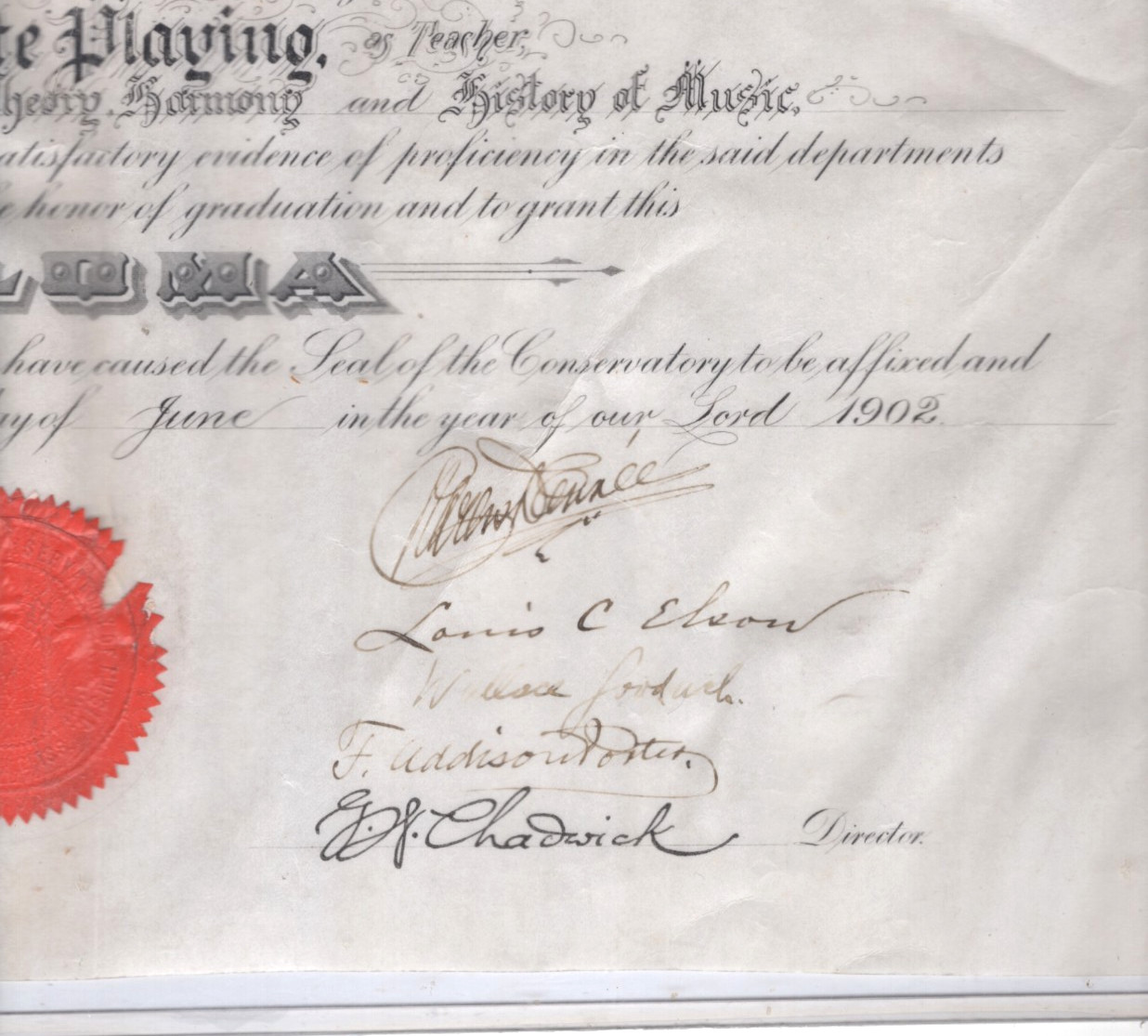
NEW ENGLAND CONSERVATORY MUSIC DIPLOMA,VELLUM 1902,FLORA LUCY STONE,PIANO-FORTE For Sale

When you click on links to various merchants on this site and make a purchase, this can result in this site earning a commission. Affiliate programs and affiliations include, but are not limited to, the eBay Partner Network.

NEW ENGLAND CONSERVATORY MUSIC DIPLOMA,VELLUM 1902,FLORA LUCY STONE,PIANO-FORTE:
$165.00
FLORA LUCY STONE ALSO STUDIED, AS STATED BELOW... "ADDITIONAL STUDY IN CHORAL HARMONYAND HISTORY OF MUSIC"SIGNED LOWER LEFT BY PRESIDENT CHARLES P. GARDINERLOWER RIGHT (TOP SIGNATURE CAN'T STATE) LOUIS C. ELSON WALLACE GOODRICHF. ADDISON PORTER G. H. CHADWICK DIRECTOR SIGNATURES SHOWN ON LAST TWO SCANS. 19" X 15" COLOR IS WHITE. BLANK ON REVERSE.IN LARGE CLEAR, HARD PLASTIC SLEEVE, EASILY REMOVABLE IF ONE WISHES. ONE END IS OPEN.BUT READY FOR DISPLAY. WILL SEND INSURED WITH TRACKING(SHIPPING WEST OF THE MISSISSIPPI WILL BE $30.00.NOT SELLING TO HAWAII OR ALASKA) 5 BIOS. BELOW.... From Wikipedia, the free encyclopediaLouis C. Elson Louis Charles Elson (April 17, 1848 – February 14, 1920) was an American music historian, music critic, writer on music, journalist, and professor of music theory at the New England Conservatory.[1] He was influential editor of American music magazines,[2] and along with William Foster Apthorp and Philip Hale was a leading music critic in Boston in the late 19th and early 20th centuries.[3] He was also a singer and composer, but only had modest success in these two aspects of his career.[1] His son, Arthur Elson (1873–1940), was also an editor and writer on music.[4]
Charles Perkins Gardiner (1836–1908) was a prominent Boston lawyer, trustee, and prominent social figure who served as the President of the New England Conservatory of Music around 1902. He was a member of Boston's elite "old money" society.Key Details & 1902 Significance - The 1902 Lawsuit (Gardiner v. Brookline): In 1902, he was the center of a notable Massachusetts tax residency lawsuit. The town of Brookline attempted to tax his personal property, but Gardiner argued that his true legal domicile was his estate in Nahant, Massachusetts, despite maintaining an office at 2 Pemberton Square and a winter home in Boston.
- The New England Conservatory: In June 1902, as President of the Conservatory, he famously hosted a brilliant reception for the graduating class at his beautiful estate on Clyde Street in Brookline (adjacent to the Country Club).
- Family Lineage: Born in Boston to William Howard Gardiner and Caroline Perkins, he was the grandson of the highly influential merchant Thomas Handasyd Perkins. In 1864, he married Emma Fields Glidden.
- Boston Properties: His primary urban properties included the Charles P. Gardiner House located at 6 Marlborough Street in Boston’s Back Bay, as well as a summer home in Nahant that previously belonged to the famous scientist Louis Agassiz
- George Whitefield Chadwick (1854–1931) was a prominent American composer, conductor, and educator who served as the director of the New England Conservatory of Music (NEC) in Boston from 1897 until 1930.Key Details
- Dates: November 13, 1854 (Lowell, Massachusetts) – April 4, 1931 (Boston, Massachusetts).
- Role at NEC: Served as director for over three decades (1897–1930), transforming the school's curriculum to match advanced European conservatory standards. He was also the driving force behind moving the conservatory to its Huntington Avenue location and erecting Jordan Hall.
- Musical Style: A leading member of the "Boston School" (or Boston Classicists) of composers. His music blended European Romantic training with distinct American vernacular elements like ragtime and folk.
- Notable Works: Included symphonies, overtures (Rip Van Winkle), and orchestral suites (Symphonic Sketches).
- Students: Taught many notable American composers, including William Grant Still, Horatio Parker, and Frederick Converse
- George Whitefield Chadwick (1854–1931) was a prominent American composer, conductor, and educator who served as the director of the New England Conservatory of Music (NEC) in Boston from 1897 until 1930. [1, 2, 3]Key Details
- Dates: November 13, 1854 (Lowell, Massachusetts) – April 4, 1931 (Boston, Massachusetts).
- Role at NEC: Served as director for over three decades (1897–1930), transforming the school's curriculum to match advanced European conservatory standards. He was also the driving force behind moving the conservatory to its Huntington Avenue location and erecting Jordan Hall.
- Musical Style: A leading member of the "Boston School" (or Boston Classicists) of composers. His music blended European Romantic training with distinct American vernacular elements like ragtime and folk.
- Notable Works: Included symphonies, overtures (Rip Van Winkle), and orchestral suites (Symphonic Sketches).
- Students: Taught many notable American composers, including William Grant Still, Horatio Parker, and Frederick Converse
- Wallace Goodrich (1871–1952) was an American organist, conductor, and music writer who became the organist and choirmaster at Boston's Trinity Church in 1902.Background and Career
- Early Life: He was born in Newton, Massachusetts, and studied locally before training in Munich and Paris.
- Boston Symphony Orchestra: He served as the official organist for the Boston Symphony Orchestra from 1897 to 1900.
- Choral Art Society: He founded Boston's Choral Art Society in 1901 and led it for several years.
- Trinity Church Post: He began his prominent tenure as organist and choirmaster at Boston's Trinity Church in 1902, serving in the role until 1909.
- New England Conservatory: He later had a long association with the New England Conservatory of Music, eventually serving as its director
- Frank Addison Porter (often known as F. Addison Porter) (1859–1941) was an American pianist, composer, and prominent musical educator in Boston who officially joined the faculty of the New England Conservatory of Music (NEC) in 1902.
- Background and Career
- Birth & Education: Born on September 3, 1859, in Dixmont, Maine, he moved to Boston and graduated from the New England Conservatory of Music in 1884 after studying piano, organ, and composition under notable figures like George Chadwick and Alfred Dudley Turner. He later traveled to Leipzig, Germany, for further studies.
- NEC Faculty (1902): Around 1902, he took up a formal, prominent position on the piano faculty at the New England Conservatory of Music, later heading its Piano Normal Department.
- Compositions & Writings: He published numerous instructional piano pieces, pedagogical works (such as Practical Finger Exercises and First Studies in Transposition), and classical compositions including a prelude and fugue in E minor, nocturnes, and an operetta.
- Boston Community: Alongside his private studio work at Steinert Hall and his connection to NEC, he and his wife Laura Huxtable Porter ran a private summer piano school in Boston, and he directed the Allston Musical Improvement Society
|
|
Related Items:Too many requests. | |
