When you click on links to various merchants on this site and make a purchase, this can result in this site earning a commission. Affiliate programs and affiliations include, but are not limited to, the eBay Partner Network.
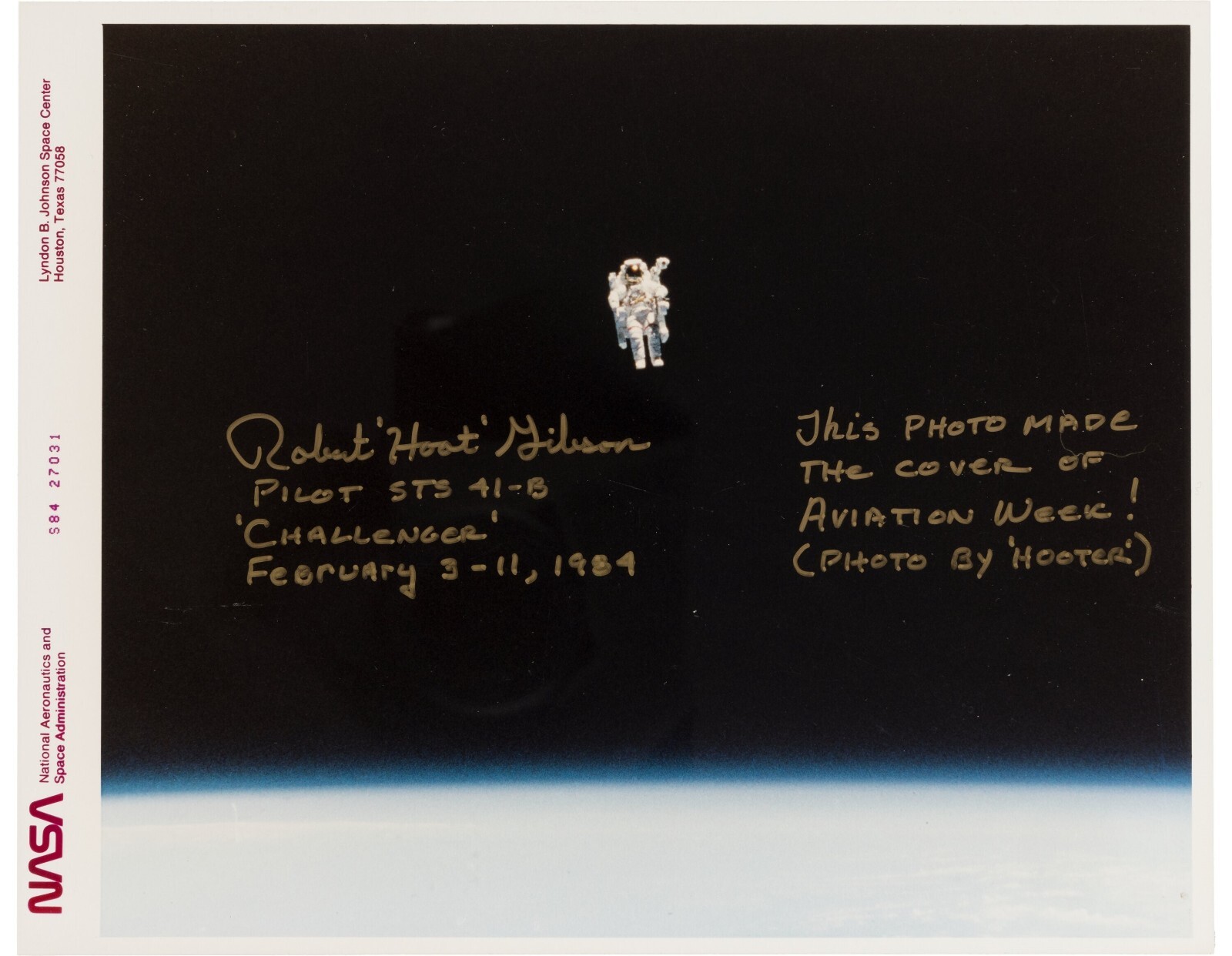
United States of America - NASA Autographed Photograph ofBruce McCandlessby Robert 'Hoot' Gibson
STS 41-B Mission from Kennedy Space Center, Launch Complex 39A (LC-39A)Astronaut Missions: STS-41-B, STS-61-C, STS-27, STS-47, STS-71
NASA Group 8 (1978)
Autograph: AstronautRobert "Hooter" Gibson
8" x 10.5" Silk Finish Photograph
February 7th, 1984 - Photographed during STS-41B Mission - Untethered Spacewalk
NASA Series Signed Modern Red Number Color Photo with red numbers at top and black ink captions on the versos
.Reference: S84-27031
Untethered Spacewalk Color Photo of Bruce McCandless floating in space
Autograph signed in gold felt tip:
"Robert 'Hoot' Gibson / PILOT STS 41-B / 'CHALLENGER' / FEBRUARY 3-11, 1984 / THIS PHOTO MADE / THE COVER OF / AVIATION WEEK! / (PHOTO BY 'HOOTER')."
Signed with comments to left and right.
Condition:
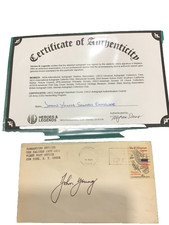
Very Fine, Rarely offered as signedArrives with specifications sheet for your reference.
See theGenuine HistoryCollection
STS-41-B was NASA's tenth Space Shuttle mission and the fourth flight of the Space Shuttle Challenger. It launched on February 3, 1984 and landed on February 11, 1984, after deploying two communications satellites. It was also notable for including the first untethered spacewalk.
Following STS-9, the flight numbering system for the Space Shuttle program was changed. Because the original successor to STS-9, STS-10, was canceled due to payload delays, the next flight, originally and internally designated STS-11, became STS-41-B as part of the new numbering system.
The STS-41-B crew included commander Vance D. Brand, making his second Shuttle flight; pilot Robert L. Gibson; and mission specialists Bruce McCandless II, Ronald E. McNair, and Robert L. Stewart.
Challenger lifted off from Kennedy Space Center at 08:00:00 a.m. EST on February 3, 1984. It was estimated that 100,000 people attended the launch. Two communications satellites were deployed about 8 hours after launch; one, Westar 6, was for America's West Union, and the other, Palapa B2, for Indonesia; both were Hughes-built HS-376-series satellites. However, the Payload Assist Modules (PAM) for both satellites malfunctioned, placing them into a lower-than-planned orbit. Both satellites were retrieved successfully in November 1984 during STS-51-A, which was conducted by the orbiter Discovery.
Untethered EVA
On February 7, the fourth day of the mission, astronauts McCandless and Stewart performed the first untethered spacewalk, operating the Manned Maneuvering Unit (MMU) for the first time. At 8:25 a.m. EST, pulsing the MMU's thrusters, McCandless ventured out of Challenger's payload bay, and reached 98 m from the orbiter. Stewart tested the "work station" foot restraint at the end of the Remote Manipulator System (Canadarm). On the seventh day of the mission, both astronauts performed another extravehicular activity (EVA) to practice capture procedures for the Solar Maximum Mission (SMM) satellite retrieval and repair operation, which was planned for the next mission, STS-41-C.
Issues with the orbiter
During the mission, the nozzles of Challenger's supply and wastewater venting systems experienced below-freezing temperatures; subsequently, the supply water dump valve failed to open, so excess water was dumped through the flash evaporator for the remainder of the mission. During re-entry, ice from the dump valves broke off their nozzles situated near the nose of the orbiter and struck the left Orbital Maneuvering System (OMS) pod, damaging three Thermal Protection System (TPS) tiles and leading to a burn-through, but the damage was minimal enough that Challenger and its crew were unharmed. During the post-flight inspection it was found that the dump line upstream of the two nozzles had ruptured due to the wastewater expanding as it froze, and insulation was missing around both nozzles. The TPS tiles near the nozzles were also discolored, indicating ice had built up prior to re-entry.
Return to Earth
The 7 days, 23 hours, 15 minutes, and 55 seconds flight ended on February 11, 1984 with a successful landing at Kennedy Space Center's Shuttle Landing Facility. This marked the first landing of a spacecraft at its launch site. Challenger completed 128 orbits and traveled 5,329,150 km.
STS-41B launch
Robert Lee "Hoot" Gibson (born October 30, 1946), (Captain, USN, Ret.), is a former American naval officer and aviator, test pilot, and aeronautical engineer. A retired NASA astronaut, he also served as Chief of the Astronaut Office from 1992 to 1994. Today Gibson is active as a professional pilot, racing regularly at the annual Reno Air Races. He was inducted into the U.S. Astronaut Hall of Fame in 2003 and the National Aviation Hall of Fame in 2013, and has received several military decorations throughout his career.
Selected by NASA in January 1978, Gibson became an astronaut in August 1979. Gibson flew five missions: STS-41-B in 1984, STS-61-C in 1986, STS-27 in 1988, STS-47 in 1992, and STS-71 in 1995. Gibson served as Chief of the Astronaut Office (December 1992 to September 1994) and as Deputy Director, Flight Crew Operations (March–November 1996).
On his first space flight, Gibson was the pilot on the crew of STS 41-B which launched from the Kennedy Space Center, Florida, on February 3, 1984. The flight accomplished the deployment of two Hughes 376 communications satellites which later failed to reach desired geosynchronous orbits due to upper-stage rocket failures. The STS 41-B mission marked the first checkout of the Manned Maneuvering Unit (MMU), and Manipulator Foot Restraint (MFR), with Bruce McCandless II and Bob Stewart performing two EVAs (spacewalks). The German Shuttle Pallet Satellite (SPAS), Remote Manipulator System (RMS), six "Getaway Specials", and materials processing experiments were included on the mission. The eight-day orbital flight of Challenger culminated in the first-ever landing at the Kennedy Space Center on February 11, 1984.
Gibson was the commander of the STS-61-C mission, and the first of only four people under the age of 40 to command an STS Orbiter. The seven-man crew on board the Orbiter Columbia launched from the Kennedy Space Center on January 12, 1986. During the six-day flight, the crew deployed the SATCOM Ku satellite and conducted experiments in astrophysics and materials processing. The mission concluded with a successful night landing at Edwards Air Force Base, California, on January 18, 1986.
Gibson subsequently participated in the investigation of the Space Shuttle Challenger accident, and also participated in the redesign and recertification of the solid rocket boosters.
The famous photo showing McCandless using the MMU. It was Gibson who took the photo and later remarked imagining about the caption being "NASA Photo by Hooter" STS-41-B in 1984
As the commander of STS-27, Gibson and his five-man crew launched from the Kennedy Space Center on December 2, 1988, aboard the Orbiter Atlantis. The mission carried a Department of Defense payload, and a number of secondary payloads. After 68 orbits of the Earth the mission concluded with a dry lakebed landing on Runway 17 at Edwards Air Force Base on December 6, 1988. The mission is noteworthy due to the severe damage Atlantis sustained to its critical heat-resistant tiles during ascent.
When in training for the 1991 STS-46 mission, Gibson was involved in a collision during a weekend air race in Texas that left a second pilot dead and raised questions about the enforcement of rules banning such high-risk activity by expensively trained astronauts. He lost his flight status on NASA's T-38 training aircraft for one year, thus being unable to participate in the training for the mission.
On Gibson's fourth space flight, the fiftieth Space Shuttle mission, he served as commander of STS-47, Spacelab-J, which launched on September 12, 1992, aboard the Orbiter Endeavour. The mission was a cooperative venture between the United States and Japan, and included the first Japanese astronaut, Mamoru Mohri, and the first African-American woman, Mae Jemison, in the crew. During the eight-day flight, the crew focused on life science and materials processing experiments in over forty investigations in the Spacelab laboratory, as well as scientific and engineering tests performed aboard the Orbiter Endeavour. The mission ended with a successful landing on the runway at the Kennedy Space Center in Florida on September 20, 1992.
On his last flight, (June 27 to July 7, 1995), Gibson commanded a crew of seven-members (up) and eight-members (down) on Space Shuttle mission STS-71. This was the first Space Shuttle mission to dock with the Russian Space Station Mir, and involved an exchange of crews. The Atlantis Space Shuttle was modified to carry a docking system compatible with the Russian Mir Space Station. It also carried a Spacelab module in the payload bay in which the crew performed various life sciences experiments and data collections. When the hatch separating the two modules was opened, Gibson and Vladimir Dezhurov shook hands, symbolizing the newly-found cooperation between the United States of America and the Russian Federation. Later that day, President Bill Clinton in a statement mentioned that this handshake was a major breakthrough towards the ending of the Cold War.
When giving public speeches, Gibson often jokes that he ended the Cold War.
In five space flights, Gibson completed a total of 36.5 days in space.
Robert Lee "Hooter" Gibson