When you click on links to various merchants on this site and make a purchase, this can result in this site earning a commission. Affiliate programs and affiliations include, but are not limited to, the eBay Partner Network.
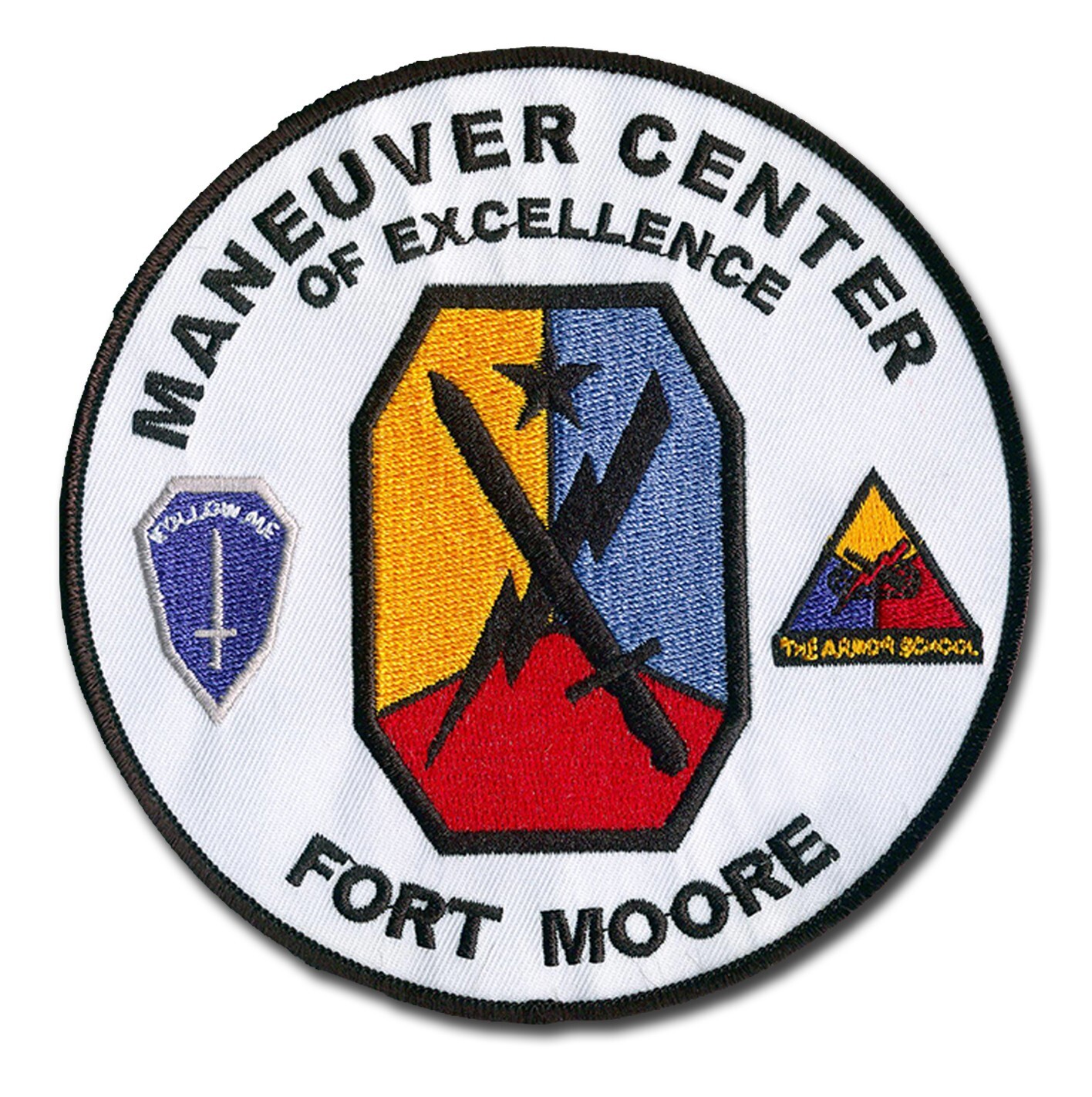
History of the Organization of tManeuver Center of Excellence embroidered patch - Fort Moore - 5 inch, wax back
Fort Moore (formerly Fort Benning) is a United States Army post near Columbus, Georgia, adjacent to the Alabama–Georgia border. Fort Moore supports more than 120,000 active-duty military, family members, reserve component soldiers, retirees and civilian employees on a daily basis. As a power projection platform, the post can deploy combat-ready forces by air, rail, and highway for their designated mission. Fort Moore is the home of the United States Army Maneuver Center of Excellence, the United States Army Armor School, United States Army Infantry School, the Western Hemisphere Institute for Security Cooperation (formerly known as the School of the Americas), elements of the 75th Ranger Regiment, the 1st Security Force Assistance Brigade, and other tenant units.
It was originally named for Henry L. Benning, a brigadier general in the Confederate States Army during the Civil War. Fort Benning was one of the ten U.S. Army installations named for former Confederate generals that was renamed on 11 May 2023, following a recommendation from the congressionally mandated Naming Commission that Fort Benning be renamed Fort Moore after Lieutenant General Hal Moore and his wife Julia Compton Moore, both of whom are buried on post. On 6 October 2022, Secretary of Defense Lloyd Austin accepted the recommendation and directed the name change occur no later than 1 January 2024. The redesignation ceremony officially renaming Fort Benning as Fort Moore was held on May 11, 2023.
Since 1918, Fort Moore has served as the Home of the Infantry. Since 2005, Fort Moore has been transformed into the Maneuver Center of Excellence, as a result of the 2005 Base Realignment and Closure (BRAC) Commission's decision to consolidate a number of schools and installations to create various "centers of excellence". Included in this transformation was the move of the Armor School from Fort Knox to Fort Moore.
Camp Benning was established 19 October 1918, initially providing basic training for World War I units, post-war. Dwight D. Eisenhower served at Benning from 24 December 1918, until 15 March 1919, with about 250 of his Camp Colt, Pennsylvania, tankers who had been transferred to Benning after the armistice.: 72 In December 1918, a portion of the Camp Polk tank school near Raleigh, North Carolina was transferred to Camp Benning "to work in conjunction with the Infantry school". Camp Benning tank troops were moved to Camp Meade in February 1919.
In February 1920, Congress voted to declare Camp Benning a permanent military post and appropriated more than $1 million of additional building funds for the Infantry School of Arms, which later became the Infantry School. By the fall of 1920, more than 350 officers, 7,000 troops and 650 student officers lived at Camp Benning. The post was renamed to Fort Benning in 1922, after Henry L. Benning, a general in the army of the Confederate States of America. Benning fought against U.S. Army troops in the Civil War as commander of Confederate States Army forces.
In 1924, Brig. Gen. Briant H. Wells became the fourth commandant of the Infantry School and established the Wells Plan for permanent construction on the installation, emphasizing the importance of the outdoor environment and recreation opportunities for military personnel. During Wells' tenure, the post developed recreational facilities such as Doughboy Stadium, Gowdy Field, the post theater and Russ swimming pool. Doughboy Stadium was erected as a memorial by soldiers to their fallen comrades of World War I. One of the Doughboys' original coaches was a young captain named Dwight D. Eisenhower.
Lt. Col George C. Marshall was appointed assistant commandant of the post in 1927 and initiated major changes. Marshall, who later became the Army Chief of Staff during World War II, was appalled by the high casualties of World War I caused, he thought, by insufficient training. He was determined to prevent a lack of preparation from costing more lives in future conflicts. He and his subordinates revamped the education system at Fort Benning. The changes he fostered are still known as the Benning Revolution. Later in his life, Marshall went on to author the Marshall Plan for reviving postwar Europe and was awarded the Nobel Peace Prize in 1953.
In August 1940, 2 officers and 46 enlisted volunteers of what was known as the Parachute Test Platoon, made their first airborne jump over Lawson Field at Fort Benning after intensive training. Observers from several countries including Germany and the Soviet Union attended. These 48 were the seed that grew into the branches of America's Airborne Infantry.
During World War II Fort Benning had 197,159 acres (797.87 km2) with billeting space for 3,970 officers and 94,873 enlisted persons. Among many other units, Fort Benning was the home of the 555th Parachute Infantry Battalion, whose training began in December 1943. The unit's formation was an important milestone for black Americans, as was explored in the first narrative history of the installation, Home of the Infantry. The battalion, later expanded to become the 555th Parachute Infantry Battalion and nicknamed the Triple Nickels, was trained at Fort Benning but did not deploy overseas and never saw combat during World War II.
During this period, the specialized duties of the Triple Nickels were primarily in a firefighting role, with over one thousand parachute jumps as smoke jumpers. The 555th was deployed to the Pacific Northwest of the United States in response to the concern that forest fires were being set by the Japanese military using long-range incendiary balloons. The 82nd Armored Reconnaissance Battalion was activated 15 July 1940, and trained at the Fort. The 17th Armored Engineer Battalion became active and started training 15 July 1940.
At the start of the Korean War an Airborne Ranger Training Center was established by Colonel John G. Van Houten under the direction of General J. Lawton Collins.
The 4th Infantry Division, first of four divisions committed by the United States to the North Atlantic Treaty Organization, reorganized and completed its basic training at Fort Benning (Sand Hill and Harmony Church areas) from October 1950 to May 1951, when it deployed to Germany for five years.
The Airborne School on Main Post has three 249-foot (76 m) drop towers called "Free Towers." They are used to train paratroopers. The towers were modeled after the parachute towers at the 1939 World's Fair in New York. Only three towers stand today; the fourth tower was toppled by a tornado on 14 March 1954.
During the spring of 1962 General Herbert B. Powell, Commanding General, U.S. Continental Army Command, directed that all instruction at the Infantry School after 1 July reflect Reorganization Objective Army Division structures. Therefore, the Infantry School asked for permission to reorganize the 1st Infantry Brigade under a ROAD structure. Instead, the Army Staff decided to inactivate the Pentomic-structured brigade and replace it with a new ROAD unit, the 197th Infantry Brigade, which resolved a unit designation issue.
With the designation 1st Infantry Brigade slated to return to the 1st Infantry Division when it converted to ROAD, the existing unit at Fort Benning required a new title. The staff selected an infantry brigade number that had been associated with an Organized Reserve division that was no longer in the force. For the new ROAD brigade at Fort Benning, Georgia, the adjutant general on 1 August 1962, restored elements of the 99th Reconnaissance Troop, which thirty years earlier had been organized by consolidating infantry brigade headquarters and headquarters companies of the 99th Infantry Division, as Headquarters and Headquarters Companies, 197th and 198th Infantry Brigades.Chief of Staff of the United States Army George W. Casey Jr. at Fort Benning in 2009.Fort Benning was the site of the Scout dog school of the United States during the Vietnam War, where the dogs trained to detect ambushes in enemy terrain got their initial training, before being transferred to Vietnam for further advanced courses.
Fort Benning also had an urban village, McKenna Military Operations in Urban Terrain, built by Army engineers for urban training of soldiers. It was used for live, virtual and constructive experimentation on soldier systems, weapons, and equipment. The site was approximately 200 meters square, and included 15 buildings resembling a European village. There was a church, small houses, domestic residences and office-style buildings.
In 1984, following the signing of the Panama Canal Treaty, the School of the Americas relocated from Fort Gulick (Panama) to Fort Benning. After criticism concerning human rights violations committed by a number of graduates in Latin America, the school was renamed Western Hemisphere Institute for Security Cooperation.