When you click on links to various merchants on this site and make a purchase, this can result in this site earning a commission. Affiliate programs and affiliations include, but are not limited to, the eBay Partner Network.
PRINCE MAXIMILIAN OF WIED-NEUWIED ON RICHARD OWEN, THE GORILLA, THE AYE-AYE, AND THE INTERNATIONAL COMMUNITY OF NATURALISTS
Author:WIED-NEUWIED, Maximilian Alexander Philipp, Prince zu (1782–1867), German explorer, ethnologist, and naturalist
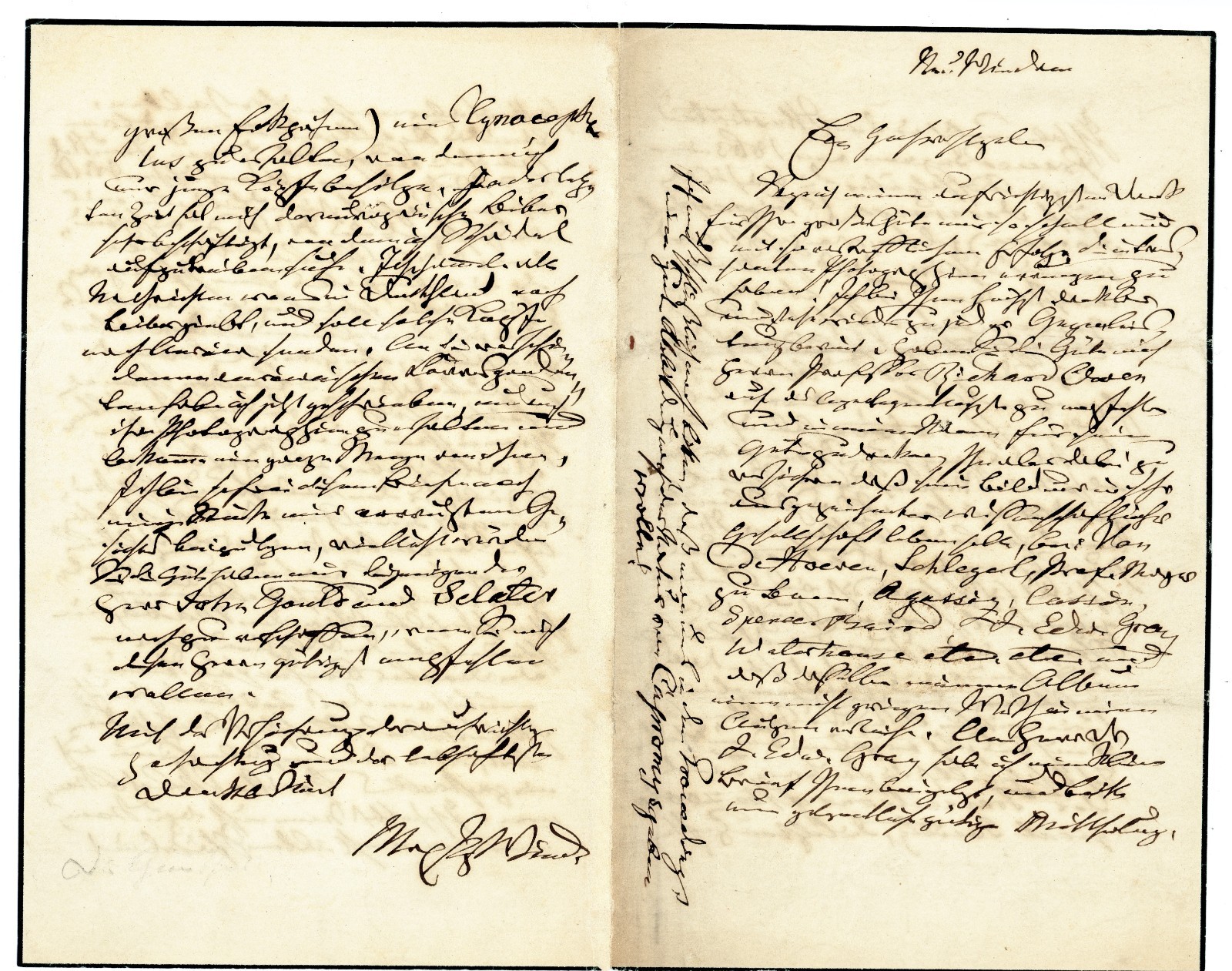
Title:Autograph Letter Signed, in German, thanking a British correspondent for obtaining a portrait of Richard Owen and discussing portraits of prominent naturalists, zoological errors in the Illustrated London News, the gorilla, and the aye-aye.
Place and Date:Neuwied, Kingdom of Prussia [present-day Germany], 20 January [c.1864].
Recipient:An unidentified zoological correspondent in Great Britain; possibly Dr. Albert C. L. G. Günther (1830–1914) of the British Museum. The proposed identification is plausible but remains unconfirmed.
Format:Autograph Letter Signed. One bifolium consisting of a single sheet folded to form four pages; four pages written in a dense but generally legible German Kurrent hand. No envelope or separate address leaf is described.
Language and Script:German, written primarily in Kurrent script.
Dimensions:8 1/8 × 5 1/8 inches (206 × 130 mm).
Summary:An exceptionally rich four-page Autograph Letter Signed by Prince Maximilian of Wied-Neuwied, one of the most important German explorer-naturalists of the nineteenth century. Written from Neuwied on January 20, probably in 1864, the letter documents Maximilian’s continued participation in international scientific correspondence during the final years of his life. Its subjects encompass the exchange and collection of photographic portraits, the identification and representation of exotic animals, Maximilian’s criticism of contemporary illustrated journalism, and current zoological interest in the gorilla and the aye-aye.The letter opens with Maximilian thanking his correspondent for the kindness shown in obtaining a portrait of the eminent British comparative anatomist Richard Owen (1804–1892). Maximilian explains that Owen’s likeness would make a distinguished addition to his personal album of scientific portraits. He identifies a remarkable group of naturalists whose portraits were already represented in the album, including the Dutch zoologist Jan van der Hoeven (1801–1868); Hermann Schlegel (1804–1884), director of the natural-history museum at Leiden; the German anatomist and physiologist August Franz Joseph Karl Mayer (1787–1865); the Swiss-American naturalist Louis Agassiz (1807–1873); Smithsonian zoologist Spencer Fullerton Baird (1823–1887); British Museum zoologist John Edward Gray (1800–1875); and the British naturalist and museum curator George Robert Waterhouse (1810–1888).
This enumeration transforms what initially appears to be a polite letter of thanks into a valuable record of Maximilian’s scientific affiliations and collecting practices. His album functioned as a visual register of the international community of zoologists, anatomists, museum officials, explorers, and taxonomists with whom he communicated or whose work he admired. The letter consequently preserves evidence of the important role that portrait photography played in maintaining scientific identity and professional relationships during the middle decades of the nineteenth century.
A substantial portion of the letter addresses an article published in the Illustrated London News during 1863. Maximilian criticizes the publication for incorrectly identifying or representing several animal species. In making his corrections, he refers to observations and drawings derived from his own Brazilian expedition of 1815–1817. His comments demonstrate that, nearly half a century after that expedition, he continued to regard direct field observation and accurately prepared illustrations as essential standards against which published zoological representations should be judged.
The letter also discusses two animals then attracting considerable scientific and popular attention: the gorilla and the aye-aye of Madagascar. The gorilla had become an especially important subject in mid-Victorian discussions of comparative anatomy, primate classification, and the anatomical relationship between humans and other animals. The aye-aye remained zoologically enigmatic because of its unusual combination of primate and rodent-like anatomical characteristics. Richard Owen’s extensively illustrated Monograph on the Aye-Aye, published in 1863, offered one of the period’s most detailed anatomical studies of the species and argued for its placement among the primates.
Maximilian concludes with cordial professional greetings to several leading members of the British zoological establishment: Richard Owen; the celebrated ornithologist and publisher John Gould (1804–1881); and Philip Lutley Sclater (1829–1913), the influential ornithologist and longtime secretary of the Zoological Society of London. These greetings reinforce the letter’s close connection to British museum and zoological circles.
Significance:This letter is an important primary source for the study of nineteenth-century natural history, scientific correspondence, photographic portrait collecting, zoological illustration, and the international circulation of scientific information. It captures Prince Maximilian not simply as the veteran of celebrated expeditions, but as an active late-career naturalist who continued to evaluate new publications, correct zoological errors, exchange information with foreign colleagues, and follow developments in comparative anatomy.
The letter is particularly notable for bringing together an unusually distinguished network of European and American naturalists. Richard Owen, Louis Agassiz, Spencer Fullerton Baird, John Edward Gray, Hermann Schlegel, John Gould, Philip Lutley Sclater, and the other individuals named or greeted in the manuscript collectively represent many of the principal museums, learned societies, and zoological institutions of the period.
Its discussion of the portrait of Richard Owen and Maximilian’s scientific photograph album also gives the letter significance for the history of photography. Portrait photographs allowed geographically dispersed scientists to create tangible records of their intellectual communities. Maximilian’s album appears to have served as both a personal collection and a visual representation of his place within the international scientific world.
Maximilian invokes knowledge acquired during his Brazilian travels to challenge inaccuracies in a widely circulated illustrated newspaper. The letter therefore records the tension between specialist field knowledge and the rapidly expanding popular illustrated press. It also demonstrates the enduring authority Maximilian attached to firsthand observation, specimen study, and carefully executed natural-history drawings.
Finally, the manuscript belongs to the closing chapter of Maximilian’s career. Written when he was approximately eighty-one years old, it shows him continuing to participate in scientific exchange only a few years before his death in 1867. Rather than being merely retrospective, the letter combines memories of his earlier fieldwork with current zoological subjects and contemporary methods of scientific portraiture.
Biographical and Historical Notes:
Prince Alexander Philipp Maximilian zu Wied-Neuwied
Prince Alexander Philipp Maximilian zu Wied-Neuwied was born at Neuwied on September 23, 1782. A member of the ruling house of Wied-Neuwied, he initially pursued a military career and served as an officer in the Prussian army during the Napoleonic Wars. His principal interests, however, were natural history, geography, ethnology, and comparative anthropology. He studied at Göttingen under Johann Friedrich Blumenbach and was strongly influenced by the scientific travel tradition associated with Alexander von Humboldt.
Following the conclusion of the Napoleonic Wars, Maximilian organized an expedition to southeastern Brazil, where he traveled from 1815 to 1817. He collected zoological specimens, recorded Indigenous languages and customs, prepared drawings, and documented the flora and fauna of regions in Rio de Janeiro, Espírito Santo, and Bahia. His resulting publications included Reise nach Brasilien in den Jahren 1815 bis 1817, Abbildungen zur Naturgeschichte Brasiliens, and the multi-volume Beiträge zur Naturgeschichte von Brasilien. His Brazilian collections and publications became important early contributions to the scientific description of South American vertebrates, particularly reptiles, amphibians, birds, and mammals. Modern scholarship continues to examine specimens and taxa associated with his collections.
Maximilian is best known in the United States for his expedition to North America between 1832 and 1834. Accompanied by the Swiss artist Karl Bodmer and the hunter and preparator David Dreidoppel, he traveled through the eastern United States and then proceeded by steamboat up the Missouri River into the northern Great Plains. Maximilian recorded the natural environment and the languages, customs, political structures, and material cultures of the Indigenous communities encountered during the journey. Bodmer, selected specifically to provide an accurate visual record, produced extraordinarily detailed portraits, landscapes, village scenes, ceremonies, and studies of material culture. Their collaboration resulted in Reise in das innere Nord-America in den Jahren 1832 bis 1834, subsequently published in English as Travels in the Interior of North America. The work remains a major documentary source for the history of the Upper Missouri and its Indigenous peoples.
The expedition’s records are especially important for the study of the Mandan and Hidatsa communities Maximilian and Bodmer visited. Their observations and images were made only a few years before the catastrophic smallpox epidemic of 1837, which caused enormous loss of life among the Mandan and seriously affected neighboring peoples of the Upper Missouri.
Maximilian never married. During his later years he resided at Neuwied, organized his collections and manuscripts, continued publishing and revising his zoological work, and maintained correspondence with naturalists, museums, collectors, and scientific societies in Europe and the United States. His surviving diaries, letters, notebooks, specimens, ethnographic objects, and the original drawings and watercolors prepared by Bodmer are now dispersed among institutional and archival collections. The recovery and publication of his North American journals and artwork have substantially increased modern understanding of his scientific methods and accomplishments.
Richard Owen, the Aye-Aye, and Victorian Zoology
Richard Owen was one of Britain’s most prominent comparative anatomists and paleontologists. He was closely associated with the natural-history departments of the British Museum and became internationally known for his studies of living and extinct vertebrates. Although his interpretation of primate anatomy brought him into controversy with Thomas Henry Huxley and other supporters of Darwinian evolutionary theory, Owen’s influence upon British museum science and comparative anatomy was immense.
Owen’s Monograph on the Aye-Aye (Chiromys madagascariensis, Cuvier) appeared in 1863 and contained a detailed anatomical examination accompanied by illustrations by Joseph Wolf. The aye-aye’s continuously growing incisors and highly specialized fingers had caused long-standing disagreement over whether it should be classified as a rodent or a primate. Owen’s anatomical investigation supported its placement among the primates. Maximilian’s discussion of the animal shortly after the monograph’s appearance places the present letter within this active period of zoological classification and comparative anatomical research.
The gorilla occupied an even more conspicuous place in contemporary scientific debate. Specimens and anatomical descriptions became central to arguments concerning primate classification and the structural similarities and differences among humans, apes, and other mammals. The present letter should not necessarily be interpreted as Maximilian taking a specific position in the Owen-Huxley or Darwinian controversies. It does, however, show that he followed the same zoological discoveries and anatomical questions then being debated by Britain’s leading naturalists.
The Scientific Portrait Album
Maximilian’s reference to an album containing portraits of naturalists is one of the most distinctive features of the manuscript. By the 1860s, photographic portraits—particularly cartes de visite and related album-sized formats—had become an important means of exchanging likenesses among scholars, artists, political figures, and members of learned societies.
The individuals Maximilian names formed a geographically broad scientific circle. Van der Hoeven and Schlegel were associated with Dutch zoology and the Leiden collections; Mayer worked in anatomy and physiology at Bonn; Agassiz became one of the leading naturalists in the United States; Baird was central to the development of the Smithsonian Institution’s scientific collections; Gray and Waterhouse held important British museum positions; and Owen dominated British comparative anatomy. The inclusion of these likenesses suggests that Maximilian’s album was deliberately assembled as a portrait collection of professional naturalists rather than as a conventional family photograph album.
Possible Recipient: Albert Günther
The recipient may have been Albert Carl Ludwig Gotthilf Günther, a German-born zoologist then working at the British Museum. Günther’s German background, his institutional proximity to Richard Owen and John Edward Gray, his specialization in fishes, reptiles, and amphibians, and his connections with the Zoological Society of London would have made him a logical intermediary between Maximilian and the British scientific community.
Günther joined the British Museum’s zoological staff during the 1850s and was deeply engaged during the 1860s in the preparation of major zoological catalogs, including his multi-volume Catalogue of the Fishes in the British Museum. He later succeeded John Edward Gray as Keeper of Zoology in 1875 and remained in that office until his retirement in 1895. The Natural History Museum’s archival authority record confirms his later appointment as Keeper, while his surviving publications demonstrate his extensive work on fishes, reptiles, and amphibians.
Nevertheless, the Günther attribution should remain qualified. The present description does not record an address leaf, envelope, recipient’s name, contemporary docket, or independently verified chain of correspondence. Other German-speaking naturalists or intermediaries in Britain may also have been capable of obtaining Owen’s portrait and conveying greetings to Owen, Gould, and Sclater. A definitive identification would require a full transcription and translation, comparison of the salutation and closing with Maximilian’s known correspondence, and research in surviving British Museum, Zoological Society of London, Gould, Owen, and Wied family archives.
Condition:The letter retains its original folds and shows light general handling wear consistent with age and use. Some show-through and offsetting are visible from the densely applied ink, but the German Kurrent text remains generally legible. Additional minor toning, edge wear, short separations, ink corrosion, stains, repairs, or losses—if present—should be described following direct examination under normal and raking light. Overall, a well-preserved and textually substantial nineteenth-century scientific letter comprising four fully written pages.References
- Günther, A. E. A Century of Zoology at the British Museum through the Lives of Two Keepers, 1815–1914. London: Dawsons of Pall Mall, 1975.
- National Archives and Records Administration, National Historical Publications and Records Commission. North American Journals of Prince Maximilian of Wied.
- Owen, Richard. Monograph on the Aye-Aye (Chiromys madagascariensis, Cuvier). London: Taylor and Francis, 1863.
- Vanzolini, Paulo E. “The Herpetological Collection of Maximilian, Prince of Wied (1782–1867), with Special Reference to Brazilian Materials.” Bulletin of the American Museum of Natural History, no. 395, 2015.
- Wied-Neuwied, Maximilian zu. Reise nach Brasilien in den Jahren 1815 bis 1817. Frankfurt am Main: Heinrich Ludwig Brönner, 1820–1821.
- Wied-Neuwied, Maximilian zu. Beiträge zur Naturgeschichte von Brasilien. Weimar, 1825–1833.
- Wied-Neuwied, Maximilian zu. Reise in das innere Nord-America in den Jahren 1832 bis 1834. Coblenz, 1839–1841.
- Wied-Neuwied, Maximilian zu. Travels in the Interior of North America. London: Ackermann and Company, 1843–1844.
- Illustrated London News. London, 1863. The specific article or issue criticized in the letter remains to be conclusively identified.