When you click on links to various merchants on this site and make a purchase, this can result in this site earning a commission. Affiliate programs and affiliations include, but are not limited to, the eBay Partner Network.
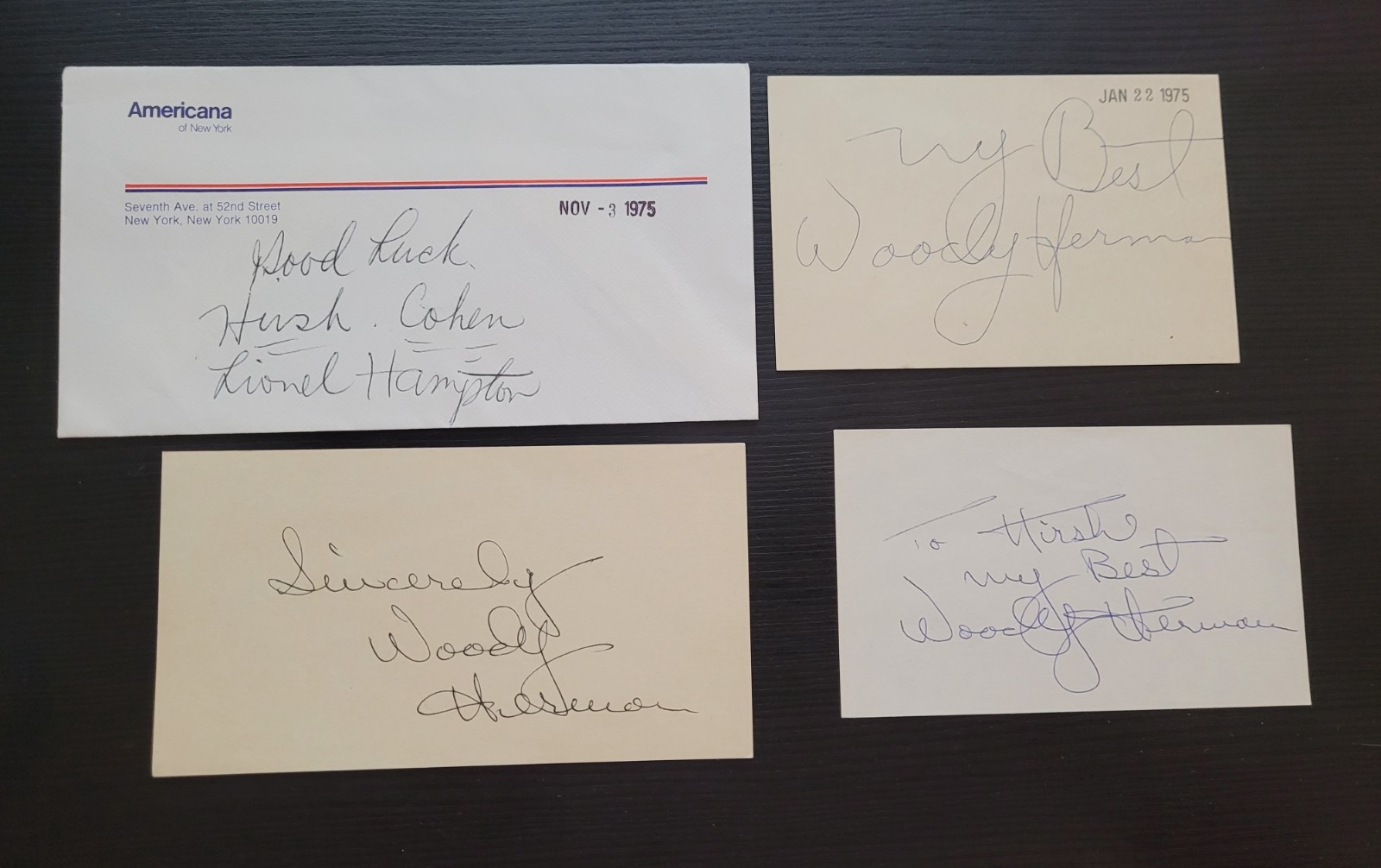
3 fantastic autographs of Woody Herman on index cards and an autograph of Lionel Hampton on an envlope sold as a lot. All signed in the 70s
____________________The Enduring Thunder: Woody Herman's Contributions to Jazz, Blues, and the Orchestra
Page 1: The Prodigy and "The Band That Plays the Blues"
Woodrow Charles "Woody" Herman was more than a bandleader; he was a musical institution, an incubator of talent, and a force of nature whose career spanned over half a century of American music. His unique ability to adapt, innovate, and surround himself with brilliant young musicians allowed him to remain a relevant and powerful presence from the Swing Era to the dawn of the digital age. His story begins not in a formal conservatory, but on the rugged stages of American vaudeville.
Born in Milwaukee, Wisconsin, on May 16, 1913, Herman was a true prodigy. His father, a passionate show business enthusiast, had Woody singing and tap-dancing on stage by age six, billed as "The Boy Wonder of the Clarinet and Saxophone." By his early teens, he was a professional musician, already seasoned by the demanding, travel-heavy life of a performer. His early education came from the bands he joined. After a short stint at Marquette University, the call of the road was too strong. He joined Tom Gerun's orchestra, a popular West Coast dance band, where he was a featured clarinet and saxophone soloist and occasional vocalist. It was here he honed his skills, learned the business of leading a band, and developed his signature, blues-inflected style.
In 1936, after the Gerun band dissolved, Herman and a core group of fellow musicians decided to form their own co-operative orchestra. This was the genesis of what would become the first Woody Herman Orchestra, famously billing itself as "The Band That Plays the Blues." This was not merely a marketing slogan; it was a mission statement. In an era dominated by the sweet, polished sounds of society dance bands, Herman's group was grittier, more soulful, and deeply rooted in the blues tradition.
Their first major hit, "Woodchopper's Ball" (1939), became their theme song and a defining anthem of the late Swing Era. It was a raw, riff-based instrumental that showcased the band's driving rhythm and Herman's own impassioned clarinet work. While other bands were smoothing out the edges of jazz for mass consumption, Herman was digging in, delivering a sound that was both danceable and emotionally direct. This first orchestra laid the groundwork for everything that was to come. It established Herman's reputation as a leader who valued musical honesty and energy over polished perfection, and it showcased his innate talent for identifying a sound that resonated with the public while staying true to its jazz and blues roots. This was the foundation upon which the legendary "Herds" would be built.
Page 2: The Thundering First Herd
By the mid-1940s, the musical landscape of jazz was undergoing a seismic shift. The revolutionary sounds of bebop, pioneered by artists like Charlie Parker and Dizzy Gillespie, were challenging the conventions of swing. While many established bandleaders resisted or dismissed this new, complex music, Woody Herman embraced it. He saw not a threat, but an opportunity for evolution. In 1944, he began retooling his orchestra, bringing in a new generation of arrangers and soloists who were fluent in the language of bop. This transformation resulted in the explosive and legendary "First Herd."
The First Herd, often called the "Thundering Herd," was a juggernaut of sound and energy. It was arguably one of the most exciting and powerful big bands of all time. Herman's genius was in his ability to fuse the raw, bluesy drive of his earlier band with the harmonic sophistication and blistering tempos of modern jazz. He assembled a lineup of virtuosic and forward-thinking musicians who would become legends in their own right.
The arranging team of Ralph Burns and Neal Hefti was central to the Herd's sound. They crafted charts that were intricate, demanding, and utterly electrifying. Songs like Hefti's "Apple Honey" and "The Good Earth," and Burns's "Bijou," became showcases for the band's incredible precision and power. The soloists were a collection of killers: the ferocious trombonist Bill Harris, the powerhouse tenor saxophonist Flip Phillips, and the brilliant trumpeter Pete Candoli. Anchoring it all was the phenomenal rhythm section, most notably propelled by the innovative and explosive drummer Dave Tough, whose propulsive energy became a trademark of the Herd's sound.
Perhaps no song captured the wild spirit of the First Herd better than "Caldonia." With its frantic tempo, screaming brass, and Herman's own manic vocal ("What makes your big head so hard?!"), it was a cultural phenomenon. It perfectly blended showmanship, instrumental virtuosity, and an infectious, almost chaotic energy that was unlike anything else on the radio.
The First Herd was also notable for its collaboration with classical composer Igor Stravinsky. In 1945, Stravinsky, intrigued by the band's musicianship, composed the "Ebony Concerto" specifically for them. This challenging, complex piece further cemented the Herd's reputation as a group of serious, world-class musicians. Despite its immense artistic and popular success, the First Herd was short-lived. Exhausted by the frantic pace and facing changing post-war economics, Herman disbanded the orchestra at its peak in late 1946, a shocking move that left the jazz world stunned.
Page 3: The Four Brothers and the Second Herd
After a brief, self-imposed retirement, Woody Herman returned to the scene in 1947, driven by his passion for the music and, in part, by financial need. The orchestra he assembled, however, was not a recreation of the high-decibel "Thundering Herd." Instead, the Second Herd was a different, cooler, but no less innovative, beast. It would become forever known as the "Four Brothers Band."
The defining feature of this new orchestra was its saxophone section. Arranger and saxophonist Jimmy Giuffre had penned a piece titled "Four Brothers," which featured a unique voicing of three tenor saxophones and one baritone saxophone. The typical big band sax section of two altos, two tenors, and a baritone was replaced by this new, warmer, and more subtle blend. The sound was lighter, more lyrical, and perfectly captured the "cool jazz" aesthetic that was beginning to emerge on the West Coast.
The original "Four Brothers" who brought this sound to life were the tenor saxophonists Stan Getz, Zoot Sims, and Herbie Steward, with Serge Chaloff on baritone. Their ability to blend seamlessly while retaining their distinct individual voices created a musical texture that was entirely new. The success of the "Four Brothers" chart made it the signature tune of the Second Herd and gave the band its identity.
While the "Four Brothers" sound was central, the Second Herd was a versatile and powerful band in its own right. It continued to explore the bebop language, but with a more refined and controlled approach than the First Herd. The band's crowning achievement and most enduring recording was "Early Autumn" (1948). An ethereal and beautiful arrangement by Ralph Burns, the piece featured a short but masterful solo by a young Stan Getz. Getz's lyrical, breathy, and exquisitely melodic improvisation became one of the most famous and influential solos in jazz history, launching him into international stardom and perfectly encapsulating the "cool" sound.
Despite its artistic triumphs, the Second Herd struggled financially. The big band era was waning, and the economics of keeping a large orchestra on the road were becoming increasingly difficult. By 1949, Herman was forced to disband once again. Though it lasted only two years, the Second Herd's legacy was immense. It helped to codify the sound of cool jazz, introduced the world to a new generation of saxophone legends, and proved, once again, Woody Herman's uncanny ability to be at the forefront of jazz innovation.
Page 4: The Later Herds and the Eternal Educator
Throughout the 1950s, 60s, 70s, and 80s, Woody Herman continued to lead a succession of top-tier big bands, collectively referred to as his "Thundering Herds." While they might not have achieved the same singular, game-changing fame as the first two Herds, these later orchestras were consistently excellent, adaptable, and served as a vital training ground for generations of jazz musicians. Woody Herman the bandleader evolved into Woody Herman the elder statesman and educator.
The Third Herd, formed in the early 1950s, was a stable, swinging, and highly professional unit. It toured extensively, including celebrated trips to Europe, solidifying Herman's international reputation. This band was less about radical innovation and more about refined, high-level performance, perfectly executing charts that ranged from swinging standards to sophisticated modern arrangements.
As the musical tides turned in the 1960s with the rise of rock and roll and funk, Herman once again adapted. He was never a purist who shut himself off from contemporary music. He began incorporating rock rhythms and pop tunes into his band's book, commissioning arrangements of songs by artists like The Doors ("Light My Fire") and Carole King ("You've Got a Friend"). While these forays were met with mixed reviews from jazz critics, they demonstrated Herman's desire to connect with younger audiences and his belief that a big band could be a living, breathing entity, not a museum piece. He formed the "Anglo-American Herd" with a mix of British and American musicians, further showcasing his global reach.
More than anything, the later Herds became a finishing school for the finest young talent coming out of American music schools and universities. Herman had an unparalleled eye for talent. A spot in the Woody Herman Orchestra was a coveted position, a seal of approval that launched countless careers. Musicians like trombonist Frank Rosolino, trumpeter Bill Chase, saxophonist Joe Lovano, and bassist Marc Johnson all passed through the Herman ranks, gaining invaluable experience on the road under the tutelage of a master.
The contract shown in the accompanying image, for a 1973 performance at an Elks Lodge in Pennsylvania, is a perfect snapshot of this era. It represents the working life of the bandleader—not a glamorous concert hall, but a dance gig in a small town. This was Herman's reality for decades: the constant travel, the one-night stands, all in the service of keeping the big band tradition alive and providing a platform for his latest crop of "young lions." He was the ultimate road warrior, fueled by a love for the music and the energy of his young players.
Page 5: Legacy of the Woodchopper
Woody Herman's final decades were marked by a relentless touring schedule, undertaken not just for love of the music, but out of grim necessity. Due to mismanagement by a business partner, Herman was saddled with a crippling tax debt to the IRS that plagued him for the rest of his life. He lost his home and most of his possessions, and the profits from his endless string of performances went largely to pay down this debt. He effectively died in 1987 with very little to his name.
Yet, his musical legacy is immeasurable and profound. Woody Herman’s primary contribution was his role as a catalyst and a bridge. He was not the primary inventor of a style, like an Ellington or a Basie, but he was arguably the greatest interpreter and synthesizer of new ideas within the big band format. He successfully bridged the gap between the swing era and the bebop revolution, making modern jazz accessible to a wider audience through the thrilling arrangements of his First Herd. He then helped to usher in the cool jazz movement with the lyrical intimacy of his Second Herd.
His orchestras were a reflection of his own personality: energetic, unpretentious, swinging, and deeply soulful. The blues was the constant, unwavering thread that ran through every iteration of his band, from "The Band That Plays the Blues" in the 1930s to the final Thundering Herd of the 1980s. This commitment to the blues gave his music an earthy, emotional honesty that audiences always connected with.
As a musician, Herman was a world-class clarinetist and a fine alto saxophonist. His clarinet style was instantly recognizable—hot, fluid, and full of bluesy inflections. While often surrounded by more famous soloists, his own playing was a vital component of the Herman sound.
Ultimately, Woody Herman's greatest legacy may be the hundreds of musicians he mentored. The "Herman Herd" was more than just a band; it was an institution. For over fifty years, to be a member of the Herd was to be part of an elite fraternity, a traveling university of jazz. He gave young players the chance to shine, to learn, and to grow on the bandstand every single night. In doing so, he ensured that the spirit of big band jazz, infused with modern creativity and a timeless connection to the blues, would thunder on long after the final note of "Woodchopper's Ball" had Charles Herman (May 16, 1913 – October 29, 1987) was an American jazz clarinetist, saxophonist, singer, and big band leader. Leading groups called "The Herd", Herman came to prominence in the late 1930s and was active until his death in 1987. His bands often played music that was cutting edge and experimental; their recordings received numerous Grammy nominations.
Early life and career
Herman was born in Milwaukee, Wisconsin, on May 16, 1913.[1] His parents were Otto and Myrtle (Bartoszewicz) Herrmann.[2][3] His mother was born in Poland.[4] His father had a deep love for show business and this influenced Woody at an early age.[5]
As a child, Woody Herman worked as a singer and tap-dancer in vaudeville, then started to play the clarinet and saxophone by age 12.[6] In 1931 he met Charlotte Neste, an aspiring actress;[7] the couple married on September 27, 1936.[8] Woody Herman joined the Tom Gerun band and his first recorded vocals were "Lonesome Me" and "My Heart's at Ease".[9] Herman also performed with the Harry Sosnick orchestra,[10] Gus Arnheim and Isham Jones.[11] Jones wrote many popular songs (including "It Had to Be You") and at some point was tiring of the demands of leading a band and wanted to live off the residuals of his songs. Herman saw the chance to lead his former band[12] and eventually acquired the remains of the orchestra after Jones' retirement.
The Band That Plays the Blues, 1936–1943
Herman's first band became known for its orchestrations of the blues, and was sometimes billed as "The Band That Plays the Blues". This band recorded for the Decca label, at first serving as a cover band, doing songs by other Decca artists.[13] The first song recorded was "Wintertime Dreams" on November 6, 1936. In January 1937, George T. Simon ended a review of the band with the words: "This Herman outfit bears watching; not only because it's fun listening to in its present stages, but also because it's bound to reach even greater stages."[14] After two and a half years on the label, the band had its first hit, "Woodchopper's Ball" recorded in 1939.[15] Herman remembered that "Woodchopper's Ball" started out slowly. "[I]t was really a sleeper. But Decca kept re-releasing it, and over a period of three or four years it became a hit. Eventually it sold more than five million copies—the biggest hit I ever had." Decca also used Herman to accompany its other artists and gave the band the name "Woody Herman's Woodchoppers" for such recordings. There were two notable hits using that title with Bing Crosby, "The Whistler's Mother-in-law" (with Muriel Lane singing with Crosby) in 1941[16] and Deep in the Heart of Texas" in 1942. In January 1942, Herman would have his highest-rated single (No. 1 in the Billboard charts), singing Harold Arlen's "Blues in the Night" backed by his orchestra. Other hits for the band include "Blue Flame" and "Do Nothin' Till You Hear from Me". Musicians and arrangers that stood out included Cappy Lewis on trumpet and saxophonist/arranger Deane Kincaide.[17] "The Golden Wedding" (1941), arranged by James "Jiggs" Noble, featured an extended (34 bars) drum solo by Frankie Carlson.[18]
Be-bop and the First Herd, 1944–1946
The trumpeter Dizzy Gillespie wrote three arrangements for Herman, "Woody'n You", "Swing Shift", and "Down Under". These were arranged in 1942.[19] "Woody'n You" was not used at the time. "Down Under" was recorded July 24, 1942. Herman's commissioning Gillespie to write arrangements for the band and hiring Ralph Burns as a staff arranger heralded a change in the style of music the band was playing.[20]
In February 1945, the band started a contract with Columbia Records.[21] Herman liked what drew many artists to Columbia, Liederkranz Hall, at the time the best recording venue in New York City. The first side Herman recorded was "Laura", the theme song of the 1944 movie.[22] Herman's version was so successful that it made Columbia hold from release the arrangement that Harry James had recorded days earlier.[23] The Columbia contract coincided with a change in the band's repertoire. The 1944 group, which he called the First Herd, was known for its progressive jazz. The First Herd's music was heavily influenced by Duke Ellington and Count Basie. Its lively, swinging arrangements, combining bop themes with swing rhythm parts, were greatly admired. As of February 1945, the personnel included Sonny Berman, Pete Candoli, Bill Harris, Flip Phillips, Billy Bauer (later replaced by Chuck Wayne), Ralph Burns, and Davey Tough.[24] On February 26, 1945, in New York City, the Woody Herman band recorded "Caldonia".[25]
Neal Hefti and Ralph Burns collaborated on the arrangement of "Caldonia" that the Herman band used.[26] "Ralph caught Louis Jordan [singing "Caldonia"] in an act and wrote the opening twelve bars and the eight bar tag."[25] "But the most amazing thing on the record was a soaring eight bar passage by trumpets near the end." These eight measures have wrongly been attributed to a Gillespie solo, but were in fact originally written by Neal Hefti.[24] George T. Simon compares Hefti with Gillespie in a 1944 review for Metronome magazine saying, "Like Dizzy [...], Hefti has an abundance of good ideas, with which he has aided Ralph Burns immensely."[27]
In 1946, the band won DownBeat, Metronome, Billboard, and Esquire polls for best band, nominated by their peers in the big band composer Igor Stravinsky wrote the Ebony Concerto, one in a series of compositions commissioned by Herman with solo clarinet, for this band in 1945. Herman recorded the work at Belock Recording Studio in Bayside, New York.[29] Herman called it a "very delicate and a very sad piece".[30] Stravinsky felt that the jazz musicians would have a hard time with the various time signatures. Saxophonist Flip Philips said: "During the rehearsal [...] there was a passage I had to play there and I was playing it soft, and Stravinsky said 'Play it, here I am!' and I blew it louder and he threw me a kiss!"[31] Stravinsky observed the massive amount of smoking at the recording session: "the atmosphere looked like Pernod clouded by water."[32] Ebony Concerto was performed live by the Herman band on March 25, 1946, at Carnegie Hall.[33]
Despite the Carnegie Hall success and other triumphs, Herman was forced to disband the orchestra in 1946 at the height of its success. This was his only financially successful band; he left it to spend more time with his wife and family. During this time, he and his family had just moved into the former Hollywood home of Humphrey Bogart and Lauren Bacall. One reason Herman may have disbanded was his wife Charlotte's growing alcoholism and pill addiction. Charlotte Herman joined Alcoholics Anonymous and gave up everything she was addicted to. Woody said, laughing: "I went to an AA meeting with Charlotte and my old band was sitting there."[34] Many critics cite December 1946 as the actual date the big-band era ended, when seven other bands, in addition to Herman's, dissolved.[35]
"The Four Brothers Band" and more Herds, 1947–1969
In 1947, Herman organized the Second Herd. This band was also known as "The Four Brothers Band". This derives from the song recorded December 27, 1947, for Columbia Records, "Four Brothers", written by Jimmy Giuffre,[36] featuring the saxophone section of Zoot Sims, Serge Chaloff, Herbie Steward, and Stan Getz.[37] The other musicians of this band included Al Cohn, Gene Ammons, Lou Levy, Oscar Pettiford, Terry Gibbs, and Shelly Manne.[38] Among this band's hits were "Early Autumn" and "The Goof and I". The band was popular enough that they went to Hollywood in the mid-1940s. Herman and his band appear in the movie New Orleans (1947) with Billie Holiday and Louis Armstrong.[39]
In 1947, Herman was Emcee and also played at the third Cavalcade of Jazz concert held at Wrigley Field in Los Angeles which was produced by Leon Hefflin, Sr. on September 7, 1947. The Valdez Orchestra, The Blenders, T-Bone Walker, Slim Gaillard, The Honeydrippers, Johnny Otis and his Orchestra, Sarah Vaughn, and the Three Blazers also performed that same in 1976
Herman's other bands include the Third Herd (1950–1956) and various later editions during the 1960s.[41] In the 1950s, the Third Herd successfully toured Europe.[42] He was known for hiring the best young musicians and using their arrangements.[43] In the early and mid 1960s, Herman fronted a Herd featuring Michael Moore, drummer Jake Hanna, tenor saxophonist Sal Nistico, trombonists Phil Wilson and Henry Southall and trumpeters like Bill Chase, Paul Fontaine, and Duško Gojković. By 1968, the Herman library came to be heavily influenced by rock and roll.[44] He was also known to feature brass and woodwind instruments rarely associated with jazz, such as the bassoon, oboe, and French horn.
In concert, as the evening wore on and the crowd started dissipating, Herman would often leave the stage and let the band continue the last set on its own; but Terry Gibbs confirmed that the band never sounded the same without Herman being present.[45]
"The Young Thundering Herds", 1970–1987
In the early 1970s, he toured frequently and began to work more in jazz education, offering workshops and taking on younger sidemen. For this reason, he got the nickname Road Father and the bands were known as the "Young Thundering Herds".[46] In January 1973, Herman was one of the featured halftime performers at Super Bowl VII.[47][48] In 1974, Woody Herman's band appeared without their leader for Frank Sinatra's television special The Main Event and album The Main Event – Live. Both were recorded mainly on October 13, 1974, at Madison Square Garden in New York City.[49] On November 20, 1976, a reconstituted Woody Herman band played at Carnegie Hall in New York City, celebrating Herman's fortieth anniversary as a bandleader.[50]
By the 1980s, Herman had returned to more straight-ahead jazz but augmented with rock and fusion.[51] Herman signed a recording contract with Concord Records around 1980.[52] In 1981, John S. Wilson reviewed one of Herman's first Concord recordings Woody Herman Presents a Concord Jam, Vol. I. Wilson's review says that the recording presents a band that is less frenetic than his bands from the forties to the seventies. Instead, it takes the listener back to the relaxed style of Herman's first band of the thirties that recorded for Decca.[53]
Timeline of Woody Herman Bands
Last years
Herman continued to perform into the 1980s, after the death of his wife and with his health in decline, chiefly to pay back taxes that were owed because of his business manager's bookkeeping in the 1960s.[54] Herman owed the IRS millions of dollars and was in danger of eviction from his home.[6] With this added stress, Herman still kept performing. In a December 5, 1985, review of the band at the Blue Note jazz club for The New York Times, John S. Wilson pointed out: "In a one-hour set, Mr. Herman is able to show off his latest batch of young stars—the baritone saxophonist Mike Brignola, the bassist Bill Moring, the pianist Brad Williams, the trumpeter Ron Stout—and to remind listeners that one of his own basic charms is the dry humor with which he shouts the blues." Wilson also spoke about arrangements by Bill Holman and John Fedchock for special attention. Wilson spoke of the continuing influence of Duke Ellington on Woody Herman bands from the 1940s to the 1980s.[55] Before Woody Herman died in 1987 he delegated most of his duties to leader of the reed section, Frank Tiberi.[56] Tiberi leads the current version of the Woody Herman orchestra.[57] Tiberi said at the time of Herman's death that he would not change the band's repertoire or library.[58] Herman died on October 29, 1987,[59] and had a Catholic funeral on November 2 at St. Victor's in West Hollywood, California.[60] He is interred in a niche in the columbarium behind the Cathedral Mausoleum in the Hollywood Forever Cemetery.
Awards won by the Woody Herman orchestras with major publications: "Voted best swing band in 1945 DownBeat poll; Silver Award by critics in 1946 and 1947 Esquire polls; won Metronome poll, band division, 1946 and 1953.
A documentary film titled Woody Herman: Blue Flame – Portrait of a Jazz Legend was released on DVD in late 2012 by the jazz documentary filmmaker Graham Carter, owner of Jazzed Media, to salute Herman and his centenary in May 2013.
Gold records and charts (singles and albums)
Gold Records
1939 Woodchopper's Ball (Decca Records) instrumental
1945 Laura (Columbia Records) vocal by Woody Herman
Hits as charted singles
(Songs that reached the top of the US or UK charts)
Between 1937 and 1956, Herman had numerous hits on Billboard's charts.[61]
Year Title Chart peak position
US US
R&B
1937 "I Double Dare You" 18
1939 "At the Woodchopper's Ball" 9
1939 "Blue Evening" 9
1941 "There I Go" 13
1941 "Frenesi" 16
1941 "The Golden Wedding" 23
1941 "Blue Flame" 5
1941 "G'bye Now" (sung by Muriel Lane) 10
1941 "By-U By-O" (sung by Muriel Lane) 20
1942 "Blues in the Night" (sung by Woody Herman) 1
1942 "Rose O'Day" (sung by Carolyn Grey & Woody Herman) 18
1942 "Amen"[62] 5
1943 "Four or Five Times" 17
1944 "Do Nothin' Till You Hear from Me" 7 4
1944 "The Music Stopped" (sung by Frances Wayne) 10
1944 "By the River of the Roses" 12
1944 "Milkman, Keep Those Bottles Quiet" 10
1944 "Let Me Love You Tonight" (sung by Billie Rogers) 18
1945 "Saturday Night (Is the Loneliest Night in the Week)" (sung by Frances Wayne) 18
1945 "Laura" 4
1945 "Caldonia" 2
1945 "A Kiss Goodnight" 9
1945 "Northwest Passage" 13
1946 "Fan It" 4
1946 "Gee, It's Good to Hold You" (sung by Frances Wayne) 17
1946 "Everybody Knew but Me " 11
1946 "Let It Snow! Let It Snow! Let It Snow!" 7
1946 "Atlanta, G.A." 11
1946 "Surrender" 8
1946 "Mabel! Mabel!" 12
1947 "Across the Alley from the Alamo" 12
1947 "That's My Desire" (Woody Herman & the Four Chips) 13
1948 "Civilization (Bongo, Bongo, Bongo)" 15
1948 "Sabre Dance" 3
1955 "Love Is a Many-Splendored Thing" 79
1956 "I Don't Want Nobody (To Have My Love but You)" 75
Hits as charted albums
(Albums charting history with Billboard magazine)
Year Album Chart peak/
year end #
Peak, US Year end
1963 Encore: Woody Herman – 1963 136 (Aug.
1963)
1964 Woody Herman: 1964 148 (March
1963)
Grammy Awards
Grammy Awards (albums)[63]
Year Nominee / work Award Result
1963 Encore: Woody Herman, 1963 Best Performance by an orchestra – for dancing Nominated
Best Jazz Performance – Large Group (Instrumental) Won
1964 Woody Herman '64 Nominated
1966 Woody's Winners Nominated
1967 Woody Live – East And West Nominated
1968 Concerto For Herd Nominated
1969 Light My Fire Nominated
1971 Woody Nominated
1973 Giant Steps Won
1974 Thundering Herd Won
1977 The 40th Anniversary, Carnegie Hall Concert Nominated
1982 Live At The Concord Jazz Festival 1981 Nominated
1984 World Class Nominated
1986 50th Anniversary Tour Nominated
1987 Woody's Gold Star Nominated
Grammy Lifetime Achievement Award
Year Nominee / work Award Result
1987 Woody Herman Lifetime Achievement Award Herman (born May 16, 1913, Milwaukee, Wisconsin, U.S.—died October 29, 1987, Los Angeles, California) was an American jazz clarinetist, saxophonist, bandleader, and singer who was best known as the front man for a succession of bands he dubbed “herds.”
Herman was a child prodigy who sang and danced in vaudeville at age six. Soon after, he began playing the saxophone and later the clarinet. Billed as the “Boy Wonder of the Clarinet,” he cut his first record, “The Sentimental Gentleman from Georgia,” at age 16. After studying music at Marquette University in Milwaukee, Wisconsin, for a term, Herman became a touring musician, joining the Tom Gerun band in 1929. In 1934 he became part of the Isham Jones Juniors; when it disbanded in 1936, Herman used its most talented sidemen to form his own ensemble, which he publicized as the “Band That Plays the Blues.” The group was propelled to stardom in 1939 with the success of “Woodchopper’s Ball.” More than a million copies of the song were sold, and it became Herman’s theme.
Woody Herman and his orchestra.
Woody Herman and his orchestra.
During the 1940s Herman’s band, then known as Herman’s Herd, was noted for its exuberance and technical brilliance. It had its own radio show, appeared in motion pictures (such as New Orleans, 1947), and in 1946 performed Igor Stravinsky’s Ebony Concerto at Carnegie Hall. As did many other bandleaders after World War II, Herman dissolved his band in 1946, but within months he formed his Second Herd, featuring tenor saxophonists Zoot Sims and Stan Getz. (Getz attained stardom with his solo on Herman’s “Early Autumn.”) The band pioneered the combination of three tenor saxophones and one baritone saxophone and became identified with the song “Four Brothers,” which used that grouping. Herman at this time was also one of the few big band leaders to incorporate bebop-tinged material into his repertoire, as on the hit “Caldonia,” which featured Herman’s eccentric vocals. After the Second Herd disbanded in 1949, Herman continued to form and lead his “Thundering Herds.”
USA 2006 - 78th Annual Academy Awards. Closeup of giant Oscar statue at the entrance of the Kodak Theatre in Los Angeles, California. Hompepage blog 2009, arts and entertainment, film movie hollywood
Britannica Quiz
Pop Culture Quiz
During the 1960s and ’70s, Herman became stylistically more eclectic, using material by artists as diverse as Charles Mingus and the Beatles. He performed live concerts continuously throughout the 1970s and ’80s and in 1986 released Woody Herman and His Big Band 50th Anniversary Tour. Although his struggles with tax authorities drastically affected his later activities, he retained his reputation as a superb leader and organizer until the end. An autobiography, The Woodchopper’s Ball (cowritten with Stuart Troup), was published posthumously in 1990.
This article was most recently revised and updated by Encyclopaedia Britannica.
saxophone
Table of & Edit History
Related Topics
Images
Alto saxophone.
Quizzes
Young girl wearing a demin jacket playing the trumpet (child, musical instruments, Asian ethnicity)
Sound Check: Musical Vocabulary Quiz
Gong. Closeup of a khong wong gong circle chime. Thai classical musical instrument, part of piphat ensemble. (percussion, music)
Music Quiz
Trumpet musical instrument.
Musical Instruments
Entertainment & Pop Culture
Musical instrument
Written and fact-checked by
Last Updated: May 30, 2025 • Article History
Key People: Charlie Parker Manu Dibango John Coltrane Van Morrison Stan Getz
Related Topics: reedpipe
saxophone, any of a family of single-reed wind instruments ranging from soprano to bass and characterized by a conical metal tube and finger keys. The first saxophone was patented by Antoine-Joseph Sax in Paris in 1846.
A saxophone has a conical metal (originally brass) tube with about 24 openings controlled by padded keys; the mouthpiece is similar to that of a clarinet. Two octave key vents allow the instrument to overblow to a higher register at the octave. Except for the sopranino and one form of the B♭ soprano saxophone, built straight like a clarinet, saxophones have an upturned lower end and a detachable crook, or neck, at the upper end.
The normal compass originally extended from B (B below middle C) to f‴ (the third F above middle C), but it soon was expanded downward one half step to include B♭. The compass of the most commonly used members of the saxophone family has been further increased: the alto and tenor can sound one half step above f‴, and the baritone can sound one half step below B♭. The compass is pitched differently for each member of the family: the B♭ soprano, a tone lower than written; the E♭ alto, a sixth lower; the B♭ tenor (made with an undulating crook), a ninth lower; the E♭ baritone (with a looped crook), an octave below the alto; and the B♭ bass (similar in shape to the baritone), an octave below the tenor. Rare forms, representing the extreme ranges of the instrument, include the sopranino, contrabass, and subcontrabass saxophones. All of the common forms were originally pitched in C or in F; the C melody saxophone, a tenor in C, is occasionally used for playing vocal music without transposition.
Young girl wearing a demin jacket playing the trumpet (child, musical instruments, Asian ethnicity)
Britannica Quiz
Sound Check: Musical Vocabulary Quiz
Sax left no historical account of his invention, which was intended for both military bands and orchestras and which may have stemmed from experiments with reed mouthpieces on brass instruments. He quickly procured its official adoption by the French army, and it soon spread to other countries. The saxophone was a popular solo instrument in the United States about World War I and was subsequently adopted in dance bands, becoming one of the most important solo instruments in the development of swing and other forms of jazz. Its use in big bands brought changes in mouthpiece design to produce a brighter, more penetrating sound. Modern instruments are also wider in bore than early ones.
The saxophone has great flexibility, blending well with both brasses and woodwinds. It is not widely used as a concert instrument but is quite prominent in jazz, in which it is a principal vehicle for melodic improvisation. Among the greatest jazz saxophonists have been Lester Young, Coleman Hawkins, Charlie Parker, Sonny Rollins, Ornette Coleman, and John Coltrane.
This article was most recently revised and updated by Virginia Gorlinski.
bebop
Table of & Edit History
Quick Facts & Related Topics
Quizzes
Young girl wearing a demin jacket playing the trumpet (child, musical instruments, Asian ethnicity)
Sound Check: Musical Vocabulary Quiz
Entertainment & Pop Culture
Music, Contemporary Genres
Jazz Music
bebop
jazz
Also known as: bop
Written and fact-checked by
Article History
Also called: bop
Key People: Charlie Christian Barry Harris Herbie Nichols Cedar Walton Hank Mobley
Related Topics: jazz hard bop
bebop, the first kind of modern jazz, which split jazz into two opposing camps in the last half of the 1940s. The word is an onomatopoeic rendering of a staccato two-tone phrase distinctive in this type of music. When it emerged, bebop was unacceptable not only to the general public but also to many musicians. The resulting breaches—first, between the older and younger schools of musicians and, second, between jazz musicians and their public—were deep, and the second never completely healed.
Whereas earlier jazz was essentially diatonic (i.e., basing melodies and harmonies on traditional Western major and minor 7-note scales comprising 5 whole and 2 half steps), much of the thinking that informed the new movement was chromatic (drawing on all 12 notes of the chromatic scale). Thus the harmonic territory open to the jazz soloist was vastly increased.
Bebop took the harmonies of the old jazz and superimposed on them additional “substituted” chords. It also broke up the metronomic regularity of the drummer’s rhythmic pulse and produced solos played in double time with several bars packed with 16th notes. The result was complicated improvisation.
Young girl wearing a demin jacket playing the trumpet (child, musical instruments, Asian ethnicity)
Britannica Quiz
Sound Check: Musical Vocabulary Quiz
The movement originated during the early 1940s in the playing of trumpeter Dizzy Gillespie, guitarist Charlie Christian, pianist Thelonious Monk, drummer Kenny Clarke, and the most richly endowed of all, alto saxophonist Charlie “Bird” Parker.
A later style, known as hard bop, or funky, evolved from and incorporated elements of gospel music and rhythm and blues. Horace Silver was the most prominent pianist, composer, and bandleader in this period. Cannonball Adderley and Art Blakey led other hard bop combos.
The Editors of Encyclopaedia Britannica
This article was most recently revised and updated by Adam Augustyn.
Stan Kenton
Table of & Edit History
Quick Facts & Related Topics
Images
Stan Kenton with Eddie Safranski
Entertainment & Pop Culture
Music, Contemporary Genres
Jazz Music
Stan Kenton with Eddie Safranski
Stan Kenton with Eddie Safranski Stan Kenton was responsible for the “progressive jazz” label that some mistake for all modern jazz. Here Kenton (foreground left) appears with Eddie Safranski, a fellow jazz musician and composer (background right), during the late 1940s.
Stan Kenton
American musician
Also known as: Stanley Newcomb Kenton
Written and fact-checked by
Article History
Quick Facts
Byname of: Stanley Newcomb Kenton
Born: December 15, 1911, Wichita, Kansas, U.S.
Died: August 25, 1979, Los Angeles, California (aged 67)
Awards And Honors: Grammy Award (1962) Grammy Award (1961)
Movement / Style: Modernism big-band jazz jazz
Stan Kenton (born December 15, 1911, Wichita, Kansas, U.S.—died August 25, 1979, Los Angeles, California) was an American jazz bandleader, pianist, and composer who commissioned and promoted the works of many modern composer-arrangers. He combined formal education with big-band jazz and produced what became the stage (or concert) band movement of the 1960s and ’70s, involving thousands of high school and college musicians.
Kenton was conceived before his parents were married; they therefore lied about his date of birth, claiming he was born on February 19, 1912, which he celebrated as his birthday into his adulthood. His birth certificate, according to researchers, states that he was born on December 15, 1911. Kenton began writing music in his teens, was a pianist and arranger for dance bands in the 1930s, and was influenced by Earl Hines as a pianist and by Claude Thornhill and Benny Carter as an arranger. Kenton formed his own band in 1940 and continued forming bands and touring almost until his death.
Much of Kenton’s music is more like nonswing 20th-century concert music than jazz or dance music, especially the serious works of Robert Graettinger (“City of Glass”), Johnny Richards (“Cuban Fire”), and Russ Garcia (“Adventures in Emotions”) and pieces by Bill Holman, Bill Russo, and others.
Kenton also featured outstanding jazz improvisers, including saxophonists Lee Konitz and Art Pepper, trumpeter Conte Candoli, and trombonist Frank Rosolino, but his emphasis was less on improvisation than on elaborate arrangements, often employing instruments uncommon to earlier jazz such as bass saxophone, tuba, French horn, strings, and mellophonium (a trumpet–French horn hybrid commissioned by Kenton). He also showed a keen interest in Latin-American music and often used a Latin most typical band sound involved high, loud, block-voiced trumpet playing, with five- and six-note chords, and open-voiced trombone-section harmonies. Saxophone passages written in sixteenth notes were also a Kenton trademark, as was his use of the full range of loudness levels that could be extracted from a band.
Kenton was responsible for the “progressive jazz” label that some mistake for all modern jazz and some use to identify all Kenton-linked jazz. Some critics place his music in the “cool jazz” category and, being based in California, many of his players—including Shorty Rogers, Bill Perkins, and Shelly Manne—were identified with West Coast jazz, a subcategory of cool jazz.
From 1970 Kenton ran his own combination record company, publishing house, and promotional network, called Creative World. His best-known composition is “Artistry in Rhythm,” the band’s theme. Among his most popular recordings are “Intermission Riff,” “Eager Beaver,” and “Peanut Leo Hampton (April 20, 1908 – August 31, 2002) was an American jazz vibraphonist, percussionist, and bandleader. He worked with jazz musicians from Teddy Wilson, Benny Goodman, and Buddy Rich, to Charlie Parker, Charles Mingus, and Quincy Jones. In 1992, he was inducted into the Alabama Jazz Hall of Fame, and he was awarded the National Medal of Arts in 1996.Hampton was a member of the executive committee of the Writers and Artists for Peace in the Middle East, a pro-Israel group.[1] In 1984, he signed a letter protesting German arms sales to Saudi Arabia.[2]
Biography
Early lifeLionel Hampton was born in 1908 in Louisville, Kentucky, and was raised by his mother. Shortly after he was born, he and his mother moved to her hometown of Birmingham, Alabama.[3][4][5] He spent his early childhood in Kenosha, Wisconsin, before he and his family moved to Chicago, Illinois, in 1916. As a youth, Hampton was a member of the Bud Billiken Club, an alternative to the Boy Scouts of America, which was off-limits because of racial segregation.[6]During the 1920s, while still a teenager, Hampton took xylophone lessons from Jimmy Bertrand and began to play drums.[7] Hampton was raised Catholic, and started out playing fife and drum at the Holy Rosary Academy near Chicago.[8][9]
Early careerLionel Hampton began his career playing drums for the Chicago Defender Newsboys' Band (led by Major N. Clark Smith) while still a teenager in Chicago. While he lived in Chicago, Hampton saw Louis Armstrong at the Vendome, recalling that the entire audience went crazy after his first solo.[10]He moved to California in 1927 or 1928, playing drums for the Dixieland Blues-Blowers. He made his recording debut with The Quality Serenaders led by Paul Howard, then left for Culver City and drummed for the Les Hite band at Sebastian's Cotton Club. One of his trademarks as a drummer was his ability to do stunts with multiple pairs of sticks such as twirling and juggling without missing a beat.[11]During this period, he began practicing on the vibraphone. In 1930 Louis Armstrong came to California and hired the Les Hite band for performances and recordings. Armstrong was impressed with Hampton's playing after Hampton reproduced Armstrong's solo on the vibraphone and asked him to play behind him like that during vocal choruses.[12] So began his career as a vibraphonist, popularizing the use of the instrument in the process.[7][13]While working with the Les Hite band, Hampton also occasionally did some performing with Nat Shilkret and his orchestra. During the early 1930s, he studied music at the University of Southern California. In 1934 he led his own orchestra, and then appeared in the Bing Crosby film Pennies From Heaven (1936) alongside Louis Armstrong (wearing a mask in a scene while playing drums).[14]
With Benny Goodman As far as I'm concerned, what he did in those days—and they were hard days in 1937—made it possible for Negroes to have their chance in baseball and other fields.Lionel Hampton on Benny Goodman[15]Also in November 1936,[16] the Benny Goodman Orchestra came to Los Angeles to play the Palomar Ballroom. When John Hammond brought Goodman to see Hampton perform, Goodman invited him to join his trio, which soon became the Benny Goodman Quartet with pianist Teddy Wilson and drummer Gene Krupa completing the lineup. The Trio and Quartet were among the first racially integrated jazz groups to perform before audiences,[15][17] and were a leading small group of the day.
Lionel Hampton Orchestra
Lionel Hampton at the Aquarium, New York, c. June 1946 (photograph: William Gottlieb)While Hampton worked for Goodman in New York, he recorded with several different small groups known as the Lionel Hampton Orchestra, as well as assorted small groups within the Goodman band. In 1940 Hampton left the Goodman organization under amicable circumstances to form his own big band.[16]Hampton's orchestra developed a high profile during the 1940s and early 1950s. His third recording with them in 1942 produced the version of "Flying Home", featuring a solo by Illinois Jacquet that anticipated rhythm & blues. Although Hampton first recorded "Flying Home" under his own name with a small group in 1940 for Victor, the best known version is the big band version recorded for Decca on May 26, 1942,[18] in a new arrangement by Hampton's pianist Milt Buckner.[19] The 78 RPM disc became successful enough for Hampton to record "Flyin' Home #2" in 1944, this time a feature for Arnett Cobb. The song went on to become the theme song for all three men.Guitarist Billy Mackel first joined Hampton in 1944, and would perform and record with him almost continuously through to the late 1970s.[20] In 1947, Hamp performed "Stardust" at a "Just Jazz" concert for producer Gene Norman, also featuring Charlie Shavers and Slam Stewart; the recording was issued by Decca. Later, Norman's GNP Crescendo label issued the remaining tracks from the concert.Hampton was a featured artist at numerous Cavalcade of Jazz concerts held at Wrigley Field in Los Angeles and produced by Leon Hefflin Sr.[21] His first performance was at the second Cavalcade of Jazz concert held on October 12, 1946, and also featured Jack McVea, Slim Gaillard, T-Bone Walker, the Honeydrippers and Louis Armstrong.The fifth Cavalcade of Jazz concert was held in two locations, Wrigley Field in Los Angeles and Lane Field in San Diego, July 10, 1949, and September 3, 1949, respectively. Betty Carter, Jimmy Witherspoon, Buddy Banks, Smiley Turner and Big Jay McNeely also played with Hampton.It was at the sixth Cavalcade of Jazz, June 25, 1950, that Hampton's playing precipitated the closest thing to a riot in the show's eventful history. Lionel and his band paraded around the ball park's infield playing ‘Flying High’.[22] The huge crowd, around 14,000, went berserk, tossed cushions, coats, hats, programs, and just about anything else they could lay hands on and swarmed on the field.[23] Dinah Washington, Roy Milton, PeeWee Crayton, Lillie Greenwood, Tiny Davis and Her Hell Divers[24] were also featured.His final Cavalcade of Jazz concert held on July 24, 1955 (Eleventh) also featured Big Jay McNeely, The Medallions, The Penguins and James Moody and his Orchestra.[25]From the mid-1940s until the early 1950s, Hampton led a lively rhythm & blues band whose Decca Records recordings included numerous young performers who later had significant careers. They included bassist Charles Mingus, saxophonist Johnny Griffin, guitarist Wes Montgomery, vocalist Dinah Washington, and vocal stylist "Little" Jimmy Scott. Other noteworthy band members were trumpeters Dizzy Gillespie, Cat Anderson, Kenny Dorham, and Snooky Young, trombonist Jimmy Cleveland, and saxophonists Jerome Richardson and Curtis Lowe.[26]The Hampton orchestra that toured Europe in 1953 included Clifford Brown, Gigi Gryce, Anthony Ortega, Monk Montgomery, George Wallington, Art Farmer, Quincy Jones, and singer Annie Ross. Hampton continued to record with small groups and jam sessions during the 1940s and 1950s, with Oscar Peterson, Buddy DeFranco, and others. In 1955, while in California working on The Benny Goodman Story he recorded with Stan Getz and made two albums with Art Tatum for Norman Granz as well as with his own big band.Hampton performed with Louis Armstrong and Italian singer Lara Saint Paul at the 1968 Sanremo Music Festival in Italy. The performance created a sensation with Italian audiences, as it broke into a real jazz session.[27] That same year, Hampton received a Papal Medal from Pope Paul VI.
Later career
Lionel Hampton during a concert in Aachen (Germany) on May 19, 1977During the 1960s, Hampton's groups were in decline; he was still performing what had succeeded for him earlier in his career. He did not fare much better in the 1970s, though he recorded actively for his Who's Who in Jazz record label, which he founded in 1977/1978.[16][28]Beginning in February 1984, Hampton and his band played at the University of Idaho's annual jazz festival, which was renamed the Lionel Hampton Jazz Festival the following year.[29] In 1987, the UI's school of music was renamed for Hampton, the first university music school named for a jazz musician.[30][31]During much of the 1980s, some notable sidemen in Hampton's orchestra included Thomas Chapin, Paul Jeffrey, Frankie Dunlop, Arvell Shaw, John Colianni, Oliver Jackson and George Duvivier. Hampton remained active until a stroke in Paris in 1991 led to a collapse on stage. That incident, combined with years of chronic arthritis, forced him to cut back drastically on performances. However, he did play at the Smithsonian National Museum of American History in 2001 shortly before his death.[8][16][32] On April 15, 2002, the United States Congress celebrated Hampton's life and "resolved by the Senate (the House of Representatives concurring), That the Congress, on behalf of the American people, extends its birthday greetings and best wishes to Lionel Hampton on the occasion of his 94th birthday."[33]Hampton died at age 94 from congestive heart failure at Mount Sinai Hospital in New York City on August 31, 2002.[30][34] His funeral was held a week later on September 7 and featured a performance by Wynton Marsalis and David Ostwald's Gully Low Jazz Band at Riverside Church in Manhattan; the Saturday procession began at The Cotton Club in Harlem.[35][34][36] Speakers at his funeral included U.S. representatives Charles Rangel and John Conyers and former president George H. W. Bush; Hampton was interred at Woodlawn Cemetery in The Bronx.[37][38]
Personal life
Hampton in 1997On November 11, 1936, in Yuma, Arizona, Lionel Hampton married Gladys Riddle (1913–1971).[39] Gladys was Lionel's business manager throughout much of his career. Many musicians recall that Lionel ran the music and Gladys ran the business.Around 1945 or 1946, he handed a pair of vibraphone mallets to then-five year old (later jazz musician) Roy Ayers.During the 1950s he had a strong interest in Judaism and raised money for Israel. In 1953 he composed a King David suite and performed it in Israel with the Boston Pops Orchestra. Later in life Hampton became a Christian Scientist.[8] Hampton was also a Thirty-third degree Prince Hall freemason.[40]In January 1997, his apartment caught fire and destroyed his awards and belongings; Hampton escaped uninjured.[41]
CharityHampton was deeply involved in the construction of various public housing projects, and founded the Lionel Hampton Development Corporation. Construction began with the Lionel Hampton Houses in Harlem, New York, in the 1960s, with the help of then Republican governor Nelson Rockefeller. Hampton's wife, Gladys Hampton, also was involved in construction of a housing project in her name, the Gladys Hampton Houses. Gladys died in 1971. In the 1980s, Hampton built another housing project called Hampton Hills in Newark, New Jersey.Hampton was a staunch Republican and served as a delegate to several Republican National Conventions.[42] He served as vice-chairman of the New York Republican County Committee for some years[43] and also was a member of the New York City Human Rights Commission.[8] He served as Director of Special Events for Gerald Ford's 1976 re-election campaign.[44] Hampton donated almost $300,000 to Republican campaigns and committees throughout his lifetime.[45] However, in 1996 he endorsed Clinton/Gore, saying that the Republican party, which he had joined because it was the party of Lincoln, no longer represented moderates like himself.[46]
Awards
President George W. Bush honors Lionel Hampton during a ceremony recognizing Black Music Month in the White House in 2001. 2021 – Grammy Lifetime Achievement Award (posthumous)
2001 – Harlem Jazz and Music Festival's Legend Award
1996 – International Jazz Hall of Fame Induction and Award (performed "Flying Home" with Illinois Jacquet and the Count Basie Orchestra)
1996 – National Medal of Arts presented by President Bill Clinton
1995 – Honorary Commissioner of Civil Rights by George Pataki
1995 – Honorary Doctorate from the New England Conservatory of Music
1993 – Honorary Doctorate from the University of Maryland Eastern Shore
1992 – Inducted into the Alabama Jazz Hall of Fame
1992 – "Contributions To The Cultural Life of the Nation" award from John F. Kennedy Center for the Performing Arts
1988 – The National Endowment for the Arts Jazz Masters Fellowship
1988 – The National Association of Jazz Educators Hall of Fame Award
1987 – Honorary Doctorate of Humanities from the University of Idaho – UI's School of Music was renamed Lionel Hampton School of Music
1987 – The Roy Wilkins Memorial Award from the NAACP
1986 – The "One of a Kind" Award from Broadcast Music, Inc.
1984 – Jazz Hall of Fame Award from the Institute of Jazz Studies
1984 – Honorary Doctorate of Music from USC
1983 – The International Film and Television Festival of New York City Award
1983 – Honorary Doctorate of Humane Letters from the State University of New York
1982 – Hollywood Walk of Fame Star
1981 – Honorary Doctorate of Humanities from Glassboro State College
1981 – News and Documentary Emmy Award for Outstanding Musical Direction.[47]
1979 – Honorary Doctorate of Music from Howard University
1978 – Bronze Medallion from New York City
1976 – Honorary Doctorate of Humanities from Daniel Hale Williams University
1975 – Honorary Doctorate of Music from Xavier University of Louisiana
1974 – Honorary Doctorate of Fine Arts from Pepperdine University
1968 – Papal Medal from Pope Paul VI
1966 – Handel Medallion
1957 – American Goodwill Ambassador by President Dwight D. Eisenhower
1954 – Israel's Statehood AwardDiscography
Compilations and original issues
Year Album Notes Label
1937–39 Benny Goodman – The Complete RCA Victor Small Group Recordings [3CD] along with Teddy Wilson and Gene Krupa, appearing as a sideman for Benny Goodman RCA/BMG 68764
1937–39 Hot Mallets, Vol. 1 the All-Star groups including appearances by Cootie Williams, Johnny Hodges, Harry James, Benny Carter, Chu Berry, Ziggy Elman, Dizzy Gillespie, Coleman Hawkins, Ben Webster, Charlie Christian Bluebird RCA 6458-2-RB
1937–39 The Jumpin' Jive, Vol. 2 the All-Star groups including appearances by Johnny Hodges, Benny Carter, Chu Berry, Ziggy Elman, Dizzy Gillespie Bluebird RCA 2433-2-RB
1938 Benny Goodman – The Famous 1938 Carnegie Hall Jazz Concert [2LP] along with Teddy Wilson and Gene Krupa, appearing as a sideman for Benny Goodman Columbia SL-160
1939–40 Tempo And Swing, Vol. 3 the All-Star groups including appearances by Coleman Hawkins, Ben Webster, Nat "King" Cole, Oscar Moore, Helen Forrest Bluebird RCA 66039-2
1945 All American Award Concert recorded April 15, 1945, at Carnegie Hall Decca DL-8088 (12" LP)
1947 Gene Norman Presents Just Jazz (AKA The "Original" Star Dust) the famous "Just Jazz" jam session; recorded August 4, 1947, at the Civic Auditorium, Pasadena CA Decca DL-7013 (10" LP); DL-9055 (12" LP); DL-74194
1947 Lionel Hampton With The Just Jazz All Stars second volume of the previous set; with Charlie Shavers, Willie Smith, Corky Corcoran, Milt Buckner, Slam Stewart, Jackie Mills, Lee Young GNP Crescendo GNP-15 (12" LP)/various Vogue 78s/London Records (1972 transfer)
1947 Hamp's Boogie Woogie a 4-disc collection of 78rpm recordings: #23836, #23837, #23838, #23839, includes 6 tracks by Hampton & His Orchestra, plus 1 track by His Septet, and 1 track by His Quartet Decca A-523; DL-5230 (10" LP)
1948 New Movements In Be-Bop a 4-disc collection of 78rpm recordings: #24428, #24429, #24430, #24431, includes 4 tracks by Hampton & His Orchestra, and 4 tracks by Hampton & His Sextet Decca A-661; DL-5222 (10" LP)
1951 Moonglow a 4-disc collection of 78rpm recordings: #27372, #27373, #27374, #27375, includes 8 tracks by Hampton & His Sextet; the 12" LP contains 3 extra tracks Decca A-804; DL-5297 (10" LP); DL-8230 (12" LP)
1953 Lionel Hampton's Paris All Stars (AKA Jazz Time Paris) a CD compilation of Vogue LD-166, LD-167, LD-168 (all 10" LPs); all material recorded September 28, 1953 RCA/BMG 51150
1953 Hamp In Paris recorded November 30, 1953; with Milton "Mezz" Mezzrow EmArcy MG-26037 (10" LP); MG-36032 (12" LP)
1953 Crazy Hamp second volume of the previous set; both 10" LPs (8 tracks worth) reissued on the 12" LP EmArcy MG-26038 (10" LP); MG-36032 (12" LP)
1954 Apollo Hall Concert 1954 first released in Netherlands, 1954; first US release: 1955 Epic LN 3190 (12" LP)
1954 The Lionel Hampton Quintet with Buddy DeFranco, Oscar Peterson, Ray Brown, Buddy Rich; includes a 17-minute jam on "Flyin' Home". ––––– NOTE: there is also a 5-CD box set [731455979725] of the complete Verve recordings of Hampton's quartets and quintets with Peterson, as well as a number of other single-disc compilations. Clef MGC-628; Verve
1955 Crazy Rhythm recorded March 18, 1955 EmArcy MG-36034
1955 Jam Session In Paris second volume of the previous set EmArcy MG-36035
1955 Hamp and Getz with Stan Getz, Lou Levy, Leroy Vinnegar, Shelly Manne Norgran MGN-1037; Verve
1955 Oh Rock! contains 12 of the 21 tracks that Hampton & His Orchestra recorded for the MGM label in 1951. MGM E-285 (10" LP); E-3386 (12" LP)
1956 Wailin' At The Trianon Columbia CL-711
1957 Jazz Flamenco recorded June 30, 1956, in Madrid, Spain; with Maria Angelica on castanets RCA Victor LPM-1422
1958 Lionel ... Plays Drums, Vibes, Piano Audio Fidelity AFSD-5849; Avid
1958 The High & The Mighty Supervised by Norman Granz Columbia 33CX10146[48]
1959 Hamp's Big Band Audio Fidelity AFSD-5913; Avid
1959 Golden Vibes with "Reeds And Rhythm" (a reed quintet + rhythm section) Columbia CL-1304/CS-8110; Collectables
1960 Silver Vibes with "Trombones And Rhythm" (a trombone quartet + rhythm section) Columbia CL-1486/CS-8277; Collectables
1961 Soft Vibes, Soaring Strings Columbia CL-1661/CS-8461
1962 Many Splendored Vibes Epic BA-16027
1963 The Great Hamp And Little T – Lionel Hampton & Charlie Teagarden In Person recorded live at The Silver Slipper, Las Vegas Coral CRL-757438
1964 Benny Goodman Quartet – Together Again! the reunion with Teddy Wilson and Gene Krupa RCA Victor LPM-2698
1964 You Better Know It!!! with Clark Terry, Ben Webster, Hank Jones, Milt Hinton, Osie Johnson Impulse! AS-78; GRP/Impulse! GRD-140
1972 Them Changes Brunswick BL-754182; Versatile NED-1128
1973 Please Sunrise Brunswick BL-754190
1973 There It Is! Brunswick BL-754198
1974 Stop! I Don't Need No Sympathy! Brunswick BL-754203
1974 Transition with Buddy Rich, Zoot Sims, Teddy Wilson, George Duvivier Groove Merchant GM-3302
1975 The Works! [2LP] Groove Merchant GM-4400
1976 Off Into A Black Thing Brunswick BL-754213
1977 Lionel Hampton And His Jazz Giants 77 with Cat Anderson, Eddie Chamblee, Milt Buckner, Billy Mackel Black & Blue 33.107; BB-870
1977 Lionel Hampton And His Jazz Giants, Vol. 2 second volume of the previous set; 11 tracks from these sessions are reissued on the CD Black & Blue 33.130; BB-870
1977 Lionel Hampton Presents: The Music of Charles Mingus a tentet session of mostly Mingus compositions, numerous ballads; Hampton and Gerry Mulligan are the major soloists with Mingus playing bass. Who's Who In Jazz WWLP-21005
1978 Alive & Jumping with Milt Buckner MPS 15469
1978 Live At The Muzeval 1978 (AKA Live In Emmen/Holland) Timeless SJP-120
1979 Good Vibes recorded 1973; produced by Sonny Lester 51 West/CBS Q-16074
1984 L.A. is my lady (Frank Sinatra's last studio album, with Quincy Jones Orchestra) As one of the most remarcable sideman in the recording sessions, including the Brecker brothers, Frank Foster, Frank Wess, George Benson and many others.
1986 Sentimental Journey reissue of Glad-Hamp GHS-1025 Atlantic 81644
1988 Mostly Blues Musicmasters 5011
1990 Mostly Ballads Musicmasters 5044
1991 Live At The Blue Note (with "The Golden Men of Jazz") jamming with old friends including trumpeters Clark Terry and Harry "Sweets" Edison, trombonist Al Grey, tenors James Moody and Buddy Tate, pianist Hank Jones, bassist Milt Hinton, drummer Grady Tate. Telarc 83308
1992 Just Jazz – Live At The Blue Note second volume of the previous set; again with "The Golden Men of Jazz" Telarc 83313
1995 For The Love Of Music featuring Norman Brown, Ron Carter, Roy Haynes, Chaka Khan, Tito Puente, Joshua Redman, Dianne Reeves, Wallace Roney, Patrice Rushen, Grover Washington Jr., Stevie Wonder MoJazz/Motown 530554
1998 (released 2001) Live at the John Anson Ford Amphitheatre [2CD] with Ernie Andrews, Gerald Wiggins Trio, Harry "Sweets" Edison, Teddy Edwards Phillip PR-1530
Other compilations
Year Album Notes Label
1937–40 Swing Classics – Lionel Hampton and His Jazz Groups Recordings from 1937 to 1940; issued 1961 RCA Victor LPM-2318
1939–40 + 56 Greatest Hits – Lionel Hampton Selections from various RCA Victor recordings RCA/BMG 68496
1937–41 The Complete Lionel Hampton Victor Sessions 1937–1941 [5CD][49] All of Hampton's RCA Victor recordings Mosaic MD5-238
1942–50 Hamp's Golden Favorites – Lionel Hampton and His Orchestra Recordings from 1942 to 1950; issued 1962; reissued 1980 Decca DL-4296; MCA 204
1942–50 The Best Of Lionel Hampton [2LP] Recordings from 1942 to 1950; issued 1975 MCA 2-4075
1942–44 Steppin' Out – Lionel Hampton and His Orchestra Recordings from 1942 to 1944; issued 1969; reissued 1980 Jazz Heritage Series; Decca DL-79244; MCA 1315
1945–46 Slide Hamp Slide – Lionel Hampton and His Orchestra Recordings from 1945 to 1946; issued 1980 Jazz Heritage Series; MCA 1323
1945–50 Sweatin' With Hamp – Lionel Hampton and His Orchestra Recordings from 1945 to 1950; issued 1980 Jazz Heritage Series; MCA 1331
1946–49 Rarities – Lionel Hampton and His Orchestra Recordings from 1946 to 1949; issued 1982 Jazz Heritage Series; MCA 1351
1942–63 Hamp – The Legendary Decca Recordings Of Lionel Hampton [2CD] Selections from various Decca recordings GRP/Decca Jazz GRD2-652
1937–49 The Lionel Hampton Story [4CD] Selections from various RCA Victor and Decca recordings + AFRS and V-Disc Proper BOX12
The Chronological ... Classics seriesnote: every recording by Lionel Hampton & His Orchestra is included in this 12 volume series from the CLASSICS reissue label The Chronological Lionel Hampton & His Orchestra 1937–1938 (#524) – RCA Victor recordings
The Chronological Lionel Hampton & His Orchestra 1938–1939 (#534) – RCA Victor recordings
The Chronological Lionel Hampton & His Orchestra 1939–1940 (#562) – RCA Victor recordings
The Chronological Lionel Hampton & His Orchestra 1940–1941 (#624) – RCA Victor recordings; first Decca session
The Chronological Lionel Hampton & His Orchestra 1942–1944 (#803) – Decca recordings
The Chronological Lionel Hampton & His Orchestra 1945–1946 (#922) – Decca recordings
The Chronological Lionel Hampton & His Orchestra 1946 (#946) – Decca recordings
The Chronological Lionel Hampton & His Orchestra 1947 (#994) – Decca recordings
The Chronological Lionel Hampton & His Orchestra 1949–1950 (#1161) – Decca recordings
The Chronological Lionel Hampton & His Orchestra 1950 (#1193) – Decca recordings
The Chronological Lionel Hampton & His Orchestra 1950–1951 (#1262) – last two Decca sessions; MGM recordings
The Chronological Lionel Hampton & His Orchestra 1951–1953 (#1429) – includes Hamp's first Norman Granz-produced quartet session (September 2, 1953) with Oscar Peterson, Ray Brown, and Buddy Rich.Glad-Hamp Records GHLP-1001 (1961) The Many Sides Of Hamp
GHLP-3050 (1962) All That Twist'n Jazz
GHLP-1003 (1962) The Exciting Hamp In Europe
GHLP-1004 (1963) Bossa Nova Jazz
GHLP-1005 (1963) Recorded Live On Tour
GHLP-1006 (1964) Hamp In Japan/Live
GHLP-1007 (1965) East Meets West (Introducing Miyoko Hoshino)
GHLP-1009 (1965) A Taste Of Hamp
GHS-1011 (1967) Hamp Stamps [includes "Greasy Greens"]
GHS-1012 (1966) Hamp's Portrait Of A Woman
GHS-1020 (1979) Hamp's Big Band Live!
GHS-1021 (1980) Chameleon
GHS-1022 (1982) Outrageous
GHS-1023 (1983) Live In Japan
GHS-1024 (1984) Ambassador At Large
GHS-1025 (1985) Sentimental Journey (Featuring Sylvia Bennett)
GHS-1026 (1988) One Of A Kind
GHS-1027 (1987) Midnight Blues – with Dexter Gordon
GHCD-1028 (1990) Cookin' In The KitchenAs sidemanWith Frank Sinatra L.A. Is My Lady (Qwest, 1984)FilmographyHampton appeared as himself in the films listed below.
Year Movie Director Genre
1933 Girl Without A Room Ralph Murphy Comedy
1936 Pennies From Heaven Norman Z. McLeod Comedy/Musical
1937 Hollywood Hotel Busby Berkeley Musical/Romance
1938 For Auld Lang Syne ? Documentary
1948 A Song Is Born Howard Hawks Comedy/Musical
1949 Lionel Hampton and His Orchestra Will Cowan Music
1955 Music, Music and Only Music Ernst Matray Comedy
1955 The Benny Goodman Story Valentine Davies Drama
1957 Mister Rock and Roll Charles S. Dubin Drama/Musical
1978 No Maps on My Taps George T. Nierenberg Documentary
1980 But Then She's Betty Carter Michelle Parkerson Documentary