When you click on links to various merchants on this site and make a purchase, this can result in this site earning a commission. Affiliate programs and affiliations include, but are not limited to, the eBay Partner Network.
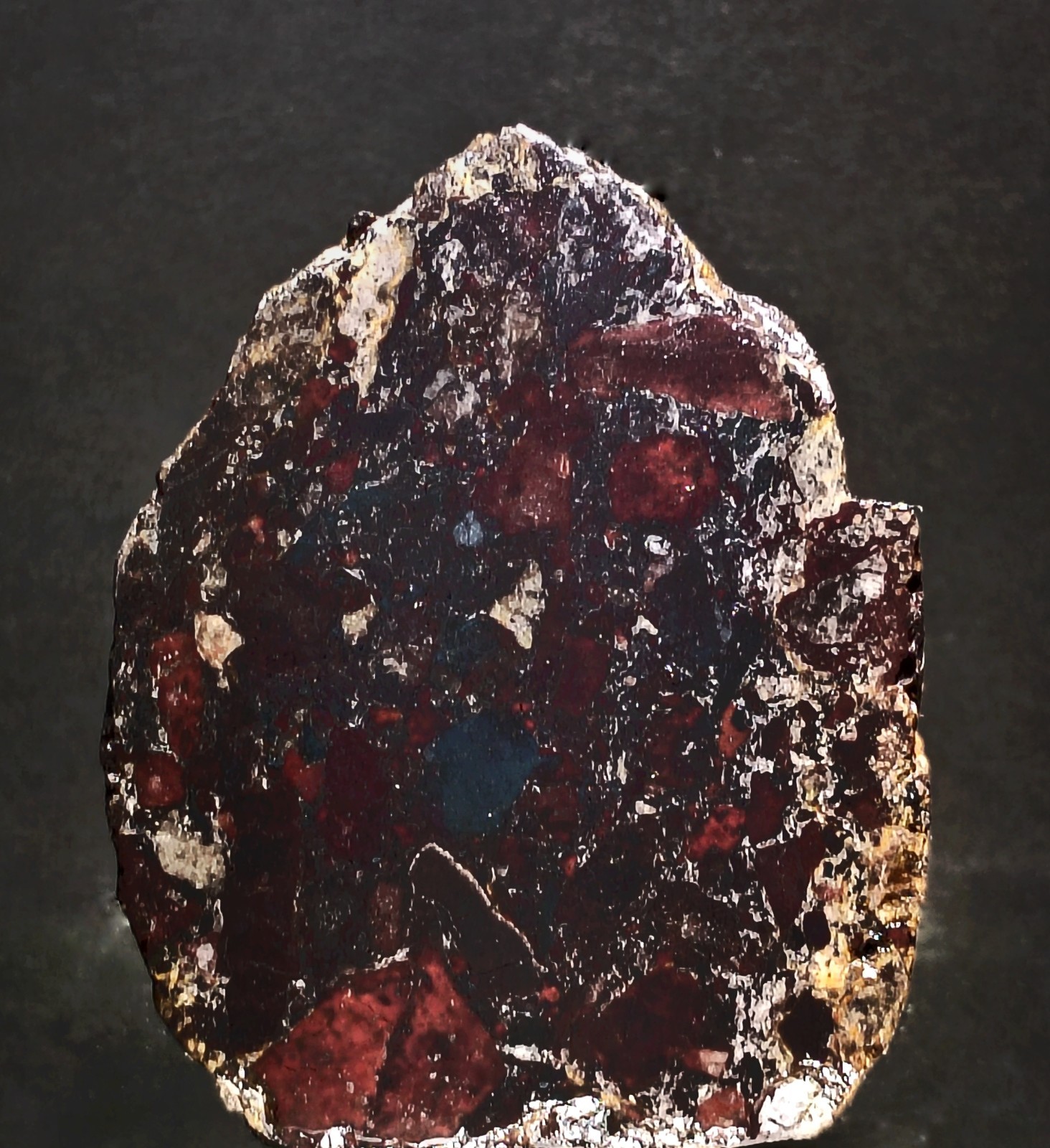
Jasper-Filled Hematite Breccia — Cedar Hill Mine (Cedar Mountain), Pilot Knob, Iron County, Missouri
This one records the second act.
The iron came first — laid down in a Mesoproterozoic caldera lake around 1.44 billion years ago, where hydrothermal fluids vented into standing water and hematite settled out as fine mud among blocks of shattered volcanic rock. That mass hardened into ore. Then the ground moved again, and the ore itself broke.
Silica-rich fluids found the new cracks. They ran through the fractured hematite carrying iron in solution, and where they slowed they left jasper — deep oxblood and blood-red, filling every opening in the broken iron ore. Look at the polished face and you can trace the sequence: steel-gray and purple-black hematite fragments, angular and locked together, with red jasper flooding the gaps between them. White and cream quartz threads cut through where the last clear fluids passed. Along the edges, warm yellow and gold goethite marks where later groundwater worked on the iron.
Broken, healed, broken again, healed again. Three separate mineralizing events on one polished face.
The mine. Cedar Hill sits on Cedar Mountain near Pilot Knob, one of the outcropping deposits worked for iron since the early 1800s and never a large operation. The ore ran in two roughly parallel veins one to four feet wide, cropping out for only about a hundred feet on a northwest–southeast line. The workings amount to an irregular pit roughly 150 by 75 feet, laid out so it nearly surrounds a standing horse of brecciated porphyry, with a short incline driven on the ore\'s shallow dip. By the time the pit was surveyed in detail it had already flooded, and only the upper portion could be examined. In character the ore matches Pilot Knob next door — the same brecciated porphyry footwall, the same fine grain and thin lamination, and the same complete absence of magnetism.
This specimen. One face cut and polished, natural back. Completely non-magnetic, exactly as the historic descriptions of Cedar Hill ore report — a useful locality check for anyone who wants to test it. Dark and rich under light, with the red jasper coming up strongly against the gray-black iron.
Dimensions: 3.\" x 2.25\" x 1\"
Weight: 195 grams
Locality: Cedar Hill Mine (Cedar Mountain), Pilot Knob, Iron County, Missouri, USA
Collected and prepared by the seller
Free dir=\"ltr\" style=\"margin-top:0; margin-bottom:0;\">KEYWORDS
Cedar Hill Mine, Cedar Mountain Mine, Cedar Mountain, Pilot Knob, Pilot Knob Missouri, Iron County Missouri, Ironton, Arcadia Valley, St. Francois Mountains, southeast Missouri, SEMO, Missouri Iron Metallogenic Province, hematite, hematite breccia, iron ore, iron formation, jasper, red jasper, oxblood jasper, brecciated jasper, jasper breccia, jaspilite, goethite, limonite, quartz, breccia, volcanic breccia, brecciated porphyry, porphyry, rhyolite, caldera, caldera lake, exhalative, sedimentary iron formation, non-magnetic, Fe2O3, Mesoproterozoic, Precambrian, 1.4 billion years, Eastern Granite-Rhyolite terrane, Laurentia, polished face, natural back, cabinet specimen, display specimen, freeform, historic mine, flooded mine, closed locality, rare locality, self collected, mineral specimen, rock collection, Missouri minerals, Missouri geology, USA locality