

|
Site Categories |
|
Featured Items |

Poodle, Spaghetti Trim, Ucagco


|
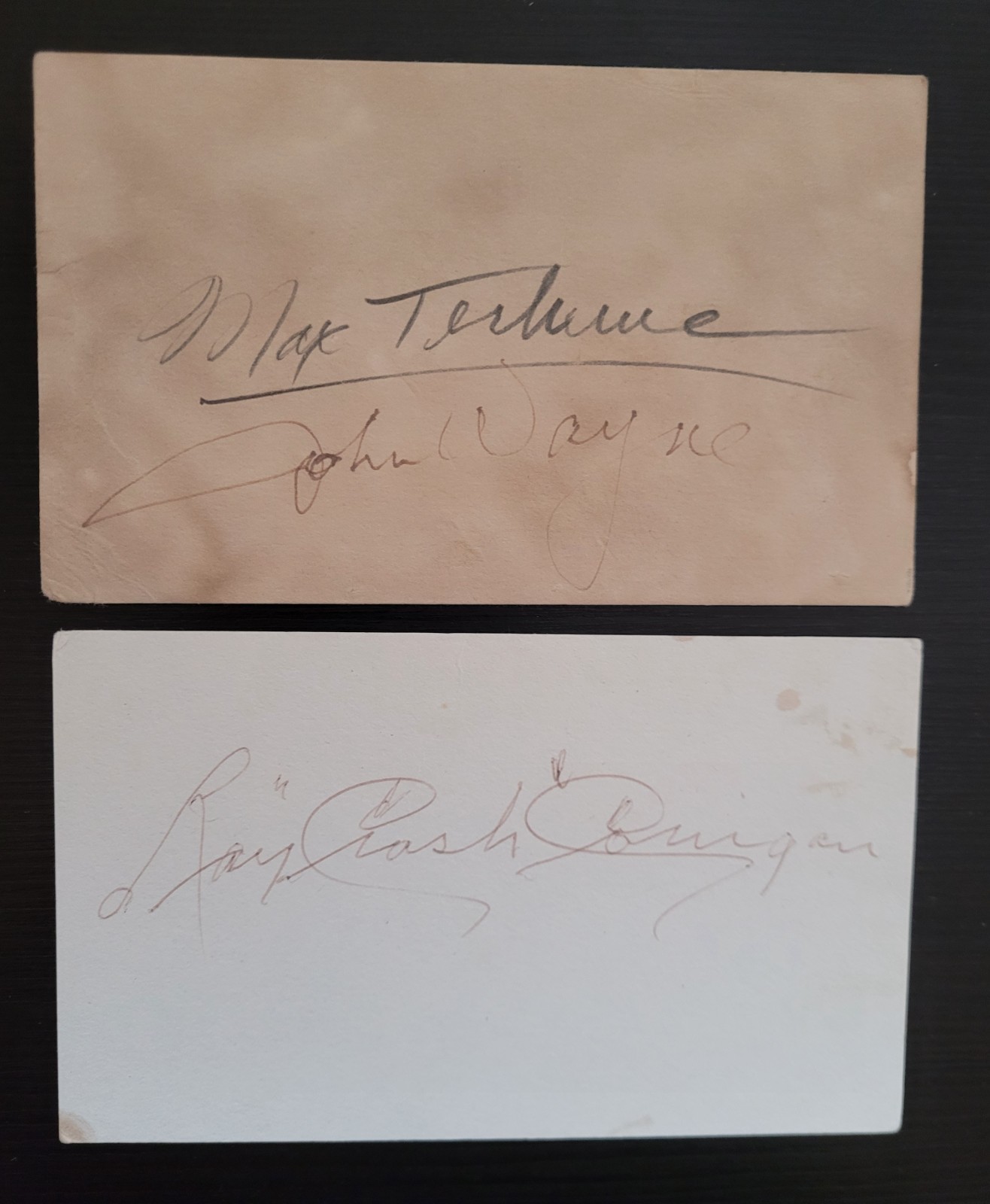
JOHN WAYNE (1907-1979) large beautiful autograph THREE MESQUITEERS signed - COA For Sale

When you click on links to various merchants on this site and make a purchase, this can result in this site earning a commission. Affiliate programs and affiliations include, but are not limited to, the eBay Partner Network.

JOHN WAYNE (1907-1979) large beautiful autograph THREE MESQUITEERS signed - COA:
$700.00
This listing features a rare set of authentic, vintage signatures from Hollywood\'s Golden Age of Westerns. Included are hand-signed autographs from the legendary John Wayne, Max Terhune, and Ray \"Crash\" Corrigan. These signatures come with a full Certificate of Authenticity (COA) from Piece of the Past, Inc.. Item Details Autographs: John Wayne, Max Terhune, and Ray \"Crash\" Corrigan. Accomapanied with a modern8”x10” b&w still, THREE MESQUITEERS #1 John Wayne, Ray Corrigan, Max Terhune Condition: Vintage signatures on paper. The paper shows natural age-related toning and some minor spotting, which adds to the authentic character of these historical pieces.
Transcription of Autograph Cards Card 1 (Front): Card 1 (Back): Card 2 (Front): Card 2 (Back): Transcription of Certificate of Authenticity CERTIFICATE OF AUTHENTICITY John Wayne vintage signature 116411 Main Text: \"This document shall serve as a certificate of authenticity for the aforementioned item, which Piece of the Past, Inc. and Kevin Martin has thoroughly examined. The OF AUTHENTICITY
John Wayne vintage signature
116411
This document shall serve as a certificate of authenticity for the aforementioned item, which Piece
of the Past, Inc. and Kevin Martin has thoroughly examined.
The signature(s) is/are consistent considering a wide range of specific qualities, including slant,
flow, pen pressure, letter size, formation, and other characteristics typical of our extensive database
of known exemplars we have examined throughout our hobby and professional career.
It is considered the opinion that the signature(s) item is genuine. This item has been assigned a
unique certification number, which is in our restricted database and can be confirmed by inquiry
to us via our website at any time. This certificate must appear on our
proprietary paper and bear the signature of Kevin Martin.
Happy Collecting!
Kevin Martin, CEO
Piece of the Past, Inc. / Star Wares / Celebrity Connection
Member: UACC, IADA, Manuscript Society, Ephemera Society
Publisher: Autograph Quarterly Magazine
Author: The Official Price Guide of Autographs, Autograph Collector Guide to Autographs,
Signatures of the Stars, Fakes, Frauds, and Forgeries, Spoiled Rotten, The 27 Club
Of THE
PAst, iNC._________________Marion Robert Morrison[1][a] (May 26, 1907 – June 11, 1979), known professionally as John Wayne, was an American actor. Nicknamed \"Duke\", he became a popular icon through his starring roles in films which were produced during Hollywood\'s Golden Age, especially in Western and war movies. His career flourished from the silent film era of the 1920s through the American New Wave, as he appeared in a total of 179 film and television productions. He was among the top box-office draws for three decades[3][4] and appeared with many other important Hollywood stars of his era. In 1999, the American Film Institute selected Wayne as one of the greatest male stars of classic American cinema.[5]Wayne was born in Winterset, Iowa, but grew up in Southern California. After losing his football scholarship to the University of Southern California due to a bodysurfing accident,[6] he began working for the Fox Film Corporation. He appeared mostly in small parts, but his first leading role came in Raoul Walsh\'s Western The Big Trail (1930), an early widescreen film epic which was a box-office failure. He played leading roles in numerous B movies during the 1930s, most of them also Westerns, without becoming a major name. John Ford\'s Stagecoach (1939) made Wayne a mainstream star, and he starred in 142 motion pictures altogether. According to biographer Ronald Davis, \"John Wayne personified for millions the nation\'s frontier heritage.\"[7]Wayne\'s other roles in Westerns included a cattleman driving his herd on the Chisholm Trail in Red River (1948), a Civil War veteran whose niece is abducted by a tribe of Comanches in The Searchers (1956), a troubled rancher competing with a lawyer (James Stewart) for a woman\'s hand in The Man Who Shot Liberty Valance (1962), and a cantankerous one-eyed marshal in True Grit (1969), for which he received the Academy Award for Best Actor. Wayne is also remembered for his roles in The Quiet Man (1952) with Maureen O\'Hara, Rio Bravo (1959) with Dean Martin, and The Longest Day (1962). In his final screen performance, he starred as an aging gunfighter suffering from cancer in The Shootist (1976). Wayne made his last public appearance at the Academy Awards ceremony on April 9, 1979,[8][9] and died of stomach cancer two months later.[10] In 1980, he was posthumously awarded the Presidential Medal of Freedom, the highest civilian honor of the United States.[11][12]
Early life
The house in Winterset, Iowa, where Wayne was bornWayne was born Marion Robert Morrison on May 26, 1907, at 224 South Second Street in Winterset, Iowa.[13] The local paper, Winterset Madisonian, reported on page 4 of the edition of May 30, 1907, Wayne weighed 13 lb (around 6 kg) at birth.[14] Wayne claimed his middle name was soon changed from Robert to Michael when his parents decided to name their next son Robert, but extensive research has found no such legal change, although it might have been changed informally or the documentation may have been lost. Wayne\'s legal name apparently remained Marion Robert Morrison his entire life,[15][16] although to this day his original name is almost always referred to as Marion Michael Morrison.Wayne\'s father, Clyde Leonard Morrison (1884–1937), was the son of Marion Mitchell Morrison (1845–1915), a veteran who had served in the Union army during the American Civil War. Wayne\'s mother, the former Mary \"Molly\" Alberta Brown (1885–1970), was from Lancaster County, Nebraska. Wayne had Scottish, Scotch-Irish, English, and Irish ancestry.[17] His great-great-grandfather Robert Morrison (b. 1782) left County Antrim, Ireland, with his mother, arriving in New York in 1799 and eventually settling in Adams County, Ohio. The Morrisons were originally from the Isle of Lewis in the Outer Hebrides, Scotland.[18] He was raised Presbyterian.[19]Wayne\'s family moved to Palmdale, California, and then in 1916 to Glendale at 404 Isabel Street, where his father worked as a pharmacist. He attended Glendale Union High School, where he performed well in both sports and academics. Wayne was part of his high school\'s football team and its debating team. He was also the president of the Latin Society and contributed to the school\'s newspaper sports column.[20]A local fireman at the station on his route to school in Glendale started calling him \"Little Duke\" because he never went anywhere without his huge Airedale Terrier, Duke.[21][22] He preferred \"Duke\" to \"Marion\", and the nickname stuck. Wayne attended Wilson Middle School in Glendale. As a teen, he worked in an ice-cream shop for a man who shod horses for Hollywood studios. He was also active as a member of the Order of DeMolay, which he was later inducted into the Hall of Fame.[23] He played football for the 1924 league champion Glendale High School team.[24]Wayne applied to the U.S. Naval Academy, but was not accepted due to poor grades. Instead, he attended the University of Southern California (USC), majoring in pre-law. He was a member of the Trojan Knights and Sigma Chi fraternities.[25]: 30 Wayne, who stood 6 feet 4+1⁄2 inches (1.94 metres) tall, also played on the USC football team under coach Howard Jones. A broken collarbone injury curtailed his athletic career; Wayne later noted he was too terrified of Jones\' reaction to reveal the actual cause of his injury, a bodysurfing accident.[26] He lost his athletic scholarship and, without funds, had to leave the university.[27][28]
Career
Wayne with Marguerite Churchill in the widescreen The Big Trail (1930), his first role as a leading man
Early works and first lead roleAs a favor to coach Jones, who had given silent Western film star Tom Mix tickets to USC games, director John Ford and Mix hired Wayne as a prop boy and extra.[29][30] Wayne later credited his walk, talk, and persona to his acquaintance with Wyatt Earp, who was good friends with Mix.[29] Wayne soon moved to bit parts, establishing a longtime friendship with Ford, the director who provided most of those roles. Early in this period, he had a minor, uncredited role as a guard in the 1926 film Bardelys the Magnificent. Wayne also appeared with his USC teammates playing football in Brown of Harvard (1926), The Dropkick (1927), and Salute (1929) and Columbia\'s Maker of Men (filmed in 1930, released in 1931).[31] While working for Fox Film Corporation in bit roles, Wayne was given on-screen credit as \"Duke Morrison\" only once, in Words and Music (1929). Director Raoul Walsh saw him moving studio furniture while working as a prop boy and cast him in his first starring role in The Big Trail (1930). For his screen name, Walsh suggested \"Anthony Wayne\", after Revolutionary War General \"Mad\" Anthony Wayne. Fox Studios chief Winfield Sheehan rejected it as sounding \"too Italian\". Walsh then suggested \"John Wayne\". Sheehan agreed, and the name was set. Wayne was not even present for the discussion.[32] His pay was raised to $105 a week.[33]The Big Trail was to be the first big-budget outdoor spectacle of the sound era, made at a then-staggering cost over $2 million (over $38.8 million equivalent in 2025),[34] using hundreds of extras and wide vistas of the American Southwest, still largely unpopulated at the time. To take advantage of the breathtaking scenery, it was filmed in two versions, a standard 35 mm version and another in the new 70 mm Grandeur film process, using an innovative camera and lenses. Many in the audience who saw it in Grandeur stood and cheered, but only a handful of theaters were equipped to show the film in its widescreen process, and the effort was largely wasted at the time. The film was considered a huge box-office flop at the time, but came to be highly regarded by modern critics.[35]
Subsequent films and breakthrough
Wayne with Evalyn Knapp and Natalie Kingston in His Private Secretary (1933)
Wayne with Jean Rogers and Ward Bond in Conflict (1936)
Wayne with Marsha Hunt in Born to the West (1937)After the commercial failure of The Big Trail, Wayne was relegated to small roles in A pictures, including Columbia\'s The Deceiver (1931), in which he played a corpse. He appeared in the serial The Three Musketeers (1933), an updated version of the Alexandre Dumas novel in which the protagonists were soldiers in the French Foreign Legion in then-contemporary North Africa. He played the lead, with his name over the title, in many low-budget Poverty Row Westerns, mostly at Monogram Pictures and serials for Mascot Pictures Corporation. By Wayne\'s own estimation, he appeared in about 80 of these horse operas from 1930 to 1939.[36] In Riders of Destiny (1933), he became one of the first singing cowboys of film, albeit via dubbing.[37] Wayne also appeared in some of the Three Mesquiteers Westerns, whose title was a play on the Dumas classic. He was mentored by stuntmen in riding and other Western skills.[31] Stuntman Yakima Canutt and Wayne developed and perfected stunts and onscreen fisticuffs techniques which are still in use.[38] One of the main innovations with which Wayne is credited in these early Poverty Row Westerns is allowing the good guys to fight as convincingly as the bad guys, by not always making them fight clean. Wayne claimed, \"Before I came along, it was standard practice the hero must always fight clean. The heavy was allowed to hit the hero in the head with a chair or throw a kerosene lamp at him or kick him in the stomach, but the hero could only knock the villain down politely and then wait until he rose. I changed all that. I threw chairs and lamps. I fought hard and I fought dirty. I fought to win.\"[39]Wayne\'s second breakthrough role came with John Ford\'s Stagecoach (1939). Because of Wayne\'s B-movie status and track record in low-budget Westerns throughout the 1930s, Ford had difficulty getting financing for what was to be an A-budget film. After rejection by all the major studios, Ford struck a deal with independent producer Walter Wanger in which Claire Trevor—a much bigger star at the time—received top billing. Stagecoach was a huge critical and financial success, and Wayne became a mainstream star. Cast member Louise Platt credited Ford as saying at the time that Wayne would become the biggest star ever because of his appeal as the archetypal \"everyman\".[40]
1940s
Wayne with Joan Blondell in Lady for a Night (1942)
Wayne with Gail Russell in Angel and the Badman (1947)
Wayne (right) acting in a short clip from Angel and the Badman (1947) (click to play)America\'s entry into World War II resulted in a deluge of support for the war effort from all sectors of society, and Hollywood was no exception. Wayne was exempted from service due to his age (34 at the time of Pearl Harbor) and family status (classified as 3-A – family deferment). Wayne repeatedly wrote to Ford saying he wanted to enlist, on one occasion inquiring whether he could get into Ford\'s military unit.[41] Wayne did not attempt to prevent his reclassification as 1-A (draft eligible), but Republic Studios was emphatically resistant to losing him, since he was their only A-list actor under contract. Herbert J. Yates, president of Republic, threatened Wayne with a lawsuit if he walked away from his contract,[42] and Republic Pictures intervened in the Selective Service process, requesting Wayne\'s further deferment.[43]U.S. National Archives records indicate Wayne, in fact, did make an application[44] to serve in the Office of Strategic Services (OSS), precursor to the modern CIA, but his offer was ultimately unsuccessful. Wayne toured U.S. bases and hospitals in the South Pacific for three months in 1943 and 1944,[45] with the United Service Organizations (USO).[46][47][48] During this trip, he carried out a request from William J. Donovan, head of the OSS, to assess whether General Douglas MacArthur, commander of the South West Pacific Area, or his staff were hindering the work of the OSS.[22]: 88 Donovan later issued Wayne an OSS Certificate of Service to memorialize Wayne\'s contribution to the OSS mission.[22]: 88 [49] By many accounts, his failure to serve in the military later became the most painful part of his life.[41] His widow later suggested his patriotism in later decades sprang from guilt, writing: \"He would become a \'superpatriot\' for the rest of his life trying to atone for staying home.\"[50]Wayne\'s first color film was The Shepherd of the Hills (1941), in which he co-starred with his longtime friend Harry Carey. The following year, he appeared in his only film directed by Cecil B. DeMille, the Technicolor epic Reap the Wild Wind (1942), in which he co-starred with Ray Milland and Paulette Goddard; it was one of the rare times he played a character with questionable values.Like most Hollywood stars of his era, Wayne appeared as a guest on radio programs, such as: The Hedda Hopper Show and The Louella Parsons Show. He made a number of appearances in dramatic roles, mainly recreations for radio of his own film roles, on such programs as Screen Directors Playhouse and Lux Radio Theatre. For six months in 1942, Wayne starred in his own radio adventure series, Three Sheets to the Wind, produced by film director Tay Garnett. In the series, an international spy/detective show, Wayne played Dan O\'Brien, a detective who used alcoholism as a mask for his investigatory endeavors. The show was intended by Garnett to be a pilot of sorts for a film version, though the motion picture never came to fruition. No episodes of the series featuring Wayne seem to have survived, though a demonstration episode with Brian Donlevy in the leading role does exist. Wayne, not Donlevy, played the role throughout the series\' run on NBC.[51] Director Robert Rossen offered to Wayne the starring role in All the King\'s Men (1949), but Wayne refused, believing the script to be \"un-American in many ways.\"[52] Broderick Crawford, who was eventually cast in the role, won the 1949 Oscar for Best Actor, ironically beating out Wayne, who had been nominated for Sands of Iwo Jima (1949).
1950s
Wayne with Maureen O\'Hara in The Quiet Man (1952)
Wayne in The Searchers (1956)
Wayne with Janet Leigh in Jet Pilot (1957)
Wayne with Dean Martin in Rio Bravo (1958)He lost the leading role of Jimmy Ringo in The Gunfighter (1950) to Gregory Peck due to his refusal to work for Columbia Pictures because its chief, Harry Cohn, had mistreated him years before when he was a young contract player. Cohn had bought the project for Wayne, but Wayne\'s grudge was too deep, and Cohn sold the script to Twentieth Century Fox, which cast Peck in the role Wayne badly wanted, but for which he refused to bend.[52][53]Batjac, the production company co-founded by Wayne in 1952, was named after the fictional shipping company Batjak in Wake of the Red Witch (1948), a film based on the novel by Garland Roark. (A spelling error by Wayne\'s secretary was allowed to stand, accounting for the variation.)[52] Batjac (and its predecessor, Wayne-Fellows Productions) was the arm through which Wayne produced many films for himself and other stars. Its best-known non-Wayne productions were Seven Men From Now (1956), which started the classic collaboration between director Budd Boetticher and star Randolph Scott, and Gun the Man Down (1956) with contract player James Arness as an outlaw.One of Wayne\'s most popular roles was in The High and the Mighty (1954), directed by William Wellman, and based on a novel by Ernest K. Gann. His portrayal of a heroic copilot won widespread acclaim. Wayne also portrayed aviators in Flying Tigers (1942), Flying Leathernecks (1951), Island in the Sky (1953), The Wings of Eagles (1957), and Jet Pilot (1957).He appeared in nearly two dozen of John Ford\'s films over 20 years, including She Wore a Yellow Ribbon (1949), The Quiet Man (1952), and The Searchers (1956). The latter film was the first one in which he called someone \"Pilgrim\", and is often considered to contain Wayne\'s finest and most complex performance.[54]On May 14, 1958, Hal Kanter\'s I Married a Woman starring George Gobel and Diana Dors had its Los Angeles opening. In it, Wayne had a cameo as himself.[55] On October 2, John Huston\'s The Barbarian and the Geisha, in which Wayne played the lead and clashed with his director all the way, had its New York opening.[56]Howard Hawks\'s Rio Bravo premiered on March 18, 1959. In it, Wayne plays the lead with a supporting cast including Dean Martin, Ricky Nelson, Angie Dickinson, Walter Brennan and Ward Bond.[57] Ford\'s The Horse Soldiers had its world premiere in Shreveport, Louisiana on June 18. Set during the Civil War, Wayne shares the lead with William Holden.[58]Wayne notoriously portrayed Genghis Khan in The Conqueror (1956), which was panned by critics.
1960s
Wayne in The Comancheros (1961)
Wayne in The Longest Day (1962)
Wayne with Kim Darby in True Grit (1969)
Wayne with Rock Hudson in The Undefeated (1969)In 1960, Wayne directed and produced The Alamo, his directorial debut, portraying Davy Crockett, with Richard Widmark as Jim Bowie. Wayne was nominated for an Oscar as the producer in the Best Picture category.[59] Also in 1960, Wayne played the lead in Henry Hathaway\'s North to Alaska, also starring Stewart Granger and Ernie Kovacs.[60] In 1961, Wayne shared the lead with Stuart Whitman in Michael Curtiz\'s The Comancheros.[61]In 1962, Wayne starred in John Ford\'s The Man Who Shot Liberty Valance with James Stewart.[62] May 29 marked the premiere of Howard Hawks\' Hatari!, shot on location in Africa with Wayne playing the lead capturing wild animals from the beds of trucks; all the scenes with animals in the film are real.[63] On October 4, The Longest Day started its theatrical run, with Wayne memorably acting with an ensemble cast.[64] Although the other top-level actors in the film accepted a token payment of only $10,000 each to play their roles, making the all-star cast feasible for the budget, Wayne was paid a quarter of a million dollars due to an earlier dispute with producer Darryl F. Zanuck. During this time, the cast of the television drama, Combat!, were preparing for the inaugural season. The principal cast (including Vic Morrow) were to go through a week of basic training at the Army\'s Infantry Training Center at Fort Ord in northern California.[65] Morrow noted the instructors who worked with the cast at Fort Ord had one common request: not to act like John Wayne. \"Poor John,\" Morrow told a reporter. \"I wonder if he knows he\'s almost a dirty word in the Army.\"[65]In 1963, Wayne acted in a segment of How the West Was Won,[66] directed by Ford. On June 12, Wayne played the lead in his final Ford film, Donovan\'s Reef, co-starring Lee Marvin.[67] On November 13, another film starring Wayne premiered, Andrew V. McLaglen\'s McLintock!, once again opposite Maureen O\'Hara.[68]In 1964, Wayne played the leading role in Hathaway\'s Circus World with Claudia Cardinale and Rita Hayworth.[69]In 1965, Wayne played the brief cameo role of a centurion in George Stevens\'s The Greatest Story Ever Told.[70] On April 6, he shared the screen with Kirk Douglas and Patricia Neal in Otto Preminger\'s In Harm\'s Way.[71] On June 13, he acted in Hathaway\'s The Sons of Katie Elder with Dean Martin.[72]In 1966, Wayne appeared in a cameo role for Melville Shavelson\'s Cast a Giant Shadow starring Douglas.[73]In 1967, Wayne played the lead in Burt Kennedy\'s The War Wagon with Douglas as the second lead.[74] His second movie that year, Hawks\' El Dorado, a highly successful partial remake of Rio Bravo with Robert Mitchum playing Martin\'s original role, premiered on June 7.[75]In 1968, Wayne co-directed with Ray Kellogg The Green Berets,[76] the only major film made during the Vietnam War in support of the war.[27] Wayne wanted to make this movie because at the time Hollywood had little interest in making movies about the Vietnam War.[77] During the filming of The Green Berets, the Degar or Montagnard people of Vietnam\'s Central Highlands, fierce fighters against communism, bestowed on Wayne a brass bracelet he wore in the film and all subsequent films.[52] Also in 1968, Wayne played the lead in Andrew V. McLaglen\'s Hellfighters, a film about the crews who put out oil rig fires.[78] Katharine Ross played a supporting role.On June 13, 1969, Hathaway\'s True Grit premiered. For his role as Rooster Cogburn, Wayne won the Best Actor Oscar at the 42nd Academy Awards.[79] In November of 1969, another film starring Wayne was released, Andrew V. McLaglen\'s The Undefeated with Rock Hudson.[80]
1970s: later career
Wayne and Richard Boone at Big Jake screening, 1971On June 24, 1970, Andrew V. McLaglen\'s Chisum started to play in cinemas. Wayne took the role of the owner of a cattle ranch, who finds out a businessman is trying to own neighboring land illegally.[81] On September 16, Howard Hawks\' Rio Lobo premiered. Wayne played Col. Cord McNally, who confronts Confederate soldiers who stole a shipment of gold at the end of the Civil War.[82] This was another remake of Rio Bravo, albeit without a second lead the box office caliber of Dean Martin or Robert Mitchum.In June 1971, George Sherman\'s Big Jake made its debut. Wayne played the role of an estranged father who must track down a gang who kidnapped his grandson.[83] The film was a critically acclaimed hit.In 1972, Wayne starred in Mark Rydell\'s The Cowboys. Vincent Canby of The New York Times, who did not particularly care for the film, wrote: \"Wayne is, of course, marvelously indestructible, and he has become an almost perfect father figure\".[84] The same year, he was selected in the last round of the NFL draft by the Atlanta Falcons for his past football experience, though the pick was disallowed by league officials as he was 64 years old at the time.[85]On February 7, 1973, Burt Kennedy\'s The Train Robbers opened; Wayne appeared alongside Ann-Margret, Rod Taylor and Ben Johnson.[86] On June 27, Andrew V. McLaglen\'s Cahill U.S. Marshal premiered, with Wayne, George Kennedy and Gary Grimes. It was a box office failure.[87]In 1974, Wayne took on the role of the eponymous detective in John Sturges\'s crime drama McQ.[88]On March 25, 1975, Douglas Hickox\'s Brannigan premiered. In it, Wayne played a Chicago police lieutenant named Jim Brannigan on the hunt in London for an organized-crime leader.[89] On October 17, Rooster Cogburn started its theatrical run; Wayne reprised his role as U.S. Marshal Reuben J. \"Rooster\" Cogburn[90] with strong elements of the plot of The African Queen along with Katharine Hepburn as his leading lady.In 1976, Wayne starred in Don Siegel\'s The Shootist, also starring Lauren Bacall, Ron Howard and James Stewart. It was Wayne\'s final cinematic role, whose main character, J. B. Books, was dying of cancer, to which Wayne himself succumbed three years later. It contains numerous plot similarities to The Gunfighter of nearly 30 years before, a role which Wayne had wanted, but turned down.[52] Upon its theatrical release, it grossed $13,406,138 domestically. About $6 million were earned as US theatrical rentals.[91] The film received positive reviews.[92] It was named one of the Ten Best Films of 1976 by the National Board of Review. Film critic Roger Ebert of the Chicago Sun-Times ranked The Shootist number 10 on his list of the 10 best films of 1976.[93] The film was nominated for an Oscar, a Golden Globe, a BAFTA film award, and a Writers Guild of America award.
Personal life
Wayne with his second wife Esperanza Baur, 1949 (left); Wayne with his third wife Pilar Pallete, 1971 (right)Wayne was married three times and divorced twice. His wives included one of Spanish American descent, Josephine Alicia Saenz, and two from Latin America, Esperanza Baur and Pilar Pallete. He had four children with Josephine: Michael Wayne (1934–2003), Mary Antonia \"Toni\" Wayne LaCava (1936–2000), Patrick Wayne (born 1939), and Melinda Wayne Munoz (1940–2022). He had three more children with Pilar: Aissa Wayne (born 1956), John Ethan Wayne (born 1962), and Marisa Wayne (born 1966).Several of Wayne\'s children entered the film and television industry. Son Ethan was billed as John Ethan Wayne in a few films, and played one of the leads in the 1990s update of the Adam-12 television series.[94] Ethan has also appeared on the History Channel show Pawn Stars to help authenticate merchandise supposedly related to his father\'s career. Granddaughter Jennifer Wayne, daughter of Aissa, is a member of the country music group Runaway June.[95]In 1973, Wayne was encouraged by Pilar, an avid tennis player, to build the John Wayne Tennis Club in Newport Beach, California. In 1995, the club was sold to Ken Stuart, former general manager, and became the Palisades Tennis Club. In The Quiet Man (1952), Wayne tells Michaeleen \"Óg\", (Irish: Young), Flynn (portrayed by Barry Fitzgerald) he is six feet \"four and a half\" (194 cm), an assertion corroborated by Pilar\'s book John Wayne: My Life With the Duke.[96]His divorce from Baur, a Mexican former actress, was stormy. She believed Wayne and co-star Gail Russell were having an affair, a claim both Wayne and Russell denied. The night the film Angel and the Badman (1947) wrapped, the usual party was held for cast and crew, and Wayne came home very late. Esperanza was in a drunken rage by the time he arrived, and she attempted to shoot him as he walked through the front door.[52]Wayne had several high-profile affairs, including one with Merle Oberon which lasted from 1938 to 1947.[97] After his separation from Pilar, in 1973, Wayne became romantically involved and lived with his former secretary Pat Stacy (1941–1995) until his death in 1979.[27] Stacy published a book about her life with him in 1983, titled Duke: A Love Story.[98]Wayne\'s hair began to thin in the 1940s, and he had begun to wear a hairpiece by the end of the decade.[99] He was occasionally seen in public without the hairpiece (such as, according to Life, at Gary Cooper\'s funeral). During an appearance at Harvard University, Wayne was asked by a student, \"Is it true your toupée is real mohair?\" He responded: \"sir, that\'s real hair. Not mine, but real hair.\"[100]A close friend, California Congressman Alphonzo E. Bell Jr., wrote of Wayne: \"Duke\'s personality and sense of humor were very close to what the general public saw on the big screen. It is perhaps best shown in these words he had engraved on a plaque: \'Each of us is a mixture of some good and some not so good qualities. In considering one\'s fellow man, it\'s important to remember the good things. [...] We should refrain from making judgments just because a fella happens to be a dirty, rotten S.O.B.\'\"[101]Wayne was fond of literature, his favorite authors being Charles Dickens, Arthur Conan Doyle, and Agatha Christie. His favorite books were David Copperfield, and Conan Doyle\'s historical novels The White Company and Sir Nigel.
Wayne playing chess with Marlene Dietrich, 1943Wayne was a chess player. Roger Ebert recalls on the set of Chisum, \"we were playing a chess game, both of us bending over the board on an upended apple crate. Wayne, slouched in his old stitched leather director\'s chair, had a crowd of kibitzers: wranglers, extras, old cronies, drinking buddies, a couple of Mexican stuntmen. He studied the board, roared with laughter, and said, \'God...damn it! You\'ve trapped my queen!\' We studied the board. I made a decisive move. \'Why the hell did I just say that?\' he asked. If I hadn\'t-a...said it, you wouldn\'t-a...seen it.\'\"[102] According to Michael Munn, when Wayne was asked about Rock Hudson\'s sexuality, he replied, \"Who the hell cares if he\'s a queer? The man plays great chess.\"[103]He used the same 1873 Colt Single Action Army revolver in many of the Westerns in which he appeared.[104][105]Wayne had been a chain smoker of cigarettes since young adulthood and was diagnosed with lung cancer in 1964. He underwent successful surgery to remove his entire left lung[106] and two ribs. Despite efforts by his business associates to prevent him from going public with his illness for fear it would cost him work, Wayne announced he had cancer and called on the public to get preventive examinations. Five years later, Wayne was declared cancer-free. Wayne has been credited with coining the term \"the Big C\" as a euphemism for cancer.[107] Wayne biographer Michael Munn chronicled Wayne\'s drinking habits.[22] According to Sam O\'Steen\'s memoir, Cut to the Chase, studio directors knew to shoot Wayne\'s scenes before noon, because by afternoon, he \"was a mean drunk\".[108] Ebert quotes him as saying: \"Tequila makes your head hurt. Not from your hangover. From falling over and hitting your head.\"[102]Wayne was a very active Freemason. He was made a Master Mason at Marion McDaniel Lodge No. 56 F&AM, in Tucson, Arizona.[109][110][111] He became a 32nd Degree Scottish Rite Mason and later joined the Al Malaikah Shrine Temple in Los Angeles, along with fellow actor Roy Rogers. He later became a member of the York Rite.[112][113] During his childhood, he was a member of a local Demolay chapter in Glendale.During the early 1960s, Wayne traveled often to Panama, and he purchased the island of Taborcillo off the nation\'s Pacific coast. It was sold by his estate at his death.Wayne\'s yacht, the Wild Goose, was one of his favorite possessions. He kept it docked in Newport Beach Harbor, and it was listed on the U.S. National Register of Historic Places in 2011.[114]
Political and social views
Wayne in The Challenge of Ideas (1961)
Wayne meeting with President Richard Nixon and Henry Kissinger in San Clemente, California, July 1972
Wayne addressing the Republican Convention in Miami, 1968Throughout most of his life, Wayne was a vocally prominent conservative Republican in Hollywood, supporting anti-communist positions.[115] However, he voted for Democratic President Franklin D. Roosevelt in the 1936 presidential election and expressed admiration for Roosevelt\'s successor, fellow Democratic President Harry S. Truman, despite having supported Republican candidate Thomas E. Dewey in 1948.[116][117] He took part in creating the conservative Motion Picture Alliance for the Preservation of American Ideals in February 1944 before being elected its president in 1949. An ardent anti-communist and vocal supporter of the House Un-American Activities Committee (HUAC), he made Big Jim McLain (1952) with himself as a HUAC investigator to demonstrate his support for the cause of anti-communism. His personal views found expression as a proactive inside enforcer of the \"Black List\", denying employment and undermining careers of many actors and writers who had expressed their personal political beliefs earlier in life. Soviet leader Joseph Stalin is alleged to have said Wayne should be assassinated for his frequently espoused anti-communist politics, despite being a fan of his movies.[118][119] Wayne was a supporter of Senator Joseph McCarthy.[120]Wayne supported Vice President Richard Nixon in the presidential election of 1960, but expressed his vision of patriotism when John F. Kennedy won the election: \"I didn\'t vote for him, but he\'s my president, and I hope he does a good job.\"[121] He used his star power to support conservative causes, including rallying support for the Vietnam War by producing, co-directing, and starring in the financially successful film The Green Berets (1968).[122] In 1960, he joined the anti-communist John Birch Society, but quit after the organization denounced fluoridation of water supplies as a communist plot.[123] In 1964, Wayne was a staunch supporter of Barry Goldwater, and actively campaigned for him.[124]Due to his status as the highest-profile Republican star in Hollywood, wealthy Texas Republican Party backers asked Wayne to run for national office in 1968, like his friend and fellow actor Senator George Murphy. He declined, joking he did not believe the public would seriously consider an actor in the White House. Instead, he supported his friend Ronald Reagan\'s campaigns for Governor of California in 1966 and 1970. He was asked to be the running mate for Democratic Alabama Governor George Wallace, who had been nominated for president by the American Independent Party, in his 1968 campaign, but he immediately rejected the offer[115] and actively campaigned for Nixon;[125] Wayne addressed the 1968 Republican National Convention on its opening day.[123]In 1971, Wayne wrote to President Nixon, who was a friend, to oppose Nixon\'s planned trip to China. Wayne enclosed some hate literature on \"that Jew, Kissinger,\" who had negotiated the historic meeting with Chinese leaders.[126]Wayne openly differed with many conservatives over the issue of returning the Panama Canal, as he supported the Panama Canal Treaty in the mid-1970s;[127] while Republican leaders such as Reagan, Jesse Helms, and Strom Thurmond had wanted the U.S. to retain full control of the canal, Wayne and fellow conservative William F. Buckley believed the Panamanians had the right to the canal and sided with President Jimmy Carter. Wayne was a close friend of Panamanian leader Omar Torrijos Herrera, and Wayne\'s first wife Josephine was a native of Panama. His support of the treaty brought him hate mail for the first time in his life.[128][129]In 1973, actor Marlon Brando refused an Oscar he had won, due to \"the treatment of American Indians today by the film industry\"; Brando did not attend the award ceremony but asked Native American civil rights activist Sacheen Littlefeather to attend and deliver a refusal speech in the event he won. Wayne was allegedly waiting in the wings and was so angry about her presence there, Littlefeather said \"he was coming towards me to forcibly take me off the stage, and he had to be restrained by six security men to prevent him from doing so.\"[130] However, an investigation in 2022 found this is unlikely to have happened, and Littlefeather had no way of witnessing this take place.[131]Roger Ebert wrote Wayne had a sense of humor about his politics. He recalls Wayne giving him a tour of his house: \"He pointed out autographed photos of Eisenhower, Nixon, Goldwater, and J. Edgar Hoover. I said I had to take a pee. On the wall of the bathroom opening off the den, he had a photo of Hubert Humphrey, inscribed \'with warm appreciation for your continued Support.\'\"[132] Colorado Congresswoman Pat Schroeder recalled \"John Wayne gave me a silver cigarette lighter during the Vietnam War which said \' Communism\' on it. I didn\'t know how to do that. I still don\'t.\"[133]Left-wing activist Abbie Hoffman paid tribute to Wayne\'s singularity, saying, \"I like Wayne\'s wholeness, his style. As for his politics, well—I suppose even cavemen felt a little admiration for the dinosaurs which were trying to gobble them up.\"[134] Maoist avant garde film maker and critic Jean Luc Godard, in his Cahiers du Cinéma text \"3000 heures de cinéma\" (\"3000 hours of cinema\"), asked rhetorically:[135] How can I hate John Wayne upholding Goldwater and yet love him when abruptly he takes Natalie Wood in his arms in the last reel of The Searchers?In a video clip which aired posthumously on People for the American Way\'s 1982 I Love Liberty TV special, Wayne stated while he disagreed with Jane Fonda, he still believed she had the right to say what she believes.[136]
1971 Playboy interview
Wayne signing the helmet of Pfc. Fonzell Wofford during a visit at Chu Lai, South Vietnam, in June 1966In May 1971, Playboy magazine published an interview with Wayne, in which he expressed his support for the Vietnam War,[137] and made headlines for his opinions about social issues and race relations in the United States:[138] With a lot of blacks, there\'s quite a bit of resentment along with their dissent, and possibly rightfully so. But we can\'t all of a sudden get down on our knees and turn everything over to the leadership of the blacks. I believe in white supremacy until the blacks are educated to a point of responsibility. ... I don\'t feel we did wrong in taking this great country away from the Indians. Our so-called stealing of this country from them was just a matter of survival. There were great numbers of people who needed new land, and the Indians were selfishly trying to keep it for the same Playboy interview, he also responded to questions about whether social programs were good for the country: I know all about that. In the late \'20s, when I was a sophomore at USC, I was a socialist myself—but not when I left. The average college kid idealistically wishes everybody could have ice cream and cake for every meal, but as he gets older and gives more thought to his and his fellow man\'s responsibilities, he finds it can\'t work out that way—some people just won\'t carry their load ... I believe in welfare—a welfare work program. I don\'t think a fella should be able to sit on his backside and receive welfare. I\'d like to know why well-educated idiots keep apologizing for lazy and complaining people who think the world owes them a living. I\'d like to know why they make excuses for cowards who spit in the faces of the police and then run behind the judicial sob sisters. I can\'t understand these people who carry placards to save the life of some criminal, yet have no thought for the innocent victim.[137]In February 2019, the Playboy interview resurfaced,[142] which resulted in calls for John Wayne Airport to be renamed.[143] Wayne\'s son, Ethan, defended him, stating: \"It would be an injustice to judge someone based on an interview which is being used out of context.\"[144] The calls for changing the airport\'s name back to Orange County Airport were renewed during the George Floyd protests in June 2020,[145] though the name, as of 2025, remains unchanged.In October 2019, student activists of Wayne\'s alma mater University of Southern California called for removing from the university\'s premises an exhibit dedicated to Wayne, citing the interview as cause.[146] In July 2020, it was announced the materials of the 2012-created exhibit would be moved to the USC Cinematic Arts Library for \"research,\" to \"allow scholarship to continue on the role John Wayne\'s films played in the history of cinema.\"[147][148]
DeathAlthough he enrolled in a cancer vaccine study in an attempt to ward off the disease,[106] Wayne died of stomach cancer on June 11, 1979, aged 72, at the UCLA Medical Center in Los Angeles.[149] He was buried in the Pacific View Memorial Park Cemetery in Corona del Mar, Newport Beach. According to his son Patrick and his grandson Matthew Muñoz, who was a priest in the California Diocese of Orange, Wayne converted to Roman Catholicism shortly before his death.[150][151][152] He requested his tombstone read \"Feo, Fuerte y Formal \", a Spanish epitaph Wayne described as meaning \"ugly, strong, and dignified\".[153] His grave, which was unmarked for 20 years, has been marked since 1999 with the quotation: Tomorrow is the most important thing in life. Comes into us at midnight very clean. It\'s perfect when it arrives and it puts itself in our hands. It hopes we\'ve learned something from yesterday.[154][155]Legacy
Acting evaluation
Wayne in Rio Bravo (1959)In 1974, film critic Charles Champlin wrote of Wayne: \"Wayne is a motion picture actor, first, last and always, who defined as powerfully as anyone else what that means. From the lean and intense early days, in those low-cost dusters which still play on morning television, Wayne has had a presence which got through the lenses and shutters and onto the film undiminished.\"[10] John Ford said of him: \"He\'s not something out of a book, governed by acting rules. He portrays John Wayne, a rugged American guy. He\'s not one of those method actors, like they send out here from drama schools in New York. He\'s real, perfectly natural.\" Lee Strasberg observed Wayne was similar to fellow actors Spencer Tracy and Gary Cooper, who \"try not to act but be themselves\".Wayne thought of himself as a reactor rather than an actor, and felt the difference between good and bad acting was in acting and reacting. He explained this difference: \"In a bad picture, you see them acting all over the place. In a good picture, they react in a logical way to a situation they\'re in, so the audience can identify with the actors.\" When asked about his approach to acting, Wayne commented: \"I read dramatic lines undramatically and react to situations normally. This is not as simple as it sounds. I\'ve spent a major portion of my life trying to do it well and I am not past learning it yet.\" Much like many actors of his generation, Wayne disliked method acting, and once said of them: \"Let those actors who picked their noses get all the dialogue, just give me the close-up of reaction.\"[156]Howard Hawks, who directed him in five films, felt after losing one of his lungs, Wayne became a much better actor. Hawks explained: \"Because of the lung Wayne lost, he reads his lines differently. He pauses in the strangest places simply because he hasn\'t got the breath he used to have. This device is terribly effective, because you keep your eyes on him and wait for him to finish, because you don\'t know what\'s coming next.\" Raoul Walsh noted: \"Wayne underacts, and it\'s mighty effective, not because he tries to underact—it\'s a hard thing to do if you try—but because he can\'t overact.\"[157]Despite his popularity at the box office, Wayne was often criticized for playing the same type of character during most of his career. In a 1969 interview with Roger Ebert, Wayne remarked: \"Of course, they give me John Wayne stuff so much, claim I always play the same role. Seems like nobody remembers how different the fellows were in The Quiet Man or Iwo Jima, or Yellow Ribbon, where I was 35 playing a man of 65. To stay a star, you have to bring along some of your own personality. Thousands of good actors can carry a scene, but a star has to carry the scene and still, without intruding, allow some of his character into it.\"[158]Gene Hackman said Wayne \"was one of the best actors ever. You must admire how really good he was as an actor, in command of the scene and with such great charisma.\"[159]
Awards, celebrations, and landmarks
Irene Dunne, Wayne, Rosalind Russell and James Stewart at the premiere of How the West Was Won, 1962Wayne\'s enduring status as an iconic American was formally recognized by the U.S. government in the form of the two highest civilian decorations. On his 72nd birthday on May 26, 1979, Wayne was awarded the Congressional Gold Medal. Hollywood figures and American leaders from across the political spectrum, including Maureen O\'Hara, Elizabeth Taylor, Frank Sinatra, Mike Frankovich, Katharine Hepburn, Omar Bradley, Gregory Peck, Robert Stack, James Arness, and Kirk Douglas, testified to Congress in support of the award. Robert Aldrich, president of the Directors Guild of America, made a particularly notable statement: It is important for you to know I am a registered Democrat, and to my knowledge, share none of the political views espoused by Duke. However, whether he is ill disposed or healthy, John Wayne is far beyond the normal political sharpshooting in this community. Because of his courage, his dignity, his integrity, and because of his talents as an actor, his strength as a leader, his warmth as a human being throughout his illustrious career, he is entitled to a unique spot in our hearts and minds. In this industry, we often judge people, sometimes unfairly, by asking whether they have paid their dues. John Wayne has paid his dues over and over, and I\'m proud to consider him a friend and am very much in favor of my government recognizing in some important fashion the contribution Mr. Wayne has made.[160]Wayne was posthumously awarded the Presidential Medal of Freedom on June 9, 1980, by President Jimmy Carter. He had attended Carter\'s inaugural ball in 1977 \"as a member of the loyal opposition\", as he described it. In 1998, he was awarded the Naval Heritage Award by the US Navy Memorial Foundation for his support of the Navy and military during his film career. In 1999, the American Film Institute named Wayne 13th among the Greatest Male Screen Legends of classic Hollywood cinema.In the essay \"John Wayne: A Love Song\", Joan Didion recalls the first time she saw Wayne in a movie: \"it was there, in summer of 1943 while the hot wind blew outside, I first saw John Wayne. Saw the walk, heard the voice. Heard him tell the girl in a picture called War of the Wildcats he would build her a house, \'at the bend in the river where the cottonwoods grow.\' As it happened I did not grow up to be kind of woman who is the heroine in a Western, and although the men I have known have had many virtues and have taken me to live in many places I have come to love, they have never been John Wayne, and they have never taken me to the bend in the river where the cottonwoods grow. Deep in the part of my heart where the artificial rain forever falls, is still the line I want to hear... When John Wayne rode through my childhood, and perhaps through yours, he determined forever the shapes of certain of our dreams. It did not seem possible such a man could fall ill, could carry within him the most inexplicable and ungovernable of diseases.\"[161] Wayne\'s most enduring image is that of the displaced loner uncomfortable with the very civilization he is helping to establish and preserve...At his first appearance, we usually sense a very private person with some wound, loss or grievance from the past. At his very best he is much closer to a tragic vision of life...projecting the kind of mystery associated with great acting.– Film historian Andrew Sarris (1979)[162]Various public locations are named in honor of Wayne, including the John Wayne Airport in Orange County, California, where a 9-foot (2.7 m) bronze equestrian statue of him stands at the entrance;[138] the John Wayne Marina[163] for which Wayne bequeathed the land, near Sequim, Washington; John Wayne Elementary School (P.S. 380) in Brooklyn, New York, which boasts a 38-foot (12 m) mosaic mural commission by New York artist Knox Martin[164] entitled \"John Wayne and the American Frontier\";[165] and over 100 miles (160 km) named the \"John Wayne Pioneer Trail\" in Washington\'s Iron Horse State Park. A larger-than-life-sized bronze statue of Wayne atop a horse was erected at the corner of La Cienega Boulevard and Wilshire Boulevard in Beverly Hills, California, at the former offices of the Great Western Savings and Loan Corporation, for which Wayne had made a number of commercials. In the city of Maricopa, Arizona, part of Arizona State Route 347 is named John Wayne Parkway, which runs through the center of town.In 2006, friends of Wayne and his former Arizona business partner, Louis Johnson, inaugurated the \"Louie and the Duke Classics\" events benefiting the John Wayne Cancer Foundation[166] and the American Cancer Society.[167][168] The weekend-long event each fall in Casa Grande, Arizona, includes a golf tournament, an sale of John Wayne memorabilia, and a team roping competition.[167]Several celebrations took place on May 26, 2007, the centennial of Wayne\'s birth. A celebration at the John Wayne birthplace in Winterset, Iowa, included chuck-wagon suppers, concerts by Michael Martin Murphey and Riders in the Sky, a Wild West Revue in the style of Buffalo Bill\'s Wild West show, and a Cowboy Symposium with Wayne\'s costars, producers, and costumers. Wayne\'s films ran continuously at the local theater. Ground was broken for the new John Wayne Birthplace Museum and Learning Center at a ceremony consisting of over 30 of Wayne\'s family members, including Melinda Wayne Muñoz, Aissa, Ethan, and Marisa Wayne. Later in the year, California Governor Arnold Schwarzenegger and First Lady Maria Shriver inducted Wayne into the California Hall of Fame, located at the California Museum in Sacramento.[169]In 2016, Republican assemblyman Matthew Harper proposed marking May 26 as \"John Wayne Day\" in California.[170] This resolution was struck down by a vote of 35 to 20, due to Wayne\'s views on race and his support of controversial organizations such as the John Birch Society and the House Un-American Activities Committee.[170][171]
American icon
Wayne and James Stewart in The Man Who Shot Liberty Valance (1962)Wayne rose beyond the typical recognition for a famous actor, to an enduring icon who symbolized and communicated American values and ideals.[172] Using the power of communication through silent films and radio, Wayne was instrumental in creating a national culture from disparate areas of the US, and made the creation of a national hero possible.[173] By the middle of his career, Wayne had developed a larger-than-life image, and as his career progressed, he selected roles which would not compromise his off-screen image.[174] Wayne embodied the image of strong American masculinity and rugged individualism in both his films and his life.[175] At a party in 1957, Wayne confronted actor Kirk Douglas about the latter\'s decision to play the role of Vincent van Gogh in the film Lust for Life, saying: \"Christ, Kirk, how can you play a part like that? There\'s so goddamn few of us left. We got to play strong, tough characters. Not these weak queers.\"[176] However, actor Marlon Brando was notably critical of Wayne\'s public persona and of the cultural insensitivity of Wayne\'s characters, arguing on The Dick Cavett Show, \"We [Americans] like to see ourselves as perhaps John Wayne sees us. We are a country who stands for freedom, for rightness, for justice,\" before adding \"it just simply doesn\'t apply.\"[177][178]Wayne\'s rise to being the quintessential movie war hero began to take shape four years after World War II, when Sands of Iwo Jima (1949) was released. His footprints at Grauman\'s Chinese theater in Hollywood were laid in concrete which contained sand from Iwo Jima.[179] His status grew so large and legendary, when Japanese emperor Hirohito visited the United States in 1975, he asked to meet John Wayne, the symbolic representation of his country\'s former enemy.[180] Likewise when Soviet leader Nikita Khrushchev visited the United States in 1959, he made two requests: to visit Disneyland and meet Wayne.[181]In the Motion Picture Herald Top Ten Money-Making Western Stars poll, Wayne was listed in 1936 and 1939.[182] He appeared in the similar Box Office poll in 1939 and 1940.[183] While these two polls are really an indication only of the popularity of series stars, Wayne also appeared in the Top Ten Money Makers Poll of all films from 1949 to 1957 and 1958 to 1974, taking first place in 1950, 1951, 1954, and 1971. With a total of 25 years on the list, Wayne has more appearances than any other star, surpassing Clint Eastwood (21) who is in second place.[184]Wayne is the only actor to appear in every edition of the annual Harris Poll of Most Popular Film Actors, and the only actor to appear on the list after his death. Wayne was in the top 10 in this poll for 19 consecutive years, starting in 1994, 15 years after his death.[185]Mylène Demongeot declared in a 2015 filmed interview: \"Gary Cooper was sublime, there I have to say, now he, was part of the stars, Gary Cooper, Cary Grant, John Wayne, those great Americans who I\'ve met really were unbelievable guys, there aren\'t any like them anymore.\"[186]
John Wayne Cancer FoundationThe John Wayne Cancer Foundation was founded in 1985 in honor of John Wayne, after his family granted the use of his name (and limited funding) for the continued fight against cancer.[187] The foundation\'s mission is to \"bring courage, strength, and grit to the fight against cancer\".[187] The foundation provides funds for innovative programs which improve cancer patient care, including research, education, awareness, and support.[187]
Dispute with Duke UniversityNewport Beach, California-based John Wayne Enterprises, a business operated by Wayne\'s heirs, sells products, including Kentucky straight Bourbon, bearing the \"Duke\" brand and using Wayne\'s picture. When the company tried to trademark the image appearing on one of the bottles, Duke University in Durham, North Carolina, filed a notice of opposition. According to court documents, Duke has tried three times since 2005 to stop the company from trademarking the name. The company sought a declaration permitting registration of their trademark. The company\'s complaint filed in federal court said the university did \"not own the word \'Duke\' in all contexts for all purposes.\" The university\'s official position was not to object provided Wayne\'s image appeared with the name.[188] On September 30, 2014, Orange County, California federal judge David Carter dismissed the company\'s suit, deciding the plaintiffs had chosen the wrong article: John Wayne filmography
Portrait of Wayne, 1952Between 1926 and 1977, Wayne appeared in over 170 films. According to Quigley Polling, Wayne was named the top money maker (as of 2005).[190]
Missed roles Wayne turned down the lead role in the 1952 film High Noon because he felt the film\'s story was an allegory against blacklisting, which he supported. In a 1971 interview, Wayne said he considered High Noon \"the most un-American thing I\'ve ever seen in my whole life\", and he would \"never regret having helped run screenwriter Carl Foreman [who was later blacklisted] out of the country\".[25]: 142
An urban legend has it, in 1955 Wayne turned down the role of Matt Dillon in the long-running television series Gunsmoke and recommended James Arness, instead. While he did suggest Arness for the part and introduced him in a prologue to the first episode, no film star of Wayne\'s stature would have considered a television role at the time.[191]
Terry Southern\'s biographer Lee Hill wrote the role of Major T. J. \"King\" Kong in Dr. Strangelove (1964) was originally written with Wayne in mind, and Stanley Kubrick offered him the part after Peter Sellers supposedly injured his ankle during filming; he immediately turned it down.[192] While Sellers went on to play three other roles in the film, Slim Pickens played Kong.
In 1966, Wayne accepted the role of Major Reisman in The Dirty Dozen (1967), and asked Metro-Goldwyn-Mayer for some script changes, but eventually withdrew from the project to make The Green Berets. He was replaced by Lee Marvin.[193]
Though Wayne campaigned for the title role in Dirty Harry (1971), Warner Bros. decided at 63 he was too old, and cast the 41-year-old Clint Eastwood.[194]
In the early \'70s, several years before the film was made, Wayne was offered the lead role in Michael Cimino\'s Heaven\'s Gate (1980), then under the title The Johnson County War. Wayne would later present the Best Picture prize to Cimino at the 51st Academy Awards for The Deer Hunter (1978).[195]
Director Peter Bogdanovich and screenwriter Larry McMurtry pitched a film in 1972 called The Streets of Laredo which would co-star Wayne along with James Stewart and Henry Fonda. They conceived it as a Western which would bring the final curtain down on Hollywood Westerns. Stewart and Fonda both agreed to appear in it, but after long consideration, Wayne turned it down, citing his feeling his character was more underdeveloped and uninteresting than those of his co-stars, which was largely based on John Ford\'s recommendation after perusing the script. The project was shelved for some 20 years, until McMurtry rewrote and expanded the original screenplay co-written with Bogdanovich to make the novel and subsequent TV miniseries Lonesome Dove, with Tommy Lee Jones in Wayne\'s role and Robert Duvall playing the part originally written for Stewart in the extremely popular miniseries.[196][197][198]
Mel Brooks offered Wayne the role of the Waco Kid (eventually played by Gene Wilder) in Blazing Saddles (1974). After reading the script, Wayne declined, fearing the dialogue was \"too dirty\" for his family-friendly image, but told Brooks he would be \"first in line\" to see the movie.[199][200]
Steven Spielberg offered Wayne and Charlton Heston the role of Major General Joseph Stilwell in the film 1941 with Wayne also considered for a cameo in it. After reading the script, Wayne decided not to participate due to ill health, but also urged Spielberg not to pursue the project. Wayne and Heston felt the film was unpatriotic. Spielberg recalled, \"[Wayne] was really curious and so I sent him the script. He called me the next day and said he felt it was a very un-American movie, and I shouldn\'t waste my time making it. He said, \'You know, that was an important war, and you\'re making fun of a war which cost thousands of lives at Pearl Harbor. Don\'t joke about World War II\'.\"[201]Awards and nominations
Academy Awards
Year Work Category
Result
1949 Sands of Iwo Jima Best Actor Nominated
1960 The Alamo Best Picture Nominated
1969 True Grit Best Actor Won
Golden Globe Awards
Year Work Category
Result
1953 —N/a Henrietta Award (World Film Favorite – Male) Won
1966 —N/a Cecil B. DeMille Award Honored[202]
1970 True Grit Best Actor – Motion Picture Drama Won
Grammy Awards
Year Work Category
Result
1972 America, Why I Love Her Best Spoken Word Album Nominated[203]
Brass Balls AwardIn 1973, The Harvard Lampoon, a satirical paper run by Harvard University students, invited Wayne to receive The Brass Balls Award, created in his \"honor\", after calling him \"the biggest fraud in history\". Wayne accepted the invitation as a chance to promote the recently released film McQ, and a Fort Devens Army convoy offered to drive him into Harvard Square on an armored personnel carrier.[204][205] The ceremony was held on January 15, 1974, at the Harvard Square Theater and the award was officially presented in honor of Wayne\'s \"outstanding machismo and penchant for punching people\".[206] Although the convoy was met with protests by members of the American Indian Movement and others, some of whom threw snowballs, Wayne received a standing ovation from the audience when he walked onto the stage.[204] An internal investigation was launched into the Army\'s involvement in the day.[205]
Additional awards and honors 1960, Award a star on the Hollywood Walk of Fame at 1541 Vine Street for his contribution to the motion pictures industry.[207]
1970, Received the DeMolay Legion of Honor[208]
1970, Received the Golden Plate Award of the American Academy of Achievement[209][210]
1973, Awarded the Gold Medal from the National Football Foundation
1974, Inducted into the Hall of Great Western Performers in the National Cowboy and Western Heritage Museum
1978, Received the Omar Bradley Spirit of Independence Award[211]
1979, Received the Congressional Gold Medal[212]
1980, Awarded the Presidential Medal of Freedom, the nation\'s highest civilian honor, by President Jimmy Carter
1986, Inducted into the DeMolay Hall of Fame[213]
There is a street named after Wayne in San Antonio, Texas[214]See also Biography portal John Wayne filmography
Hall of Great Western Performers
List of film director and actor collaborations
List of famous amateur chess players
List of Freemasons
National Cowboy & Western Heritage MuseumRay \"Crash\" Corrigan (born Raymond Benitz; February 14, 1902 – August 10, 1976) was an American actor most famous for appearing in many B-Western movies (among these the Three Mesquiteers and The Range Busters film series). He also was a stuntman and frequently acted as silver screen gorillas using his own gorilla costumes.In 1937, Corrigan purchased land in the Santa Susana Mountains foothills in Simi Valley and developed it into a movie ranch called \"Corriganville\". The movie ranch was used for location filming in film serials, feature films, and television shows, as well as for the performance of live western shows for tourists. Bob Hope later bought the ranch in 1966 and renamed it \"Hopetown\". It is now a Regional Park and nature preserve.[1]
Film career
In New Frontier (1939), L-R: Corrigan, Jennifer Jones and John WayneCorrigan\'s Hollywood career began as a physical fitness instructor and physical culture trainer to the stars. In the early 1930s he did stunts and bit parts in several films, billed as Ray Benard. Many of his early roles were in ape costumes, for example, as a gorilla in Tarzan and His Mate (1934) and an \"orangopoid\" in the first Flash Gordon serial.
Republic PicturesIn 1936, Corrigan had his screen breakthrough with the starring role in a Republic serial, The Undersea Kingdom, which evoked memories of Universal\'s first \"Flash Gordon\" serial. His character was known as Ray \"Crash\" Corrigan, and he adopted it as his screen name. He followed playing the role of John C. Fremont in the Western serial The Vigilantes Are Coming.On the basis of this, Republic signed him to their standard Term Player Contract, running from May 25, 1936, to May 24, 1938. He was cast as one of the trio in the Three Mesquiteers series of westerns, starring in 24 of the 51 \"3M\" films made by the studio. He later left Republic in 1938 over a pay dispute. Over at Monogram Pictures, Corrigan began a new series of feature westerns shot at Corriganville, The Range Busters, cheap knock-offs of The Three Mesquiteers, with a series character that used his name; between 1940 and 1943, he starred in 20 of the 24 films in this series.
Gorilla ManFollowing this, his on-screen work largely returned to appearing in ape costumes, beginning with Three Missing Links (1938), followed by roles in The Strange Case of Doctor Rx (1942), Captive Wild Woman (1943), Nabonga (1944), White Pongo (1945) and as a prehistoric sloth in Unknown Island (1948). The original gorilla \"mask\" seen in films like The Ape (1940) was replaced with a subtler design with a more mobile jaw.Corrigan sold his gorilla suits in 1948 and provided training in using them to their new owner, Steve Calvert, a Ciro\'s bartender. Calvert stepped into Corrigan\'s paw prints starting with a Jungle Jim film starring Johnny Weissmuller. Despite reports to the contrary, Calvert and Corrigan never appeared together on-screen in an ape costume. Since both Corrigan and Calvert eschewed screen credit playing gorillas, their film credits are often confused; any appearance of the \"Corrigan suit\" after 1948 is by Calvert.His final theatrical film was playing the title role in the science fiction film It! The Terror from Beyond Space, according to bio information given to visitors at the Thousand Oaks, California, Corrigan\'s Steak House and Bar that his son Tom once owned.
Television seriesIn 1950, he had a television show called Crash Corrigan\'s Ranch.[2] He also planned a television series called Buckskin Rangers with his old associate Max Terhune.[3]
CorriganvilleIn 1937, Corrigan was on a hunting trip with Clark Gable when he had an idea to purchase land in Simi Valley, California, and use it as a Western-themed ranch similar to Iverson Movie Ranch. He paid a $1,000 down payment, then a thousand dollars a month until the $11,354 price was paid.[4] He developed this into Corriganville, a location used for many Western films and TV shows. The location featured many different types of terrain for producers such as lakes, mountains, and caves.[5] Not merely set fronts, Corriganville contained actual buildings where film crews could live[6] and store their equipment to save the time and expense of daily travel from studios to an outdoor location.Corrigan profited well from renting this location to film studios and from paying visitors. In 1949, Corrigan opened his ranch to the public on weekends for Western-themed entertainment. The weekend attractions included stuntmen shows throughout the day, a Cavalry fort set, an outlaw shack, a full western town with saloon, jail, and hotel, live western music, Indian crafts, stagecoach rides, pony rides, and boating on the ranch\'s artificial lake. It was common for film and TV personalities to appear in person for photos and autographs, attracting as many as 20,000 people on weekends.Examples of feature films and TV shows that were filmed at Corriganville: Drums of Fu Manchu (1939)
Fort Apache (1948)
The Lone Ranger (1949–1957)
The Cisco Kid (1950–1956)
The Adventures of Kit Carson (1951–1955)
The Adventures of Rin Tin Tin (1954–1959)
Have Gun – Will Travel (1957–1963)
Casey Jones (1957)Hollywood cowboy stars who filmed there include: Gene Autry, Roy Rogers, Buster Crabbe, John Wayne, Smiley Burnette, Clayton Moore, Jay Silverheels, Charles Starrett, Ken Maynard, Hoot Gibson, Bob Steele, Tex Ritter, and Corrigan himself.Corriganville was eventually sold to Bob Hope in 1966, becoming Hopetown. Today, what remains is known as Corriganville Park and features some of the old landmarks. Signs along a hiking trail point out the historic features.
NicknameThe origin of the \"Crash\" nickname is from his football-playing days. This was verified by Corrigan himself when he was a contestant on the June 11, 1959, episode of You Bet Your Life starring Groucho Marx. When asked how he got the name \"Crash\", Corrigan told Groucho, \"When I would go to tackle somebody or instead of fighting them with my fists, I would just take off and dive at them head first and that\'s how I acquired the name \'Crash\'\".His first starring role using the name professionally was in the Republic Pictures\' serial The Undersea Kingdom (1936), in which his screen character was also named \"Crash Corrigan\". The serial was created to capitalize on the popularity of Universal Pictures\' Flash Gordon serials, and the nickname may have been appropriated by Republic\'s publicity department to create a similarly named hero.[7]
DeathFollowing his death from a heart attack at age 74 on August 10, 1976, in Brookings Harbor, Oregon, Ray \"Crash\" Corrigan was interred at Inglewood Park Cemetery, Inglewood, California. More than four decades later, his grave still remains unmarked, without a headstone.
Filmography Tarzan the Ape Man (1932) – Ape / Stuntman (uncredited)
Tarzan and His Mate (1934) – Gorilla / Stuntman (uncredited)
Hollywood Party (1934) – Ping Pong the Gorilla (uncredited)
Murder in the Private Car (1934) – Naba the Gorilla (uncredited)
Tomorrow\'s Children (1934) – Intern (uncredited)
Romance in the Rain (1934) – (uncredited)
The Phantom Empire (1935, Serial) – Thunder Rider (uncredited)
Night Life of the Gods (1935) – Apollo
She (1935) – Guard (uncredited)
Dante\'s Inferno (1935) – Devil (uncredited)
Mutiny on the Bounty (1935) – Able Bodied Seaman (uncredited)
The Singing Vagabond (1935) – Private Hobbs (uncredited)
Darkest Africa (1936, Serial) – Bonga / Samabi (uncredited)
The Leathernecks Have Landed (1936) – Officer of the Day (uncredited)
Flash Gordon (1936, Serial) – Orangopoid / Stuntman (uncredited)
Undersea Kingdom (1936, Serial) – Crash Corrigan
Kelly the Second (1936) – Fight Arena Doorman (uncredited)
The Vigilantes Are Coming (1936) – Captain John Charles Fremont, US Army Captain (uncredited)
The Three Mesquiteers (1936) – Tucson Smith
Ghost-Town Gold (1936) – Tucson Smith
Country Gentlemen (1936) – Briggs
Roarin\' Lead (1936) – Tucson Smith
Riders of the Whistling Skull (1937) – Tucson Smith
Join the Marines (1937) – Lt. Hodge
Round-Up Time in Texas (1937) – Gorilla (uncredited)
Hit the Saddle (1937) – Tucson Smith
Gunsmoke Ranch (1937) – Tucson Smith
Come on, Cowboys (1937) – Tucson Smith
The Painted Stallion (1937) – Clark Stuart
Range Defenders (1937) – Tucson Smith
Heart of the Rockies (1937) – Tucson Smith
The Trigger Trio (1937) – Tucson Smith
Wild Horse Rodeo (1937) – Tucson Smith
The Purple Vigilantes (1938) – Tucson Smith
Call the Mesquiteers (1938) – Tucson Smith
Outlaws of Sonora (1938) – Tucson Smith
Riders of the Black Hills (1938) – Tucson Smith
Three Missing Links (1938, Short) – Naba, the Gorilla
Heroes of the Hills (1938) – Tucson Smith
Pals of the Saddle (1938) – Tucson Smith
Overland Stage Raiders (1938) – Tucson Smith
Santa Fe Stampede (1938) – Tucson Smith
Red River Range (1938) – Tucson Smith
The Night Riders (1939) – Tucson Smith
Three Texas Steers (1939) – Tucson Smith / Willie the Gorilla
Wyoming Outlaw (1939) – Tucson Smith
New Frontier (1939) – Tucson Smith
The Range Busters (1940) – \'Crash\' Corrigan
The Ape (1940) – Nabu the Gorilla (uncredited)
Trailing Double Trouble (1940) – \'Crash\' Corrigan
West of Pinto Basin (1940) – \'Crash\' Corrigan
Trail of the Silver Spurs (1941) – Crash Corrigan
The Kid\'s Last Ride (1941) – Crash Corrigan
Tumbledown Ranch in Arizona (1941) – Crash Corrigan
Wrangler\'s Roost (1941) – Crash Corrigan
Fugitive Valley (1941) – Crash Corrigan
Saddle Mountain Roundup (1941) – Crash Corrigan
Tonto Basin Outlaws (1941) – Crash Corrigan
Underground Rustlers (1941) – Crash Corrigan
Thunder River Feud (1942) – \'Crash\' Corrigan
Rock River Renegades (1942) – \'Crash\' Corrigan
The Strange Case of Doctor Rx (1942) – Nbongo the Gorilla (uncredited)
Boot Hill Bandits (1942) – Marshal \'Crash\' Corrigan
Texas Trouble Shooters (1942) – \'Crash\' Corrigan
Arizona Stage Coach (1942) – Crash Corrigan
Dr. Renault\'s Secret (1942) – Ape (uncredited)
Dizzy Detectives (1943) - Bonzo the Gorilla (uncredited)
Land of Hunted Men (1943) – \'Crash\' Corrigan
Cowboy Commandos (1943) – Crash Corrigan
Captive Wild Woman (1943) – Cheela the Gorilla (uncredited)
Black Market Rustlers (1943) – \'Crash\' Corrigan
Bullets and Saddles (1943) – \'Crash\' Corrigan
She\'s for Me (1943) – Gorilla Man
The Phantom (1944, Serial) – Brutus the Gorilla (uncredited)
Nabonga (1944) – Gorilla
The Monster Maker (1944) – Gorilla (uncredited)
The Hairy Ape (1944) – Goliath the Gorilla (uncredited)
The Monster and the Ape (1945) – Thor (uncredited)
The White Gorilla (1945) – Steve Collins / Konga – the White Gorilla / Narrator
White Pongo (1945) – White Pongo (uncredited)
Renegade Girl (1946) – William Quantrill
Miraculous Journey (1948) – Gorilla (uncredited)
Unknown Island (1948) – Monster (uncredited)
Crime on Their Hands (1948) – Gorilla (uncredited)
The Lost Tribe (1949) – Simba the Gorilla (uncredited)
Zamba (1949) – Zamba the Gorilla
The Adventures of Sir Galahad (1949) – One-Eye (Innkeeper) / Stuntman
Forofferden Jungle (1950) – Gege the Gorilla (uncredited)
Crash Corrigan\'s Ranch (1950, TV Series) – Host
Trail of Robin Hood (1950) – Crash Corrigan
Bela Lugosi Meets a Brooklyn Gorilla (1952) – Gorilla (uncredited)
The Great Adventures of Captain Kidd (1953) – Docklin (uncredited)
Killer Ape (1953) – Norley
Man with the Steel Whip (1954, Serial) – Painted Stallion Character (archive footage) (uncredited)
Apache Ambush (1955) – Hank Calvin
Zombies of Mora Tau (1957) – Sailor
Domino Kid (1957) – Buck (uncredited)
The Bride and the Beast (1958) – Spanky (the wife-stealing gorilla) (uncredited)
It! The Terror from Beyond Space (1958) – ItReferencesMax Terhune (February 12, 1891 – June 5, 1973) was an American actor. He appeared in nearly 70 films, mostly B-westerns, between 1936 and 1956. Among these, Terhune starred in The Three Mesquiteers and Range Busters series.
BaseballTerhune worked as a tool maker and when he was 20 he played semi-pro baseball for teams in Minneapolis, Indianapolis, and Newark;[2] he also spent the 1913 season playing Class-D baseball for the Vincennes Alices of the Kitty League.[3]During this time he became friends with Kermit Maynard, a star university athlete who launched a career as a silent western movie star that continued into the sound era. Kermit\'s younger brother was Ken Maynard, a hugely popular western star from the early 1920s through the 1930s.
Film career
icon
This section needs additional citations for verification. Please help improve this article by adding citations to reliable sources in this section. Unsourced material may be challenged and removed.
Find sources: \"Max Terhune\" – news · newspapers · books · scholar · JSTOR (August 2022) (Learn how and when to remove this message)Terhune performed in 21 episodes of a popular Republic Studios western series called The Three Mesquiteers.[4] His character, Lullaby Joslin, was launched by another popular character actor, Syd Saylor, but then Terhune stepped into the series which, involving 12 different actors, lasted for a total of 51 pictures over eight years. His co-stars in 15 of the pictures were Robert Livingston and Ray \"Crash\" Corrigan. He then worked with Corrigan and John Wayne, who took over Livingston\'s role shortly before Wayne\'s career was launched by his starring role in Stagecoach.Terhune and Corrigan went on to work together in another trio western series, The Range Busters (24 entries with Ray Corrigan and John King at Monogram Pictures). He did several supporting roles with Gene Autry (at Republic). It was Autry, with whom he had worked in radio in Chicago, who convinced him to come to Hollywood. Later he worked in Johnny Mack Brown westerns at Monogram. Terhune played the comic sidekick (Lullaby Joslin in the Republic Pictures Mesquiteers movies and usually a character called Alibi in the Monogram Pictures thereafter) — with a major distinction. He always traveled the range with his dummy Elmer sharing his saddle. Elmer received a film credit for his appearances.
MagicBesides being a ventriloquist, whistler and animal imitator, Terhune was a magician. Card tricks were his forte, and he often performed such in his movies. His former vaudeville act included juggling, bird calls and barnyard animal impressions, talents also incorporated into his sidekick roles. His hands doubled for those of Clark Gable in \"The King and Four Queens\" in 1956. He performed on occasion at The Magic Castle in Hollywood. (Source: Audio interview: Max Terhune 1971)
Later yearsHe appeared frequently on weekends in the 1950s at Corriganville, a popular western film location developed by his co-star and friend who purchased the land in the late 1930s. Tourists paid to see stunt shows and musical performances as well as wander around the western streets where scores of films and TV episodes were filmed over 25 years. His last film role was in the major Hollywood film Giant, in which he played the dramatic role of the physician Dr. Walker.
Family
icon
This section does not cite any sources. Please help improve this section by adding citations to reliable sources. Unsourced material may be challenged and removed.
Find sources: \"Max Terhune\" – news · newspapers · books · scholar · JSTOR (August 2022) (Learn how and when to remove this message)Terhune married Maude Cassady and they had three children: Donald Roltaire, Robert, and Maxine. His son Robert was a stuntman who doubled burly actors like George Kennedy in films. Donald Roltaire was killed at age 27 in an automobile accident near Fresno, California, in 1958.
DeathTerhune died in Cottonwood, Arizona, at the age of 82.[5]
Selected filmography Ride Ranger Ride (1936) – Rufe Jones
Ghost-Town Gold (1936) – Lullaby Joslin
The Big Show (1936) – Ventriloquist
Roarin\' Lead (1936) – Lullaby Joslin
Riders of the Whistling Skull (1937) – Lullaby Joslin
Hit the Saddle (1937) – Lullaby Joslin
The Hit Parade (1937) – Rusty Callahan
Gunsmoke Ranch (1937) – Lullaby Joslin
Come on, Cowboys (1937) – Lullaby Joslin
Range Defenders (1937) – Lullaby Joslin
Heart of the Rockies (1937) – Lullaby Joslin
Boots and Saddles (1937) – Wedding Guest (uncredited)
The Trigger Trio (1937) – Lullaby Joslin
Manhattan Merry-Go-Round (1937) – Himself
Wild Horse Rodeo (1937) – Lullaby Joslin
Mama Runs Wild (1937) – Applegate
The Purple Vigilantes (1938) – Lullaby Joslin
Call the Mesquiteers (1938) – Lullaby Joslin
Outlaws of Sonora (1938) – Lullaby Joslin
Ladies in Distress (1938) – Dave Evans
Riders of the Black Hills (1938) – Lullaby Joslin
Heroes of the Hills (1938) – Lullaby Joslin
Pals of the Saddle (1938) – Lullaby Joslin
Overland Stage Raiders (1938) – Lullaby Joslin
Santa Fe Stampede (1938) – Lullaby Joslin
Red River Range (1938) – Lullaby Joslin
The Night Riders (1939) – Lullaby Joslin
Man of Conquest (1939) – Deaf Smith
Three Texas Steers (1939) – Lullaby Joslin
The Range Busters (1940) – \'Alibi\' Terhune
Trailing Double Trouble (1940) – \'Alibi\' Terhune
West of Pinto Basin (1940) – \'Alibi\' Terhune
Trail of the Silver Spurs (1941) – \'Alibi\' Terhune
The Kid\'s Last Ride (1941) – \'Alibi\' Terhune
Tumbledown Ranch in Arizona (1941) – \'Alibi\' Terhune
Wrangler\'s Roost (1941) – \'Alibi\' Terhune
Fugitive Valley (1941) – \'Alibi\' Terhune
Saddle Mountain Roundup (1941) – \'Alibi\' Terhune
Tonto Basin Outlaws (1941) – \'Alibi\' Terhune
Underground Rustlers (1941) – \'Alibi\' Terhune
Thunder River Feud (1942) – \'Alibi\' Terhune
Rock River Renegades (1942) – \'Alibi\' Terhune
Boot Hill Bandits (1942) – \'Alibi\' Terhune
Texas Trouble Shooters (1942) – \'Alibi\' Terhune
Arizona Stage Coach (1942) – \'Alibi\' Terhune
Texas to Bataan (1942) – \'Alibi\' Terhune
Trail Riders (1942) – \'Alibi\' Terhune
Two Fisted Justice (1943) – \'Alibi\' Terhune
Haunted Ranch (1943) – \'Alibi\' Terhune
Land of Hunted Men (1943) – \'Alibi\' Terhune
Cowboy Commandos (1943) – \'Alibi\' Terhune
Black Market Rustlers (1943) – \'Alibi\' Terhune
Bullets and Saddles (1943) – \'Alibi\' Terhune
Cowboy Canteen (1944) – Professor Merlin
Sheriff of Sundown (1944) – Third Grade Simms
Harmony Trail (1944) – Marshal Max Terhune
Swing, Cowboy, Swing (1946) – \'Alibi\' Terhune
Along the Oregon Trail (1947) – Himself
The Sheriff of Medicine Bow (1948) – Alibi
Gunning for Justice (1948) – Alibi Parsons
Hidden Danger (1948) – Alibi
Law of the West (1949) – Alibi Jenkins
Trails End (1949) – Alibi
West of El Dorado (1949) – Alibi
Range Justice (1949) – Alibi
Western Renegades (1949) – Sheriff Alibi
Square Dance Jubilee (1949) – Sheriff
Rawhide (1951) – Stagecoach Passenger from Missouri (uncredited)
Jim Thorpe – All-American (1951) – Farmer (uncredited)
Giant (1956) – Dr. Walker (uncredited)The Three Mesquiteers is the umbrella title for a Republic Pictures series of 51 American Western B-movies released between 1936 and 1943. The films, featuring a trio of Old West adventurers, was based on a series of Western novels by William Colt MacDonald. The eponymous trio, with occasional variations, were called Stony Brooke, Tucson Smith and Lullaby Joslin. John Wayne, who played Stony Brooke in eight of the films in 1938 and 1939, was the best-known actor in the series. Other leads included Bob Livingston, Ray \"Crash\" Corrigan, Max Terhune, Bob Steele, Rufe Davis and Tom Tyler.
BackgroundWilliam Colt MacDonald wrote a series of novels about The Three Mesquiteers, beginning with The Law of 45\'s in 1933. The name \"Mesquiteer\" was a play on words, referring to mesquite, a plant common in the Western United States, and the characters of the 1844 Alexander Dumas novel The Three Musketeers.[1] The film series blended the traditional Western period with more modern elements,[2] a technique used in other B-Western films and serials. Toward the end of the series, during World War II, the trio of cowboys were opposing Nazis. One film, Outlaws of Sonora (1938), has a revisionist theme as an early example of the outlaw/gunfighter sub-genre.[3]
Previous non-Republic films The Law of the 45\'s (1935, First Division Pictures) starred Guinn \"Big Boy\" Williams as Tucson \"Two Gun\" Smith and Al. St. John as Stoney Martin; there was no Lullaby Joslin in the film.
Powdersmoke Range (1935, RKO Pictures) starred Harry Carey as Tucson Smith, Hoot Gibson as Stony Brooke, and Guinn \"Big Boy\" Williams as Lullaby Joslin.
Too Much Beef (1935, Grand National Pictures) starred Rex Bell as Johnny Argyle, who adopts the name Tucson Smith as an undercover identity.The Mesquiteers
Theatrical release poster for Pals of the Saddle (1938) starring John WayneIn the Republic series, the cast list varied but always featured a trio of cowboys. The original and most frequently recurring Mesquiteer characters were: Stony Brooke
(played by Bob Livingston in 29 films, John Wayne in 8 films, and Tom Tyler in 13 films)[4]
Tucson Smith
(played by Ray Corrigan in 24 films, and by Bob Steele in 20 films)
Lullaby Joslin
(played by Syd Saylor in one film, Max Terhune in 21 films, Rufe Davis in 14 films, and by Jimmie Dodd in six films)Other members of the trio over the entire series were: Ralph Byrd as Larry Smith (one film, replacing Bob Livingston, injured during filming)
Raymond Hatton as Rusty Joslin (nine films)
Duncan Renaldo as Rico Rinaldo (seven films)
Kirby Grant as Tex Reilly (in Red River Range, Tex and Stony Brooke swap identities so that Stony can take Tex\'s place in an undercover investigation of cattle rustlers)Stars in supporting roles at various times included: Noah Beery
Henry Brandon
Louise Brooks
Yakima Canutt
Chief Thundercloud
Rita Hayworth (billed as Rita Cansino, her real name)
Jennifer Jones
Carole Landis
George Montgomery
Roy Rogers (billed as Dick Weston)
Robert Warwick
Hank WordenActress Lois Collier was sometimes called the Fourth Mesquiteer because seven of the movies featured her as the female lead.[5]Max Terhune, when playing Lullaby Joslin, would sometimes appear with a ventriloquist dummy called Elmer.
ReceptionThe Three Mesquiteers series was extremely popular at the time of its release. The series was the only one of its kind to be specifically named and ranked in contemporary polls of the top Western film stars. From 1937 to the end of the series in 1943, the Motion Picture Herald consistently ranked the series in its top 10, reaching a peak of fifth place in 1938, when a pre-Stagecoach John Wayne was the series lead.[6]
InfluenceThe success of the series led to many \"trigger trio\" imitators at other studios.The first was The Range Busters (1940–43) from Monogram Pictures, which starred original Mesquiteer Ray \"Crash\" Corrigan as the character \"Crash\" Corrigan. Monogram also released The Rough Riders (1941–42), again poaching a Mesquiteer in the form of Raymond Hatton, and The Trail Blazers (1943–44).Producers Releasing Corporation produced two similar series, The Texas Rangers (1942–45) and The Frontier Marshals (1942).[6]On television, NBC broadcast Laredo from 1965 to 1967. It starred Neville Brand, William Smith and Peter Brown as a trio of Texas Rangers.[7]
FilmsRepublic Pictures produced 51 films in The Three Mesquiteers series between 1936 and 1943:
Year Title Director Mesquiteers Lead actress
1936 1. The Three Mesquiteers Ray Taylor Bob Livingston
(Stony Brooke) Ray Corrigan
(Tucson Smith) Syd Saylor
(Lullaby Joslin) Kay Hughes
2. Ghost-Town Gold Joseph Kane Max Terhune
(Lullaby Joslin)
3. Roarin\' Lead Sam Newfield
Mack V. Wright Christine Maple
1937 4. Riders of the Whistling Skull Mack V. Wright Mary Russell
5. Hit the Saddle Rita Cansino
6. Gunsmoke Ranch Joseph Kane Jean Carmen
7. Come On, Cowboys Maxine Doyle
8. Range Defenders Mack V. Wright Eleanor Stewart
9. Heart of the Rockies Joseph Kane Lynne Roberts
10. The Trigger Trio William Witney Ralph Byrd
(Larry Smith, Tucson\'s brother) Sandra Corday
11. Wild Horse Rodeo George Sherman Bob Livingston
(Stony Brooke) June Martel
1938 12. The Purple Vigilantes Joan Barclay
13. Call the Mesquiteers John English Lynne Roberts
14. Outlaws of Sonora George Sherman none
15. Riders of the Black Hills Ann Evers
16. Heroes of the Hills Priscilla Lawson
17. Pals of the Saddle John Wayne
(Stony Brooke) Doreen McKay
18. Overland Stage Raiders Louise Brooks
19. Santa Fe Stampede June Martel
20. Red River Range Lorna Gray
1939 21. The Night Riders Doreen McKay
22. Three Texas Steers Carole Landis
23. Wyoming Outlaw Raymond Hatton
(Rusty Joslin) Pamela Blake
24. New Frontier Jennifer Jones
25. The Kansas Terrors Bob Livingston
(Stony Brooke) Duncan Renaldo
(Rico Renaldo) Julie Bishop
26. Cowboys from Texas Carole Landis
1940 27. Heroes of the Saddle William Witney none
28. Pioneers of the West Lester Orlebeck Beatrice Roberts
29. Covered Wagon Days George Sherman Kay Griffith
30. Rocky Mountain Rangers Rosella Towne
31. Oklahoma Renegades Nate Watt Florine McKinney
32. Under Texas Skies George Sherman Bob Steele
(Tucson Smith) Rufe Davis
(Lullaby Joslin) Lois Ranson
33. The Trail Blazers Pauline Moore
34. Lone Star Raiders June Johnson
1941 35. Prairie Pioneers Lester Orlebeck Esther Estrella
36. Pals of the Pecos June Johnson
37. Saddlemates Gale Storm
38. Gangs of Sonora John English June Johnson
39. Outlaws of Cherokee Trail Lester Orlebeck Tom Tyler
(Stony Brooke) Lois Collier
40. Gauchos of El Dorado
41. West of Cimarron
1942 42. Code of the Outlaw John English none
43. Raiders of the Range Lois Collier
44. Westward Ho
45. The Phantom Plainsmen
46. Shadows on the Sage Lester Orlebeck Jimmie Dodd
(Lullaby Joslin) Cheryl Walker
47. Valley of Hunted Men John English none
1943 48. Thundering Trails Nell O\'Day
49. The Blocked Trail Elmer Clifton Helen Deverell
50. Santa Fe Scouts Howard Bretherton Lois Collier
51. Riders of the Rio Grande Lorraine MillerSaluted as one of the most patriotic men the nation has ever produced, John Duke Wayne enjoyed a successful film career in which he was the top money winner in the business for 23 consecutive years. He topped the box offices four times, and appeared in a total of 170 films. Wayne scored a hat trick for his role as the Western Marshal in “True Grit,” taking home the Academy and Golden Globe awards for Best Actor.The Glendale, Calif., native appeared on two unbeaten Glendale High School teams, leading to an athletic scholarship to USC. Wayne played on the freshman team, and was a member of College Football Hall of Fame head coach Howard Jones’ varsity team. He found work at local film studios when he lost his scholarship as a result of a bodysurfing accident. Initially working for the Fox Film Corporation, he mostly appeared in small bit parts. His first leading role came in the widescreen epic “The Big Trail” (1930), which led to leading roles in numerous films throughout the 1930s, many of them in the western genre.Wayne has been honored by the U.S. Marine Corps with the Iron Mike Award, the highest honor given to a civilian, the Veterans of Foreign Wars with the Americanism Award, and the American Legion with another Americanism Award. He also won The Cecil B. DeMille Award for lifetime achievement in motion pictures by the Hollywood Foreign Press Association. Wayne defeated lung cancer in 1964, but passed away due to stomach cancer in 1979 at the age of 72.Appearing in more than 175 films during a career that spanned a half-century, John Wayne became the personification of the Western hero and an American icon. Nearly thirty years after his death, he still consistently ranks among the most popular movie stars of all time.Wayne was born Marion Morrison on May 26, 1907, in Winterset, Iowa. When he was six years old, his family moved to Glendale, California, where he acquired his nickname, Duke, based on the name of his Airedale terrier.While attending the University of Southern California on a football scholarship, Wayne got a summer job with Fox Film Corporation. There, he drew the attention of director John Ford, and soon he was playing bit roles. His first starring role was in The Big Trail in 1930. Stories indicate it was the film’s director, Raoul Walsh, who urged Duke to change his name from Marion Morrison to John Wayne.Stagecoach, released in 1939, made him a star. From that point on, his career never faltered. Though best known for his Westerns, his films also included WWII epics, police dramas and even romantic comedies. A few of his best known movies include Red River, The Searchers, The Alamo – in which he produced, directed and starred – McLintock!, The Green Berets and True Grit, for which he won an Oscar in 1969.Wayne also was a proud supporter of the military, and entertained the troops as part of the United Service Organization (USO) in WWII, and in Vietnam. Posthumously, he was awarded the Congressional Gold Medal, and in 1980 President Jimmy Carter awarded him the Presidential Medal of Freedom.Wayne married three times and had seven children. Diagnosed with lung cancer in 1964, he used his illness to raise awareness of the disease. He beat the lung cancer, ultimately dying of stomach cancer June 11, 1979. After his death, his family established the John Wayne Cancer Foundation and the John Wayne Cancer Institute at St. John’s Hospital in Santa Monica, California in his memory.
John Wayne (born May 26, 1907, Winterset, Iowa, U.S.—died June 11, 1979, Los Angeles, California) was a major American motion-picture actor who embodied the image of the strong, taciturn cowboy or soldier and who in many ways personified the idealized American values of his era.Marion Morrison was the son of an Iowa pharmacist; he acquired the nickname “Duke” during his youth and billed himself as Duke Morrison for one of his early films. In 1925 he enrolled at the University of Southern California (Los Angeles), where he played football. He worked summers at the Fox Film Corporation as a propman and developed a friendship with director John Ford, who cast him in some small film roles starting in 1928. His first leading role—and his first appearance as “John Wayne”—came in director Raoul Walsh’s The Big Trail (1930). During the next eight years Wayne starred in more than 60 low-budget motion pictures, mostly in roles as cowboys, soldiers, and other rugged men of adventure. He reached genuine star stature when Ford cast him as the Ringo Kid in the classic western Stagecoach (1939). After that film his place in American cinema was established and grew with each successive year. Ford’s The Long Voyage Home (1940), a film based on several Eugene O’Neill one-act plays, featured one of Wayne’s most praised performances from the early years of his stardom and offered further evidence of his commanding screen presence.
John Wayne and Robert Montgomery in They Were Expendable
John Wayne and Robert Montgomery in They Were ExpendableJohn Wayne (left) and Robert Montgomery in They Were Expendable (1945), directed by John Ford.Speculation exists as to whether Wayne purposely avoided military service during World War II, but evidence suggests that his attempts to enlist in the Navy were rejected because of his age, an old football injury, and a federal government directive to draft boards to go easy on actors whose talents could be used for building morale. He spent the war years entertaining troops overseas and making films such as the popular action-adventures Flying Tigers (1942), The Fighting Seabees (1944), They Were Expendable (1945), and Back to Bataan (1945), all of which featured Wayne as quintessentially American fighting men who overcome great odds. He also appeared during this period in melodramas such as The Spoilers (1942) and Flame of Barbary Coast (1945). By the end of the war, Wayne was firmly established as one of Hollywood’s top stars.
Empty movie theater and blank screen (theatre, motion pictures, cinema).
Britannica Quiz
Oscar-Worthy Movie Trivia
John Wayne and Maureen O\'Hara in The Quiet Man
1 of 3
John Wayne and Maureen O\'Hara in The Quiet ManJohn Wayne and Maureen O\'Hara in The Quiet Man (1952), directed by John Ford.
John Wayne in The Searchers
2 of 3
John Wayne in The SearchersJohn Wayne in The Searchers (1956), directed by John Ford.
James Stewart, John Ford, and John Wayne
3 of 3
James Stewart, John Ford, and John Wayne(From left) James Stewart, John Ford, and John Wayne on the set of the motion picture The Man Who Shot Liberty Valance (1962).Wayne’s screen image was permanently defined in the many classic films he made with directors Ford and Howard Hawks during the postwar years and into the early 1960s. For Ford, Wayne starred in what has come to be known as the “Cavalry Trilogy”: Fort Apache (1948), She Wore a Yellow Ribbon (1949), and Rio Grande (1950), three elegiac films in which Wayne portrays stoic cavalry officers of the Old West. Wayne’s roles in these and other films for Ford offer a somewhat complex representation of the American character in that they exhibit unflagging patriotism but are disillusioned by, and resigned to, the inherent hypocrisies within America. In this manner the Ford-Wayne films both honour and undermine the mythology of the Old West, nowhere more so than in The Searchers (1956), a film considered by some to be the greatest western ever made. Wayne’s character in this film pursues a noble goal (rescuing his kidnapped niece from a renegade Comanche leader), but his obsessive behaviour and blatant bigotry reveal him to be as mad as he is heroic. Ford’s exploration of the dark underbelly of Old West legends culminated in The Man Who Shot Liberty Valance (1962), a film that both questions and justifies the “when the truth interferes with the legend, print the legend” philosophy of 19th-century journalists of the American West. In all, the Ford-Wayne films present an Old West rendered obsolete by the very society it helped to create. Wayne also appeared in films for Ford that were not westerns, including standouts such as The Quiet Man (1952) and Donovan’s Reef (1963).
scene from Red River
1 of 2
scene from Red RiverJohn Wayne (left) and Montgomery Clift in Red River (1948), directed by Howard Hawks.
John Wayne in Rio Bravo
2 of 2
John Wayne in Rio BravoJohn Wayne in Rio Bravo (1959), directed by Howard Hawks.Howard Hawks’s collaborations with Wayne are less iconoclastic than Ford’s, but no less revered. Red River (1948), another candidate for the greatest western of all time, features Wayne as an autocratic, monomaniacal cattle baron at odds with the orphan boy he has reared (portrayed in adulthood by Montgomery Clift in his first screen role) and the modern values he represents. Wayne did not work with Hawks again until Rio Bravo (1959), a film born of Hawks’s and Wayne’s dissatisfaction with the popularity of High Noon (1952), the Gary Cooper western in which citizens of a western community are portrayed as weak-willed and cowardly when their sheriff asks their help in forming a posse. The sheriff portrayed by Wayne in Rio Bravo, conversely, is determined to do his duty with or without help from anyone. Although greeted with lukewarm reviews upon its release, Rio Bravo is now regarded as a classic western. Hawks and Wayne remade essentially the same story twice, in El Dorado (1967) and in Rio Lobo (1970), Hawks’s final film.
Who was John Wayne?
1 of 5
Who was John Wayne?Learn about the life and career of American film actor John Wayne.
See all videos for this article
John Wayne in Sands of Iwo Jima
2 of 5
John Wayne in Sands of Iwo JimaJohn Wayne in Sands of Iwo Jima (1949), directed by Allan Dwan.
John Wayne in True Grit
3 of 5
John Wayne in True GritJohn Wayne in True Grit (1969).
See a scene from McLintock! starring John Wayne and Maureen O\'Hara
4 of 5
See a scene from McLintock! starring John Wayne and Maureen O\'HaraScene from McLintock! (1963), starring John Wayne (George Washington McLintock) and Maureen O\'Hara (Katherine McLintock).
See all videos for this article
Ron Howard, Lauren Bacall, and John Wayne in The Shootist
5 of 5
Ron Howard, Lauren Bacall, and John Wayne in The Shootist(From left) Ron Howard, Lauren Bacall, and John Wayne in The Shootist (1976), directed by Don Siegel.Wayne’s standout films for other directors include Sands of Iwo Jima (1949), in which his performance as an uncompromisingly tough Marine sergeant earned an Oscar nomination; Hondo (1953), perhaps the only classic western filmed in 3-D; The Alamo (1960), an epic-length film that Wayne himself directed and in which he starred as Davy Crockett; The Longest Day (1962) and In Harm’s Way (1965), two hugely successful World War II epics; and McLintock! (1963), a slapstick western farce that was his only successful comedy. After a screen career of more than 40 years, Wayne was honoured with an Academy Award for his portrayal of the drunken, cantankerous, but endearing U.S. Marshal Rooster Cogburn in True Grit (1969), a role he reprised opposite Katharine Hepburn in Rooster Cogburn (1975), a partial remake of the Hepburn–Humphrey Bogart classic The African Queen (1951). Wayne’s final film, The Shootist (1976), in which he portrays an aging gunfighter who is dying of cancer, was praised by many as his best western since Rio Bravo. This role was a poignant screen farewell for an actor who himself would succumb to cancer three years later.
Quick FactsByname:
DukeOriginal name:
Marion Michael MorrisonBorn:
May 26, 1907, Winterset, Iowa, U.S.Died:
June 11, 1979, Los Angeles, California (aged 72)Awards And Honors:
Presidential Medal of Freedom
Academy Award (1970)
Academy Award (1970): Actor in a Leading Role
Cecil B. DeMille Award (1966)
Golden Globe Award (1970): Best Actor in a Motion Picture - Drama
Golden Globe Award (1953): World Film FavoritesWayne endured criticism throughout his career from those who questioned his versatility as an actor. His ability to convey quiet tenderness, however, and his capacity for multilayered portrayals of complex characters, as in Red River and The Searchers, was often overlooked. Wayne himself was also the subject of controversy: his outspoken right-wing politics were admired by conservatives but derided by liberals as being naively jingoistic. His politics notwithstanding, he is considered a towering cinematic icon and, to some, the greatest Hollywood star of all time. He was posthumously awarded the Congressional Gold Medal and the Presidential Medal of Freedom.
Access for the whole family!
Bundle Britannica Premium and Kids for the ultimate resource destination.
The Editors of Encyclopaedia BritannicaThis article was most recently revised and updated by Encyclopaedia Britannica.
Entertainment & Pop Culture
Movies
Gunfight at the O.K. Corral
Gunfight at the O.K. Corral Scene from Gunfight at the O.K. Corral (1957), directed by John Sturges.
western
narrative genre
Britannica Editors
Nov. 8, 2025 •History
Top Questions What is a western in storytelling?
Where and when are most western stories set?
Who are typical characters found in westerns?
What common themes appear in the western genre?western, a genre of novels and short stories, motion pictures, and television and radio shows that are set in the American West, usually in the period from the 1850s to the end of the 19th century. Though basically an American creation, the western had its counterparts in the gaucho literature of Argentina and in tales of the settlement of the Australian outback. The genre reached its greatest popularity in the early and middle decades of the 20th century and declined somewhat thereafter.The western has as its setting the immense plains, rugged tablelands, and mountain ranges of the portion of the United States lying west of the Mississippi River, in particular the Great Plains and the Southwest. This area was not truly opened to white settlement until after the American Civil War (1861–65), at which time the Plains Indians were gradually subdued and deprived of most of their lands by white settlers and by the U.S. cavalry. The conflict between white pioneers and Indians forms one of the basic themes of the western. Another sprang out of the class of men known as cowboys, who were hired by ranchers to drive cattle across hundreds of miles of Western pasturelands to railheads where the animals could be shipped eastward to market. The cattle and mining industries spurred the growth of towns, and the gradual imposition of law and order that such settled communities needed was accomplished by another class of men who became staple figures in the western, the town sheriff and the U.S. marshal. Actual historical persons in the American West have figured prominently in latter-day re-creations of the era. Wild Bill Hickok, Wyatt Earp, and other lawmen have frequently been portrayed, as have such outlaws as Billy the Kid and Jesse James.The western has always provided a rich mine for stories of adventure, and indeed a huge number of purely commercial works have capitalized on the basic appeal of gunslinging frontier adventurers, desperadoes, and lawmen. But the western has also furnished the material for a higher form of artistic vehicle, particularly in motion pictures. This was perhaps because the historical western setting lacked the subtly confining web of social conventions and mundane safeties that typify more settled societies. The West’s tenuous hold on the rule of law and its fluid social fabric necessitated the settling of individual and group conflicts by the use of violence and the exercise of physical courage, and the moral dramas and dilemmas arising within this elemental, even primeval, framework lent themselves remarkably well to motion-picture treatment.
Judy Garland as Dorothy Gale, with her dog, Toto, from the motion picture film The Wizard of Oz (1939); directed by Mervyn LeRay. (cinema, movies)
Britannica Quiz
Classic Closing LinesIn literature the western story had its beginnings in the first adventure narratives that accompanied the opening of the West to white settlement shortly before the Civil War. Accounts of the Western plainsmen, scouts, buffalo hunters, and trappers were highly popular in the East. Perhaps the earliest and finest work in this genre was James Fenimore Cooper’s The Prairie (1827), though the high artistic level of this novel was perhaps atypical in regard to what followed. An early writer to capitalize on the popularity of western adventure narratives was E.Z.C. Judson, whose pseudonym was Ned Buntline; known as “the father of the dime novel,” he wrote dozens of western stories and was responsible for transforming Buffalo Bill into an archetype. Owen Wister, who first saw the West while recuperating from an illness, wrote the first western that won critical praise, The Virginian (1902). Classics of the genre have been written by men who actually worked as cowboys; one of the best loved of these was Bransford in Arcadia (1914; reprinted 1917 as Bransford of Rainbow Range) by Eugene Manlove Rhodes, a former cowboy and government scout. Andy Adams incorporated many autobiographical incidents in his Log of a Cowboy (1903). By far the best known and one of the most prolific writers of westerns was Zane Grey, an Ohio dentist who became famous with the classic Riders of the Purple Sage (1912). In all, Grey wrote more than 80 books, many of which retained wide popularity. Another popular and prolific writer of westerns was Louis L’Amour.Western short stories have also been among America’s favourites. A.H. Lewis (c. 1858–1914), a former cowboy, produced a series of popular stories told by the “Old Cattleman.” Stephen Crane created a comic classic of the genre with “The Bride Comes to Yellow Sky” (1898), and Conrad Richter (1890–1968) wrote a number of stories and novels of the Old Southwest. The Western Writers of America, formed in 1952, has cited many fine western writers, including Ernest Haycox (1899–1950); W.M. Raine (1871–1954), a former Arizona ranger who wrote more than 80 western novels; and B.M. Bower (1871–1940), a woman whose talent for realistic detail convinced thousands of readers that she was a real cowboy writing from personal experience. Other western classics are Walter van Tilburg Clark’s The Ox-Bow Incident (1940), which uses a Nevada lynching as a metaphor for the struggle for justice; A.B. Guthrie, Jr.’s The Big Sky (1947), about frontier life in the early 1840s, and The Way West (1949); and Larry McMurtry’s Pulitzer Prize-winning paean to the bygone cowboy, Lonesome Dove (1985). Many western novels and short stories first appeared in pulp magazines, such as Ace-High Western Stories and Double Action Western, that were specifically devoted to publishing works in the genre.
Watch the early movie The Great Train Robbery
Watch the early movie The Great Train RobberyLearn about the movie The Great Train Robbery by watching it.
See all videos for this articleThe western film can be dated from Edwin S. Porter’s The Great Train Robbery (1903), which set the pattern for many films that followed. D.W. Griffith made a series of highly successful westerns in the years before World War I. During the silent-screen era three actors achieved great popularity as stars of westerns. G.M. (Bronco Billy) Anderson, the screen’s first cowboy star, made hundreds of pictures that appeared almost weekly for four years, William S. Hart realistically portrayed a strong, silent man of the frontier, and Tom Mix dazzled audiences with his polished horsemanship and cleverness in outwitting outlaws. Other early cowboy stars such as Buck Jones, Hoot Gibson, Ken Maynard, William Boyd (Hopalong Cassidy), and Harry Carey contributed to a romanticized concept of the hero of westerns.
View a scene from “Under California Stars” starring Roy Rogers
View a scene from “Under California Stars” starring Roy RogersA scene from Under California Stars (1948), starring Roy Rogers.
See all videos for this articleMost of the hundreds of westerns made from the 1920s to the 1940s were low-budget films that had only slight variations on standard plots. But an increasing number were “big” or “epic” westerns, a type introduced in James Cruze’s The Covered Wagon (1923) and John Ford’s The Iron Horse (1924). This type featured important stars and used larger budgets and modern production methods. The first epic western to use talking in its sound track was Raoul Walsh’s The Big Trail (1930). Other early epic westerns include Cimarron (1931), Destry Rides Again (1939), and Ford’s Stagecoach (1939), which starred John Wayne, the mainstay of many westerns. The singing cowboy, first made popular by Gene Autry and later by Tex Ritter and Roy Rogers, was an odd accoutrement of some of the westerns of the late 1930s and the ’40s and ’50s.
Access for the whole family!
Bundle Britannica Premium and Kids for the ultimate resource destination.The epic western entered its heyday in the 1940s and ’50s with high-quality films by important directors such as Ford (My Darling Clementine, 1946), Howard Hawks (Red River, 1948), Michael Curtiz (Santa Fe Trail and Virginia City, both 1940), Fritz Lang (Western Union, 1941), William Wellman (The Ox-Bow Incident, 1943), King Vidor (Duel in the Sun, 1946), and others. Their films were marked by greater artistic self-expression and a somewhat more rigorous historical realism.
Promotional poster for High Noon
Promotional poster for High NoonHigh Noon (1952), directed by Fred Zinnemann, earned seven Academy Award nominations.A new and intently serious western that could treat a wide variety of themes with sensitivity and dramatic realism appeared in the 1950s. Notable among these films were Henry King’s The Gunfighter (1950), Anthony Mann’s Winchester ’73 (1950) and The Man from Laramie (1955), Fred Zinnemann’s High Noon (1952), Lang’s Rancho Notorious (1952), George Stevens’s Shane (1953), Nicholas Ray’s Johnny Guitar (1954), Samuel Fuller’s Run of the Arrow (1956), William Wyler’s The Big Country (1958), and Hawks’s Rio Bravo (1959). These later westerns tended to dispense with the traditional models of the “good” lawman and the “bad” outlaw and instead treated their main characters as complex and fallible human beings. Westerns explored various moral ambiguities and topical problems by means of dramatic allegories set in the Old West, thereby becoming a completely sophisticated genre in the process.
James Stewart, John Ford, and John Wayne
James Stewart, John Ford, and John Wayne(From left) James Stewart, John Ford, and John Wayne on the set of the motion picture The Man Who Shot Liberty Valance (1962).The emphasis on human psychology and motivation continued into the 1960s with such films as Marlon Brando’s One-Eyed Jacks (1961), Ford’s The Man Who Shot Liberty Valance (1962), and Sam Peckinpah’s Ride the High Country (1962), but there was also a new accent on graphically portrayed violence, as in Peckinpah’s The Wild Bunch (1969). There was also a shift in sympathy toward the Indians, the previous film depictions of whom were remarkably lacking in both understanding and appreciation. This new sympathy was exemplified in Ford’s Cheyenne Autumn (1964) and Arthur Penn’s Little Big Man (1970).By the time that Wayne made his last film (The Shootist, 1976), the epic western was clearly suffering from exhaustion, as cinematic attempts to debunk the mythologies of the Old West had merely resulted in the destruction of the genre’s credibility and relevance altogether. These efforts did, however, produce some notably lighthearted westerns, including Cat Ballou (1965) and Butch Cassidy and the Sundance Kid (1969). During the late 1960s and the ’70s, low-budget Italian- and Spanish-made western films achieved some commercial success. Sergio Leone was the chief director of such films, and Clint Eastwood, his principal actor in A Fistful of Dollars (1964) and The Good, the Bad, and the Ugly (1966), went on to direct and star in a few notable resuscitations of the western, including The Outlaw Josey Wales (1976), Pale Rider (1985), and Unforgiven (1992). But by the 1980s westerns had almost ceased to be produced in the United States. They were partially replaced by the space epic, a genre in which often all the aspects of a western were utilized but the setting. Kevin Costner’s Dances with Wolves (1990), another film sympathetic to the Indians, was one of the most commercially successful westerns made late in the 20th century.Key People:
Clint Eastwood
George Marshall
Anthony Mann
John Sturges
John FordRelated Topics:
popular literature
spaghetti western
genrethe radio show Death Valley Days“Sam Bass,” a 1936 episode of the radio show Death Valley Days.Westerns were also serialized on radio programs during that medium’s heyday in the 1930s and ’40s. The best known of these western radio dramas were The Lone Ranger, featuring the mysterious lawman of that name, and Death Valley Days, which was set in the Far West. Television also took up westerns in its earlier years. Such long-lived series as Gunsmoke, Bonanza, The Big Valley, and a half-dozen others captured large viewing audiences in the late 1950s and the ’60s, after which their popularity faded.
|
|
Related Items: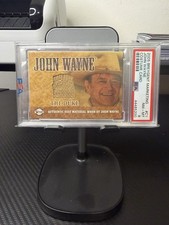
2005 Breygent Marketing John Wayne Costume Card The Duke PSA 8 RARE $65.00
John Wayne Cast Iron Bottle Opener, 8.8 x 2.8 in $18.99
JOHN WAYNE COWBOY WESTERN STATUE CS60022 $195.00
|
|
|
Shopping Cart  |

|
Recently Viewed |
|
Latest Items |
|
Facebook |
Secure Websites

|
