When you click on links to various merchants on this site and make a purchase, this can result in this site earning a commission. Affiliate programs and affiliations include, but are not limited to, the eBay Partner Network.
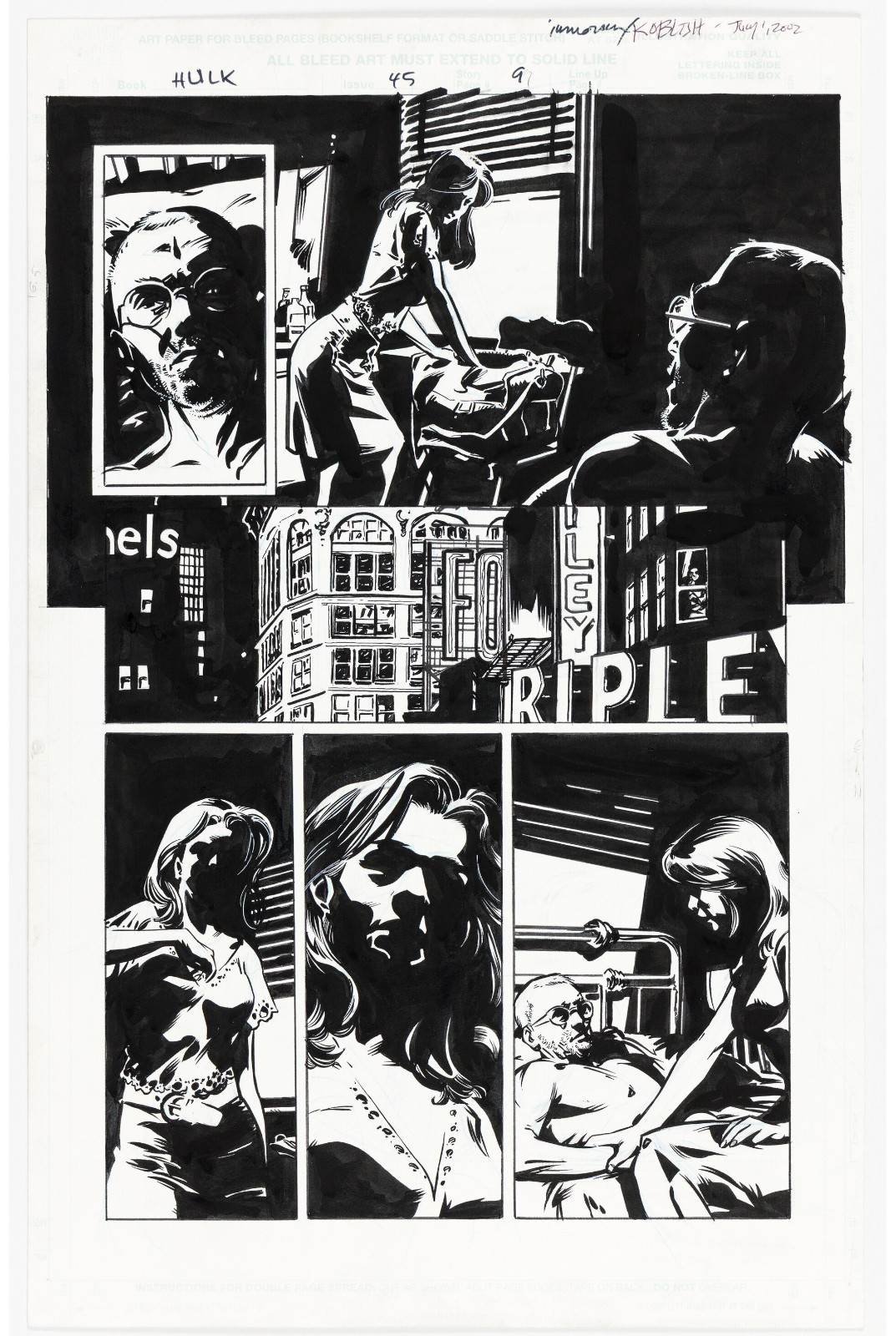
Stuart Immonen and Scott Koblish Original Production ArtworkIncredible Hulk
Marvel Comic #45 (2002), Story Page 9Incredible Hulk #45 Story Page 9 Original Art (Marvel, 2002)
By Stuart Immonen and Scott Koblish on July 1, 2002
.
From \"Remember Me Never\", written by Bruce Jones, Laurie leaves Bruce Banner to go see her sick motherInk over graphite and blue pencil on Marvel Bristol board with an image area of 15\" x 10.5\"
Whiteout touch-ups and light smudging/handling wear. Autographed byStuart Immonen and Scott Koblishalong top right with comments: \"July 1, 2002\"Condition: ExcellentArrives with specifications sheet for your reference.
See theGenuine HistoryCollection
The Incredible Hulk is a superhero comic book series published by Marvel Comics. Created by Stan Lee and Jack Kirby, it stars scientist Bruce Banner, who is irradiated by gamma rays that cause him to transform under stress into the Hulk, a giant powerful green-skinned monster who is the manifestation of Banner\'s anger.
The comic has been published on and off since 1962, and has been passed to many high-profile comics writers, such as Bill Mantlo, Peter David, and Greg Pak. Throughout its publication history, it has been intermittently replaced as the primary Hulk title by other series, including Tales to Astonish (1963–68), Indestructible Hulk (2013–15), and The Immortal Hulk (2018–21). The title is currently being written by Phillip Kennedy Johnson, who will relaunch it as The Infernal Hulk in 2025.
The original series was canceled with issue #6 (March 1963). Lee had written each story, with Jack Kirby penciling the first five issues and Steve Ditko penciling and inking the sixth.
A year and a half after the series was canceled, the Hulk became one of two features in Tales to Astonish, beginning in issue #60 (Oct. 1964). This new Hulk feature was initially scripted by writer-editor Lee and illustrated by the team of penciller Steve Ditko and inker George Roussos. Other artists later in this run included Jack Kirby from #68–87 (June 1965 – Oct. 1966), doing full pencils or, more often, layouts for other artists; Gil Kane, credited as \"Scott Edwards\", in #76 (February 1966), his first Marvel Comics work; Bill Everett inking Kirby in #78–84 (Feb–Oct. 1966); and John Buscema penciling Kirby\'s layouts in #85–87. The Tales to Astonish run introduced the supervillains the Leader, who would become the Hulk\'s nemesis, and the Abomination, another gamma-irradiated being. Comics artist Marie Severin finished out the Hulk\'s run in Tales to Astonish.
Beginning with issue #102 (April 1968) the book was retitled The Incredible Hulk (vol. 2) and ran until 1999, when Marvel canceled the series and restarted the title with the shorter-titled Hulk #1.
The Incredible Hulk (vol. 2) was published through the 1970s. At times, the writers included Archie Goodwin, Chris Claremont, and Tony Isabella. Len Wein wrote the series from 1974 through 1978. Nearly all of the 1970s issues were drawn by either Herb Trimpe, who was the regular artist for seven years, or Sal Buscema, who was the regular artist for 10 years, starting with issue #194 (December 1975). Issues #180–181 (Oct.–Nov. 1974) introduced the character Wolverine, who would go on to become one of Marvel Comics\' most popular. The original art for the comic book page that introduced Wolverine sold for $657,250 in May 2014. Key supporting characters included Jim Wilson and Jarella, both of whom would make few appearances outside of this decade.
In 1977, Marvel launched a second title, The Rampaging Hulk, a black-and-white comics magazine. This was originally conceived as a flashback series, set between the end of his original, short-lived solo title and the beginning of his feature in Tales to Astonish. After nine issues, the magazine was retitled The Hulk! and printed in color. A nine-part \"continuity insert\" that in many ways contradicted the original comics stories was retconned later as an in-universe film made by Bereet.
Following Roger Stern, Bill Mantlo took over the writing with issue #245 (March 1980). Among the adversaries Mantlo created for the series were the U-Foes and the Soviet Super-Soldiers. Mantlo\'s \"Crossroads of Eternity\" stories, which ran through issues #300–313 (Oct. 1984 – Nov.1985), explored the idea that Banner had suffered child abuse. Later, The Incredible Hulk writers Peter David and Greg Pak called these stories an influence on their approaches to the series. After five years, Mantlo left the title to write Alpha Flight, while Alpha Flight writer John Byrne took over the series and left it after six issues, claiming, \"I took on the Hulk after a discussion with editor-in-chief Jim Shooter, in which I mentioned some of the things I would like to do with that character, given the chance. He told me to do whatever was necessary to get on the book, he liked my ideas so much. And once installed he immediately changed his mind—\'You can\'t do this!\' Six issues was as much as I could take.\" Byrne\'s final issue featured the wedding of Bruce Banner and Betty Ross. Byrne had done a seventh issue, consisting entirely of one-panel pages. It was eventually published in Marvel Fanfare #29.
Al Milgrom briefly succeeded Byrne before new regular writer Peter David took over with issue #331 (May 1987), the start of an 11-year tenure. He returned to the Stern and Mantlo abuse storyline, expanding the damage caused, and depicting Banner as suffering dissociative identity disorder. In issue #377 he merged Banner, the green Hulk, and the grey Hulk into a single being with the unified personality, intelligence, and powers of all three. David claimed he had been planning this from the beginning of his tenure on the series, and had held off so that he could make the readers have an emotional attachment to the grey Hulk. David worked with numerous artists over his run on the series, including Dale Keown, Todd McFarlane, Sam Kieth, Gary Frank, Liam Sharp, Terry Dodson, Mike Deodato, George Pérez, and Adam Kubert.
In 1998, David followed editor Bobbie Chase\'s suggestion to kill Betty Ross. In the introduction to the Hulk trade paperback Beauty and the Behemoth, David said that his wife had recently left him, providing inspiration for the storyline. Marvel executives used Ross\' death as an opportunity to push the idea of bringing back the Savage Hulk. David disagreed, leading to his parting ways with Marvel. His last issue of The Incredible Hulk (vol. 2) was #467 (Aug. 1998), his 137th. Also in 1998, Marvel relaunched The Rampaging Hulk as a standard comic book rather than as a comics magazine.
Following David\'s departure, Joe Casey took over as writer until this series ended with The Incredible Hulk (vol. 2) #474 (March 1999). The first volume of the shorter-titled Hulk began immediately the following month, scripted by Byrne and penciled by Ron Garney. Erik Larsen and Jerry Ordway briefly took over scripting and with issue #12 (March 2000) the series was restarted as The Incredible Hulk vol. 3. New series writer Paul Jenkins developed the Hulk\'s multiple personalities, and his run was followed by Bruce Jones. Jones\' storyline featured Banner being pursued by a secret conspiracy and aided by the mysterious Mr. Blue. Jones appended his 43 issues of Incredible Hulk with the limited series Hulk/Thing: Hard Knocks #1–4 (Nov. 2004 – Feb. 2005), which Marvel published after putting the ongoing series on hiatus.
Peter David, who had initially signed a contract for the six-issue Tempest Fugit limited series, returned as writer when it was decided to make that story the first five parts of the revived volume three. After a four-part tie-in to the House of M crossover and a one-issue epilogue, David left the series once more, citing the need to do non-Hulk work for the sake of his career.
In 2006, writer Greg Pak took over the series. With issue #113 (Feb. 2008), it was retitled The Incredible Hercules, still written by Pak but starring the mythological demigod Hercules and teenage genius Amadeus Cho. Concurrently, Marvel launched Hulk (vol. 2), written by Jeph Loeb and drawn by Ed McGuinness. While continuing to publish Hulk (vol. 2), Marvel also relaunched the second 1960s Hulk series with The Incredible Hulk (vol. 2) #600 (Sept. 2009). With the arrival of the Red Hulk—a transformed General \"Thunderbolt\" Ross, the Hulk\'s longtime nemesis—and the Red She-Hulk—the revived Betty Ross—this series was retitled Incredible Hulks with issue #612 (Nov. 2010). This lasted through issue #635 (Oct. 2011). Yet another Hulk series, The Incredible Hulk vol. 4, written by Jason Aaron and drawn by Marc Silvestri, began with a new #1 and lasted 15 issues (Dec. 2011 – Dec. 2012). In November 2012, Marvel announced it would publish a new Hulk title, Indestructible Hulk, by writer Mark Waid and artist Leinil Yu. Hulk (vol. 2) became Red She-Hulk with issue #58 (Dec. 2012).
In 2015, Amadeus Cho became the \"Totally Awesome Hulk\", replacing Bruce Banner. Shortly afterward, Banner was killed in the 2016 storyline Civil War II. In 2017, The Incredible Hulk was relaunched with issue #709, with the series using \"legacy numbering\". In 2019, Banner was resurrected in the series The Immortal Hulk, which features horror-inspired stories.
In 2023, The Incredible Hulk was relaunched with volume 4 (issue #782), written by Phillip Kennedy Johnson with art by Nic Klein. It continues the horror themes established by The Immortal Hulk and sees Hulk travel around the United States and battle monsters alongside the newly introduced character Charlie Tidwell.Marvel\'s logo from 1990 to 2002
Stuart Immonen(born 1967) is a Canadian comics artist. He is best known for his work on the Marvel Comics series Nextwave, Ultimate X-Men, The New Avengers, The Amazing Spider-Man, and Ultimate Spider-Man, the DC Comics series Action Comics and The Adventures of Superman, as well as for the original Millarworld series Empress, co-created with Mark Millar. His pencils are usually inked by Wade Von Grawbadger.
Immonen\'s first published work was the self-published series titled Playground which was released in 1988. From 1990 through 1992, he drew several issues of Rock \'N\' Roll Comics for Revolutionary Comics, including issues on Prince, 2 Live Crew and Public Enemy, ZZ Top, Anthrax, and more. He worked at several smaller comic book companies before being hired by DC Comics in 1993. Since then, Immonen has drawn such high-profile characters as Superman, the Hulk, and the X-Men. His work since 2004 includes stints on the titles Ultimate Fantastic Four and Ultimate X-Men with writers Warren Ellis and Brian K. Vaughan respectively, as well as a 12-issue run pencilling Nextwave, which again paired him with Warren Ellis.
Stuart Immonen has also done work for Top Cow and Image Comics.
In 1993 and 1994, Immonen drew the Legion of Super-Heroes and with writers Mark Waid and Tom McGraw created a new Legion continuity, beginning with a retelling of the team\'s origin story starting in Legion of Super-Heroes vol. 4 #0 (Oct. 1994). In 1996, writer Karl Kesel and Immonen produced The Final Night limited series. That same year, Immonen was one of the many creators who contributed to the Superman: The Wedding Album one-shot wherein the title character married Lois Lane. Immonen wrote and drew part of the Superman Red/Superman Blue one-shot which launched the storyline of the same name which ran through the various Superman titles. Immonen ended his ongoing involvement with the Superman franchise with the Superman: End of the Century graphic novel in 2000 but returned to the character for the Superman: Secret Identity limited series in 2004.
In 2000, Immonen was one of the founders of Gorilla Comics, a company formed with Mark Waid, Kurt Busiek and several others. Immonen and Busiek collaborated on the Shockrockets limited series and the Superstar: As Seen on TV one-shot but the company folded after a short time.
In 2005, Immonen published 50 Reasons to Stop Sketching at Conventions, a series of fifty comics that detail why he no longer does sketches for fans. Besides self-publishing, Immonen also maintains a webcomic called Never as Bad as You Think which is co-authored by his wife, Kathryn. In 2010, Top Shelf Productions released Moving Pictures a graphic novel drawn by Immonen and co-authored by him and his wife.
Immonen illustrated Marvel Comics\' Ultimate Spider-Man from issue #111 to issue #133. He subsequently worked on The New Avengers from issue #55 to issue #64. He continued to be the series artist when The New Avengers relaunched during the \"Heroic Age\" storyline and was the regular artist for the first seven issues as well as issue #11.
In 2011 Immonen illustrated Marvel\'s Fear Itself miniseries which formed the core of a company-wide crossover storyline of the same name. In November 2012 he and writer Brian Michael Bendis started the series All-New X-Men.
In 2014 Immonen drew the six-issue limited series, All-New Captain America, for Marvel\'s Avengers NOW! relaunch. From 2017 to 2018 he drew The Amazing Spider-Man #25 to 31, 789 to 791, 794, and 797 to 800, which included long-time series writer Dan Slott\'s last major storyline, titled \"Go Down Swinging\".
Immonen in June 2011
Scott Koblish (born May 28, 1970) is an American comic book artist. He has hundreds of comics credits at both Marvel Comics and DC Comics.
Scott Koblish attended The Kubert School of Cartooning and Graphic Art when he was nine years old. He graduated from the School of Visual Arts in Manhattan with a BFA in Cartooning and Illustration.
Scott Koblish began working at Marvel Comics through an apprentice program called the Romita Raiders in 1993. By summer 1993, he was working freelance as an inker, and for the next 15 years he inked hundreds of comics such as G.I. Joe, Punisher, Elektra, Excalibur, Thor, Captain America, The Avengers, Fantastic Four, and Nomad. Freelancing for DC Comics, Koblish inked on multiple titles such as OMAC, The Brave and the Bold, Worlds\' Finest, and Final Crisis: Legion of 3 Worlds. He inked the Star Trek/X-Men crossover \"Second Contact\".
Beginning in 2008, Koblish began pencilling projects with The Weapon, a mini-series from Platinum Comics. He pencilled and inked the character Deadpool for six years. Koblish pencilled various Disney Magazine Projects, notably the \"Jet Pack Pets\" for Disney and drew Stan Lee Media\'s \"7th Portal\".
In 2018, Chronicle Books published *The Many Deaths of Scott Koblish*, cartoon strips by the artist in which he lampoons his own demise.
Koblish pencilled Deadpool for six years, drawing the art for the cover to *Deadpool #27*, which set the Guinness World Record for most characters to appear on a comic book cover.
Koblish, along with Gerry Duggan and Brian Posehn, started work on a comic for Image Comics called *The Secret History of the War on Weed*, which debuted on April 20, 2022.
Scott Koblish has a child and is married to Jillian Koblish. He resides in Los Angeles, California.
Koblish at the 2023 WonderCon