When you click on links to various merchants on this site and make a purchase, this can result in this site earning a commission. Affiliate programs and affiliations include, but are not limited to, the eBay Partner Network.
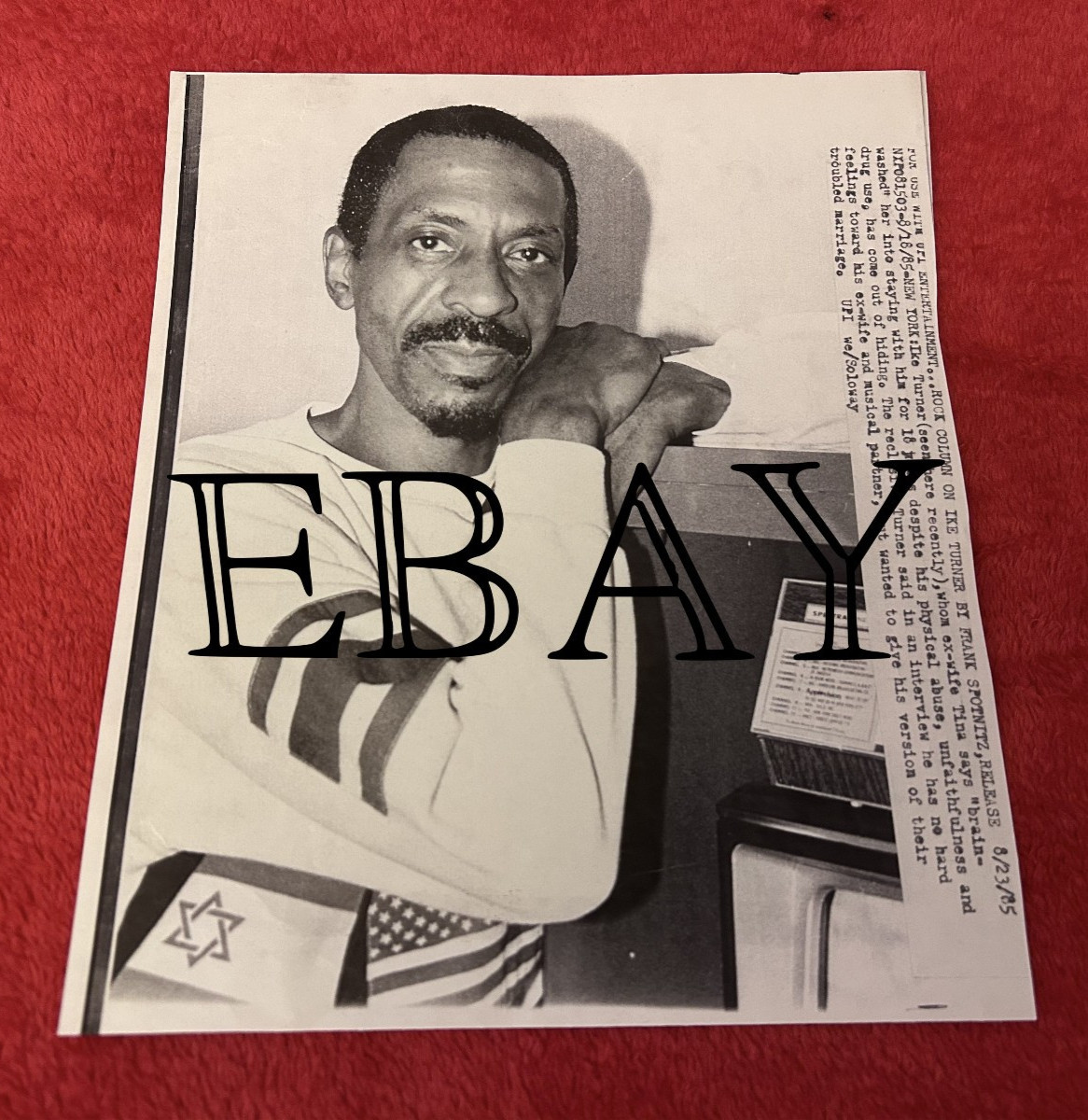
This is an original 9x8 -inch United Press International wire photo of Ike Turner.The caption says that Ike had \"come out of hiding\" give his side of his troubled marriage to Tina Turner.(Note: Wire service photos from the 1970s/1980s/1990s are *not* traditional glossy photos. They were transmitted electronically to magazines and newspapers around the world and then printed out on special thermal paper printers in the newsroom. United Press International wire photos are whiter and brighter than AP images of this era; the thermal paper they’re printed on is thinner than the AP stock, almost like fax paper. )
BACKGROUND
Tina Turner (born Anna Mae Bullock; November 26, 1939 – May 24, 2023) was a singer, songwriter, actress, and author. Dubbed the \"Queen of Rock \'n\' Roll\", her vocal prowess, raspy voice, and electrifying stage presence broke the racial barrier in rock music. Turner rose to prominence in 1960 as the lead singer of the husband-wife duo Ike & Tina Turner, known for their explosive live performances with the Ikettes and Kings of Rhythm.[6] Their tumultuous marriage led to a disbanding in 1976, and she embarked on a successful solo career, becoming one of the best-selling recording artists of all time, with estimated sales of 100 million records.
In 1984, Turner launched \"one of the greatest comebacks in music history\",[7] with her multi-platinum album Private Dancer. Her single \"What\'s Love Got to Do with It\" won the Grammy Award for Record of the Year and became her only number-one song on the Billboard Hot 100. Turner\'s worldwide chart success continued with \"Let\'s Stay Together\", \"Better Be Good to Me\", \"Private Dancer\", \"We Don\'t Need Another Hero (Thunderdome)\", \"It\'s Only Love\", \"Typical Male\", \"The Best\", \"I Don\'t Wanna Lose You\", \"I Don\'t Wanna Fight\", and \"GoldenEye\".
Turner\'s Break Every Rule World Tour (1987–88) became the highest-grossing female tour of the 1980s and set a Guinness World Record for the then-largest paying audience in a concert (180,000).[8] Her success as a live performer continued with Wildest Dreams Tour (1996–97), the second highest-grossing female tour of the 1990s, and Twenty Four Seven Tour (2000), the highest-grossing tour of the year in North America.[9] In 2009, she retired from performing after completing her Tina!: 50th Anniversary Tour. As an actress, Turner appeared in the films Tommy (1975), Mad Max Beyond Thunderdome (1985) and Last Action Hero (1993). Her life was dramatized in the film What\'s Love Got to Do with It (1993), based on her autobiography I, Tina: My Life Story (1986). She was also the subject of the jukebox musical Tina (2018) and documentary film Tina (2021).
Turner received 12 Grammy Awards, which include a Grammy Lifetime Achievement Award and three Grammy Hall of Fame inductions. Rolling Stone ranked her among the greatest artists and greatest singers of all time. She was the first black artist and first woman to be on the cover of Rolling Stone,[10] the first female black artist to win an MTV Award,[11] and the first solo artist with UK top 40 singles across seven decades. Turner has a star on the Hollywood Walk of Fame and on the St. Louis Walk of Fame. She was inducted into the Rock and Roll Hall of Fame twice: with Ike Turner in 1991 and as a solo artist in 2021. She was also a 2005 recipient of the Kennedy Center Honors and the Women of the Year award.[12]
Early life
Turner was born Anna Mae Bullock[b][1][2] on November 26, 1939, in Brownsville, Tennessee.[13][14][15][16] She was the youngest daughter of Floyd Richard Bullock and his wife Zelma Priscilla (née Currie).[13][17] The family lived in the rural unincorporated community of Nutbush, Tennessee, where Bullock\'s father worked as an overseer of the sharecroppers at Poindexter Farm on Highway 180; she later recalled picking cotton with her family at an early age.[18][19]
Bullock was African American, but she believed she had a significant amount of Native American ancestry until she participated in the PBS series African American Lives 2 with Henry Louis Gates Jr.[20][21] Gates shared her genealogical DNA test estimates and traced her family timeline.[22]
Bullock had two older sisters, Evelyn Juanita Currie and Ruby Alline Bullock, a songwriter.[23] She was the first cousin once removed of bluesman Eugene Bridges.[24] As young children, the three sisters were separated when their parents relocated to Knoxville, Tennessee, to work at a defense facility during World War II.[19] Bullock went to stay with her strict, religious paternal grandparents, Alex and Roxanna Bullock, who were deacon and deaconess at the Woodlawn Missionary Baptist Church.[19][25] After the war, the sisters reunited with their parents and moved with them to Knoxville.[19] Two years later, the family returned to Nutbush to live in the Flagg Grove community, where Bullock attended Flagg Grove Elementary School from first through eighth grade.[26][27]
As a young girl, Bullock enjoyed singing and acting, and she often performed in the streets for change so she could go to the movies.[28] She sang in the church choir at Nutbush\'s Spring Hill Baptist Church.[29][30] In 1950, when she was 11, her mother Zelma left without warning, seeking freedom from her abusive relationship with Floyd by relocating to St. Louis.[31] Two years after her mother left the family, her father married another woman and moved to Detroit. Bullock and her sisters were sent to live with their maternal grandmother, Georgeanna Currie, in Brownsville, Tennessee.[31] She stated in her autobiography I, Tina that she felt her parents did not love her and that she was not wanted.[32] Zelma had planned to leave Floyd but stayed once she became pregnant.[33] Bullock recalled: \"She was a very young woman who didn\'t want another kid.\"[33]
As a teenager, Bullock worked as a domestic worker for the Henderson family in Ripley, Tennessee.[34] She was at the Henderson house when she was notified that her half-sister Evelyn had died in a car crash alongside her cousins Margaret Currie and Vela Evans, however Evans survived the car crash with injuries.[35][36] A self-professed tomboy, Bullock joined both the cheerleading squad and the female basketball team at Carver High School in Brownsville, and \"socialized every chance she got\".[18][31] When Bullock was 16, her grandmother died, so she went to live with her mother in St. Louis. She graduated from Sumner High School in 1958.[37] After high school, Bullock worked as a nurse\'s aide at Barnes-Jewish Hospital.[38]
Ike and Tina TurnerMain article: Ike & Tina TurnerOrigins: 1956–1959
I would have been lost in my life at that point without him. I mean, I could do two things: work in a hospital or sing in Ike\'s band. I didn\'t know anything else. Or anyone else. And I wanted to sing.
—Tina Turner (1986)[39]
Bullock and her sister began to frequently attend nightclubs in St. Louis and East St. Louis.[31] She first saw Ike Turner perform with his band the Kings of Rhythm at the Club Manhattan in East St. Louis.[31] Bullock was impressed by his talent, recalling that she \"almost went into a trance\" watching him play.[40] She asked Turner to let her sing in his band despite the fact that few women had ever sung with him.[41][30] Turner said he would call her but never did.[42] One night in 1956, Bullock got hold of the microphone from Kings of Rhythm drummer Eugene Washington during an intermission and she sang the B.B. King blues ballad, \"You Know I Love You\".[43][44] Upon hearing Bullock sing, Ike Turner asked her if she knew more songs.[45] She sang the rest of the night and became a featured vocalist with his band.[44][46] During this period, he taught her the finer points of vocal control and performance.[45] Bullock\'s first recording was in 1958 under the name Little Ann on the single \"Boxtop\". She is credited as a vocalist on the record alongside Ike and fellow Kings of Rhythm singer Carlson Oliver.[47]
Early success: 1960–1965
In 1960, Ike Turner wrote \"A Fool in Love\" for singer Art Lassiter. Bullock was to sing background with Lassiter\'s backing vocalists, the Artettes. Lassiter failed to show up for the recording session at Technisonic Studios.[48] Since Turner had already paid for the studio time, Bullock suggested that she sing the lead.[49][50] He decided to use Bullock to record a demo with the intention of erasing her vocals and adding Lassiter\'s at a later date.[50][45] Local St. Louis disc jockey Dave Dixon convinced Turner to send the tape to Juggy Murray, president of R&B label Sue Records.[51][52] Upon hearing the song, Murray was impressed with Bullock\'s vocals, later stating that \"Tina sounded like screaming dirt. It was a funky sound\".[52] Murray bought the track and paid Turner a $25,000 advance for the recording and publishing rights.[52][53][54] Murray also convinced Turner to make Bullock \"the star of the show\".[54] Turner responded by renaming Bullock \"Tina\" because it rhymed with Sheena.[52][55] He was inspired by Sheena, Queen of the Jungle and Nyoka the Jungle Girl to create her stage persona.[56][57] Turner added his last name and trademarked the name \"Tina Turner\" as a form of protection; his idea was that if Bullock left him like his previous singers had, he could replace her with another \"Tina Turner\".[58] However, family and friends still called her Ann.[59][60]
Ike & Tina Turner on the cover of Cash Box\'s June 30, 1962, issue
Bullock was introduced to the public as Tina Turner with the single \"A Fool in Love\" in July 1960.[61][62] It reached No. 2 on the Hot R&B Sides chart and No. 27 on the Billboard Hot 100.[63] Journalist Kurt Loder described the track as \"the blackest record to ever creep into the white pop charts since Ray Charles\'s gospel-styled \'What\'d I Say\' that previous summer\".[52][64] Another single from the duo, \"It\'s Gonna Work Out Fine\", reached No. 14 on the Hot 100 and No. 2 on the R&B chart in 1961, earning them a Grammy nomination for Best Rock and Roll Performance.[63][65] Other singles Ike and Tina Turner released between 1960 and 1962 included the R&B hits \"I Idolize You\", \"Poor Fool\", and \"Tra La La La La\".[66]
After the release of \"A Fool in Love\", Ike Turner created the Ike & Tina Turner Revue, which included the Kings of Rhythm and a girl group, the Ikettes, as backing vocalists and dancers. He remained in the background as the bandleader. Ike Turner put the entire revue through a rigorous touring schedule across the United States, performing 90 days straight in venues around the country.[67] During the days of the Chitlin\' Circuit, the Ike & Tina Turner Revue built a reputation as \"one of the hottest, most durable, and potentially most explosive of all R&B ensembles\", rivaling the James Brown Revue in terms of musical spectacle.[68] Due to their profitable performances, they were able to perform in front of desegregated audiences in Southern clubs and hotels.[69]
Between 1963 and 1965, the band toured constantly and produced moderately successful R&B singles. Tina Turner\'s first credited single as a solo artist, \"Too Many Ties That Bind\"/\"We Need an Understanding\", was released from Ike Turner\'s label Sonja Records in 1964.[70][71] Another single by the duo, \"You Can\'t Miss Nothing That You Never Had\", reached No. 29 on the Billboard R&B chart.[63] After their tenure at Sue Records, the duo signed with more than ten labels during the remainder of the decade, including Kent, Cenco, Tangerine, Pompeii, A&M, and Minit.[72][73] In 1964, they signed to Warner Bros. Records and Bob Krasnow became their manager.[74][75] On the Warner Bros. label, they achieved their first charting album with Live! The Ike & Tina Turner Show, peaking at No. 8 on the Billboard Hot R&B LP chart in February 1965.[76] Their singles \"Tell Her I\'m Not Home\", released on Loma Records, and \"Good Bye, So Long\", released on Modern Records, were top 40 R&B hits in 1965.[63]
Tina Turner\'s profile was raised after several solo appearances on shows such as American Bandstand and Shindig! while the entire revue appeared on Hollywood a Go-Go.[77] In 1965, music producer Phil Spector attended an Ike & Tina Turner show at a club on the Sunset Strip, and he invited them to appear in the concert film The Big T.N.T. Show.[78]
Mainstream success: 1966–1975Ike & Tina Turner by Dennis Hopper in 1966
Impressed by the duo\'s performance on The Big T.N.T. Show, Phil Spector was eager to produce Tina Turner.[79] Working out a deal with Ike & Tina Turner\'s manager Bob Krasnow, who was also head of Loma, Spector offered $20,000 for creative control over the sessions to produce Turner and have Ike & Tina Turner released from their contract with Loma.[14][80] They signed to Spector\'s Philles label in April 1966 after Tina Turner had already recorded with him.[81] Their first single on his label, \"River Deep – Mountain High\", was released in May 1966. Spector considered that record, with Turner\'s maximum energy over the \"Wall of Sound\", to be his best work.[82] It was successful overseas, reaching No. 3 on the UK Singles Chart and No. 1 on Los 40 Principales in Spain,[83] but it failed to go any higher than No. 88 on the Billboard Hot 100.[84] The impact of the record gave Ike & Tina Turner an opening spot on the Rolling Stones UK tour in the fall of 1966.[85][86] In November 1967, Turner became the first female artist and the first black artist to appear on the cover of Rolling Stone magazine.[87][88]
The duo signed with Blue Thumb Records in 1968, releasing the album Outta Season in 1969.[89] The album produced their charted cover of Otis Redding\'s \"I\'ve Been Loving You Too Long\".[63] Later that year they released The Hunter album.[90] The title track, Albert King\'s \"The Hunter\", earned Turner a Grammy nomination for Best Female R&B Vocal Performance.[65] The success of the albums led to the revue headlining in Las Vegas, where their shows were attended by a variety of celebrities including Sly Stone, Janis Joplin, Cher, James Brown, Ray Charles, Elton John, and Elvis Presley.[91] Sammy Davis Jr. was particularly fond of Turner, and after she filmed an episode of The Name of the Game with him in Las Vegas he surprised her with a Jaguar XJ6.[92]
As the decade came to an end, Ike & Tina Turner began performing at music festivals.[93] Tina Turner\'s fashion evolved from formal dresses to minidresses and revealing outfits.[94] She emerged as a sex symbol and was praised for her sensual performances.[43][95]
Turner performing on stage at Tulane Stadium during Soul Bowl \'70 in October 1970
In the fall of 1969, Ike & Tina Turner\'s profile in their home country was raised after opening for the Rolling Stones on their US tour.[96] They gained more exposure from performances on The Ed Sullivan Show, Playboy After Dark, and The Andy Williams Show.[97][98][99] The duo released two albums in 1970, Come Together and Workin\' Together. Their cover of \"I Want to Take You Higher\" peaked at No. 34 on the Hot 100, whereas the original by Sly and the Family Stone had peaked at No. 38.[63] The Come Together and Workin\' Together albums marked a turning point in their careers in which they switched from their usual R&B repertoire to incorporate more rock tunes such as \"Come Together\", \"Honky Tonk Woman\", and \"Get Back\".[100][101]
In early 1971, their cover of Creedence Clearwater Revival\'s \"Proud Mary\" became their biggest hit. The single reached No. 4 on the Hot 100 and sold more than a million copies, winning them a Grammy for Best R&B Performance by a Duo or Group.[102][103][104] In July 1971, their live album, What You Hear Is What You Get, was released. It was recorded at Carnegie Hall and became their first certified Gold album. Later that year they had a top 40 R&B hit with \"Ooh Poo Pah Doo\".[63] Their next three singles to chart, \"I\'m Yours (Use Me Anyway You Wanna)\", \"Up in Heah\", and \"Early One Morning\" (a Little Richard cover) all peaked at No. 47 on the R&B chart.[63]
In 1972, the Turners opened Bolic Sound recording studio near their home in Inglewood.[105] After Liberty was absorbed into United Artists Records, they were assigned to that label.[106] Around this time, Tina Turner began writing more songs. She wrote nine out of the ten tracks on their 1972 album Feel Good.[107] In October 1972, Turner and the Ikettes performed at Star-Spangled Women, a political fundraiser for the 1972 presidential campaign of George McGovern, at Madison Square Garden in New York City.[108]
The duo\'s 1973 hit single \"Nutbush City Limits\" (No. 22 Pop, No. 11 R&B),[63] penned by Tina Turner, reached No. 1 in Austria, No. 4 in the UK, and the top 5 in several other countries.[109] It was certified silver by the BPI for selling a quarter of a million in the UK.[110] As a result of their success, they received the Golden European Record Award, the first ever given, for selling more than one million records of \"Nutbush City Limits\" in Europe.[111] Their follow-up hits included \"Sweet Rhode Island Red\", and \"Sexy Ida\" in 1974.[63]
In 1974, the duo released the Grammy-nominated album The Gospel According to Ike & Tina, which was nominated for Best Soul Gospel Performance.[65] Ike also received a solo nomination for his single \"Father Alone\" from the album.[112] Tina Turner\'s first solo album, Tina Turns the Country On!, earned her a nomination for Best R&B Vocal Performance, Female.[113] That year, Tina Turner filmed the rock opera Tommy in London.[114] She played the Acid Queen, a drug-addicted prostitute; her performance was critically acclaimed.[115] Shortly after filming wrapped, Turner appeared on Ann-Margret\'s TV special.[116] Following the release of Tommy in 1975, Tina Turner released another solo album: Acid Queen.[117] The album reached No. 39 on the Billboard R&B chart. It produced the charting singles \"Baby, Get It On\" and a cover of Led Zeppelin\'s \"Whole Lotta Love\".[118]
Split: 1976
By the mid-1970s, Ike was heavily addicted to cocaine, which hindered his relationship with Tina.[119] In 1976, they headlined at the Waldorf Astoria New York and signed a television deal with CBS-TV.[120] Ike made plans for them to leave United Artists Records for a five-year deal with Cream Records for $150,000 per year; the deal was to be signed on July 5.[121]
On July 1, the Turners flew from Los Angeles to Dallas, where the revue had a gig at the Statler Hilton in downtown. The couple got into a physical altercation on their way to the hotel. Shortly after arriving, Tina fled with only 36 cents and a Mobil card to the nearby Ramada Inn across the freeway.[122] She filed for divorce on July 27, and it was finalized on March 29, 1978.[123][124] After they disbanded, United Artists released two more albums credited to the duo: Delilah\'s Power (1977) and Airwaves (1978).[125][126]
Solo careerEarly solo career: 1976–1982
Following her separation from Ike, lawsuits mounted for canceled Ike & Tina Turner gigs.[127][128][129] Turner earned income by appearing on TV shows such as The Hollywood Squares, Donny & Marie, The Sonny & Cher Show, and The Brady Bunch Hour.[130][131] After receiving funding from Mike Stewart, an executive at United Artists Records, Turner returned to performing in order to pay off her debts.[132] In 1977, she formed a new band and re-emerged with new costumes designed by Bob Mackie.[133] She took her act to smaller venues and headlined a series of cabaret shows at Caesars Palace in Las Vegas.[134][135][136] Later that year, she embarked on her first solo concert tour in Australia.[137][138]
Turner and Tom Jones starred in an HBO TV special that was shot at the Warner Theatre in Washington, DC, in September 1978.[139] Around that time, her third solo album, Rough, was released on United Artists with distribution in North America and Europe on EMI Records.[140] That album, along with its 1979 follow-up, Love Explosion, which included a brief diversion to disco music, failed to chart, so United Artists and Turner parted ways.[141] Without the premise of a hit record, she continued performing and headlined her second tour.[142]
In 1979, Australian manager Roger Davies agreed to manage Turner after seeing her perform at the Fairmont Hotel in San Francisco.[143] In early 1979, Turner worked in Italy as a regular performer on the Rete 1 TV series Luna Park, hosted by Pippo Baudo and Heather Parisi.[144] Later that year, she embarked on a controversial five-week tour of South Africa during the apartheid regime.[145] She later regretted the decision, stating that she was \"naive about the politics in South Africa\" at the time.[146]
In October 1981, Rod Stewart attended Turner\'s show at the Ritz in New York City and invited her to perform \"Hot Legs\" with him on Saturday Night Live.[147] In November, Turner opened three shows for the Rolling Stones during their 1981 American Tour.[148] Turner performed in March 1982 in the Willem Ruis show (Netherlands), which resulted in the hit \"Shame, Shame, Shame\" (reaching No. 47 in the Netherlands). In 1982 Turner\'s recording of the Temptations\' \"Ball of Confusion\" for the UK production team B.E.F. became a hit in European dance clubs.[149] In 1982, Turner also appeared on the album Music of Quality and Distinction Volume 1 by B.E.F., a side project of Heaven 17, singing \"Ball of Confusion\". She filmed a music video for \"Ball of Confusion\" that aired on the fledgling music video channel MTV, becoming one of the first black American artists to gain airtime on the channel.[150] Also in 1982, Turner appeared as a special guest on Chuck Berry\'s television special performed at The Roxy in West Hollywood.[151]
Career resurgence and superstardom: 1983–2000
Until 1983, Turner was considered a nostalgia act, performing mostly at hotel ballrooms and clubs in the United States.[152] During her second stint at the Ritz, she signed with Capitol Records in 1983.[153] In November 1983, she released her cover of Al Green\'s \"Let\'s Stay Together\", which was produced by B.E.F. It reached several European charts, including No. 6 in the UK.[154][155] In the US, the song peaked at No. 26 on the Billboard Hot 100, No. 1 on Hot Dance Club Songs, and No. 3 on Hot Black Singles.[156]
Following the single\'s surprise success, Capitol Records approved a studio album. Turner had two weeks to record her Private Dancer album, which was released in May 1984.[152] It reached No. 3 on the Billboard 200 and No. 2 in the United Kingdom.[157][158] Private Dancer was certified 5× Platinum in the United States,[159] and sold 10 million copies worldwide, becoming her most successful album.[160][161] Also in May 1984, Capitol issued the album\'s second single, \"What\'s Love Got to Do with It\";[162] the song had previously been recorded by the pop group Bucks Fizz.[163] Following the album\'s release, Turner joined Lionel Richie as the opening act on his tour.[152]
On September 1, 1984, Turner achieved her first and only No. 1 on the Billboard Hot 100 with \"What\'s Love Got to Do with It\".[156] The follow-up singles \"Better Be Good to Me\" and \"Private Dancer\" were both US top 10 hits.[164] The same year, she duetted with David Bowie on a cover of Iggy Pop\'s \"Tonight\". Released as a single in November, it peaked at No. 53 in both the UK and the US.[165]
Turner culminated her comeback when she won three Grammys at the 27th Annual Grammy Awards, including the Grammy Award for Record of the Year for \"What\'s Love Got to Do with It\".[65] In February 1985, she embarked on her second world tour to support the Private Dancer album. Two nights were filmed at Birmingham, England\'s NEC Arena and later released as a concert on home video. During this time, she also contributed vocals to the USA for Africa benefit song \"We Are the World\".[166]
Turner\'s success continued when she traveled to Australia to star opposite Mel Gibson in the 1985 post-apocalyptic film Mad Max Beyond Thunderdome. The movie provided her with her first acting role in ten years; she portrayed the glamorous Aunty Entity, the ruler of Bartertown.[167] Upon release, critical response to her performance was generally positive.[168] The film was a global success, grossing more than $36million in the United States.[169] Turner later received the NAACP Image Award for Outstanding Actress for her role in the film.[170] She recorded two songs for the film, \"We Don\'t Need Another Hero (Thunderdome)\" and \"One of the Living\"; both became hits, with the latter winning her a Grammy Award for Best Female Rock Vocal Performance.[65] In July 1985, Turner performed at Live Aid alongside Mick Jagger.[171] Their performance shocked observers when Jagger ripped her skirt off.[172][173] Turner released a duet, \"It\'s Only Love\", with Bryan Adams.[174] It was nominated for a Grammy Award, and the music video won an MTV Video Music Award for Best Stage Performance.[175]
In 1986, Turner released her sixth solo album, Break Every Rule, which reached No. 1 in four countries and sold over five million copies worldwide within its first year of release.[176] The album sold more than a million copies in the United States and Germany alone.[159][177] The album featured the singles \"Typical Male\", \"Two People\", \"What You Get Is What You See\", and the Grammy-winning \"Back Where You Started\". Prior to the album\'s release, Turner published her autobiography I, Tina, which became a bestseller. That year, she received a star on the Hollywood Walk of Fame.[178] Her Break Every Rule World Tour, which began in March 1987 in Munich, Germany, was the third highest-grossing tour by a female artist in North America that year.[179] In January 1988, Turner performed in front of approximately 180,000 at Maracanã Stadium in Rio de Janeiro, Brazil, setting a Guinness World Record at the time for the largest paying concert attendance for a solo artist.[180][181] In April 1988, Turner released the Tina Live in Europe album, which won a Grammy Award for Best Female Rock Vocal Performance.[182] After taking time off following the end of the tour, she emerged with the Foreign Affair album in 1989. It reached No. 1 in eight countries, including in the UK (5× Platinum), her first number-one album there. The album sold over six million copies worldwide and included the international hit single \"The Best\".[183][184]
In 1990, Turner embarked on her Foreign Affair European Tour, which drew in nearly four million spectators—breaking the record for a European tour that was previously set by the Rolling Stones.[185] In October 1991 Turner released her first greatest hits compilation Simply the Best, which sold seven million copies worldwide.[186] The album is her biggest seller in the UK, where it is certified 8× Platinum with more than two million copies sold.[187]
Private Dancer was the beginning of my success in England and basically Europe has been very supportive of my music.... [I am] not as big as Madonna [in the United States]. I\'m as big as Madonna in Europe. I\'m as big as, in some places [in Europe], as the Rolling Stones [sic].
—Turner reflecting on her European success, Larry King Live, 1997[188]
In 1991, Ike & Tina Turner were inducted into the Rock and Roll Hall of Fame.[189] Ike Turner was incarcerated at the time and Tina Turner did not attend.[190] Turner stated through her publicist that she was taking a leave of absence following her tour and she felt \"emotionally unequipped to return to the U.S. and respond to the night of celebration in the manner she would want\".[191] Phil Spector accepted the award on their behalf.[192]
In 1993, the semi-autobiographical film What\'s Love Got to Do with It was released.[193] The film starred Angela Bassett as Tina Turner and Laurence Fishburne as Ike Turner; they received Best Actress and Best Actor Oscar nominations for their roles.[194] While she was not heavily involved in the film, Turner contributed to the soundtrack for What\'s Love Got to Do with It, re-recording old songs and several new songs. The single \"I Don\'t Wanna Fight\" from the soundtrack was a top 10 hit in the US and UK.[195][196] In 1993 Turner embarked on her What\'s Love? Tour, which visited primarily North America with a few shows in Australasia and Europe.
In 1995, Turner returned to the studio, releasing \"GoldenEye\", which was written by Bono and the Edge of U2 for the James Bond film GoldenEye.[197] In 1996 Turner released the Wildest Dreams album, accompanied by her \"Wildest Dreams Tour\". In September 1999, before celebrating her 60th birthday, Turner released the dance-infused song \"When the Heartache Is Over\" as the leading single from her tenth and final solo album, Twenty Four Seven.[198] The success of the single and the following tour helped the album become certified Gold by the RIAA.[159] The Twenty Four Seven Tour was the highest-grossing tour of 2000, grossing over $120million.[199] Her two concerts at Wembley Stadium were recorded by the director David Mallet and released in the DVD One Last Time Live in Concert.[200] At a July 2000 concert in Zurich, Switzerland, Turner announced that she would retire at the end of the tour.[201]
Later career: 2001–2021Turner during her 50th Anniversary Tour in 2009
In November 2004, Turner released All the Best, which debuted at No. 2 on the Billboard 200 in 2005, her highest-charting album in the United States.[202] The album went platinum in the US three months after its release and reached platinum status in seven other countries, including the UK.[203][204]
In December 2005, Turner was recognized by the Kennedy Center Honors at the John F. Kennedy Center for the Performing Arts in Washington, DC, and was elected to join an elite group of entertainers.[205]
In February 2006, Turner released \"Teach Me Again\", a duet single with Italian singer-songwriter Elisa that was recorded for the anthology film All the Invisible Children.[206][207] The whole revenue from the single\'s sales was donated to charity projects for children led by the World Food Programme and UNICEF.[206]
Turner made a public comeback in February 2008 at the Grammy Awards, where she performed alongside Beyoncé.[208][209] In addition, she won a Grammy as a featured artist on River: The Joni Letters. In October 2008, Turner embarked on her first tour in nearly ten years with the Tina!: 50th Anniversary Tour.[210][211] In support of the tour, Turner released a greatest hits compilation. The tour was a huge success and became one of the bestselling tours in history.[199] In 2009, Turner officially retired from performing.[212][213]
In 2009, Turner co-founded a global music foundation, Beyond Foundation,[214] with Swiss Christian musician Regula Curti and Swiss Tibetan Buddhist Dechen Shak-Dagsay. Turner co-released four albums of spiritual or uplifting music released through projects with Beyond: Buddhist and Christian Prayers (2009), Children (2011), Love Within (2014), and Awakening (2017). As of 2023, the Swiss Beyond Foundation remains active and enables the collaboration of musical artists from different parts of the world.[215]
In April 2010, mainly due to an online campaign by fans of Rangers Football Club, Turner\'s 1989 hit, \"The Best\", returned to the UK singles chart, peaking at No. 9. This made Turner the first female recording artist in UK chart history to score top 40 hits in six consecutive decades (1960s–2010s).[216] In 2011, Beyond\'s second album Children – With Children United in Prayer followed and charted again in Switzerland. Turner promoted the album by performing on TV shows in Germany and Switzerland. In April 2013, Turner appeared on the cover of the German issue of Vogue magazine at the age of 73, becoming the oldest person to be featured on the cover of Vogue.[217] In February 2014, Parlophone Records released a new compilation titled Love Songs.[212]
The musical Tina playing at the Aldwych Theatre in the West End, September 2019
In December 2016 Turner announced that she had been working on Tina, a musical based on her life story, in collaboration with Phyllida Lloyd and Stage Entertainment.[218] The show opened at the Aldwych Theatre in London in April 2018 with Adrienne Warren in the lead role.[219] Warren reprised her role on Broadway in the fall of 2019.[220]
Turner received the 2018 Grammy Lifetime Achievement Award and her second memoir, My Love Story, was released in October 2018.[221][222] In 2020, she came out of retirement to collaborate with Norwegian producer Kygo on a remix of \"What\'s Love Got to Do with It\".[223] With this release, she became the first artist to have a top 40 hit in seven consecutive decades in the UK.[224]
In 2020, Turner released her third book, Happiness Becomes You: A Guide to Changing Your Life for Good. She co-wrote the book with American author Taro Gold and Swiss singer Regula Curti.[225] It was chosen by Amazon\'s editors as a Best Nonfiction book of 2020.[226] In 2021, Turner appeared in the documentary film Tina directed by Dan Lindsay and T. J. Martin.[227]
In October 2021, Turner sold her music rights to BMG Rights Management for an estimated $50million, with Warner Music still handling distribution of her music.[228] Later that month, Turner was inducted into the Rock and Roll Hall of Fame as a solo artist, accepting her award via satellite from her home near Zurich, Switzerland.[229]
Personal lifeRelationships and marriagesEarly relationships
While still in Brownsville, Turner fell in love for the first time with Harry Taylor.[230] They met at a high school basketball game. Taylor initially attended a different school, but he relocated to be near her.[231] In 1986, she told Rolling Stone: \"Harry was real popular and had tons of girlfriends, but eventually I got him, and we went steady for a year.\"[232] Their relationship ended after she discovered that Taylor had married another girl who was expecting his child.[232]
After moving to St. Louis, Turner and her sister Alline became acquainted with Ike Turner\'s Kings of Rhythm. Alline was dating the band\'s drummer Eugene Washington and Tina began dating the saxophonist Raymond Hill. After Tina became pregnant during her senior year of high school, she moved in with Hill, who lived with Ike Turner.[233] She recalled, \"I didn\'t love him as much as I\'d loved Harry. But he was good-looking. I thought, \'My baby\'s going to be beautiful.\'\"[232] Their relationship ended after Hill broke his ankle during a wrestling match with Kings of Rhythm singer Carlson Oliver.[234] Hill returned to his hometown of Clarksdale before their son Craig was born in August 1958, leaving Turner to become a single parent.[235][236]
Ike TurnerIke & Tina Turner arriving at Amsterdam Airport Schiphol in 1971
Turner likened her early relationship with Ike Turner to that of a \"brother and sister from another lifetime\".[237] They were platonic friends from the time they met in 1956 until 1960. Their affair began while Ike was with his live-in girlfriend Lorraine Taylor.[238][239] They became intimate when she went to sleep with him after another musician threatened to go into her room.[232][237]
After recording \"A Fool in Love\" in 1960, a pregnant Turner told Ike that she did not want to continue their relationship; he responded by striking her in the head with a wooden shoe stretcher.[240] Turner recalled that this incident was the first time he \"instilled fear\" in her, but she decided to stay with him because she \"really did care about him\".[64] After the birth of their son Ronnie in October 1960, they moved to Los Angeles in 1962 and married in Tijuana. In 1963, Ike purchased a house in the View Park area.[241] They brought their son Ronnie, Turner\'s son Craig, and Ike\'s two sons with Lorraine (Ike Jr. and Michael) from St. Louis to live with them.[242][243] She later revealed in I, Tina that Ike was violent and promiscuous throughout their marriage, which led to her suicide attempt in 1968 by overdosing on Valium pills.[30] She said, \"It was my relationship with Ike that made me most unhappy. At first, I had really been in love with him. Look what he\'d done for me. But he was totally unpredictable.\"[244] Later on, in his old age, Ike was diagnosed with bipolar disorder.[245]
By the mid-1970s, Ike was heavily addicted to cocaine, which hindered his relationship with Turner. She abruptly left Ike after they got into a fight on their way to the Dallas Statler Hilton on July 1, 1976.[246][247] She fled with only 36 cents and a Mobil credit card in her pocket to the nearby Ramada Inn across the freeway.[248][249] On July 27, Turner filed for divorce on the grounds of irreconcilable differences.[250][251] Her divorce petition asked for $4,000 a month in alimony, $1,000 a month in child support, and custody of her sons Craig and Ronnie.[252] The divorce was finalized on March 29, 1978.[253] In the final divorce decree, Turner took responsibility for missed concert dates as well as an IRS lien and retained songwriter royalties from songs she had written, but Ike got the publishing royalties for his compositions and hers.[254] She also kept her two Jaguars, furs, jewelry, and her stage name.[254] Turner gave Ike her share of their Bolic Sound recording studio, publishing companies, and real estate, and he kept his four cars.[254] Several promoters lost money and sued to recoup their losses. For almost two years, she received food stamps and played small clubs to pay off debts.[124]
Ike Turner stated on several occasions that he was never officially married to Turner because he was legally married to another woman at the time of their ceremony.[255][256][257] However, they had a common-law marriage and still had to go through a formal divorce.[258] He also stated that her birth name was Martha Nell Bullock (not Anna Mae Bullock).[259] She signed her legal name as Martha Nell Turner on multiple contracts.[2][1]
In his autobiography Takin\' Back My Name, Ike Turner stated: \"Sure, I\'ve slapped Tina. We had fights and there have been times when I punched her to the ground without thinking. But I never beat her.\"[260] In a 1999 interview on The Roseanne Show, Roseanne Barr urged Ike to publicly apologize to Turner.[261] In 2007, Ike told Jet that he still loved her and he had written a letter apologizing for \"putting her and the kids through that kind of stuff\", but he never sent it.[262][263]
After his death on December 12, 2007, Turner issued a brief statement through her spokesperson: \"Tina hasn\'t had any contact with Ike in more than 30 years. No further comment will be made.\"[264] Tina\'s sister Alline still considered Ike her brother-in-law and attended his funeral.[265] In his eulogy, Phil Spector criticized Turner for vilifying Ike.[266] In 2018, Turner told The Sunday Times that \"as an old person, I have forgiven him, but I would not work with him. He asked for one more tour with me, and I said, \'No, absolutely not.\' Ike wasn\'t someone you could forgive and allow him back in.\"[267][268][269]
Erwin Bach
In 1986, Turner met German music executive Erwin Bach, who was sent by her European record label (EMI) to greet Turner at Düsseldorf Airport.[270] Bach was over sixteen years her junior.[271] Initially friends, they began dating later that year. In July 2013, after a 27-year romantic relationship, they married in a civil ceremony on the banks of Lake Zurich in Küsnacht, Switzerland.[272]
Children
Turner had two biological sons: one with Kings of Rhythm saxophonist Raymond Hill, named Raymond Craig, born on August 20, 1958, and the other with Ike Turner, Ronald \"Ronnie\" Renelle Turner, born on October 27, 1960.[3][45] She also adopted two of Ike Turner\'s children, raising them as her own.[3] Turner was 18 years of age when she gave birth to her eldest son.[273] Ike Turner adopted Raymond Craig Hill, and changed his name to Craig Raymond Turner.[274] Craig was found dead in an apparent suicide in July 2018.[275]
Turner\'s younger son, Ronnie, played bass guitar in a band called Manufactured Funk with songwriter and musician Patrick Moten. Ronnie also played for both of his parents\' bands.[276][277][278][279][280] Through him, Turner had two grandchildren.[3] He was married to French singer Afida Turner.[281] Ronnie died from complications of colon cancer in December 2022.[282]
During Turner\'s divorce trial, Ike sent their four sons to live with Tina and gave her money for one month\'s rent.[129][283] Ike Turner Jr. worked as a sound engineer at Bolic Sound and briefly for Turner after her divorce,[253] later winning a Grammy Award for producing his father\'s album Risin\' with the Blues.[284] He toured with former Ikette Randi Love as Sweet Randi Love and the Love Thang Band.[285] Ike Turner Jr. stated that he and his brothers had a distant relationship with their mother (Tina).[279] Turner wrote in her autobiography I, Tina that after her divorce she became \"a little bit estranged\" from all her sons except Craig.[286] In 1989, Turner told TV Week that \"she\'s still there for the boys\",[287] but there were reports of Turner\'s estrangement from her sons in the years before her death.[288][289]
Legal issues
In November 1976, Turner was stopped for a traffic violation and an officer found a .38-caliber revolver in her purse.[290] She was arrested and charged with a misdemeanor.[291] Her attorney said she was carrying the gun for her safety due to threats on her life.[291]
In 1978, Diners Club Corp. sued Turner and her company, Tina\'s Operation Oops, claiming she owed over $26,000 for purchases made using her credit card.[292]
Religious beliefs
Turner sometimes referred to herself as a \"Buddhist–Baptist\", alluding to her upbringing in the Baptist church where her father was a deacon and her later conversion to Buddhism as an adult.[293] In a 2016 interview with Lion\'s Roar magazine, she declared, \"I consider myself a Buddhist.\"[294] The February 15, 1979, issue of Jet magazine featured Turner with her Buddhist altar on the cover.[295] Turner credited the Liturgy of Nichiren Daishonin and Soka Gakkai International for her introduction to spiritual knowledge.[296][297]
Turner stated in her 1986 autobiography I, Tina that she was introduced to Nichiren Buddhism by Valerie Bishop, who Ike hired to work at their studio, Bolic Sound, in 1973.[298][299] Turner later stated in her 2020 spiritual memoir Happiness Becomes You that her son, Ronnie Turner, first suggested she might benefit from chanting.[300] Turner practiced Buddhism with her neighborhood Soka Gakkai International chanting group.[301] After chanting nam-myōhō-renge-kyō, Turner noticed positive changes in her life, which she attributed to her newfound spiritual practice. She said: \"I realized that I had within me everyone I needed to change my life for the better.\"[298][301] During the hardest times of her life, Turner chanted four hours per day, and although in later life she no longer chanted as much, she still maintained a daily practice.[299] Turner likened Buddhist chanting to singing. She told Lion\'s Roar: \"Nam-myoho-renge-kyo is a song. In the Soka Gakkai tradition we are taught how to sing it. It is a sound and a rhythm and it touches a place inside you. That place we try to reach is the subconscious mind. I believe that it is the highest place and, if you communicate with it, that is when you receive information on what to do.\"[294] Dramatizations of Turner chanting were included both in the 1993 film What\'s Love Got to Do with It and in the 2021 documentary film Tina.[302][303][304]
Turner met with the 14th Dalai Lama, in Einsiedeln, Switzerland, on August 2, 2005. She also met with Swiss-Tibetan Buddhist singer Dechen Shak-Dagsay and in 2009 co-created a spiritual music project with Shak-Dagsay and Swiss singer Regula Curti called Beyond.[305][306]
Residences, citizenship, and wealthTurner\'s home, Villa Algonquin in Küsnacht, Switzerland, two days after her death
Turner began living at Château Algonquin in Küsnacht on the shore of Lake Zurich in 1994.[307][308] She had previously owned property in Cologne, London, and Los Angeles, and a villa on the French Riviera named Anna Fleur.[309][310]
In 2013, Turner applied for Swiss citizenship,[311][312] stating she would renounce her citizenship in the United States.[313][314] The stated reasons for the relinquishment were that she no longer had any strong connections to the United States and \"has no plans to reside\" there in the future.[314] In April, she undertook a mandatory citizenship test which included advanced knowledge of German (the official language of the canton of Zurich) and of Swiss history. On April 22, 2013, she became a citizen of Switzerland and was issued a Swiss passport.[315] Turner signed the paperwork to relinquish her American citizenship at the US embassy in Bern on October 24, 2013.[314]
Turner\'s wealth was estimated at 225million Swiss francs (about US$250million) in 2022 by the Swiss business magazine Bilanz.[316]
Illness and death
Turner revealed in her 2018 memoir My Love Story that she had multiple life-threatening illnesses.[317] She had had high blood pressure since 1978, which remained mostly untreated, and resulted in damage to her kidneys and eventual kidney failure.[318] In 2013, three weeks after her wedding to Erwin Bach, she had a stroke and needed to learn to walk again.[318] In 2016, she was diagnosed with intestinal cancer.[318] She attempted to treat her health problems with homeopathy, which worsened her condition.[318]
Her chances of receiving a kidney transplant were considered low and she was urged to start dialysis. She signed up with an organization that facilitates assisted suicide, a procedure which is legal in Switzerland, becoming a member of Exit International.[319] However, her husband offered to donate a kidney for transplant.[10] She accepted his donation and had kidney transplantation surgery on April 7, 2017.[320] Turner also openly discussed her feeling of shame after discovering that she had dyslexia.[321]
Death and tributes
On May 24, 2023, Turner died at her home in Küsnacht, Switzerland, aged 83, following years of illness.[322][323] Turner\'s body was cremated after a private funeral.[324]
Turner\'s star on the Hollywood Walk of Fame covered with flowers and tributes from her fans on May 28, 2023
Following news of her death, her star on the Hollywood Walk of Fame was covered with flowers from fans.[325] Fans around the world paid respect with flowers and candles lit outside her home in Switzerland and outside London\'s Aldwych Theatre – the home of the musical Tina.[325] On May 25, 2023, theatres across the West End of London, dimmed their lights for two minutes to mark Turner\'s death.[326]
Many fellow artists mourned her loss, including Beyoncé,[327] Dolly Parton,[328] Debbie Harry, Jimmy Barnes,[329] Bette Midler,[330] Peter Andre,[331] Bryan Adams, Lionel Richie,[332] Elton John,[333] Madonna,[334] Rod Stewart,[330] Lizzo,[335] Brittany Howard,[336] Mick Jagger,[337] Keith Richards, Ronnie Wood and Cher.[338]
Turner also received tributes by British model Naomi Campbell, as well as film and television figures such as Oprah Winfrey, Angela Bassett, Jenifer Lewis, Forest Whitaker,[327][328] and theater producer Joop van den Ende.[339] US president Joe offeren, as well as former presidents Barack Obama and Bill Clinton, and Swiss president Alain Berset also paid tribute to Turner through public statements.[328][340] King Charles III paid tribute by allowing \"The Best\" to be performed during the changing of the guard.[341]
Patti LaBelle paid tribute to Turner with a rendition of \"The Best\" at the 2023 BET Awards in June 2023.[342] In February 2024, Fantasia paid tribute to Turner with a performance of \"Proud Mary\" at the 66th Annual Grammy Awards.[343]
Musical legacy and accolades
Often referred to as \"The Queen of Rock and Roll\", Turner is considered one of the greatest singers of all time.[344][345] An article in The Guardian in 2018 noted her \"swagger, sensuality, gravelly vocals and unstoppable energy\",[346] while The New York Times in 1996 noted that she was known for the appearance of her legs.[347][348] Journalist Kurt Loder asserted that Turner\'s voice combined \"the emotional force of the great blues singers with a sheer, wallpaper-peeling power that seemed made to order for the age of amplification\".[346] Daphne A. Brooks, a scholar of African-American studies, wrote for The Guardian:[346]
Turner merged sound and movement at a critical turning point in rock history, navigating and reflecting back the technological innovations of a new pop-music era in the 60s and 70s. She catapulted herself to the forefront of a musical revolution that had long marginalized and overlooked the pioneering contributions of African American women and then remade herself again at an age when most pop musicians were hitting the oldies circuit. Turner\'s musical character has always been a charged combination of mystery as well as light, melancholy mixed with a ferocious vitality that often flirted with danger.
Awards, honors and achievementsMain article: List of awards and nominations received by Tina TurnerTurner holding certification plaques with Don Grierson
Turner previously held a Guinness World Record for the largest paying audience (180,000 in 1988) for a solo performer.[180][181] In the UK, Turner was the first artist to have a top 40 hit in seven consecutive decades; she has a total of 35 UK top 40 hits.[224] Turner was ranked as one of the most successful female singles artist in German chart history.[349] She sold over 100million records worldwide, including certified RIAA album sales of 10million.[350] As of May 2023, Turner has reportedly sold around 100 to 150 million records worldwide.[351][352][353]
Turner won a total of 12 Grammy Awards. These awards include eight competitive Grammy Awards;[65] she shares the record (with Pat Benatar, and with Sheryl Crow) for most awards (four) given for Best Female Rock Vocal Performance.[354] Three of her recordings, \"River Deep – Mountain High\" (1999), \"Proud Mary\" (2003), and \"What\'s Love Got to Do with It\" (2012) are in the Grammy Hall of Fame.[355] Turner is the only female artist to have won a Grammy in the pop, rock, and R&B fields.[356] Turner received a Grammy Lifetime Achievement Award in 2018.[357] Turner also won Grammys as a member of USA for Africa and as a performer at the 1986 Prince\'s trust concert.
Turner received a star on the Hollywood Walk of Fame in 1986 and a star on the St. Louis Walk of Fame in 1991.[178][358] She was inducted into the Rock and Roll Hall of Fame as a duo with Ike Turner in 1991.[189]
Tina Turner star on the St. Louis Walk of Fame in University City, Missouri
In 2005, Turner received the prestigious Kennedy Center Honors.[359] President George W. Bush commented on her \"natural skill, the energy and sensuality\",[360] and referred to her legs as \"the most famous in show business\".[361] Several artists paid tribute to her that night including Melissa Etheridge (performing \"River Deep – Mountain High\"), Queen Latifah (performing \"What\'s Love Got to Do with It\"), Beyoncé (performing \"Proud Mary\"), and Al Green (performing \"Let\'s Stay Together\"). Oprah Winfrey stated, \"We don\'t need another hero. We need more heroines like you, Tina. You make me proud to spell my name w-o-m-a-n.\"[362]
In 2021, Turner was inducted by Angela Bassett into the Rock and Roll Hall of Fame as a solo artist.[229] Keith Urban and H.E.R. performed \"It\'s Only Love\", Mickey Guyton performed \"What\'s Love Got to Do with It\", and Christina Aguilera performed \"River Deep – Mountain High\".[229]
Turner has also received the following honors:
- 1967: Turner was the first black artist and first female on the cover of Rolling Stone magazine (Issue No. 2).[87]
- 1977: She was named the most exciting woman of the year by International Bachelor\'s Society[363]
- 1984, Turner ranked No. 18 on 25 Most Intriguing People by People magazine.[364]
- 1987: Berolina Award honored Turner with the biggest influence in music in Germany[365]
- 1990, She was voted for Best International female Singer of the year in Europe by Goldene Europa[366]
- 1990, Turner ranked No. 15 in Celebrity Sleuth 25 Sexiest Women of 1990 by Celebrity Skin (magazine)[367]
- 1993: World Music Awards presented Turner with the Legend Award.[368]
- 1993: Essence Awards honored Turner[369] with the Living Legend Award.[370]
- In 1996, Turner\'s handprints at the Walk of Fame Europe Rotterdam.[371]
- 1996: She was inducted into the International Best Dressed Hall of Fame by Vanity Fair.[372]
- 1996: Turner received the accolade of Légion d\'Honneur from the French education minister.[373]
- 1997: Hanescampaign honored Turner with the sexiest legs in entertainment business[374]
- 1999:MOBO Awardshonored Turner[375]with the Lifetime Achievement Award.
- 1999: Productores de Música de España (Promusicae) honored Turner with the Legend Award.[376]
- 1999: She was named one of The Sexiest Stars Over 50 by the American Association of Retired Persons.[377]
- 1999, Turner ranked No. 11 on The 25 Coolest Women by The Advocate.[378]
- 1999: Turner ranked No. 2 on VH1\'s list of 100 Greatest Women of Rock and Roll.[379]
- 2000, Turner ranked No. 33 on 50 Most Beautiful People in the World by People magazine.[380]
- 2000, Turner ranked No. 78 on USA Today Pop Candy\'s 100 People of the Year.[381]
- 2002, Turner ranked No. 6 on VH1\'s 100 Sexiest Artists of All Time.[382]
- 2002: Tennessee State Route 19 between Brownsville and Nutbush was named \"Tina Turner Highway\".[383][384][385]
- 2002, She was voted at No. 56 inQ magazine\'s list of the Top 100 Women Who Rock The World.[386]
- 2003: \"What\'s Love Got to Do with It\" was included in VH1\'s list of the 100 Best Songs of the Past 25 years.[387]
- 2003, Turner ranked No. 22 on VH1\'s 50 Greatest Women Of The Video Era.[388][389]
- 2003, Turner ranked No. 11 on Pollstar\'s Top 40 Grossing Tours of all-time in North America [Through 2003].[390]
- 2003, She was included on VH1\'s list of the \"200 Greatest Pop Culture Icons of All Time\".[391]
- 2003: Rolling Stone ranked Proud Mary: The Best of Ike & Tina Turner No. 212 on their list of the 500 Greatest Albums of All Time (No. 214 on 2012 revised list).[392][393]
- 2004, she was ranked No. 35 on Rolling Stone\'s 50 Greatest Portraits.[394]
- 2004: People ranked her 1985 performance of \"What\'s Love Got to Do With It\" as one of the top 10 Grammy moments.[395]
- 2005, Turner was one of 25 African-American women saluted at Oprah Winfrey\'s Legends Ball, a three-day celebration, honoring their contributions to art, entertainment, and civil rights.
- 2006, Turner ranked No. 9 on Sly Magazine\'s 10 Sexiest Women Over 40 [January 2006][396]
- 2006: She was voted one of The Sexiest Celebrity Grandparents of the Year by The Grand Magazine.[397]
- In 2007, she was ranked at number 19 onBET\'s \"Top 25 Dancers of All Time\".[398]
- 2008: Rolling Stone ranked Turner No. 17 on their list of the 100 Greatest Singers of All Time.[399]
- 2008: She was selected as the women most admired by The Washington Post[400]
- 2009: Time ranked her 1985 performance of \"What\'s Love Got to Do With It\" as one of the top 10 Grammy moments.[401]
- 2010: Rolling Stone ranked Turner No. 63 on their list of the 100 Greatest Artists of All Time.[402]
- 2011, Turner ranked No. 20 on The greatest singers ever by NME[403]
- 2012, Turner ranked No. 34 on VH1\'s 100 Greatest Artists Of All Time.[404][405]
- 2012, Turner ranked No. 22 on The 100 hottest female singers of all time by complex.com[406]
- 2013: Turner covered Vogue Germany, becoming the oldest person (aged 73) to cover Vogue magazine, surpassing Meryl Streep (aged 62) who covered American Vogue in 2012.[407]
- 2013, ABC named Turner one of the greatest women in music.[408]
- 2013, Turner ranked No. 6 on most loved singers in Switzerland. by The Swiss TV channel SRF 1.[409]
- 2013, Turner ranked No. 2 on 10 biggest musical comebacks of all time by Toronto Sun[410]
- 2014, Turner ranked No. 2 on The 15 Greatest Legs In The Music Biz by VH1.[411][412]
- 2014: Turner was inducted into the Soul Music Hall of Fame.[413]
- 2015, Turner was inducted into theHit Parade Hall of Fame.[414]
- 2015: Turner ranked No. 4 on 11 Hair Icons of all time by Hype Hair[415]
- 2015: The Tina Turner Museum at Flagg Grove School proved once again that it truly is Simply The Best addition to Tennessee Tourism winning nine awards at The Tennessee Association of Museums Conference. In a ceremony at Discovery Park of America[416]
- 2015, Turner ranked No. 33 on MetroNOW\'s Top 50 Gay Icons by MetroSource.[417]
- 2015: Rolling Stone ranked Ike & Tina Turner No. 2 on their list of the 20 Greatest Duos of All Time.[418]
- 2015: Ike & Tina Turner were inducted into the St. Louis Classic Rock Hall of Fame.[419]
- 2015, Turner was ranked number 29 in Billboard magazine\'s list of the \"35 Greatest R&B Artists of All Time\".[420]
- 2016, Turner ranked No. 2 on Top 5 Greatest Voices in the History of Rock Music by ppcorn.com.[421]
- 2016: An image of Turner taken by Jack Robinson in 1969 was used as the cover for The Last Shadow Puppets album Everything You\'ve Come to Expect.[422]
- 2016, Turner ranked No. 55 on The 75 Greatest Women of All Time by Esquire.[423]
- 2018, Billboard listed Turner\'s performance in Mad Max BeyondThunderdome(1985) film as the 68th best performance of a musician in a box-office film.[424]
- 2018, album Private Dancer appeared on Rolling Stone magazine\'s list of the 100 Best Albums of the 1980s and is also included in the book 1001 Albums You Must Hear Before You Die.[425]
- 2018,Billboardranked Turner at number 37 on their Top 60 Female Artists of All-Time list.[426]
- 2019: Turner was inducted into the Memphis Music Hall of Fame.[427]
- 2020, She was one of the greatest Voices of the 80s by MTV.[428]
- 2020, the publication included her on its list of the 100 Greatest Music Video Artists of All Time[429]
- 2020: Private Dancer was added to the National Recording Registry at the Library of Congress.[430]
- 2021: Turner became a two-time Rock and Roll Hall of Fame inductee.[431]
- 2021: Turner received an honorary doctorate for her \"unique musical and artistic life\'s work\" from the Philosophical and Historical Faculty of the University of Bern.[432]
- 2022: Mattel released a Barbie doll in Turner\'s likeness to commemorate her single \"What\'s Love Got to Do with It\".[433]
- 2023: Rolling Stone ranked Turner No. 55 on their list of the 200 Greatest Singers of All Time.[434]
- 2023, The song \"What\'s Love Got to Do With It\"appeared on Billboard\'s list of the 500 best pop songs of all time.[435]
- 2023–2024:Smooth Radioranked Turner No. 8 on their list of the top music icon of all time.[436]
- 2025, Forbes ranked her No. 9 on The 50 Black Female Singers With Incredible Vocals List.[437] and the number five female singer of the 80s .[438]
DiscographyMain articles: Tina Turner discography and Ike & Tina Turner discographySee also: List of songs written by Tina Turner and List of songs written by Ike TurnerStudio albums
- Tina Turns the Country On! (1974)
- Acid Queen (1975)
- Rough (1978)
- Love Explosion (1979)
- Private Dancer (1984)
- Break Every Rule (1986)
- Foreign Affair (1989)
- Wildest Dreams (1996)
- Twenty Four Seven (1999)
Ike & Tina Turner was an American musical duo consisting of husband-and-wife Ike Turner and Tina Turner. From 1960 to 1976, they performed live as the Ike & Tina Turner Revue, supported by the Kings of Rhythm and backing vocalists, the Ikettes. They were regarded as \"one of the most potent live acts on the R&B circuit\" and \"leading exponents\" of soul music.[2][3] They have sold more than 10 million records.[4]
The duo had a string of R&B hits with their early recordings \"A Fool In Love\", \"It\'s Gonna Work Out Fine\", \"I Idolize You\", \"Poor Fool\", and \"Tra La La La La\". The release of \"River Deep – Mountain High\" in 1966, followed by a tour of the UK with The Rolling Stones, increased their popularity in Europe. Their later works are noted for interpretive soul-infused re-arrangements of rock songs such as \"Come Together\", \"Honky Tonk Woman\", and \"Proud Mary\", the latter of which won them a Grammy Award in 1972.[5] The pair received the first Golden European Record Award for their international hit \"Nutbush City Limits\" in 1974.[6] They released dozens of albums; their most successful by chart performance being Workin\' Together. Pitchfork listed their album River Deep – Mountain High among the best of its era. Despite their success, they had a tumultuous marriage and disbanded in 1976. Following their divorce, Tina went on to enjoy a highly successful solo career.
Ike & Tina Turner were inducted into the Rock & Roll Hall of Fame in 1991.[7] They have two singles inducted into the Grammy Hall of Fame, \"River Deep – Mountain High\" and \"Proud Mary\".[8] Rolling Stone ranked them No. 2 on its list of the 20 Greatest Duos of All Time.[9]
Ike died on December 12, 2007, at the age of 76, while Tina died on May 24, 2023, aged 83.
CareerSee also: List of Ike & Tina Turner live performances1954–1959: Origins
In 1954, musician and bandleader Ike Turner visited his sister Lee Ethel Knight in St. Louis, Missouri.[10] Soon after, he returned with his band, the Kings of Rhythm, to perform at Ned Love\'s club in East St. Louis, Illinois. Love eventually convinced Turner to relocate his band from Clarksdale, Mississippi.[11] By 1956, Turner and his band became one of the most popular live attractions in the St. Louis and neighboring East St. Louis club scene. Prior to his move, Turner worked as a talent scout and session musician for Sun Records, Modern Records, and RPM Records.[12] Around this time, Ann Bullock had moved to St. Louis from Brownsville, Tennessee. She began attending a predominantly African American nightclub, Club Manhattan, where she saw the Kings of Rhythm for the first time. She later recalled that she \"almost went into a trance\" watching Turner play.[13]
Bullock eventually got to know Turner and his band. Bullock, who had tried to convince Turner to let her perform onstage with him, was given a microphone from the band\'s drummer Eugene Washington.[13] Washington was the boyfriend of Bullock\'s sister Alline Bullock, who was a bartender at the club.[14][15][16] Turner was playing B.B. King\'s \"You Know I Love You\" on the organ when Bullock chimed in. He was taken aback by her strong voice which was in contrast to her skinny frame. He asked her if she knew more songs, and by the end of the night she had joined the Kings of Rhythm.[13][17] Still in high school, Bullock performed with Turner on weekends at all of the local clubs. She was one of many other vocalists, mostly male, who would front the band at times.[13] She began dating Turner\'s saxophonist Raymond Hill, with whom she had her first child, Craig Raymond Turner, born in 1958.[18][19]
In 1958, Bullock sang on \"Boxtop\" under the name \"Little Ann\". The single was released on the St. Louis label, Tune Town Records. Bullock later moved into Turner\'s home in East St. Louis, where she was trained by him on vocal control and performance.[15] They developed a close friendship, and acted more like \"brother and sister\". However, their friendship eventually turned into a romantic relationship and she became pregnant in January 1960.[13]
1960–1965: Early successIke & Tina Turner on the cover of the June 30, 1962 issue of Cash Box
In March 1960, Ike scheduled his band to record a song he wrote, titled \"A Fool In Love\", for singer Art Lassiter. Lassiter failed to show up for the recording session at Technisonic Studios in St. Louis.[20] Having already booked the studio time, Ike allowed Bullock to record the song as a demo with Lassiter\'s backing vocalists, the Artettes: Robbie Montgomery, Frances Hodges, and Sandra Harding.[21] During a gig at the Club Manhattan in East St. Louis, Ike played the record which caught the attention of local disc jockey Dave Dixon from the radio station KATZ.[10] Dixon asked Ike to let him send the record to Juggy Murray, the president of Sue Records in New York. Murray was impressed by Bullock\'s vocal delivery and bought the rights to the song. Murray offered Ike a $20,000 advance, convincing him to keep Bullock\'s vocals on the record and suggested that he \"make her the star\" of his show.[22] This prompted Ike to rename her Tina Turner, however, family and friends still called her Ann.[10][23] He then trademarked the name for protection, so that if she left he could hire another female artist and have her perform under the moniker \"Tina Turner\".[24][10] He chose the name Tina because it rhymed with Sheena, his favorite character, Sheena, Queen of the Jungle.[25] At first they were going to use \"Ike Turner and Tina\" on the record, but Murray suggested that \"Ike and Tina Turner\" sounded better.[10] Tina had reservations about continuing her relationship with Ike. According to Tina, after she expressed her concern, Ike responded by hitting her in the head with a wooden shoe stretcher.[13]
\"A Fool In Love\" became an immediate hit after its release in July 1960, reaching No. 2 on the Billboard Hot R&B Sides on August 15.[26] Ike formed the Ike & Tina Turner Revue, which included the Kings of Rhythm, male vocalist Jimmy Thomas, and a trio of female vocalists called the Ikettes.[10] As the single climbed the pop chart they went from playing in clubs to theaters such as the Apollo Theater in Harlem. On October 3, they made their first national television debut on American Bandstand when Tina was over eight months pregnant.[13] \"A Fool In Love\" peaked at No. 27 on the Hot 100 on October 17, eventually selling a million copies.[27] Journalist Kurt Loder described the song as \"the blackest record to creep into the white pop charts since Ray Charles\'s gospel-styled \'What\'d I Say\' the previous summer.\"[13] On October 27, Tina gave birth to their son Ronald \"Ronnie\" Renelle Turner.[13]
The success of the single was followed with another hit, \"I Idolize You\" and the release of their debut album The Soul of Ike & Tina Turner in February 1961.[28] That same month, before a gig at Howard Theatre in Washington, D.C., Tina decided to have her hair bleached, but a miscue resulted in her hair falling out. To cover up the incident Ike bought Tina a wig, which became incorporated into her stage appearance.[13] In June 1961, the duo released their next hit, \"It\'s Gonna Work Out Fine\".[29] Juggy Murray is credited as the sole producer, but the R&B duo Mickey & Sylvia also contributed to the song.[30] It became Ike and Tina\'s second million-seller, and earned them their first Grammy nomination for Best Rock and Roll Recording at the 4th Annual Grammy Awards.[5]
The Ike & Tina Turner Revue toured a grueling series of one-nighters throughout the United States on the Chitlin\' Circuit,[20] breaking racial barriers by performing in front of integrated audiences in the Deep South.[31][10] Follow-up top 10 R&B hits in 1962 include \"Poor Fool\" and \"Tra La La La La\".[32] Thanks to the addition of singers Stacy Johnson and Vernon Guy, Tina and the Ikettes who at this point comprised Robbie Montgomery, Venetta Fields, and Jessie Smith, began incorporating dance routines into the act.[33] During this period, the revue built a reputation as one of the most explosive R&B ensembles.[34] Their live performances were a musical spectacle comparable to the style of James Brown and the Famous Flames.[35]
There was never any doubt that Tina Turner was the star of the Ike and Tina Turner Revue, the electrifying performer audiences came to see. Ike kept his own stage presence deliberately low-key, avoiding flamboyant moves and directing the band with underplayed, economical gestures. His songwriting, production, and music direction were geared towards showcasing Tina.
— Robert Palmer (1993)[36]
In 1962, Ike and Tina married in Tijuana, Mexico, and moved their entire band to Los Angeles.[13] In November 1962, Ike and Tina filed a $330,000 joint lawsuit with Placid Music Corporation against Sue Records, Saturn Music, and Juggy Murray for \"failing and refusing to give an accounting and pay certain royalties.\" They also charged that Sue \"withheld and concealed over $100,000\" of their earnings from them.[37] In 1963, their last two albums they previously recorded were issued on Sue, Don\'t Play Me Cheap and It\'s Gonna Work Out Fine.[38][39] Also in 1963, Ike purchased a home in View Park with an advance given by Murray for a renewed contract which they didn\'t sign.[40][10][41] Instead, the duo severed ties with Murray who had been their manager during their Sue tenure. In 1964, they signed to Warner Bros. Records and hired Bob Krasnow as their manager.[42][43]
To make sure he always had a record out while on tour, Ike formed various labels such as Teena, Prann, Innis, Sony, Sonja Records.[10][44] He released singles from vocalists within the revue and other groups as well.[45] While Ike constantly recorded the revue, they performed 300 days out of the year to make up for lack of hit records. The personnel of the Kings of Rhythm and the lineup of Ikettes changed often.[46] In the mid-1960s, Jimi Hendrix briefly played backing guitar in the band.[47]
In 1964, Ike and Tina had modest R&B hits with \"You Can\'t Miss Nothing That You Never Had\" and \"A Fool For A Fool\". They released their first live album, Ike & Tina Turner Revue Live, on Kent in November 1964.[48] It was their first album to chart, reaching No. 90 on the Cash Box Top 100.[49] Their first Billboard charting album, Live! The Ike & Tina Turner Show, was released in January 1965 on Warner Bros. Records. It reached No. 126 on Billboard Top LP\'s and No. 8 on Hot R&B LP\'s in February 1965.[50] In 1965, the duo had two top 40 Billboard R&B hits with \"Tell Her I\'m Not Home\" on Loma Records and \"Good Bye, So Long\" on Modern Records.[32] Later that year, they re-signed to Sue and released the single \"Two Is A Couple\", which peaked at No. 15 on the Cash Box R&B chart.[51]
Throughout 1965, the Ike & Tina Turner Revue performed on several teen rock and roll television shows including Shindig!, Hollywood a Go Go, and American Bandstand. Tina and the Ikettes improved their choreography by incorporating high energy dance routines. Phil Spector had seen them perform at a club on the Sunset Strip and invited them to appear in the concert film The Big T.N.T. Show which was filmed on November 29–30, 1965.[52][53] By the end of the year, the official incarnation of the Ikettes abruptly left and eventually formed the Mirettes. Ike hired another set of Ikettes: Pat Arnold (a.k.a. P. P. Arnold), Gloria Scott, and Maxine Smith.[13]
1966–1969: Career developmentIke & Tina Turner by Dennis Hopper for the album River Deep – Mountain High (1966)
Eager to produce Tina, Phil Spector negotiated a deal with Ike and Tina\'s manager Bob Krasnow, who was head of Loma Records.[54][55] Spector offered $20,000 to release them from their contract and for creative control over his sessions with Tina.[56] After their release from Loma, they signed to Spector\'s Philles Records label.[57] On March 7, 1966, Tina began recording the Phil Spector/Ellie Greenwich/Jeff Barry composition \"River Deep – Mountain High\" at Gold Star Studios in Hollywood.[58] The single failed to chart successfully in the United States, reaching No. 88 on the Hot 100.[32] The disappointing chart performance caused the album, River Deep – Mountain High, to be shelved in America where it wasn\'t released until 1969.[25] However, in Britain, the song became a hit, reaching No. 3 on the UK charts.[32] It also reached No. 1 on Los 40 Principales in Spain.[59] Due to popular demand, Spector released the album in the UK on London Records in September 1966 with liner notes written by Decca\'s promotion man Tony Hall. Hall included a quote from Spector stating, \"We can only assume that England is more appreciative of talent and exciting music than the U.S.\".[60]
Following their chart success in Britain, they toured with the Rolling Stones as an opening act on their 1966 UK Tour.[61] The successful 12-date tour began at the Royal Albert Hall on September 23 and concluded on October 9 at the Gaumont Theatre.[62] After the tour, the Turners performed at California Ballroom and toured Britain\'s club circuit to receptive crowds at Tiles, Ricky-Tick and the Mojo Club.[63][60] To take advantage of the excitement around their performances, the single \"A Love Like Yours\" was hastily released in the United Kingdom and reached No. 16 on the UK charts.[32][64]
When the revue returned to the US, they were involved in a serious bus accident while on the road in Wichita, Kansas.[65] A few band members were hospitalized, so Turner recruited members from St. Louis to continue the tour.[66] By 1967, the revue started to book bigger venues in the United States. They performed a series of \"exclusive deals\" during this period, to help increase their finances. As their careers were rising, their personal relationship was deteriorating and Tina attempted suicide before a show in 1968.[53]
In 1968, Bob Krasnow founded Blue Thumb Records, and Ike gave him enough masters for two albums.[67] The first album, Outta Season, peaked at No. 43 on the Billboard R&B LP\'s chart.[68] It produced the duo\'s cover of Otis Redding\'s \"I\'ve Been Loving You Too Long\", which peaked at No. 23 on the R&B singles chart.[69] In March 1969, Ike and Tina performed at the Grand Gala du Disque in Amsterdam.[70] In May 1969, Ike and the Kings of Rhythm released the album A Black Man\'s Soul on Pompeii Records.[71] The album earned Ike his first solo Grammy nomination for Best R&B Instrumental Performance at the 12th Annual Grammy Awards.[72]
In August 1969, the duo headlined at International Hotel\'s Casino Theatre in Las Vegas.[67] It was in Vegas that Ike, who up to that point had lived a drug and alcohol-free life, began using cocaine.[73] He later recalled that he was introduced to the drug by \"two famous Las Vegas headliners\".[74]
In September 1969, A&M Records reissued the album River Deep – Mountain High, and for the first time it was issued in the US.[25] It was successful, reaching No. 28 on the R&B albums chart.[75] The next month The Hunter was released on Blue Thumb, one of their most blues-oriented albums which features electric blues guitarist Albert Collins.[76] The title track, \"The Hunter\", an Albert King cover, reached No. 37 in the R&B singles chart. The album peaked at No. 47 on the R&B albums chart and earned Tina her first solo Grammy nomination for Best R&B Vocal Performance, Female at the 12th Annual Grammy Awards.[77][78]
In 1969, Ike and Tina began performing at rock festivals.[79] They performed at the Newport Pop Festival in Northridge, the Seattle Pop Festival in Woodinville, and the Gold Rush rock music festival in Amador County.[80][81][82] In November 1969, Ike and Tina reportedly upstaged the Rolling Stones as the opening act on their 1969 US Tour.[83][84] Tina emerged as a sex symbol and was praised for sensuality on stage.[85][86] Their erotic performance of \"I\'ve Been Loving You Too Long\", filmed during a concert at Madison Square Garden, is featured in the Rolling Stones\' 1970 documentary Gimme Shelter.[87] During a concert at Madison Square Garden, Janis Joplin joined the Turners on stage for an impromptu performance of \"Land of 1000 Dances.\"[88] Ike and Tina added rock songs by the Rolling Stones and the Beatles to their repertoire, which was receptive among crowds.[89] Their new label, Minit Records, responded by rushing the release of a studio version of \"Come Together\".[90]
1970–1976: Mainstream success
In January 1970, Ike and Tina performed on The Ed Sullivan Show.[91] Their performance of \"Bold Soul Sister\" propelled the single to No. 22 on the R&B chart.[92] In March, their single \"Come Together\" peaked at No. 21 on the R&B chart.[32] Due to the success of their singles, they were signed to Minit\'s parent label Liberty Records.[93][94] In April 1970, their first album on Liberty, Come Together, was released, reaching No. 13 on the R&B albums chart.[95][32] Their next single \"I Want to Take You Higher\" originally by Sly and the Family Stone was released in May 1970.[96] It charted higher on the Billboard Hot 100 than the original.[32] The revue\'s performance fee increased from $1,000 a night to $5,000 a night following their successful run.[97] In July, they headlined the Newport Jazz Festival in Rhode Island and the Schaefer Music Festival at New York\'s Central Park.[98][99][100] That Summer, they were featured in the Isley Brothers concert film It\'s Your Thing and they filmed Miloš Forman\'s Taking Off (1971).[101] In October 1970, they headlined the Soul Bowl at Tulane University\'s Sugar Bowl Stadium; a concert to raise money for disadvantaged minority students.[102] Later that year, they made their first trip to Asia to perform in Siam, China, Japan, and the Philippines.[103]
Ike & Tina Turner arriving at Amsterdam Airport Schiphol in 1971
Ike and Tina began performing Creedence Clearwater Revival\'s \"Proud Mary\" during their shows in 1969. Ike wasn\'t fond of the original version, but he liked the cover version by Checkmates, Ltd.[13] Ike and Tina released their version on the album Workin\' Together in November 1970.[104] Set at first to a slow acoustic rendition sung softly by both Ike and Tina, the song then transformed into a frenetic rock and soul dervish led by Tina and the Ikettes. The single was released in January 1971, reaching No. 4 on the Hot 100 and No. 5 on the R&B chart.[32] It sold more than a million copies, becoming the duo\'s best-selling single to date and won them a Grammy Award for Best R&B Vocal Performance by a Group at the 14th Annual Grammy Awards.[5] Workin\' Together became their most successful studio album, peaking at No. 25 on the Billboard 200.[105] It includes the duo\'s social conscious title track, \"Workin\' Together\", \"Funkier Than A Mosquita\'s Tweeter\" penned by Tina\'s sister Alline Bullock, and notable covers such as \"Get Back\" and \"Let It Be\" by the Beatles.[106]
In January 1971, Ike and Tina embarked on a European tour that included dates at Midem in Cannes, the Palais d\'Hiver in Lyon, and the Olympia in Paris.[107] Their performances received rave reviews.[108] The conservative Le Monde described Ike and Tina as \"the voice of desire\".[109] Their concert at the Olympia was recorded and released as the album Live In Paris. While in Paris the Turners received the French Jazz Academy Soul award.[110]
Ike and Tina participated in the concert celebrating Ghana\'s 14th Independence Day on March 6, 1971. The concert was filmed and released as Soul To Soul in theaters in August 1971.[111] The following month the soundtrack Soul To Soul was released which featured the Turners.[112] The album peaked at No. 10 on the Billboard Soul LP\'s chart.[113]
Tina is more convincing when she\'s growling out Ike\'s songs about her sexual appetites (I sure couldn\'t handle her) than when she\'s belting out Ike\'s songs about the social fabric.
— Christgau\'s Record Guide: Rock Albums of the Seventies (1981)[114]
In May 1971, Ike and Tina were the opening act for Johnny Mathis at Caesars Palace in Las Vegas; performing for the first time in a main showroom at the hotel.[115] Earlier in the year Liberty Records was absorbed into United Artists Records, where Ike and Tina would remain as a duo.[116] Their first release for the label was the live album, What You Hear Is What You Get, recorded during their concert at Carnegie Hall in April 1971.[117] It peaked at No. 25 on the Billboard 200 and No. 7 on the R&B chart.[118] The album was certified Gold by the RIAA in 1972.[119] In July 1971, Ike and Tina filmed a concert during the Schaefer Music Festival at Central Park. It aired as Good Vibrations from Central Park on ABC-TV in August 1971.[120] Also in 1971, they had a top 40 R&B hits with \"Ooh Poo Pah Doo\" and \"I\'m Yours (Use Me Anyway You Wanna)\".[32] In November 1971, Ike and Tina released the album \'Nuff Said.[121] Around this time, the Kings of Rhythm were renamed the Family Vibes.[122] In February 1972, the Turners officially opened their recording studio, Bolic Sound, to the public.[123][124] The facilities had already been in use for Turner productions since 1970.[125] A few months later they released the album Feel Good. Nine out of the ten tracks on the album were written by Tina.[126] In August, they performed at Nassau County\'s first major rock festival, Festival of Hope Rockfest, at Roosevelt Raceway to benefit crippled children.[127][128] In October, they performed \"It\'s Gonna Work Out Fine\" on The Tonight Show Starring Johnny Carson, which was included on the album Here\'s Johnny: Magic Moments From the Tonight Show.[129] The duo had moderate R&B chart success with the Tina penned \"Up in Heah\" in 1972 and a cover of Little Richard\'s \"Early One Morning\" in 1973.[32]
Ike & Tina Turner performing at Musikhalle Hamburg in Hamburg, 1972
In August 1973, they released their hit record \"Nutbush City Limits\" which was written by Tina. It peaked at No. 22 on the Billboard Hot 100 and No. 11 on the R&B chart.[32] The single was even more successful in Europe, reaching No. 4 in the UK and No. 1 in Austria. It was also a top 5 hit in several other countries.[130] On September 1, 1973, the Ike & Tina Turner Revue performed at Monticello Raceway in Monticello, New York, breaking the single-night attendance record with a crowd of 15,313.[131]
In 1974, the Turners received the Golden European Record Award, the first ever given, for selling more than one million records of \"Nutbush City Limits\" in Europe.[6][132] Their follow-up singles \"Sweet Rhode Island Red\" and \"Sexy Ida\" did well on the R&B chart and in Europe.[32]
In April 1974, Ike and Tina released the album The Gospel According to Ike & Tina Turner.[133] A few months later in September, Tina released her first solo album titled Tina Turns the Country On!.[134] Both albums received Grammy nominations at the 17th Annual Grammy Awards. Their gospel album was nominated for Best Soul Gospel Performance.[5] Ike also earned a solo nomination for his single \"Father Alone\".[72] Tina was nominated for Best R&B Vocal Performance, Female for her solo album.[78]
In 1975, the revue began billing themselves as the Ike & Tina Turner Explosion.[135] In February 1975, it was announced that Gerhard Augustin, co-founder of Beat-Club and former head of A&R at United Artists in Munich, became Ike and Tina\'s manager.[136] He had previously co-produced a few of their singles and the album Feel Good (1972). In 1975, Tina starred as the Acid Queen in the rock opera film Tommy.[137] To capitalize off her publicity surrounding the film, a solo album by Tina was released titled Acid Queen. The lead single \"Baby, Get It On\" became the duo\'s last charting single together, peaking at No. 31 on the R&B chart.[32] It was a hit in Europe where the Turners had a strong following, reaching No. 20 in Belgium and No. 9 in the Netherlands.[138]
In September 1975, Ike and Tina were co-headliners at the Newport Pop Festival—a March of Dimes benefit—at Orange Coast College Stadium in Costa Mesa.[139] In January 1976, they embarked on their second Australian concert tour.[140] In March 1976, they headlined at the Waldorf Astoria in New York City.[141] They also signed a deal with CBS-TV for nine television shows revolving around the Ike & Tina Turner Revue with the possibility of it becoming a regular series.[142]
1976–1978: The end of the duo
By 1976, Ike\'s cocaine addiction had caused a hole in his nasal septum, leading to nosebleeds from which he would relieve himself by using more of the drug.[74] Ike was planning for them to leave United Artists for a new record company, Cream Records, for a reported annual amount of $150,000. The contract had a key person clause, meaning they would have to sign it in four days, keeping Tina contractually tied to Ike for five more years.[143]
On July 1, 1976, the Ike & Tina Turner Revue flew from Los Angeles to Dallas, Texas where they had a gig at the Dallas Statler Hilton. While en route to the hotel, the Turners got into a physical altercation in the car. Shortly after their arrival, Tina fled from Ike with only 36 cents and a Mobil gas card to the nearby Ramada Inn across the freeway.[13] On July 27, 1976, Tina filed for divorce on the grounds of irreconcilable differences.[144] Years later in her 1986 autobiography I, Tina: My Life Story, she alleged that Ike had abused her throughout their marriage.[13] Ike claimed in his 1999 autobiography, Takin\' Back My Name: The Confessions of Ike Turner, that Tina initiated their final fight by purposely irritating him so that she would have a reason to break up with him before they were scheduled to sign their new contract.[10]
Their divorce was finalized on March 29, 1978. In the settlement, Tina gave Ike her share of their Bolic Sound recording studio, publishing companies, real estate, and he kept his four cars. Tina retained her songwriter royalties from songs she had written, but Ike received the publishing royalties for his compositions and hers.[13] She also kept her two Jaguars, furs and jewelry along with her stage name. Tina took responsibility for the debts incurred from their missed concert dates as well as an IRS lien.[13]
In her 1986 autobiography, Tina revealed that Turner had been abusive during their marriage. She said: \"It was my relationship with Ike that made me most unhappy. At first, I had really been in love with him. Look what he\'d done for me. But he was totally unpredictable.\"[145] Turner admitted he took Tina for granted and called her \"the best woman I ever knew\".[146] In his autobiography, he said: \"Sure, I\'ve slapped Tina. We had fights and there have been times when I punched her to the ground without thinking. But I never beat her.\"[147] In a 1999 interview, Roseanne Barr urged him to publicly apologize to Tina on The Roseanne Barr Show.[148] In 2007, Turner told Jet that he had written Tina an apology letter, but had never sent it.[149][150] In 2018, Tina told The Sunday Times that \"as an old person, I have forgiven him, but I would not work with him. He asked for one more tour with me, and I said, \'No, absolutely not.\' Ike wasn\'t someone you could forgive and allow him back in.\"[151][152]
United Artists responded to the abrupt split by finishing albums from their last recording sessions, releasing Delilah\'s Power (1977) and Airwaves (1978). In 1980, Ike released the single \"Party Vibes\"/\"Shame, Shame, Shame\" taken from The Edge (1980). The single peaked at No. 27 on the Billboard Disco Top 100 chart.[153]
After Tina\'s resurgence as a solo artist in the mid-1980s, compilation albums containing unreleased material were released, including Get Back (1985) and Gold Empire (1985). Get Back reached No. 189 on the Billboard Top Pop Albums chart.[32]
Awards and nominations
Ike & Tina Turner were inducted into the Rock & Roll Hall of Fame in 1991, and the St. Louis Classic Rock Hall of Fame in 2015.[154][155] They\'ve each received a star on the St. Louis Walk of Fame.[156][157] Tina received a star on the Hollywood Walk of Fame in 1986.[158] She is also inducted into the SoulMusic Hall of Fame, the Memphis Music Hall of Fame, and the Rock & Roll Hall of Fame as a solo artist.[159] Additionally, she is a 2005 recipient of the Kennedy Center Honors.[160] Ike is inducted into the Blues Hall of Fame, the Rhythm and Blues Music Hall of Fame, the Mississippi Musicians Hall of Fame, and Hollywood\'s RockWalk.[161]
Ike & Tina Turner received the following awards:
- 1971: Top Duo of the Year for their single \"Proud Mary\" from Hit Parade[162]
- 1971: Top Duo (Singles) from Record World DJ Poll[163]
- 1971: Best Duo from NATRA (The National Association of Television and Radio Announcers)[163]
- 1971: French Jazz Academy Soul Award[110]
- 1971: Prix Otis Redding from the Académie du Jazz for best R&B album (Workin\' Together)[164]
- 1974: Golden European Record Award, the first ever given for selling over one million records of \"Nutbush City Limits\"[6][132]
Grammy Awards
Ike & Tina Turner won a Grammy Award for \"Proud Mary\" in 1972. Two of their songs, \"River Deep – Mountain High\" and \"Proud Mary\" were inducted to the Grammy Hall of Fame in 1999 and 2003, respectively.[8] Tina won an additional seven Grammys as a solo artist; Ike won one as a solo artist in 2007.[72][78] Tina received the Grammy Lifetime Achievement Award in 2018.[165]
Izear Luster \"Ike\" Turner Jr. (November 5, 1931 – December 12, 2007) was an American musician, bandleader, songwriter, record producer, and talent scout. An early pioneer of 1950s rock and roll, he is best known for his work in the 1960s and 1970s with his wife Tina Turner as the leader of the Ike & Tina Turner Revue.
A native of Clarksdale, Mississippi, Turner began playing piano and guitar as a child and then formed the Kings of Rhythm as a teenager. His first recording, \"Rocket 88\" (credited to Jackie Brenston and his Delta Cats), is considered a contender for the distinction of first rock and roll song. During the 1950s, Turner also worked as a talent scout and producer for Sun Records and Modern Records.[2] He was instrumental in the early careers of various blues musicians such as B.B. King, Howlin\' Wolf, and Bobby \"Blue\" Bland.[3] In 1954, Turner relocated to East St. Louis where his Kings of Rhythm became one of the most renowned acts in Greater St. Louis.[4] He formed the Ike & Tina Turner Revue in 1960, which over the course of the decade became a soul/rock crossover success.
Turner\'s cocaine addiction and legal troubles, together with accounts by Tina Turner of domestic violence (published in her 1986 autobiography I, Tina and the 1993 film adaptation What\'s Love Got to Do with It), had an impact on his career.[5] Addicted to cocaine for at least 15 years, Turner was convicted of drug offenses and served 18 months in prison.[6] After his release in 1991, he relapsed in 2004, and died of a drug overdose in 2007. During the last decade of his life, Turner revived his career as a frontman by returning to his blues roots. He released two award-winning albums, Here and Now (2001) and Risin\' with the Blues (2006).
Hailed as a \"great innovator\" of rock and roll by contemporaries such as Little Richard and Johnny Otis,[7][8] Turner received critical acclaim as well.[9] Rolling Stone editor David Fricke ranked Turner No. 61 on his list of 100 Greatest Guitarists and noted, \"Turner was one of the first guitarists to successfully transplant the intensity of the blues into more commercial music.\"[10] Turner won five Grammy Awards, including two competitive awards and three Grammy Hall of Fame Awards.[11][12] He also received the Recording Academy\'s Heroes Award. Turner was inducted into the Rock and Roll Hall of Fame with Tina Turner in 1991.[13] As a solo artist he is inducted into the St. Louis Walk of Fame, the Clarksdale Walk of Fame, the Mississippi Musicians Hall of Fame, the Blues Hall of Fame, and the Rhythm & Blues Hall of Fame.