When you click on links to various merchants on this site and make a purchase, this can result in this site earning a commission. Affiliate programs and affiliations include, but are not limited to, the eBay Partner Network.
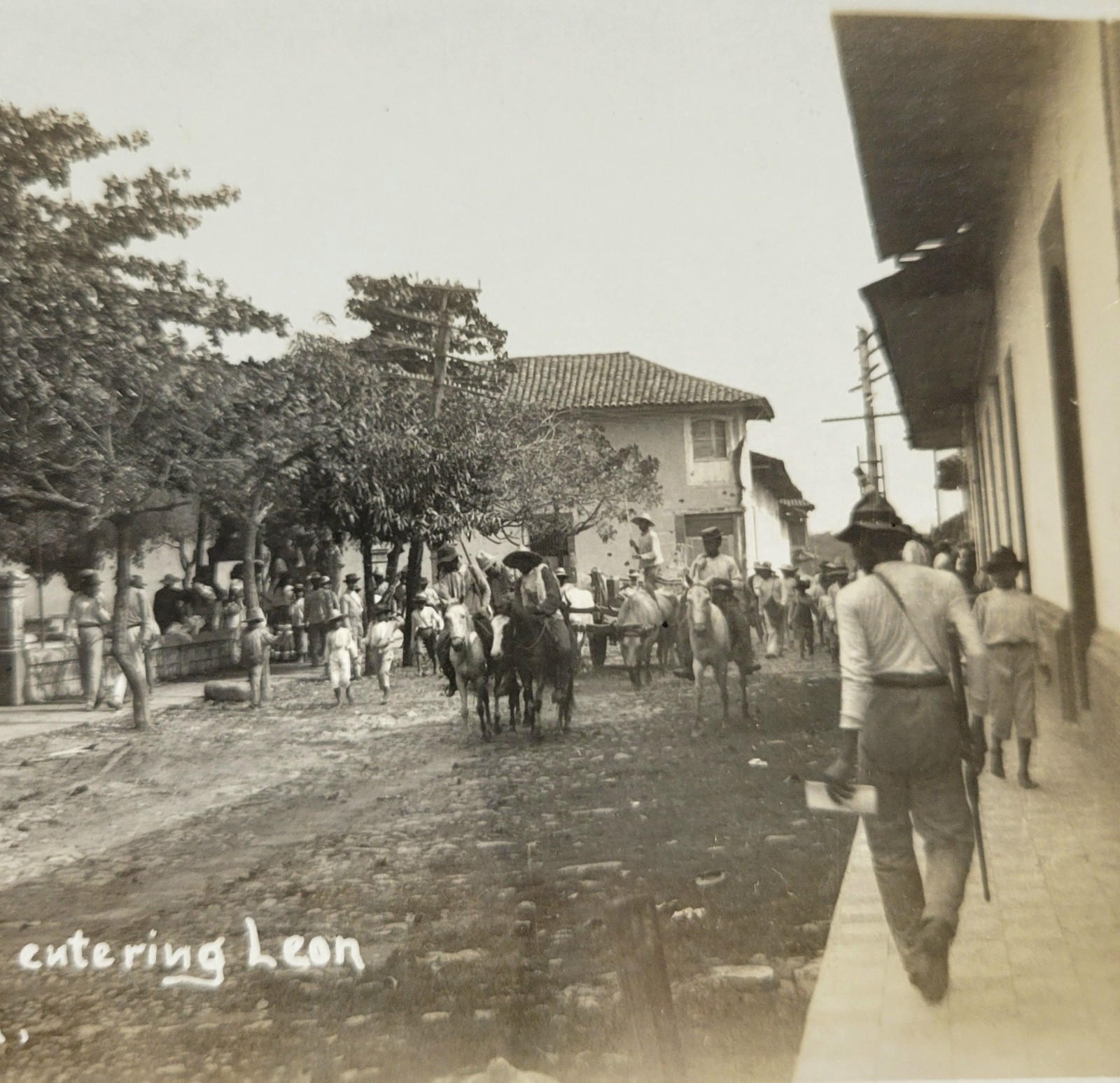
General Rudolfo Espinoza Honduran Soldiers Entering Leon Nicaragua c1912 RPPC
Size: approximately 5.5 inches by 3.5 inchesThis original real photo postcard shows Honduran soldiers entering the city of Leon, Nicaragua under General Rudolfo Espinoza. The scene captures mounted and marching troops moving along a tree lined street with local civilians observing, a moment that reflects the tense political climate in Nicaragua during the early twentieth century. The caption identifies General Espinoza by name, which provides a direct link to documented revolutionary activity in the region.
Dr. Rudolfo Espinoza was a political and military figure aligned with ex president Jose Santos Zelaya. Period reporting described Espinoza as operating from Honduras and El Salvador as part of Zelaya’s exile network. In 1911, Espinoza proposed raising an armed force to invade Nicaragua, financed by funds Zelaya had taken from the Nicaraguan treasury. Espinoza had previously represented Zelaya in Washington, and by the time this postcard was produced, he was gathering discontented Nicaraguans and mercenaries with the goal of overthrowing President Estrada and restoring Zelaya or seizing power himself. The United States monitored Espinoza’s movements closely due to American and foreign financial interests in Nicaragua and concerns that neighboring states might be used as staging grounds for revolution.
The entry of Honduran soldiers into Leon under Espinoza corresponds to this documented revolutionary activity. Leon was a major political center and a focal point of unrest during the period leading into the Mena Rebellion. Cross border intervention was common, and Honduran forces aligned with Espinoza’s plans plausibly entered the city as part of the broader struggle between Zelaya loyalists and the Estrada administration. The photograph provides a rare visual record of these movements, which were usually described only in newspapers and diplomatic reports.
This postcard is a meaningful example of Central American political and military history. Real photo postcards documenting named revolutionary leaders are rare, and images showing foreign troops entering a Nicaraguan city under a specific commander are even more difficult to find. The combination of the caption, the named figure, the Honduran military presence and the Leon setting makes this a strong primary source for researchers studying the Zelaya era, the Estrada administration and the regional conflicts that shaped Nicaragua in the early 1900s.
The rarity of this postcard is increased by the absence of other known photographic views of Espinoza’s forces. Most surviving material from this period consists of city views, portraits or generic street scenes, not named military entries tied to documented revolutionary plans. This image offers a clear and historically grounded view of a moment that was significant enough to be reported internationally but seldom photographed. In fact, it's plausible this is the remaining surviving photo/postcard from this event.
Those most interested in this postcard:
- Collectors of Central American political and military history
- Researchers studying Jose Santos Zelaya and the Estrada administration
- Historians of Honduran and Nicaraguan cross border conflicts
- Archivists documenting early twentieth century revolutionary movements
- Specialists in real photo postcards of Latin American military subjects
- Scholars examining United States diplomatic involvement in Nicaragua
This newspaper article in the Albuquerque Evening Herald (Albuquerque, N.M.), May 12, 1911 details much of Dr. Rudolfo Espinoza's mission:
"Revolution again threatens in Nicaragua. Dr. Rudolfo Espinoza Proposes to outfit army of invasion and regain control of treasure for former despot...This time Dr. Rudolfo Espinoza, who in the days of the last revolution came to Washington as the representative here of ex-president Zelaya, is to lead the new invasion and seek to banish President Estrada. Already the world-be ruler has left Mexico, where he enjoyed a haven, and he has established a base for operations in Salvador.
If the plan of Dr. Espinoza do not miscarry, the world will be called upon to witness another Central American war. The doctor will surround himself with a few hundred discontented Nicaraguans, a few score adventurers and a few dozen mercenaries.
He will be opposed by the Estrada veterans of the Nicaraguan standing army. This army is composed very largely of officers. There are a few privates in it, of course, but a large majority of the troops are captains, colonels, and generals. Most of those now in the military service succeeded to the commissions held by President Zelaya's imposing staff of officers.
Revolution in Nicaragua would not, therefore, be taken seriously by anybody, the belligerents excepted, were it not for the disquieting effect they have on the neighboring states and the annoyance to foreign interests, which have large investments in that country. It is for these two reasons that the United States takes anything more than a passing interest in strife in Central America.
Unfortunately, however, these revolutions have their serious phases. There is about $20,000,000 of American money invested in Nicaragua. There is at least that much more of foreign money invested, and it is the duty of the powers to provide protection for their interests and their citizens.
This has resulted in a hurried investigation of the impending uprising and the purposes of Dr. Espinoza. It has already been determined that probably the motive of the new leader is the ultimate restoration of Zelaya to the presidency of the republic or the seizure of the presidency for himself.
Just a little more than a year ago, the despot, Zelaya, was driven from the presidency and from the borders of his own country. This fate befell him after he had ordered or permitted the murder of two American youths who had gone to Nicaragua and had been captured as prisoners of war. Zelaya fled to Mexico, where he was feted and honored and shown every consideration. Later, he sailed for Europe, and is now sojourning in first one and then another of the European capitals.
It was common knowledge at the time that Zelaya carried with him from Nicaragua a fortune, ill gotten, of from $25,000,000 to $35,000,000. This money had been extorted from the people of the country by various means of taxation. It had been deposited first as public funds and was then stolen from the treasury.
It is this money that is now available in financing the new revolution. By its use Dr. Espinoza, according to recent official investigations, expects to raise an army of sufficient strength to overthrow the Estrada administration and again secure control of the republic for his friend Zelaya or for himself.
The United States government has already taken steps to prevent further civil strife in Nicaragua. The American minister to Salvador has been directed to obtain definitive information of Dr. Espinoza's presence and purposes in Salvador, and to remind the government of that country that the United States expects it to meet its treaty obligations and prevent its territory from being used as a base for a revolution directed against a neighboring state.
It is now the opinion of state department officials that the only solution of the ever recurring difficulties in Nicaragua lies in the negotiation of a treaty between that country similar to the one between the United States and Honduras now pending before the Senate.
Such a pact would guarantee the payment of Nicaragua's debts by the application of customs house receipts collected under the nominal supervision of the United States. This would give the United States just enough control of the Central American state to prevent the revolutionists from capturing the customs houses.
If the hope of financial reward is removed, there would be fewer revolutions in Nicaragua, in the opinion of the department. That is, if energetic and ambitious citizens found that by overthrowing the administration then in power they would not be in a position to collect the revenues, they would hesitate longer about revolting. The public treasury is the single object of all uprisings.
Already an agreement similar to that recently negotiated with Honduras has been proposed to the Estrada administration now in control of the government. It has not been favorably received up to this time, but if the president of that state sees that his regime is threatened by Espinoza he will, it is thought, be more inclined to give the United States an excuse for protecting his treasury."Please inspect the pictures, as they give the best representation of condition. May have discoloring, edge or corner wear, marks, creases, fading, smudges, corner or edge bends, tears, or corners missing.
(Inventory #B106)