When you click on links to various merchants on this site and make a purchase, this can result in this site earning a commission. Affiliate programs and affiliations include, but are not limited to, the eBay Partner Network.
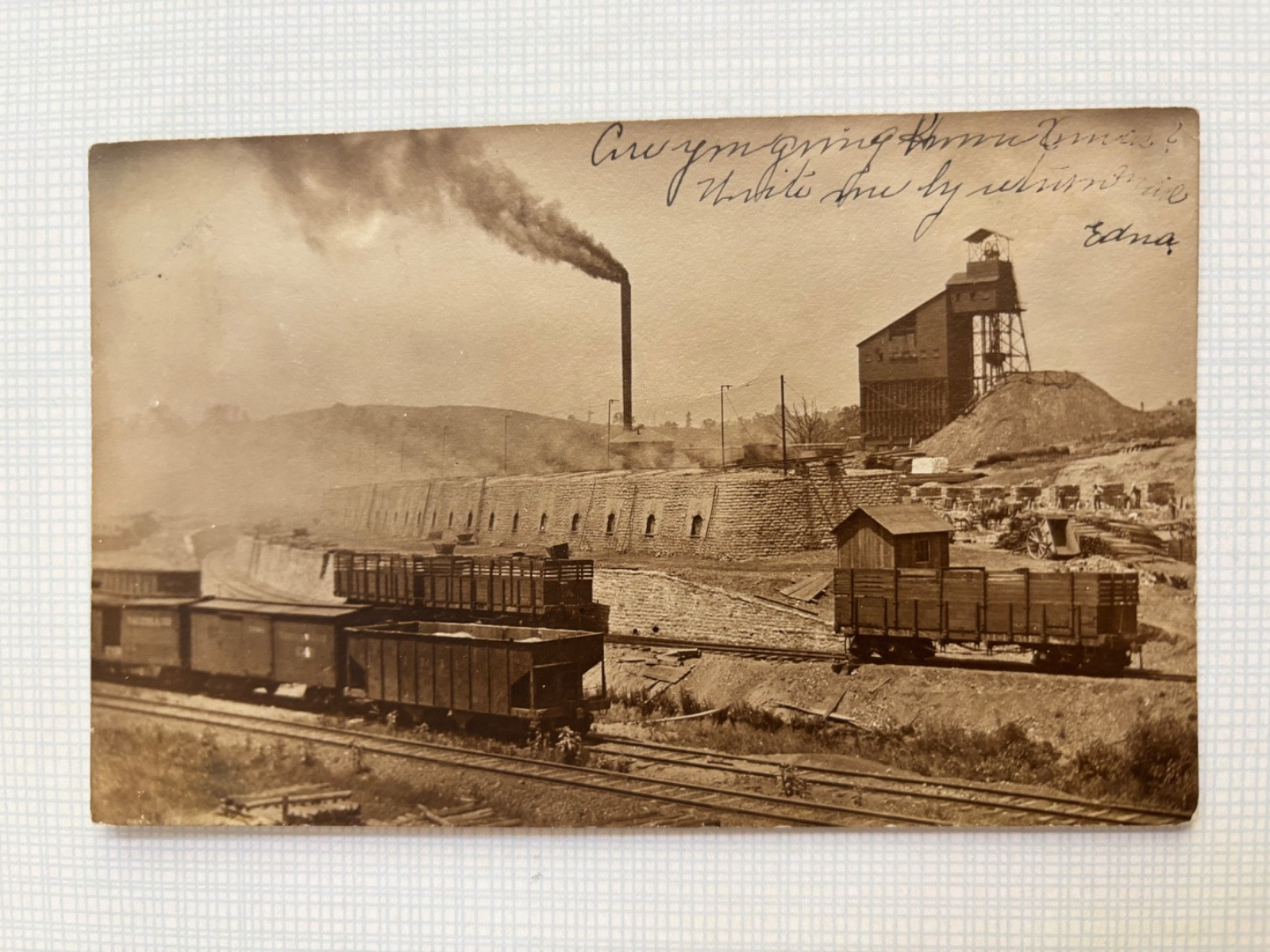
Vintage RPPC - Coal Mine Tipple and Beehive Coke Ovens
Real photo view across a working coal and coke operation. At the right stands a tall timber-framed tipple with a steel headframe rising above it, the hoist sheaves housed under a small peaked roof at the top, and a gob pile banked against its base. Running away across the center of the frame is a long bank of stone-faced beehive coke ovens, their arched drawing doors set in a curving retaining wall, with workmen visible along the oven bench and horse-drawn larry carts on the charging track above. A tall brick stack at center pours a heavy column of black smoke across the sky. In the foreground, several parallel tracks carry a string of slat-sided coke cars, wooden boxcars and a steel gondola, with a small board-and-batten shanty beside the rails, stacked timber, and a horse-drawn wagon standing among the material piles at the right.
Postally used. Postmarked Republic, Pa., December 15, 1907, PM, and addressed in ink to a recipient on North 22d Street in Philadelphia, Pa. The back is an undivided back reading THIS SIDE FOR THE ADDRESS with a printed PLACE ONE-CENT STAMP HERE box, the format required in the United States from December 1901 until divided backs were permitted on March 1, 1907 - which is why the sender's message is written across the sky on the picture side. It reads: "Are you going home Xmas? Write me by return mail. Edna."
The beehive coke oven is what gave southwestern Pennsylvania's Connellsville region its distinctive landscape. Coal was baked in rows of masonry ovens built into hillsides, and by 1880 Fayette County was the largest coke producer in the country, with something close to three-quarters of the regional workforce employed in coal or coke. Operators built hundreds of company towns around works like this one. Beehive coking was largely obsolete by the 1920s as steel companies moved to by-product ovens at the mills, and most of the ovens were abandoned and left to collapse.
A strong piece for collectors of coal mining and coke industry postcards, coal patch and company town history, or early railroad and industrial real photo views.