When you click on links to various merchants on this site and make a purchase, this can result in this site earning a commission. Affiliate programs and affiliations include, but are not limited to, the eBay Partner Network.
C19th Antique Ottoman Student Notebook Roman Law French Arabic Script Manuscript
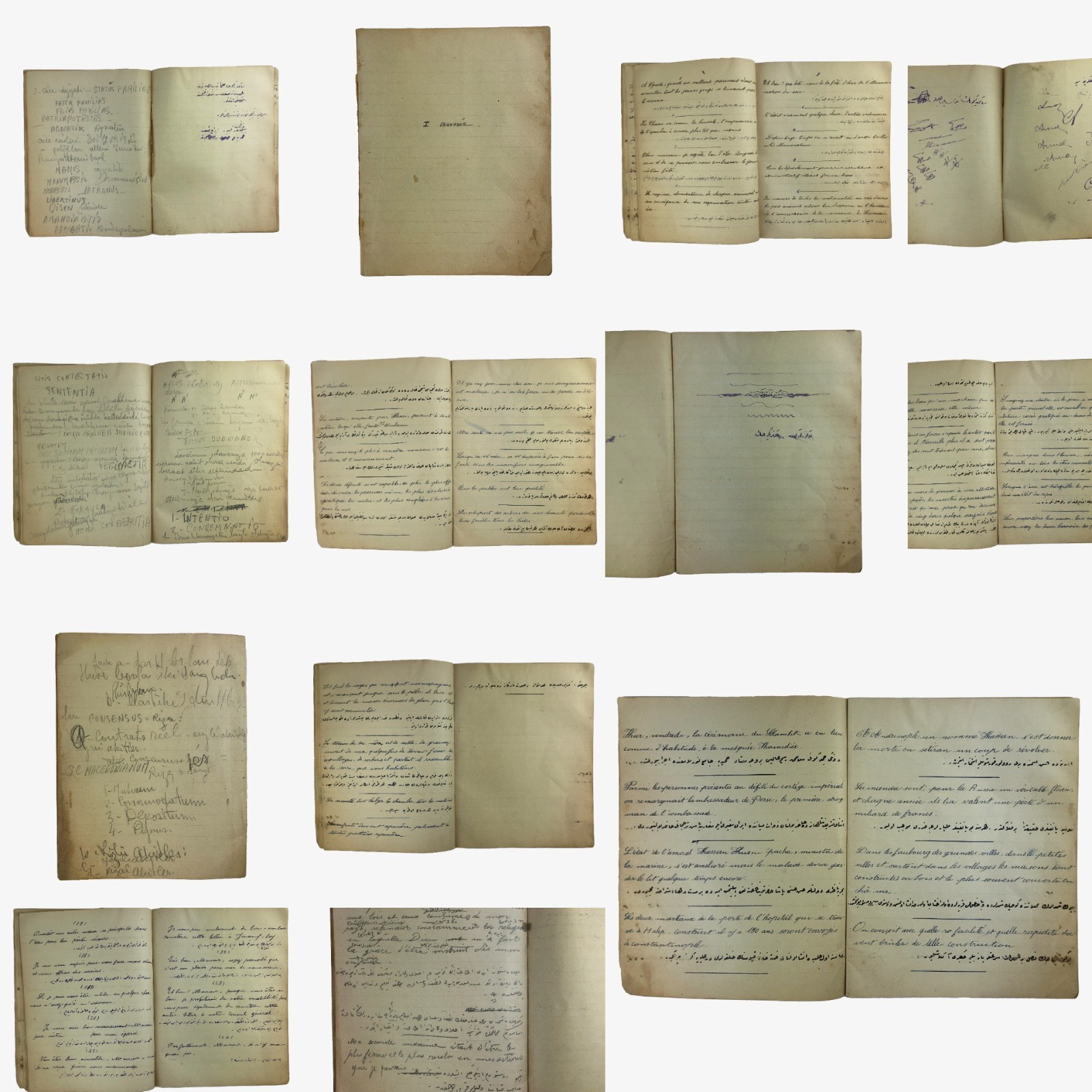
Antique handwritten manuscript notebook (cahier/defter), evidently kept by a student, combining two distinct bodies of content on facing pages throughout: Latin/French Roman-law study notes on one side, and parallel French-language text with Ottoman Turkish (Arabic-script) translation or commentary on the facing side. The notebook\'s cover/first page is inscribed simply \"I année\" (\"Year One\" or \"1st Year\"), suggesting this was a first-year student\'s exercise book, likely from a law faculty curriculum that, in the late Ottoman period, commonly followed a continental European model including Roman law instruction.
The Roman law portions are written in a combination of Latin legal terminology and French explanatory notes, organized under headings and legal maxims. Visible terms and headings include \"Status Familiae,\" \"Pater Familias,\" \"Filius Familias,\" \"Patria Potestas,\" \"Agnatio,\" \"Cognatio,\" \"Manus,\" \"Manumissio,\" \"Patronus,\" \"Libertinus,\" \"Litis Contestatio,\" \"Sententia,\" \"Intentio,\" \"Condemnatio,\" \"Consensus,\" \"S.C. Macedonianum,\" and a list of contract types (\"Mutuum, Commodatum, Depositum, Pignus\") — all standard subject headings from a classical Roman law course (Institutes-style curriculum covering family law, manumission/slavery status, legal procedure \"per formulas,\" and the law of obligations/contracts). This content strongly indicates the notebook belonged to a law student, most likely enrolled in an Ottoman or early Turkish law school where Roman law was taught as a foundation for civil law studies.
The facing French-language pages contain narrative prose, written as continuous text with an Ottoman Turkish translation or paraphrase in Arabic script directly beneath each French line or paragraph — a format consistent with a language-learning or dictée exercise, in which a French passage (possibly copied from a newspaper or reading primer) is translated/rendered into Ottoman Turkish for practice. Some pages contain personal/family-themed content (references to \"chère maman,\" embracing family members, a household\'s dietary routine), suggesting elementary composition exercises, while other pages contain what reads as a current-events bulletin or newspaper-style report, referencing: the Friday \"Selamlık\" ceremony taking place \"comme d\'habitude, à la mosquée Hamidiye\" (as usual, at the Hamidiye Mosque) — a reference to the Ottoman Sultan\'s weekly public procession to Friday prayers, a practice associated with the reign of Sultan Abdülhamid II (the Hamidiye Mosque at Yıldız was built under his patronage); the presence of \"l\'ambassadeur de Perse\" (the Persian ambassador) among dignitaries at the imperial procession; and the health of \"l\'amiral Hassan Husnü Pacha, ministre de la marine\" (Admiral Hasan Hüsnü Pasha, Minister of the Navy) — a real historical figure who served as Ottoman Kapudan Pasha / Minister of Marine in the late 19th century, which helps place this bulletin content within the Hamidian era (circa 1880s–1900s). Another passage references an incident involving a person named \"Hasan\" at Adrianople (Edirne), described as having shot himself with a revolver; exact surrounding context is partially [unclear] due to handwriting density. Additional passages discuss house fires (\"incendies\") as a recurring hazard in Russia, and wooden-built houses/roofing common in towns and villages, plus a note about twin minarets at a hospital in Aleppo (\"Halep\") said to be 180 years old at the time of writing.
Further pages contain what appear to be letter-writing practice exercises in French (a polite, formal register addressing \"Monsieur,\" discussing being useful, instructive, and expressing thanks), along with loose personal notes, numbered lists, doodles, and repeated practice signatures/names in a different, looser hand (including scrawled names such as \"Ahmed\" and others,in places), consistent with a student notebook that saw repeated informal use over time. Several pages are blank or contain only a decorative penned divider line, and physical condition throughout shows heavy toning, foxing, edge wear, and some staining consistent with age and handling; the binding appears to be a simple sewn/stitched school-copybook structure rather than a formal bound volume.
This item is a rich piece of Ottoman-era educational ephemera, combining evidence of Roman/civil law instruction, French-Ottoman Turkish bilingual language pedagogy, and contemporary references to Hamidian-era court ceremony and Ottoman naval administration. It would be of strong interest to collectors and researchers of late Ottoman education, legal history, Franco-Ottoman bilingual schooling, and Hamidian-era court and political history, as well as those studying handwritten primary-source manuscripts from the Ottoman Empire\'s late 19th/early 20th century period. No cover title, author name, school name, or explicit date is visible in the photographed pages beyond the \"I année\" heading; all identifications of historical figures and institutions above are based solely on what is legibly written in the manuscript itself.
Format: Handwritten manuscript notebook/copybook, sewn binding
Language: French, Latin, and Ottoman Turkish (Arabic script)
Subject matter: Roman law lecture notes; French-Ottoman Turkish bilingual reading/dictée exercises; current-events bulletin content; personal letter-writing practice
Notable historical references: Selamlık ceremony at the Hamidiye Mosque; Admiral Hasan Hüsnü Pasha, Ottoman Minister of Marine; Adrianople (Edirne); Aleppo (Halep)
Condition: Heavy toning and foxing, edge wear, generally legible handwriting throughout, no covers/binding details fully shown
Measures 15 x 20 centimeters (approx.)
We always ensure your item is securely packed in a protective plastic sleeve, placed between hard cardboard, and shipped in an envelope withregistered mail tracking!
Have questions? We\'re happy to help!Browse our storefor more.We are happy to offer combined shipping on multiple collectible purchases to help you save! Just add all items to your cart and request an invoice before paying, or send us a quick message — we’ll calculate the best shipping rate soyou can buy more and save more!
Please examine the listing, some bent corners, era folds, small tears and slight stains due to their genuine antique aging.What you see is what you will get. We try to present the real state of the object as completely as possible with photos.Antique Condition: As is - Good