When you click on links to various merchants on this site and make a purchase, this can result in this site earning a commission. Affiliate programs and affiliations include, but are not limited to, the eBay Partner Network.
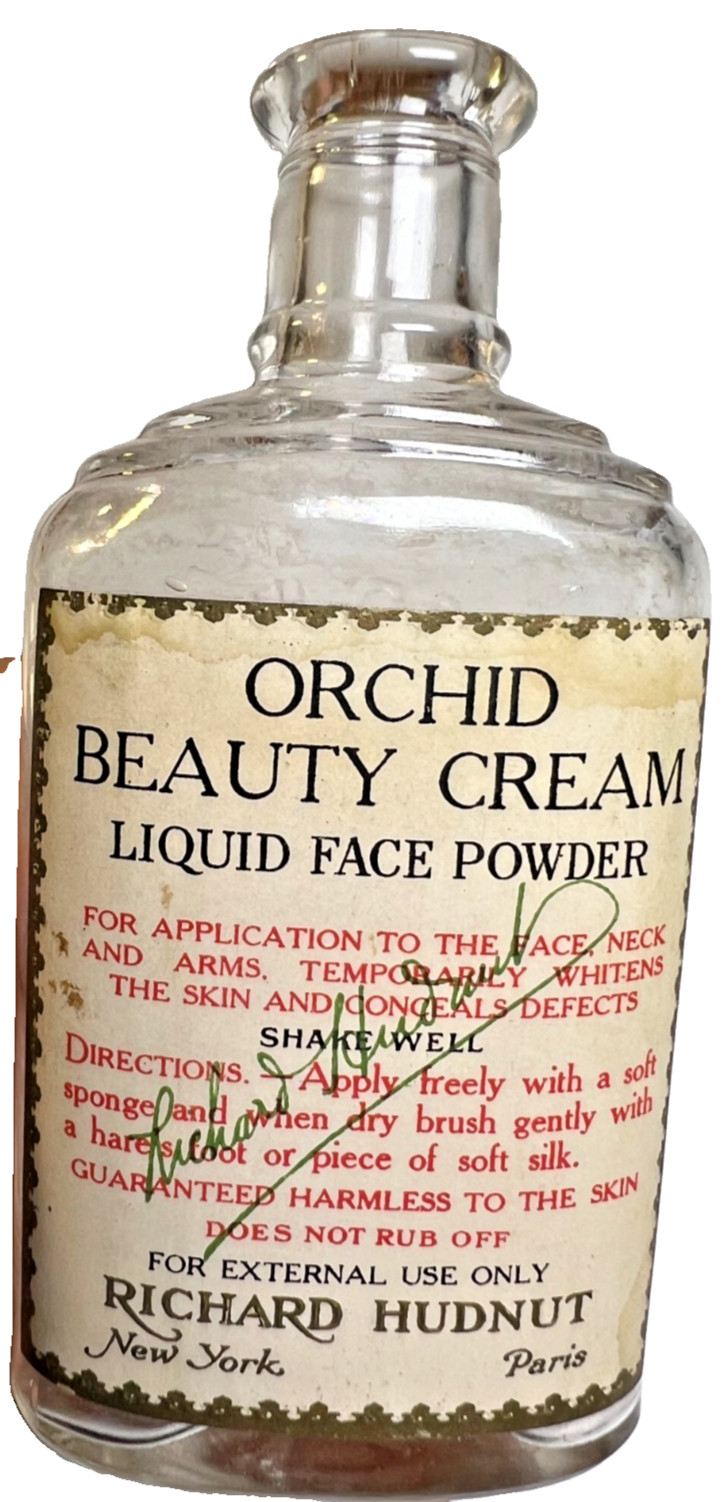
An especially appealing survivor from America’s early beauty industry, this antique Richard Hudnut Orchid Beauty Cream bottle combines a full, richly detailed paper label with an embossed eagle trademark on the reverse. Standing approximately 5 1/8 inches tall, it is a small but remarkably expressive piece of dressing-table history.
The clear glass has a flattened body with rounded corners, stepped shoulders, and a substantial flared mouth. Its label is the visual centerpiece: bold black product lettering, red instructions, an ornamental border, and Richard Hudnut’s sweeping printed signature in green. The cities New York and Paris appear along the bottom, giving the package the cosmopolitan character its maker wanted customers to associate with his preparations.
The back is embossed RICHARD HUDNUT above an eagle trademark, with NEW YORK and U.S.A. beneath. With advertising on the front and molded decoration on the back, this is a bottle that rewards being picked up and examined.
DATE, MAKER & PLACE
Attributed to circa 1910, with an approximate dating range of 1905–1920. Richard Hudnut was a New York City, New York, perfumery and cosmetics business. The American association is reinforced by the bottle’s embossed NEW YORK and U.S.A. markings; the Paris name on the label should not be taken by itself as evidence that this particular bottle was manufactured in France.
A period illustration of Orchid Beauty Cream appears in Hudnut’s 1915 Beauty Book, providing a contemporary reference for the product and its packaging. The exact year of this individual bottle and the company that made the glass have not been established.
THE MAN BEHIND THE NAME
Richard Hudnut developed his business from a background in the New York pharmacy trade into a nationally recognized perfume and cosmetics concern. His range extended across fragrances, powders, creams, soaps, and other toilet preparations. As demand increased, the firm built a six-story headquarters with manufacturing, shipping, office, and showroom space at 115–117 East 29th Street, completed by 1906.
Hudnut’s early marketing favored beauty booklets that cultivated exclusivity. He also required retailers to maintain his prices, protecting the brand’s prestige against discounting. This bottle reflects that approach: decorative packaging, a prominent signature, and the promise of refined personal care.
WHAT THE BOTTLE ORIGINALLY HELD
Despite its “Beauty Cream” name, the label identifies the preparation as liquid face powder. It was intended to leave a cosmetic covering on the face, neck, and arms, temporarily lightening the appearance of the skin and concealing imperfections. The product was available in shades called White, Flesh, and Brunette; no definite shade identification is offered for this bottle.
The directions are a particularly interesting survival. Users were instructed to shake the preparation, apply it with a soft sponge, and, after drying, gently brush the skin with a hare’s foot or soft silk. These were the tools of a beauty routine very different from today’s pumps, compacts, and blending sponges.
The label’s promises of harmlessness and resistance to rubbing off are historical advertising claims. An authenticated ingredient formula for this particular version has not been established, and the white haze inside should not be treated as proof of any specific ingredient.
SELLING BEAUTY BEFORE THE MODERN MAKEUP COUNTER
The marketing appealed to women seeking a polished complexion without an obviously theatrical appearance. My reading of the package is that it offered an ideal of discreet, respectable refinement: beauty that looked effortless, even when the directions required several steps.
This was also a period when American cosmetics were becoming nationally branded consumer goods. Department stores increasingly placed profitable cosmetics near their entrances, where attractive bottles and packaging could catch shoppers’ attention. A bottle such as this belonged to that expanding world of beauty merchandise and personal aspiration.
LIFE IN HUDNUT’S NEW YORK
Around 1910, New York was growing at an extraordinary pace. Its population increased approximately 39 percent during the preceding decade, reaching about 4.8 million. Immigration was a major force behind that growth.
The city’s elegant shops existed alongside crowded immigrant neighborhoods and working households in tenement buildings. For many newcomers, New York was their first experience of America; during the peak immigration era, nearly three-quarters of immigrants entering the country came through its port. The contrast gives this little bottle added meaning: it advertised an attainable piece of elegance in a city where everyday circumstances varied enormously.
EVENTS THAT SHAPED THE CITY AROUND ITS ESTIMATED DATE
• 1904: New York’s first subway opened on October 27, with a five-cent fare, changing how residents traveled across Manhattan.
• 1907: A financial panic shook Wall Street and the banking system, helping spur the movement toward establishing the Federal Reserve.
• 1909: Construction of the Queensboro Bridge was completed, adding a major new connection between Manhattan and Queens.
• 1911: The Triangle Shirtwaist Factory fire killed 146 workers, becoming a defining tragedy in the history of the city’s garment industry.
• 1913: Grand Central Terminal opened on February 2; more than 150,000 people visited on its first day.
These events place the bottle within a city undergoing tremendous commercial, social, and technological change.
MEASUREMENTS & CONDITION
• Approximately 5 1/8 inches tall.
• Clear glass with full paper product label.
• Embossed Richard Hudnut name and eagle trademark on the reverse.
• No chips or cracks.
• Some white haze/residue inside.
• Label shows age toning, staining/discoloration, and scattered surface and border wear.
• Printed wording remains readily legible.
• No cap or stopper is included.
An attractive example for collectors of antique cosmetic packaging, early advertising, New York business history, vanity accessories, or embossed American bottles. Its strongest feature is the combination of the surviving full label and the decorative embossed reverse.