When you click on links to various merchants on this site and make a purchase, this can result in this site earning a commission. Affiliate programs and affiliations include, but are not limited to, the eBay Partner Network.
Early Richard Hellmann’s Blue Ribbon Mayonnaise Jar — San Francisco, California — Circa 1920s
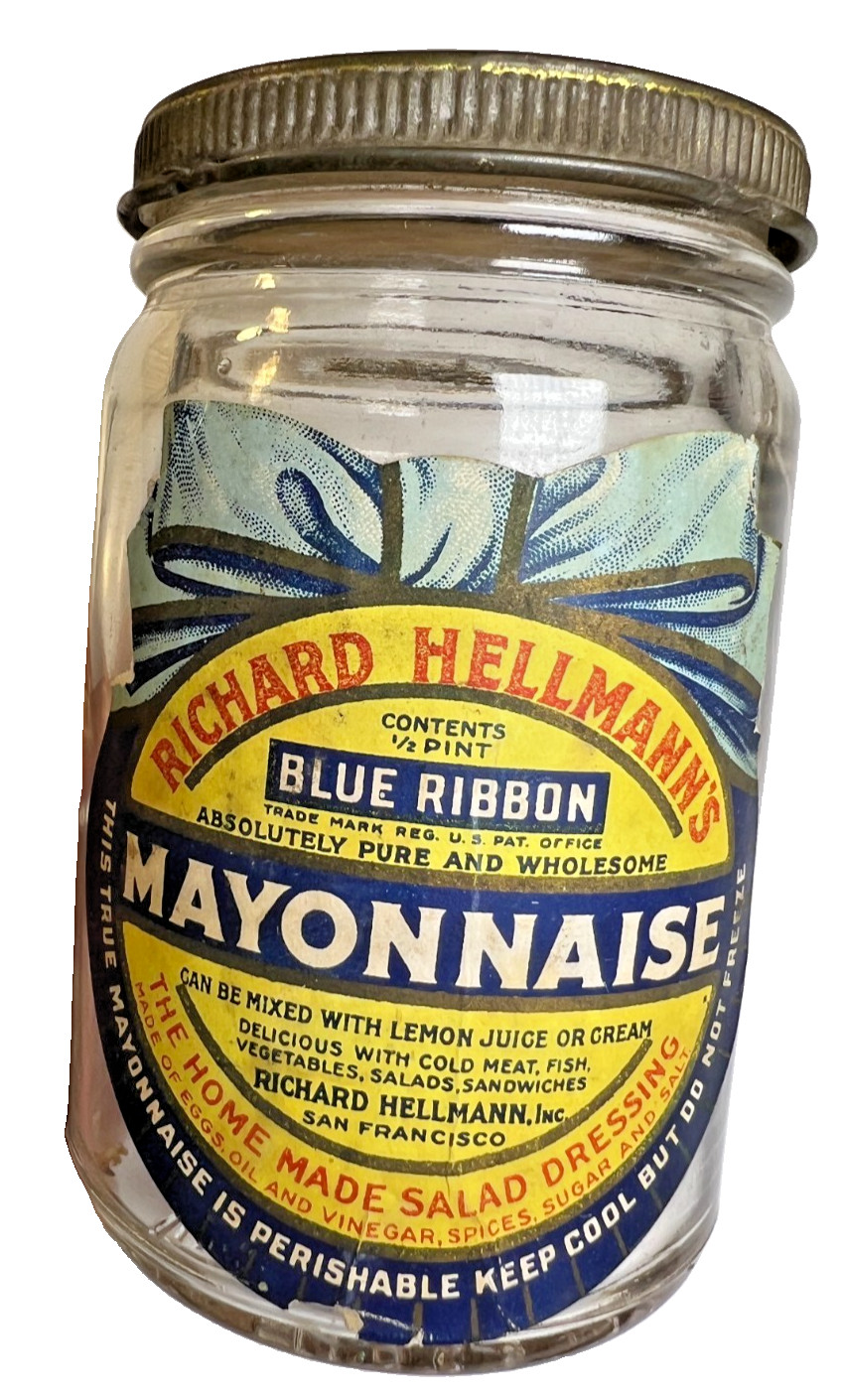
A wonderfully colorful survivor from the early years of one of America’s most familiar food brands. This clear-glass, half-pint Richard Hellmann’s Blue Ribbon Mayonnaise jar retains its striking original paper label and matching printed metal screw cap, bringing together early grocery advertising, San Francisco business history, and a delightful glimpse into the American kitchen of a century ago.
Measuring approximately 4¼ inches tall by 2½ inches wide, this compact jar has tremendous display appeal. The label combines bright yellow, deep blue, red lettering, and a large illustrated blue ribbon, with the maker’s name prominently arched above the bold MAYONNAISE lettering. Its unusually informative lid adds an entirely separate piece of advertising.
Maker, Location & Date
The label identifies the business as Richard Hellmann, Inc., San Francisco.
Richard Hellmann was a German immigrant whose New York delicatessen business developed into a nationally recognized mayonnaise company. The business incorporated in 1916 and expanded beyond its original New York market as demand grew.
The San Francisco connection is particularly interesting. Hellmann was arranging a western factory in 1922, and a 1924 advertisement placed Richard Hellmann, Inc., at 16th and Harrison Streets, San Francisco, California. This jar represents that early western-market chapter of the business.
Estimated date: circa 1923–1929, probably the middle 1920s. This attribution is based on the San Francisco company identification, early label design, and period packaging.
The Blue Ribbon Name
The Blue Ribbon name became the company’s recognizable symbol of quality. Hellmann’s brand history describes the ribbon as a way of distinguishing a favored mayonnaise recipe, which developed into the familiar Blue Ribbon identity.
The enormous illustrated ribbon on this label makes that branding especially clear. Customers could recognize the product by its color and design before reading the smaller print—a useful advantage on a crowded grocery shelf.
Original Contents & How It Was Used
The label states a capacity of ½ pint, equivalent to eight U.S. fluid ounces. (Its tiny compared to our modern day mayonnaise jars)
It originally contained prepared mayonnaise. The printed ingredient wording names eggs, oil, vinegar, spices, sugar, and salt.
The label recommends serving it with cold meat, fish, vegetables, salads, and sandwiches, and suggests mixing it with lemon juice or cream. This was a versatile prepared dressing intended for everyday household use, from sandwich making to more elaborate salad dishes.
The wide mouth allowed convenient access with a spoon and made the empty jar useful afterward.
The jar is now empty and is offered as a historical collectible.
Advertising, Purity & Household Convenience
The label stresses purity and wholesomeness while describing the product as a home-made salad dressing. That combination is revealing: a factory-prepared food was being marketed through the reassuring language of the home kitchen.
Prepared mayonnaise offered convenience and consistency, saving the buyer the work of making an emulsion from scratch. The label also supplied serving suggestions, encouraging customers to use it across several meals.
Its outer border warns that the mayonnaise is perishable and directs the owner to keep it cool without freezing. This is a particularly evocative detail from the era of household iceboxes and the growing adoption of electric refrigeration.
The Wonderful Advertising Lid - One-Cent Sealing Discs
The matching blue-and-gold metal cap is one of the most appealing features.
It instructs customers wishing to reuse the cap and jar for home preserving to write to Richard Hellmann, Inc., offering No. 63 rubber ring discs at one cent each.
That small advertisement gives the jar a second story. The package was promoted as useful after its original contents were gone, with inexpensive replacement sealing parts available directly from the company.
For a household accustomed to saving containers and putting up preserves, the reusable jar added practical value to the purchase. Today, the surviving instructions make the cap an especially engaging piece of early packaging history.
San Francisco in the 1920s
This jar belongs to the San Francisco of busy neighborhood groceries, electric streetcars, cable cars, waterfront commerce, and expanding automobile traffic. The city had rebuilt after the devastating earthquake and fire of 1906 and was firmly established as a major Pacific Coast commercial center.
National Prohibition was in force, radio was becoming an increasingly important presence in American homes, and new electrical appliances were changing household routines. Medicine was still practiced before the widespread availability of antibiotics.
A major event near the beginning of this jar’s estimated period was President Warren G. Harding’s death at San Francisco’s Palace Hotel on August 2, 1923, after which Calvin Coolidge became president.
Against that larger historical backdrop, an ordinary grocery jar records a quieter change: branded, prepared foods becoming a familiar part of daily kitchen life.
Size, Glass & Construction
• Approximately 4¼ inches tall × 2½ inches wide.
• Original label identifies ½-pint contents.
• Clear, colorless glass with a cylindrical body, rounded shoulder, and wide screw-top opening.
• Visible mold seams, consistent with machine-made commercial packaging.
• Raised Hellmann’s / Blue Ribbon branding is visible through the base; the photographs do not show every character clearly enough for a complete transcription.
• Retains its matching period printed metal screw cap.
• Original multicolor paper label remains attached.
The food company is identified by the label. The actual glass manufacturer has not been established.
Rarity & Collector Appeal
An uncommon and particularly attractive surviving combination of early paper label, San Francisco identification, embossed glass, and matching illustrated advertising cap.
Hellmann’s jars were commercial packages produced in quantity. What makes this example appealing is the survival of the fragile printed material and the detailed lid advertising. Labels were easily washed away, damaged during reuse, or lost after disposal, while metal caps were vulnerable to corrosion and separation.
The San Francisco identification adds regional interest beyond the familiar national brand name.
A compelling piece for collectors of early food advertising, antique grocery packaging, kitchen Americana, mayonnaise jars, advertising tins, and San Francisco commercial history.
Condition
The paper label retains strong, attractive color and substantial readable detail. It shows age toning, staining, creases, tears, and scattered losses, particularly around the edges and lower border.
The metal cap retains substantial printed decoration, with surface wear, scratches, oxidation, and wear to its finish.
The glass shows scattered surface marks and age-related wear. No obvious major glass breakage is apparent in the photographs, although the mouth beneath the fitted cap is not fully visible.
Please examine all photographs for the exact condition of the label, glass, and cap. Offered in its present antique condition.
A colorful little survivor with an unusually good story: early Hellmann’s branding, San Francisco roots, and a lid that promised the jar another useful life for a penny.