When you click on links to various merchants on this site and make a purchase, this can result in this site earning a commission. Affiliate programs and affiliations include, but are not limited to, the eBay Partner Network.
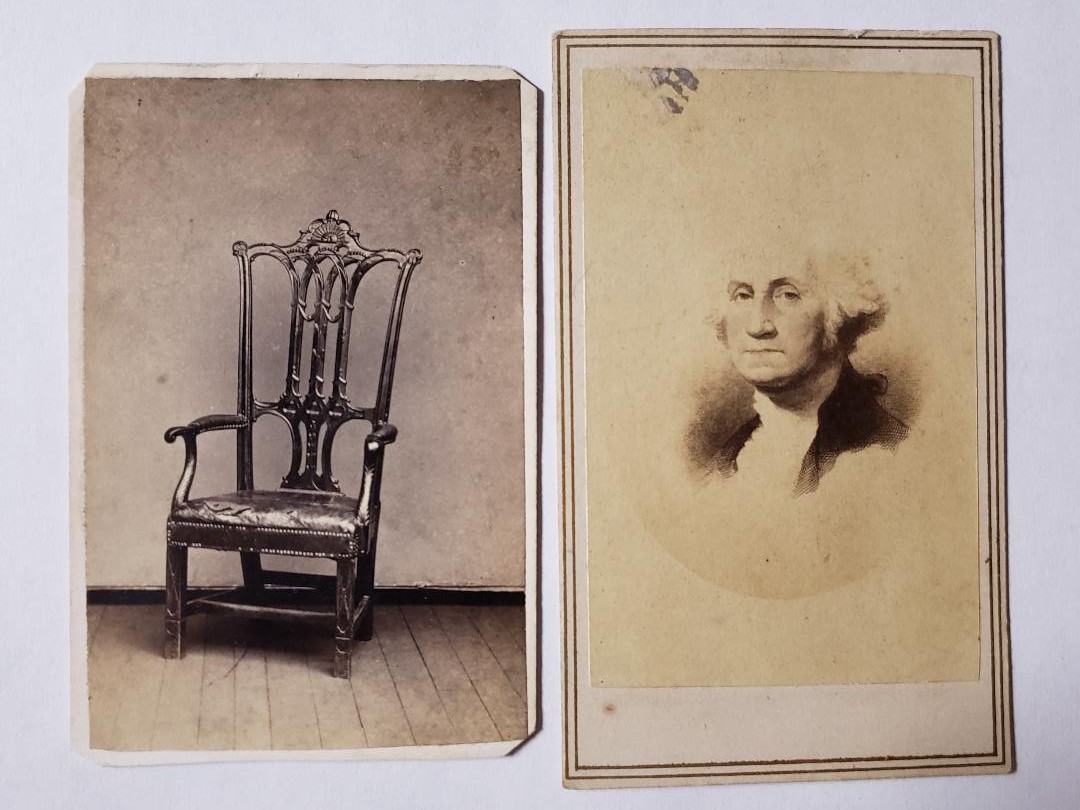
Antique Original Civil War Era CDV (carte-de- visite) Photo Lot George Washinton's 1787 United States Constitutional Convention "THE RISING SUN CHAIR" and Engraving Bust of George Washington.Chair shows damage missing carved wood piece (see red circle in 4th sale photo), worn ripped damage to seatupholstery along with missing quite a few of theupholstery tacks.Taken by photographer:B.L.H. DABBS(Benjamin Lomax Horsely Dabbs), (see bio below)46 & 48 St. Clair St.,Pittsburg, Pennsylvania
Dabbs, B. L. H., photographer, 46 & 48 St. Clair St., Pittsburg, PA (1864-1866)
(Since photo was taken between 1864 to 1866 then the 1879 chair would have been between 84 to 88 years old and 76 to 80 years old since the 1787 Constitutional Convention.)
President-elect Abraham Lincoln stepped into "the hall of Independence" in 1861 as he journeyed to Washington D.C. for his inauguration. Standing in the Assembly Room, he said that he would rather be "assassinated on the spot" than give up the ideals of the Declaration of Independence. After his assassination in the nation's capital in 1865, his body returned to the Assembly Room for two days. Upwards of 85,000 mourners passed by the casket.The Rising Sun Chair supposedly adorned the hall of Independence during Abraham Lincoln's visit in life and in death. (see red arrow in 6th sale photo)
The “Rising Sun” Chair.In 1779, Philadelphia furniture maker John Folwell provided the Pennsylvania Assembly with a new chair for the legislature’s Speaker. Today, we call this the “Rising Sun” Chair after Franklin’s famous 1787 observation that the gilded half sun on the chair’s top was analogous to the new nation under the Constitution in that both were “rising” to greatness. The Rising Sun Chair replaced an earlier one presumably destroyed by the British Army when they occupied Philadelphia during the fall of 1777 and the spring of 1778. That earlier chair was the one that John Hancock sat in during the Declaration of Independence’s creation in the summer of 1776.
During the 19th and early 20th centuries, people frequently confused Hancock’s chair with the Rising Sun Chair and assumed that the two were one and the same. It wasn’t until furniture scholar William Macpherson Hornor, Jr. published his Blue Book, Philadelphia Furniture in 1935 that Folwell’s 1779 creation of the Rising Sun Chair was widely publicized. Even after Hornor’s clarification, the name “Hancock’s Chair” clung to the Rising Sun Chair. Franklin’s 1787 observation about the chair as Washington’s seat during the Constitutional Convention was well known, but it didn’t contribute to naming the chair until the latter part of the 20th century. Perhaps the National Park Service invented the name “Rising Sun” Chair in an attempt to get people to stop calling it “Hancock’s” Chair? The Rising Sun Chair remained in the custody of the Pennsylvania State Legislature until 1872 when Frank Etting, the chairman of Philadelphia’s Centennial committee, and two former state governors negotiated the chair’s return to Independence Hall. Since then, the chair has been a focal point of many exhibits in the Hall’s Assembly Room.
The Rising Sun Armchair(George Washington's Chair)
George Washington used this chair for nearly three months of the 1787 Constitutional Convention's continuous sessions. Benjamin Franklin is credited with immortalizing the chair at the close of the convention, observing:
I have often looked at that picture behind the president without being able to tell whether it was rising or setting. But now at length I have the happiness to know that it is a rising and not a setting sun.This is the most well-known version of the sentiments regarding the sun chair, but this well polished version only dates to the 1987 State of the Union address by President Ronald Reagan, who was paraphrasing James Madison, who in turn was reporting the commentary he heard Franklin express. The original text, as written into the federal record by Madison, appeared as follows:
While the last members were signing it [i.e., the Constitution] Doc FRANKLIN looking towards the Presidents Chair, at the back of which a rising sun happened to be painted, observed to a few members near him, that Painters had found it difficult to distinguish in their art a rising from a setting sun. I have said he, often and often in the course of the Session, and the vicissitudes of my hopes and fears as to its issue, looked at that behind the President without being able to tell whether it was rising or setting: But now at length I have the happiness to know that it is a rising and not a setting Sun.Cdv of Chair has some wear, was trimmed and measures approximately 2 1/2 x 3 3/4 inches.
Cdv of George Washinton has some wear with a smudge in tope corner and measures approximately 2 1/2 x 4 1/8 inches.Please see sale photos for condition.
PLEASE NOTE: Please keep in mind that due to not being an exact science, digital camera taken, uploaded sale photo images may be slightly off in color than when viewed in person.
I do combine shipping.Thanks for your interest.
Benjamin Lomax Horsley DabbsBenjamin Lomax Horsley Dabbs was born in London in 1839. He immigrated into the United States while still in his childhood. His father was a pioneer in the American photographic supply trade. Dabbs learned the photography field from his father, George Dabbs. Benjamin came to Pittsburgh in 1861 and opened a business selling photography supplies. That same year he also bought a gallery from a Mr. Rorah. He grew the business dramatically and in 1869 he sold his supply business to concentrate on being a photographer. During his tenure as a photographer in Pennsylvania, he was considered by many to be the best photographer in the state. In 1868 Dabbs married Sadie Dickson and the couple ultimately had nine children. Dabbs was a close personal friend of Abraham Lincoln and steel magnate Andrew Carnegie. Dabbs drew some attention for his stance on free resittings for customers who were not satisfied with the portraits taken by his studio. Unlike many other photographers, he refused free resittings because “the public do not value what they can get for nothing”. In his later years, Dabbs was debilitated by rheumatism and other illness. He died at age sixty in 1899. His celebrated portrait of Andrew Carnegie can be viewed today at Pittsburgh’s Carnegie Museum of Art.