When you click on links to various merchants on this site and make a purchase, this can result in this site earning a commission. Affiliate programs and affiliations include, but are not limited to, the eBay Partner Network.
a.imagelink {color:#0000FF;} a:hover.imagelink {color:#0000FF;} a:visited.imagelink {color:#800080;} a.imagelink img.saleimage { border: 2px solid #0000FF; } a:visited.imagelink img.saleimage { border: 2px solid #800080; }
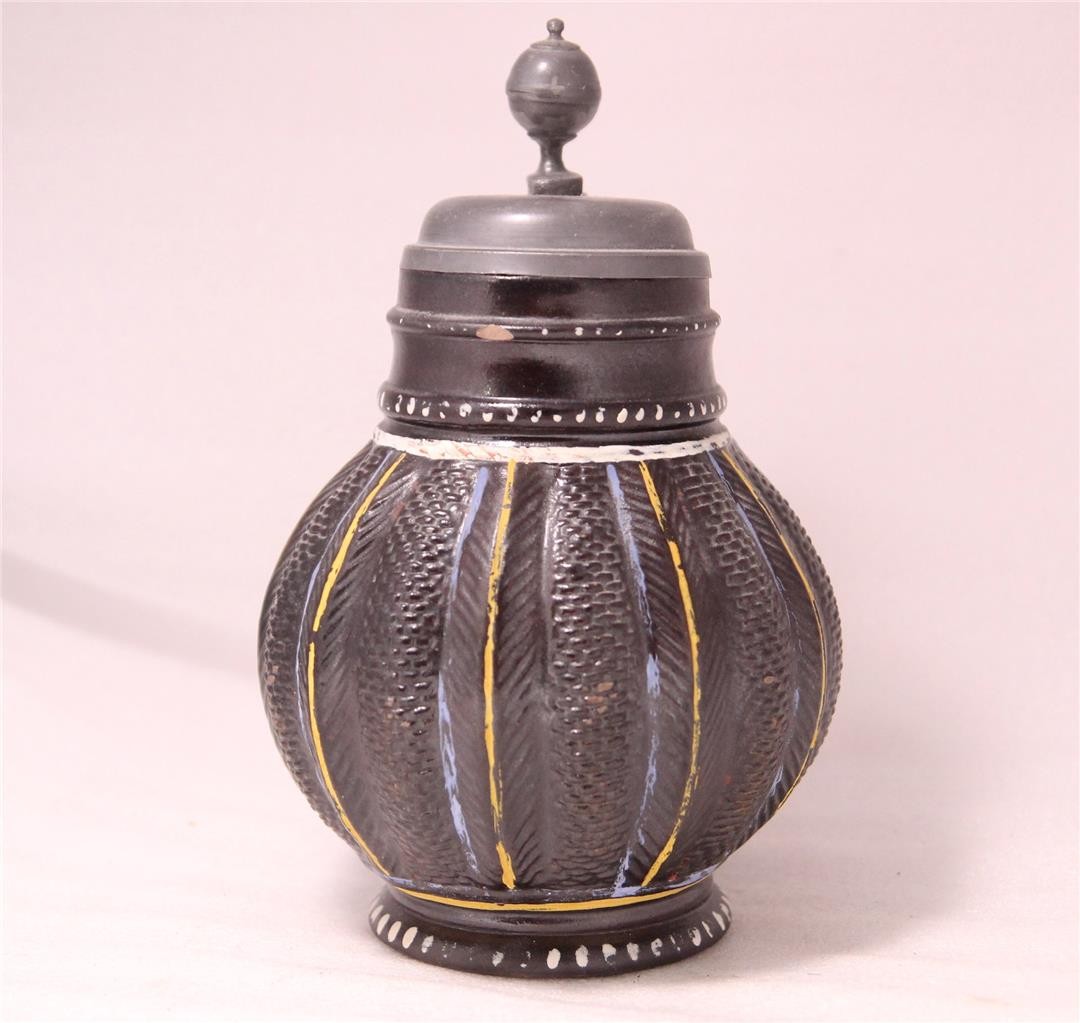
Antique German Beer Stein Dippoldiswalde/Annaberg w/Scaled Pattern circa 1900?
Description: Presented is a German beer stein made to imitate Renaissance-period beer steins made in the German town of Dippoldiswalde/Annaberg in the 1600s.
Ones of the most cherished by collectors and most expensive beer steins are the steins made in the Franconian/Bavarian town of Creussen in the 1600s - early 1700s. These Creussen beer vessels were extremely expensive and very prestigious at the time.
Very similar steins were made around the same time in the Saxonian town of Dippoldiswalde. They were very close but still different from Creussen - not thrown but molded, with the specific dark brown color achieved by glaze. For years, these steins were attributed to Annaberg. However, recent archaeological excavations in Dippoldiswalde have made it absolutely clear that the beer-drinking vessels formerly attributed to Annaberg were actually made in Dippoldiswalde.
In the 1880s - 1890s, several beer stein manufacturers produced steins imitating the faience of the 1700s, Creussen and Dippoldiswalde stoneware, and some Westerwald stoneware of the 1600s - 1700s. At the end of the 1800s and the beginning of the 1900s, several well-known beer stein manufacturers produced Creussen- and Dippoldiswalde-like steins, including Mettlach and Marzi & Remy.
I don\'t know what company made this particular one, but its form and decorations perfectly imitate Dippoldiswalde steins of the mid-1600s. It features a dark brown glaze with an impressed scale pattern - typical for Dippoldiswalde stoneware. It is also decorated with blue, yellow, and white enamel, which is also typical for Dippoldiswalde.
The pewter features a hollow ball thumblift - these thumblifts were made from 1600 till the mid-1800s, after that, they were almost entirely made as solid balls, even when imitating early steins.
The stein is in great condition. There is some minor chipping on the relief band along the upper rim, but there are no hairlines, major chips, or repairs.
It stands 8.5\" tall to the top of the thumblift, with about 1L capacity.
Reference#: Condition: Very good with minor flakes on the upper band Year: 1900 Country: Germany Size: 9.5 in tall, 5.5\" diameter Materials: Stoneware
Get images that
make Supersized seem small.
THE simple solution for sellers.
Track Page Views With
Auctiva\'s Counter