When you click on links to various merchants on this site and make a purchase, this can result in this site earning a commission. Affiliate programs and affiliations include, but are not limited to, the eBay Partner Network.
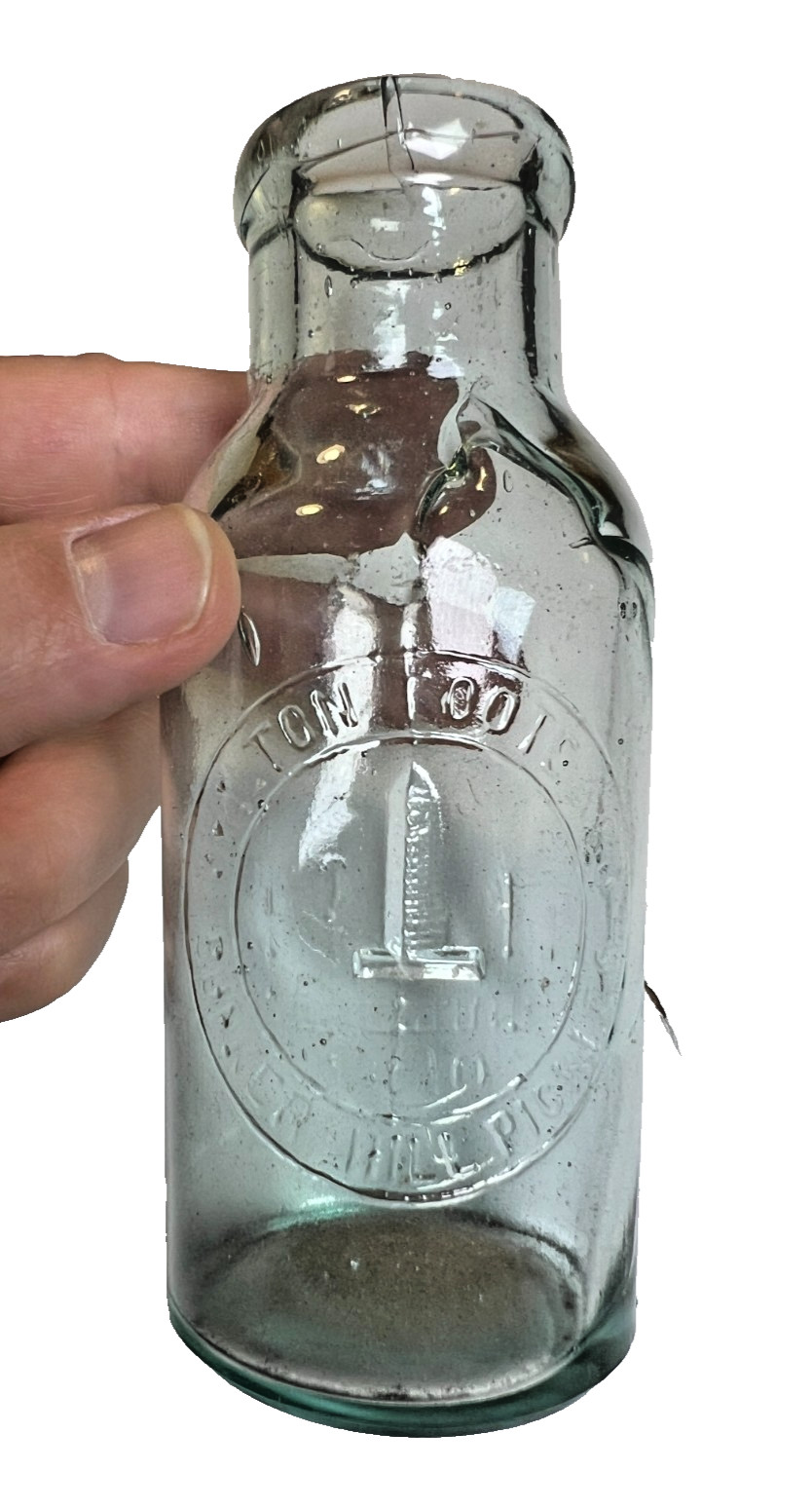
Rare Skilton Foote “Bunker Hill Pickles” Bottle – ca. 1870s–1880s – Aqua Glass with Large Internal Bubble
A striking survivor from the early days of American food packaging, this Skilton Foote “Bunker Hill Pickles” bottle was hand-blown in the late 19th century and proudly embossed with the image of the Bunker Hill Monument—a patriotic marketing emblem that symbolized American pride and purity in food production.
The bottle stands approximately 5 3/8″ tall, crafted in clear aqua glass with lovely waviness, fine seed bubbles, and a massive open internal air bubble that actually breaks through to the interior—an unmistakable hallmark of its early hand-blown origin. The glass exhibits a soft whittled texture and beautiful light refraction typical of bottles produced in small New England glasshouses of the era.
Embossed in a circular seal around the monument image:
“SKILTON FOOTE & CO / BUNKER HILL PICKLES”
About Skilton, Foote & Co.
Based in Boston, Massachusetts, Skilton, Foote & Co. was active during the mid-to-late 1800s, specializing in pickles, sauces, and condiments. Their “Bunker Hill” branding referenced both a symbol of New England patriotism and a guarantee of quality—part of a broader post–Civil War trend toward nationally themed branding in food packaging. The company’s bottles were produced by regional glasshouses such as Lyndeborough or Stoddard (NH), and each example shows unique handcrafting marks from the mold and pontil process.
Condition
Excellent for age — bright, clean, and clear glass
Large open internal air bubble (original from manufacture, rare and desirable)
No chips, cracks, or repairs
Smooth, early applied lip
Historical Context
In the 1870s–1880s, the American glass industry was transitioning from full hand-blown to semi-automatic molding. Air bubbles, glass ripples, and whittled textures were common—and now highly collectible as proof of early craftsmanship. Skilton Foote’s Bunker Hill bottles were among the first to blend patriotism, branding, and reusable packaging, as many were returned, washed, and refilled by grocers.
The World of “Bunker Hill Pickles” — America in the 1870s–1880s
Imagine Boston in the decades after the Civil War — the air thick with coal smoke, the clang of trolley bells, and the scent of baked bread and vinegar brine drifting from commercial kitchens along the harbor. In this era of steam, expansion, and invention, Skilton, Foote & Co. proudly packed their “Bunker Hill Pickles” into handsome aqua glass bottles like this one, each a miniature monument to Yankee industriousness and patriotic pride.
The Bunker Hill Monument embossed on the bottle wasn’t just decorative. It was a brand statement — invoking Revolutionary courage and New England craftsmanship. Housewives trusted it. Grocers displayed it. A jar of Bunker Hill pickles on the table meant you were buying American.
In the Kitchen
Picture a late-1870s kitchen:
A heavy oak table, iron stove roaring, light slanting through a lace-curtained window. The cook wears a long apron and lifts this very bottle from the pantry shelf. Inside, crisp gherkins swim in a sharp, spiced vinegar brine. She sets out sliced ham and brown bread, spoons of mustard, and cold pickles as her family gathers for supper — her husband reading the Boston Daily Globe, the children chattering about the new horse-drawn streetcars.
Pickles were essential — not a garnish but a preservation miracle before refrigeration. Vinegar brines kept vegetables edible through long New England winters, and the pickle trade itself had become a thriving industry stretching from Maine to Cincinnati.
The Nation Around It
The United States in this bottle’s lifetime was in full transformation.
President Ulysses S. Grant had just finished his term; Rutherford B. Hayes and later James Garfield and Chester A. Arthur presided over an uneasy Reconstruction and a surge of industrial power.
Railroads were binding the coasts together; telegraphs carried messages faster than ever; Edison’s electric light bulb (patented 1879) was about to change how Americans lived after dark.
Factories in cities like Boston, Lowell, and Worcester were modernizing food production — yet still relied on the handiwork of glassblowers to create bottles like this one.
Patriotism ran deep, commerce was booming, and “pure” American food was both a point of pride and a marketing promise in the wake of industrial adulteration scandals.
The Bottle’s Role
Each Skilton, Foote & Co. bottle was filled, corked, sealed with wax or paper, and shipped by rail and horse-drawn wagon to grocers across New England. Housewives saved and reused them — often refilling them with homemade preserves or pickled beets. The thick aqua glass and occasional dramatic air bubbles, like the large internal one in your example, are testaments to the imperfect but artful production methods of small 19th-century glasshouses.
Why It Matters
To hold this bottle is to hold a fragment of that industrious, proud, transitional America — a time when the same household might own both a hand-blown pickle bottle and a telegraph connection to the world beyond.
In an age when the country was redefining itself — politically, technologically, and culturally — this “Bunker Hill Pickles” bottle stood for reliability, American craftsmanship, and the daily rhythm of ordinary life.